15 Minute Stories for Kids

Warm bedtime tales sized for a full fifteen minute read, long enough to settle in and short enough to finish.

✨ Make Your Child the Hero

Fifteen minutes is a sweet spot at bedtime. It is long enough to settle a busy mind and short enough to fit between pajamas and lights out. These stories are sized for exactly that window. Each one gives your child a full adventure with a beginning, middle, and happy ending, all inside a cozy fifteen minute read. There is room to slow down, ask a question, and still tuck them in on time. No rushing, no cutting the ending short. With CreateStory.ai, you can make those fifteen minutes personal. Upload a photo and your child becomes the hero of their own story.

How much do kids gain from fifteen minutes of reading?

Fifteen minutes a day adds up fast. An Ohio State University study found that children who are read to regularly enter kindergarten having heard about 1.4 million more words than children who are never read to.

Those extra words become the building blocks for reading on their own. A steady fifteen minute story time is one of the simplest ways to give a child that head start, day after day, one book at a time.

Why do longer stories suit older picture book readers?

As children grow, they can follow a plot with more steps and small surprises. A fifteen minute story lets a problem build, twist a little, and then resolve, which teaches a child how good stories are put together.

This longer form also invites children to ask questions, point at pictures, and guess what happens next. That turns story time into a small conversation, which deepens a child's love of books and reading for years to come.

Sample Stories

Read these stories, then create a personalized version where your child is the hero

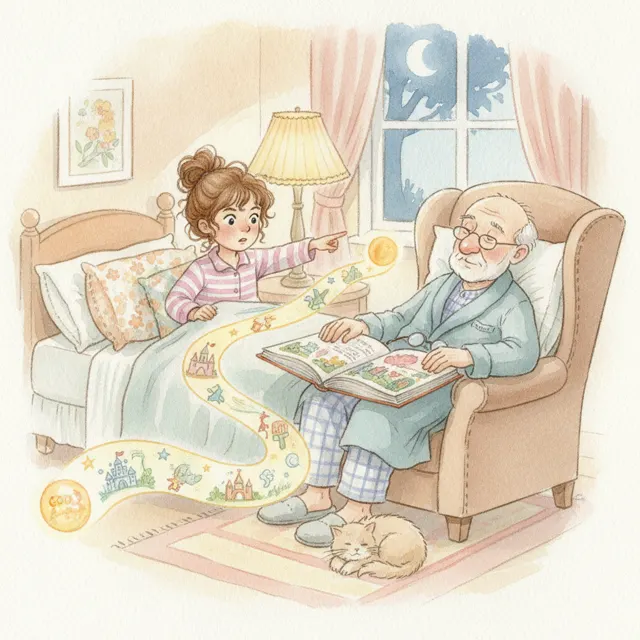
The Story That Finally Finished
Ages 3-815 minpatience
The Story That Finally Finished story for kids illustration

Every night Grandpa starts a long bedtime story and falls asleep before the ending. Tonight Lily is determined to stay awake until the very last word, and she learns that good endings are worth the wait.

Moral: Good endings are worth staying awake for.

Every night, Grandpa told Lily a story. But Grandpa's stories were long, and somewhere near the middle, Grandpa would yawn, close his eyes, and drift off before the ending. Lily never minded. She liked the sleepy sound of Grandpa's voice. But tonight, she really wanted to hear the end. "Grandpa," she said, "tonight I am staying awake until the story is finished. Promise." Grandpa smiled and opened the book. "Then we will read slowly," he said. "Good endings are worth the wait." So Grandpa began. He told of a little fox who wanted to cross a wide river. The fox tried to jump it. Too wide. The fox tried to swim it. Too cold. The fox sat on the bank, feeling stuck. Lily listened, eyes wide. "Is the fox going to make it?" she asked, sitting up. "Almost there," Grandpa said. "The story needs a little more time." The fox found a fallen log. It was wobbly and mossy, but it reached the other side. Step by careful step, the little fox crossed the river at last, tail held high. "And that," Grandpa said, closing the book, "is how the fox learned that slow and steady wins the trip." Lily clapped softly. "We finished it!" she said. Grandpa tucked the blanket around her. "Some stories take a little longer," he said. "But the best ones are worth staying awake for." Lily closed her eyes, happy. For the first time, she had heard the ending, and it had been worth every minute. From that night on, she never once wished Grandpa's stories were shorter. She only wished they would last just a little longer.
The Moon That Took Its Time

Ages 3-815 mincuriosity
The Moon That Took Its Time story for kids illustration

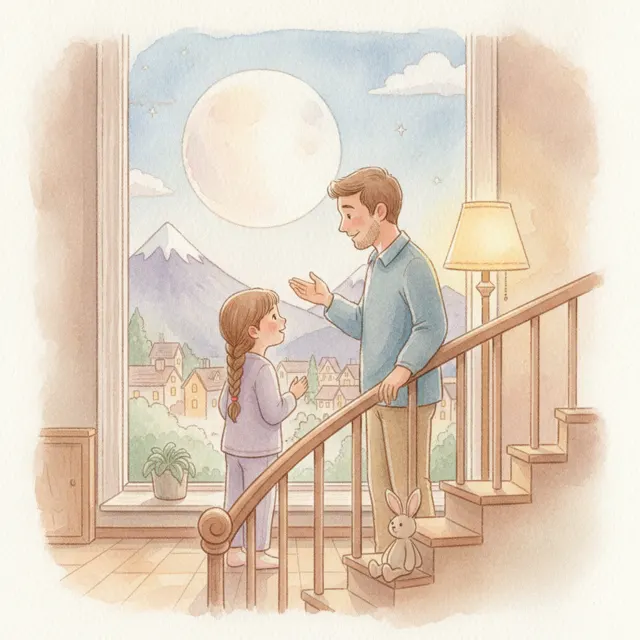
Luna asks her dad why the moon takes so long to climb into the sky when she could race up the stairs in seconds. She learns that some things are worth slowing down for.

Moral: Slowing down is how you notice the good things around you.

Luna loved to watch the moon rise from her bedroom window. It started as a small silver edge on the horizon, then grew a little more each minute, until a full round moon hung in the sky. "Daddy," Luna asked one night, "why does the moon take so long to come up? I could climb the stairs faster than that." Her dad laughed and sat beside her. "The moon is not in a hurry," he said. "It has the whole night ahead of it, so it takes its time." Luna thought about that. She was always in a hurry. She rushed her dinner, rushed her bath, and rushed to bed so she would not miss a single minute of anything. "What if I miss something by slowing down?" she asked. Her dad pointed at the sky. "You already did miss something. Look at what you saw tonight. The moon rising over the hill, the first star coming out, the clouds turning pink. You would have missed all of it if you had been rushing." Luna looked. The sky really was beautiful. The moon had climbed higher now, and it cast a soft silver path across the dark grass. "I never noticed before," she whispered. "That is the secret of taking your time," her dad said. "The world slows down for you, and you get to see it all." They watched together until the moon was high and bright. Luna leaned against her dad, feeling calm and happy. She had learned that slowing down was not missing out. It was how you noticed the moon rise in the first place. And every night after that, Luna watched the moon take its time, grateful for every slow minute of it.

The Bear Who Read Slowly

Ages 3-815 minappreciation
The Bear Who Read Slowly story for kids illustration

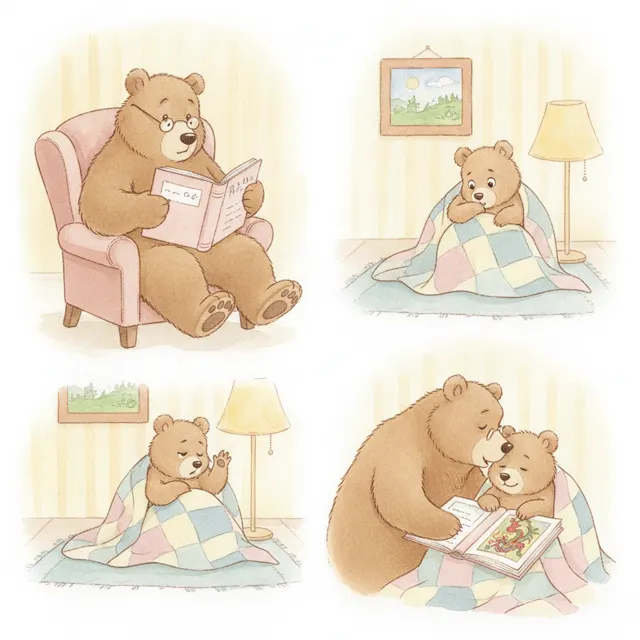
Papa Bear reads bedtime stories very slowly, and Cub wants to skip to the end. But when the story gets exciting, Cub learns that reading slowly is what makes the ending so sweet.

Moral: A story you rush is a story you miss.

Papa Bear read bedtime stories slowly. Very slowly. He stopped to do funny voices. He stopped to point at the pictures. He stopped to ask Cub what he thought would happen next. "Faster, Papa," Cub said one night, wiggling under his blanket. "I want to know how it ends." Papa Bear smiled and kept reading, slow as honey. "A good story is like a good meal," he said. "You do not gobble it. You taste it." Cub sighed. He wanted the ending right now. But Papa kept reading, slow and steady, and Cub, without meaning to, started to listen. He noticed the little mouse hiding on every page. He noticed the way the rabbit's ears twitched when she was scared. He started to guess, quietly, what might happen next. When the story reached its exciting part, Cub sat straight up. The fox was sneaking up on the rabbit! "Watch out!" Cub called to the page. Papa Bear slowed down even more, and Cub held his breath. Then came the ending, soft and perfect, and Cub let out a happy sigh. "That was the best story ever," Cub said. "It was the same story as always," Papa Bear said. "But tonight, you were not rushing. You were right there inside it." Cub snuggled close. "Read it slow again tomorrow, Papa," he said. "I want to taste every bit." Papa Bear laughed and turned off the light. And Cub fell asleep dreaming of rabbits and mice and a slow, slow story that had been worth every single minute.

The Long Walk to the Mailbox

Ages 3-815 mincourage
The Long Walk to the Mailbox story for kids illustration

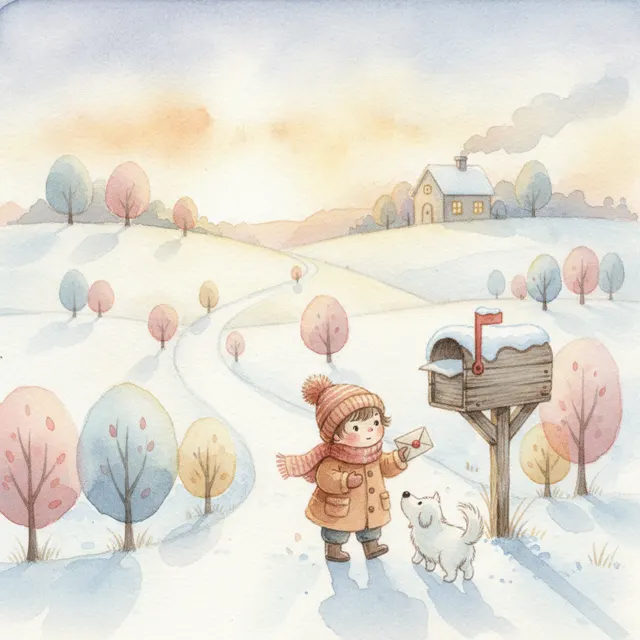
Zoe is sure the walk to the mailbox at the end of the long driveway is too far and too scary. With her mom beside her, she takes it one step at a time and finds her courage along the way.

Moral: Big scary things get smaller when you take them one step at a time.

Zoe's mailbox stood at the end of a long driveway, far from the house. The walk was so long that Zoe was sure she would get tired, or lost, or scared before she reached it. "I will go with you," her mom said one afternoon, holding out her hand. They started walking. Zoe's legs felt wobbly at first, and she kept looking back at the house. "How many steps is it?" Zoe asked. "A lot," her mom said. "But we do not have to count them all at once. Just one step, then one more." Zoe took one step. Then one more. Then one more. She stopped looking back and started looking at the little things beside the path. A red ladybug. A smooth pebble. A puddle that showed the sky. "Look, Mom, a puddle with a cloud in it," she said. "It is a tiny window to the sky," her mom said. "You only see things like that when you take your time." Step by step, they reached the mailbox. Zoe opened the little door and peeked inside. There was a letter for her, with her name on it. "I did it," she said, proud. "I walked the whole long way." "You did," her mom said. "And now the way back will feel shorter, because you already know how brave you are." Zoe smiled. The walk that had seemed so long was done. She had taken it one step at a time, and somewhere along the way, she had stopped being scared. The long driveway did not look so long anymore. It looked like an adventure she could handle, one step at a time.

The Book with Room for Two

Ages 3-815 minsharing
The Book with Room for Two story for kids illustration

Priya wants the bedtime story all to herself until her little brother asks to listen too. She learns that a good story grows bigger, not smaller, when you share it.

Moral: A story grows bigger when you share it with someone you love.

Priya loved bedtime because it was her time with Dad. Just the two of them, one story, no little brother. That was the rule. One night, her little brother Arjun shuffled in with his teddy. "Can I listen too?" he asked. Priya frowned. "It is my story time," she said. "There is only room for two in this reading corner." Dad looked at her. "A good story is funny that way," he said. "It makes room for one more." Priya did not believe him. But she did not want Arjun to cry, so she moved over. Arjun climbed into the corner and leaned against her arm. He was warm and a little wobbly, and he smelled like his favorite blanket. Dad began to read. Priya tried to stay grumpy, but Arjun laughed at the funny parts, and his laugh was so silly that Priya laughed too. When the story got a little scary, Arjun grabbed her hand. Priya did not pull away. "And that," Dad finished, "is how the little rabbit found his way home." "Again!" Arjun said. "Read it again!" Priya looked at her brother, then at Dad. "One more time," she said. "But only because Arjun asked." Dad read it again, and the corner that had felt small now felt just right. Priya leaned her head against Arjun's. "The story was better with you here," she whispered. Arjun smiled, half asleep. "You share good," he mumbled. Priya hugged her teddy and her brother. The reading corner had made room after all, and the story had grown bigger because two hearts had heard it instead of one.

The Slow Path to Grandma's House

Ages 3-815 minutespatience
The Slow Path to Grandma's House story for kids illustration

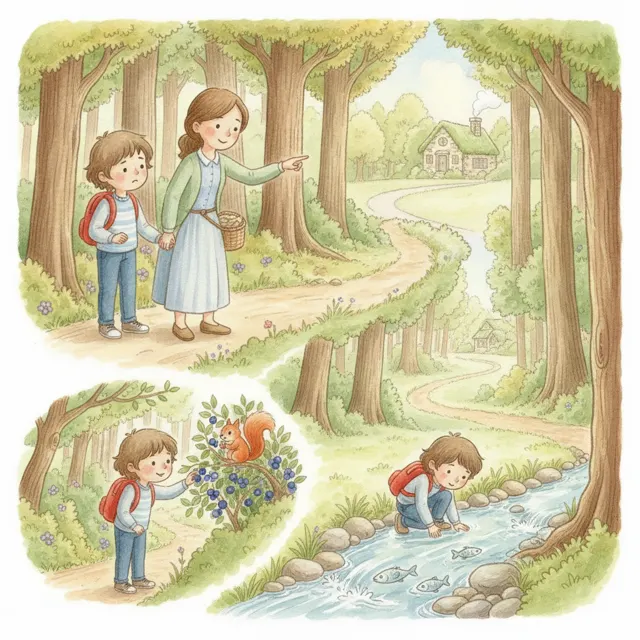
Leo wants the fast road, but Mom picks the slow path through the woods. Along the way they find berries, a squirrel, and fish in a stream. Leo learns that the long way can hold hidden treasures.

Moral: Slow walks leave room for good things.

Every Saturday, Leo walked to Grandma's house with his mother. The fast road took ten minutes. But today, Mom pointed to the slow path through the woods. "Let us take the long way today," she said. "The slow path is so long," said Leo. "The fast road is quicker." "Sometimes the long way is better," said Mom. "You see more." They started down the path. The trees made a cool shade. A squirrel ran up a trunk and chattered at them. "Look!" said Leo. "He is talking to us." They stopped to watch. The squirrel flicked its tail and dashed away. On the fast road, Leo never saw squirrels. Further along, they found a patch of wild berries. Mom picked a few. They were warm from the sun and very sweet. "We never find berries on the fast road," said Leo. They crossed a little bridge over a stream. Fish darted in the clear water. Leo lay on his belly to watch them. "They are like silver arrows," he said. By the time they reached Grandma's house, the sun was low. Grandma hugged Leo tight. "You took the long way," she said. "Did you find anything good?" "Berries and squirrels and fish," said Leo. "The slow path is full of treasures." "The fast road only gets you there," said Mom. "The slow path lets you live the walk." "Next week," said Leo, "let us take the slow path again. I want to see what else it hides." Grandma nodded. "Then I will pack cookies for the walk," she said. "Something sweet for the slow way."

The Turtle Who Finished Last

Ages 3-815 minutespersistence
The Turtle Who Finished Last story for kids illustration

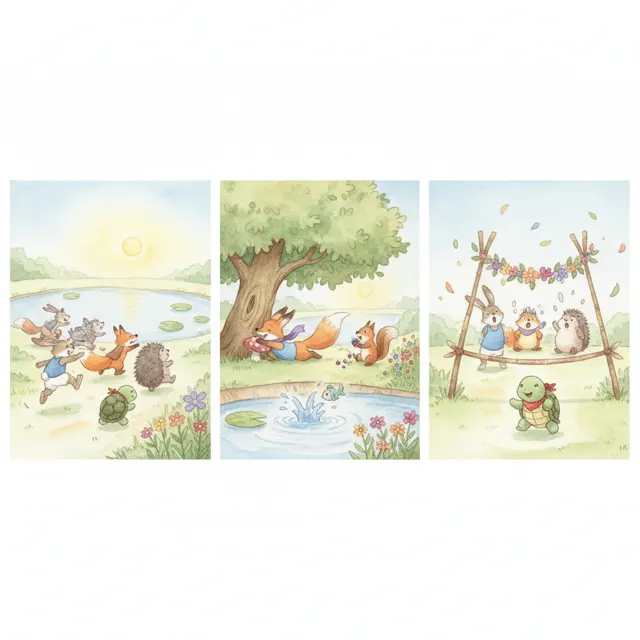
All the animals race around the pond, and Tully the turtle is slowest. While the others stop to nap and play, Tully keeps going and wins. Tully learns that slow and steady can finish first.

Moral: Finishing matters more than being first.

All the animals gathered for the great race around the pond. There was a rabbit, a fox, a duck, and one little turtle named Tully. "You are too slow," said the rabbit. "Why do you even race?" "I race because I like to try," said Tully. The race began. The rabbit shot ahead. The fox and the duck followed. Tully started slowly. Step, step, step. The others were far away in seconds. The rabbit got tired of running and stopped to nap. The fox stopped to eat berries. The duck stopped to swim in the pond. Only Tully kept going. Step, step, step. The sun crossed the sky. Tully did not stop. His legs were short and his shell was heavy, but he kept moving. Step, step, step. One by one, the others looked up and saw Tully pass them. "How is the turtle ahead?" they cried. They jumped up and ran, but it was too late. Tully crossed the finish line first. The animals cheered. The rabbit's ears drooped. "You were right to try," said the rabbit. "Slow and steady wins the race," said Tully, and he smiled. "I did not need to be fast. I only needed to keep going." That night, Tully told his grandmother the story. "I finished last in every other race," he said. "But this time I finished first, because I never gave up." Tully's grandmother clapped her slow, old flippers. "You see, little one," she said, "the race does not go to the fastest. It goes to the one who does not stop."

Fifteen Minutes of Soft Rain

Ages 3-815 minutescalm
Fifteen Minutes of Soft Rain story for kids illustration

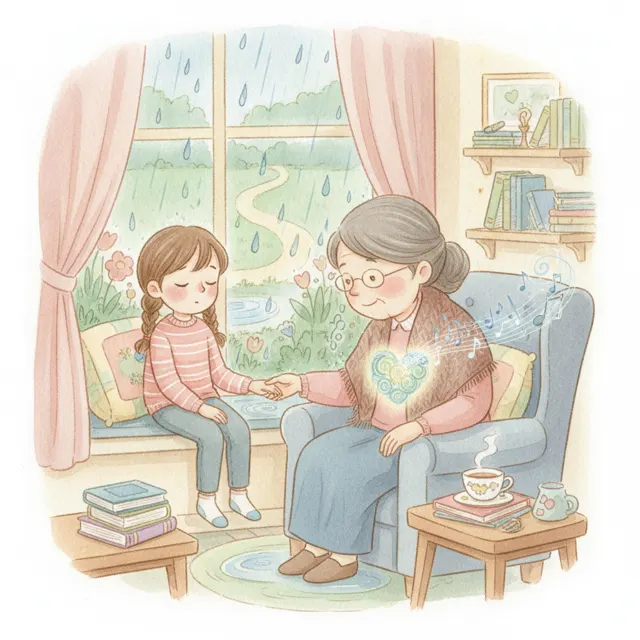
Mina is bored by the rain until Grandma teaches her to listen. In fifteen quiet minutes, she hears the rain's soft music and feels calm. Mina learns that quiet time can fill a heart with peace.

Moral: Quiet time is good for growing.

Mina stood at the window and watched the rain. It was not a storm. It was a soft, steady rain. The drops tapped on the glass like little fingers. "I wanted to play outside," said Mina. "Now I have nothing to do." "You have the rain," said Grandma. "Let us sit and listen to it." They sat by the window. For a little while, no one spoke. The rain fell. Tap, tap, tap. It was a quiet, steady song. "What do you hear?" asked Grandma. "Just rain," said Mina. "Listen closer," said Grandma. "The rain has many sounds." Mina listened. She heard drops on the leaves. She heard drops in the puddle. She heard drops on the roof, far and soft. Each sound was a little different. "It is like music," said Mina. "Slow music." "Rain music," said Grandma. "You can only hear it if you sit still and listen." They watched the rain wash the street clean. The flowers drank it up. The leaves turned a brighter green. "The whole world is having a drink," said Mina. After fifteen quiet minutes, Mina felt calm and warm inside. "I thought the rain was boring," she said. "But it is peaceful." "Quiet time is not wasted time," said Grandma. "It helps your heart grow still and full." When the rain stopped, Mina smiled. "I am glad it rained today," she said. "I heard the music." That night, Mina fell asleep to the soft sound of the last drops. She dreamed of rain music and green leaves, and her heart stayed calm and full.

The Boy Who Took His Time

Ages 3-815 minutespatience
The Boy Who Took His Time story for kids illustration

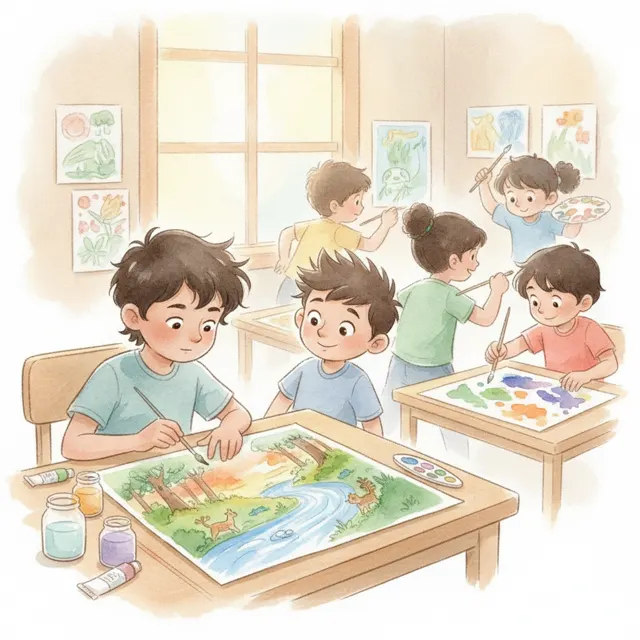
Arun paints slowly while his classmates rush. His careful picture turns out beautiful, and Raj asks to learn his secret. Arun learns that taking your time can make work much better.

Moral: Taking your time is not the same as wasting it.

Arun was the slowest painter in his class. While the other children slapped paint on paper and ran to play, Arun sat and looked. He mixed his colors slowly. He painted one careful line at a time. "You are so slow," said a boy named Raj. "I finished three pictures already." "I am not finished with my first," said Arun. "I like to take my time." Raj ran off to play. Arun kept painting. He painted a green field. He painted a blue sky. He painted a small red bird in a tree. Each part took a long time, but each part looked just right. When the teacher came by, she stopped and stared at Arun's paper. "This is beautiful," she said. "Look at the details." The other children gathered around. Raj looked at Arun's picture, then at his own three fast ones. "Yours is so much better," said Raj quietly. "How did you do it?" "I did not rush," said Arun. "Slow work makes careful work. When you rush, you miss the small things." "Can you teach me?" asked Raj. Arun smiled. "We can paint together," he said. "And this time, we will take our time." They sat side by side. Arun showed Raj how to mix a soft green, and how to wait for the paint to dry before adding more. By the end, Raj had painted his best picture ever. "Slow is not the same as bad," said Raj. "Slow can be wonderful." The teacher hung both pictures on the wall, side by side, so everyone could see what patience and care could do.

A Quiet Walk Through the Meadow

Ages 3-815 minutesnature
A Quiet Walk Through the Meadow story for kids illustration

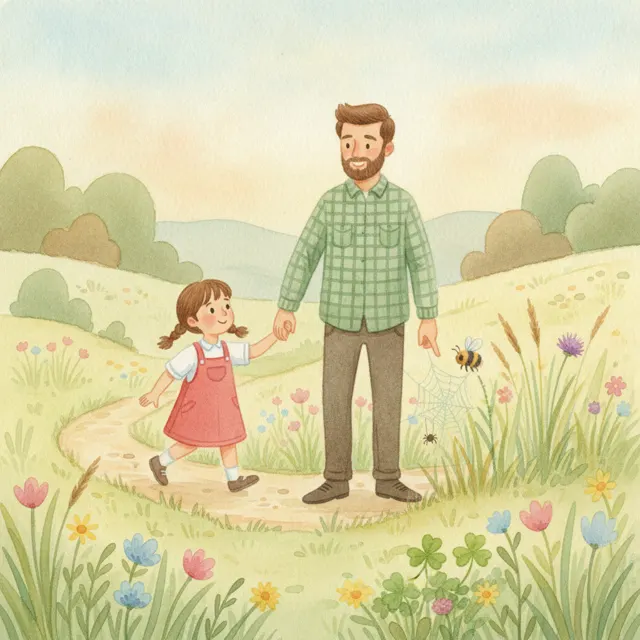
Zara always hurries through the meadow until Dad asks her to slow down. She sees bees, a spider web, and even a four leaf clover. Zara learns that slowing down helps you notice wonderful things.

Moral: Slow looking shows you more.

Every morning, Zara walked through the meadow on her way to school. She always hurried, her eyes on the path and her mind on the day. One morning, her father said, "Today, let us walk slowly and see what the meadow holds." "But I will be late," said Zara. "We will still make it," said Dad. "Just walk with me and look." They slowed down. Zara looked. She saw bees moving from flower to flower. She saw a ladybug crawling up a tall blade of grass. She saw a spider web strung with tiny drops of dew, shining like a necklace. "I have walked here a hundred times," said Zara. "I never saw the spider web." "You were too busy hurrying," said Dad. "The meadow was always full of wonders. You just had to slow down to notice." They stopped at a patch of clover. Dad pointed. "Look for one with four leaves," he said. Zara searched. It took a while, but she found one. Four perfect leaves. "This is lucky," she said, and she tucked it in her pocket. When they reached school, Zara was not late at all. The slow walk had taken only a little longer, but it had been full of treasures. "From now on," said Zara, "I will walk a little slower. There is too much to miss when you rush." At the school gate, Zara waved to Dad. "Save the clover for me," she called, and she ran inside with a pocket full of treasures and a mind full of new eyes.

The Pond Under the Ice

Ages 3-815 minutesseasons
The Pond Under the Ice story for kids illustration

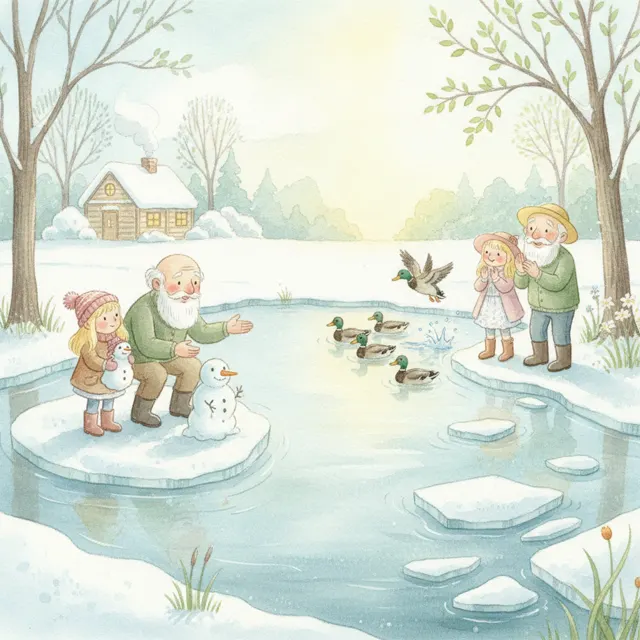
All winter the pond sleeps under thick ice, and Tessa misses summer. Grandpa tells her spring always returns. When the ice cracks and the ducks come back, Tessa learns that waiting can bring joy.

Moral: Spring always comes back.

All winter, the pond was frozen. The ducks had flown south. The fish swam deep and slow under the thick ice. Tessa missed the splash and sparkle of summer. "Will the pond ever come back?" she asked her grandpa. "The pond is still here," said Grandpa. "It is just sleeping under the ice. Spring will wake it." Tessa pressed her mitten to the ice. "How do you know?" she asked. "It happens every year," said Grandpa. "The cold never lasts forever. Wait and see." So Tessa waited. She visited the pond every day. The ice was hard and gray. Nothing moved. "Still sleeping," she said. Then one day, the air grew warmer. The sun stayed longer in the sky. The ice began to crack. Thin lines ran across it like silver rivers. "It is waking up," said Grandpa. The next day, a patch of water opened at the edge. Then another. Soon the ice was gone, and the pond sparkled in the sun. The ducks came back. The frogs began to sing. The fish rose to the surface. "You were right," said Tessa. "The pond was only sleeping." "Spring always comes back," said Grandpa. "You just have to wait for it." Tessa watched the ducks glide across the water. "I am glad I waited," she said. "This is worth the whole long winter." Tessa clapped as the ducks landed on the water. "Next winter," she said, "I will not be sad. I will remember that the ice is only the pond taking a nap."

The Kite Without Any Wind

Ages 3-815 minuteshope
The Kite Without Any Wind story for kids illustration

Ida wants to fly her kite, but there is no wind. She holds it ready and waits all day. When a breeze finally comes, her kite soars. Ida learns that good things come to those who hold on.

Moral: Good things come to those who keep hoping.

Ida had a beautiful kite shaped like a fish. It had scales of red and gold and a long silver tail. But the sky was empty and still. There was no wind at all. "No wind, no flying," said Ida. She sat on the hill with her kite in her lap. "Wind comes when it is ready," said her mother. "You cannot push it." "I do not want to wait," said Ida. "I want to fly my kite now." "Then hold it ready," said Mom. "The wind likes a kite that is waiting for it." So Ida held her kite up. She watched the grass. She watched the leaves on the trees. Nothing moved. The day was quiet. She waited through the morning. She ate her lunch on the hill. She waited through the afternoon. Her arms grew tired, but she held the kite ready. Then, just as the sun began to sink, a leaf trembled. Then another. A soft breeze ran through the grass. "Wind!" said Ida. "The wind is here!" She ran with the kite. It lifted from her hands and climbed into the sky. Its silver tail streamed behind it. It danced and swooped, bright against the setting sun. "It was worth the wait," said Ida, breathless and happy. "The best things come to those who hold on," said Mom. "You held on, and the wind found you." Ida held the string and watched her fish kite swim across the evening sky. "Tomorrow," she said, "I will come back and hold it ready again. The wind will come. It always does."

Frequently Asked Questions

Turn Your Child Into the Hero of Their Own Story

Upload their photo and watch as AI creates a beautiful, personalized storybook with illustrations that look just like them. From $5.99/month.

✨ Make Your Child the Hero

Plans from $5.99/month