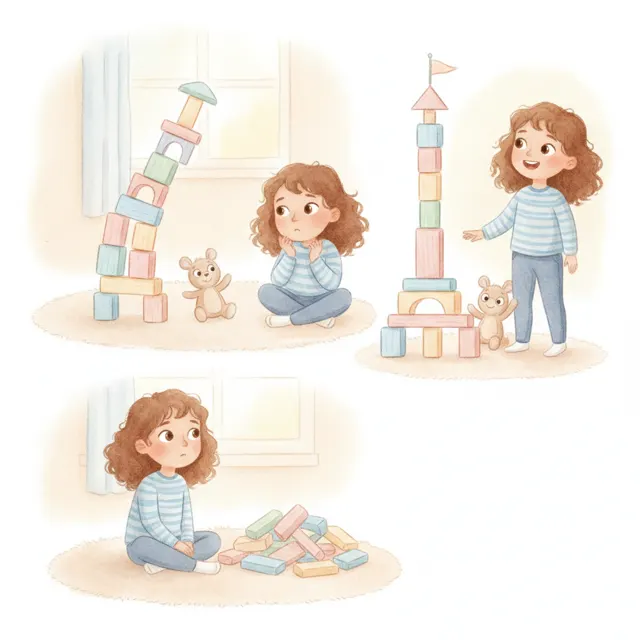
Engineer Stories for Kids

Towers that wobble, bridges that hold, and little machines that work, all dreamed up by a child who loves to build.

✨ Make Your Child the Hero

Children are natural builders. They stack blocks into towers, turn boxes into rockets, and ask how everything works, from doorbells to drawbridges. Engineer stories feed that itch. They show a child that problems are puzzles, that a thing can fall down nine times and be rebuilt ten, and that the best tool a kid owns is a curious mind. These gentle tales are full of wobbly towers, leaky buckets, and clever little machines, each solved with patience and a good idea. With CreateStory.ai, you can put your child right in the middle of it. Upload a photo, and your child becomes the hero who builds and fixes the day.

What Do Engineers Build to Help People Every Day?

Engineers design bridges, roads, cars, and tall buildings that make life easier and safer. The Great Wall of China is one of the biggest things people ever built. All its parts together stretch about 21,196 kilometers, or 13,171 miles (Britannica).

How Tall Is the Tallest Building That Engineers Made?

The tallest building in the world is the Burj Khalifa in Dubai. It stands 828 meters, or 2,717 feet, tall (Guinness World Records). That is more than twice as high as the Eiffel Tower. Engineers planned each floor so the tower would stand strong in the wind.

Sample Stories

Read these stories, then create a personalized version where your child is the hero

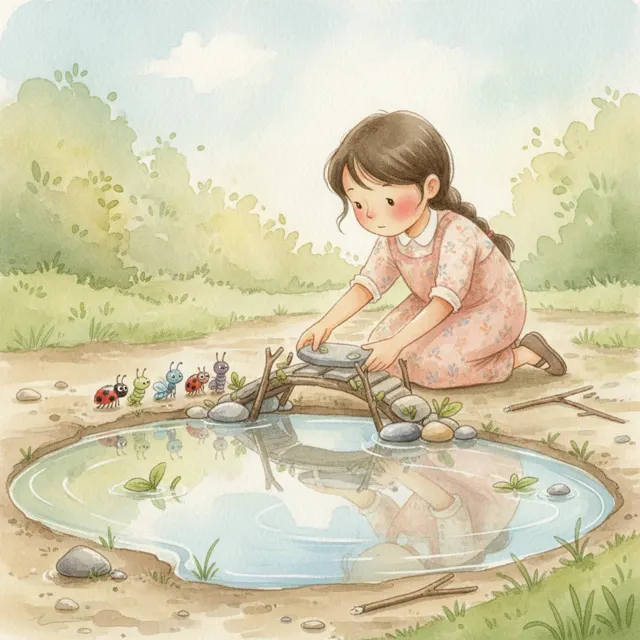
The Bridge That Maya Built
Ages 3-83 minproblem-solving
The Bridge That Maya Built story for kids illustration

After a big rain, the tiny bugs on Maya's garden path cannot cross a wide puddle. She gathers sticks and stones and builds them a little bridge, one careful piece at a time.

Moral: When something is in the way, a careful builder can find a way across.

After a night of heavy rain, Maya stepped into the garden and found a big puddle right across the path. On one side, a line of tiny ants and beetles waited, waving their little legs. They could not get across. "Oh no," said Maya. "You are stuck." The ants wiggled. The beetles looked up at her. Maya wanted to help. She looked around the garden. There were sticks by the fence and stones by the flowers. She had an idea. "I will build you a bridge," she said. Maya carried the sticks to the puddle, one by one. She laid them across the water, but they floated and drifted apart. The bridge did not hold. "Hmm," said Maya. "Sticks float. I need something heavy." She fetched the flat stones and set them in the middle of the puddle. Then she laid the sticks on top of the stones. Now the sticks stayed put. A little ant stepped onto the first stick. Then another. Then a whole line of ants marched across, right over the stones, to the dry side of the path. "It worked!" Maya clapped. The beetles crossed too, one by one. When the last beetle reached the other side, they all turned and waved their antennae as if to say thank you. Maya smiled. The bridge was not fancy, but it was strong, and she had built it all by herself. The next morning, the puddle was gone. The sun had dried it up. But Maya kept the bridge right where it was, because she knew that in a garden, there is always another puddle, and always another friend who needs a way across.
Leo's Wobbly Tower

Ages 3-84 minpersistence
Leo's Wobbly Tower story for kids illustration

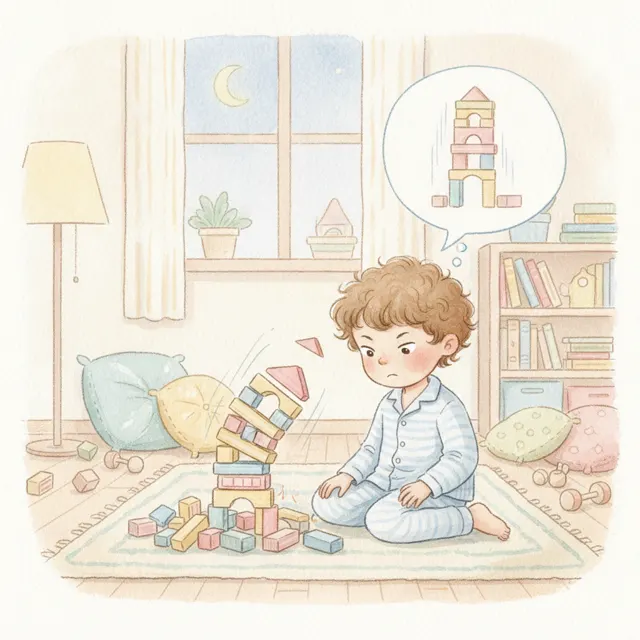
Leo wants to build the tallest block tower on the playroom floor, but it keeps toppling over. Each time it falls, he learns a little more about how to make it steady.

Moral: A tower falls many times before it learns to stand tall.

In the corner of the playroom, Leo had a big box of wooden blocks. He wanted to build the tallest tower anyone had ever seen. He wanted it to reach the ceiling. "I will build it higher than the bookshelf," Leo said. He stacked the blocks one on top of the other, higher and higher. The tower wobbled. Then, crash! It fell and rolled across the floor. Leo sighed and started again. He stacked faster this time. The tower reached his waist, then his shoulder. It wobbled. Crash! Down it came. "Why does it keep falling?" Leo said. His older sister Ana knelt beside him. "Look at the bottom," she said. "The bottom blocks are small, and the top ones are big. A tower needs a wide, strong base." Leo looked. She was right. The bottom was narrow, and all the heavy blocks were up top. "So I should put the big blocks at the bottom," Leo said. He started again. This time, he laid the wide, flat blocks first, making a strong base. Then he added smaller blocks on top, one careful layer at a time. The tower grew taller. It reached his waist, his shoulder, and kept going. It wobbled once, and Leo held his breath. But it did not fall. "I did it!" Leo cheered. The tower stood tall and steady, almost as high as the bookshelf. Leo stepped back and smiled. It had taken three tries, and every fall had taught him something. The tower that finally stood was not just taller. It was strong.

The Sock-Sorting Machine

Ages 3-83 mincreativity
The Sock-Sorting Machine story for kids illustration

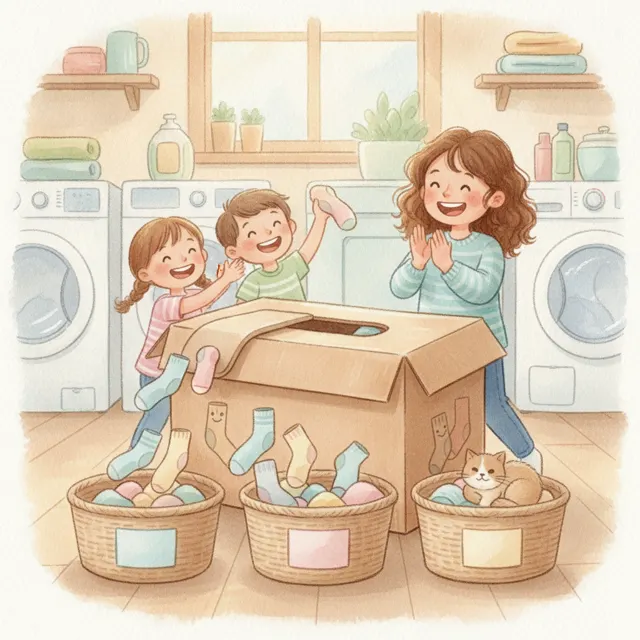
Rosa's family loses socks every laundry day, so she invents a simple machine from a box, a ramp, and three baskets to sort them by color. Her clever idea makes a boring chore fun.

Moral: A good idea can turn a boring job into something fun.

In Rosa's house, laundry day was a puzzle. Socks went in pairs, but they always came out of the basket alone. One blue sock here, one striped sock there, and nobody could find the match. "I wish socks could sort themselves," Rosa's dad said one morning. Rosa thought about it. Then she had an idea. "I will build a machine," she said. She took a cardboard box and cut a hole in the top. Then she found a long, flat piece of wood and leaned it against the box to make a ramp. At the bottom, she set three baskets: one for white socks, one for dark socks, and one for colorful socks. "Now watch," Rosa said. She rolled a white sock down the ramp. It slid into the box and dropped into the white basket. Then a striped sock, and it landed in the colorful basket. "It works!" her little brother shouted. Soon the whole family was rolling socks down the ramp. Red socks, blue socks, polka-dot socks. Each one slid down and dropped into the right basket. They laughed every time a sock made a perfect landing. When the basket was empty, every sock had a partner again. "You turned a boring job into a game," her dad said, hugging her. Rosa shrugged and smiled. "The best machines are the ones that make work fun." And from that day on, laundry day in Rosa's house was everyone's favorite chore, all because one girl looked at a pile of lonely socks and saw a chance to build something clever.

Ravi and the Leaky Bucket

Ages 3-85 minpatience
Ravi and the Leaky Bucket story for kids illustration

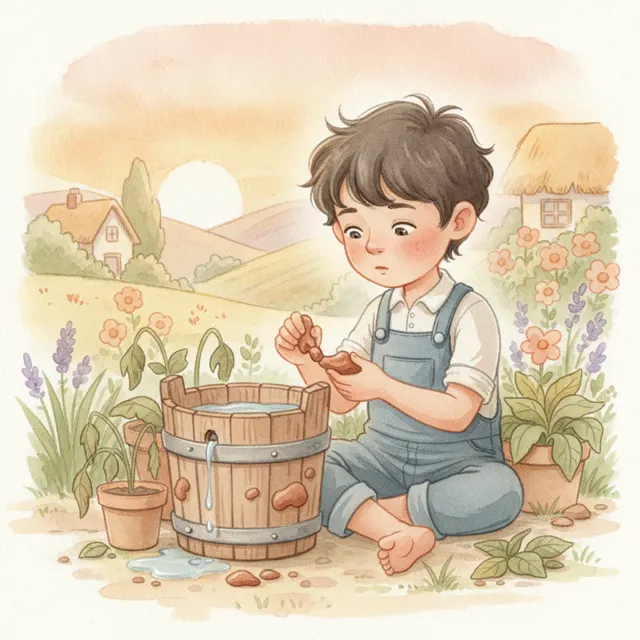
Ravi's bucket has a small hole, and his garden plants are thirsty. Instead of giving up, he studies the leak and patches it with a little clay and a lot of patience.

Moral: Look closely at a problem and the fix will show itself.

Ravi had a small garden with three tomato plants, and every morning he carried water to them in a little metal bucket. But one day, the bucket started to leak. A thin line of water trickled out and made a wet path all the way from the tap to the garden. "The plants are thirsty," Ravi said. "And half my water is gone before I get there." He could have given up and used a cup. But Ravi wanted to fix the bucket. First, he looked closely at the leak. There was a tiny hole near the bottom, no bigger than a grain of rice. He put his finger over it, but the water still dripped out the sides. "I need to cover it," Ravi said. He found some soft clay by the garden wall. He rolled a little ball of it in his hands and pressed it over the hole, smoothing it flat. Then he waited for the clay to dry. The next morning, he filled the bucket. Water still trickled out, but much slower. The clay was not quite enough. "One more try," Ravi said. He added a second layer of clay and pressed it on with his thumb. He waited again. This time, when he filled the bucket, not a single drop leaked out. Ravi carried a full bucket to his tomato plants and watered them slowly. "You did it," his mother said, watching from the door. "You did not give up." Ravi smiled. "The bucket just needed someone to look closely," he said. "The fix was there all along." And as the tomatoes grew red and ripe, Ravi knew that a little patience had watered them all.

The Two-Wheel Race Car

Ages 3-84 minteamwork
The Two-Wheel Race Car story for kids illustration

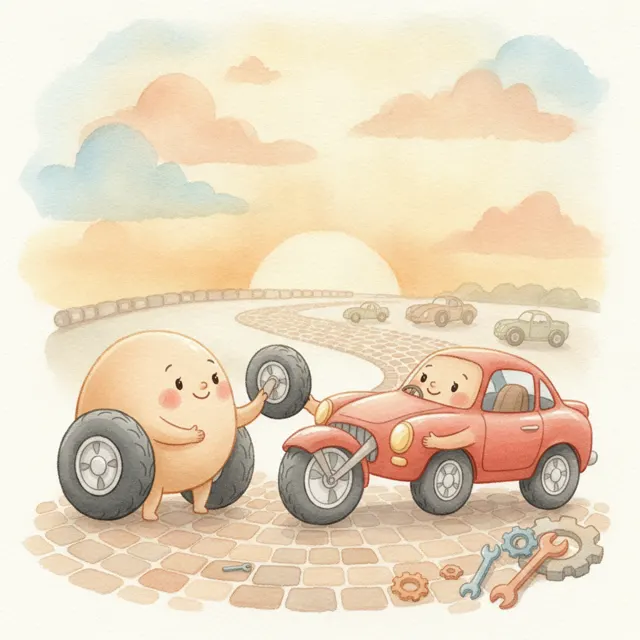
Sam has four wheels and Priya has a car body, but neither one has enough parts to race alone. They team up, share what they have, and build a car that beats them all.

Moral: Great things get built when friends work together.

Sam had four shiny wheels but no car to put them on. Priya had a wooden car body but no wheels. Both of them wanted to win the big toy car race on Saturday, and neither one could race alone. "We could just watch," Sam said sadly. "Or," Priya said, "we could build one car together." Sam's eyes went wide. "You would share your car body?" "Only if you share your wheels," Priya said. So the two of them sat down on the porch and got to work. Sam screwed on the wheels while Priya held the body steady. Sam's wheels were fast, and Priya's body was light and smooth. "It needs a flag," Sam said, and Priya taped on a little red flag. "And a stripe down the middle," Priya said, and Sam painted on a blue stripe. When the car was done, they stood back and looked at it. It was better than anything either of them could have made alone. On race day, the two of them carried their car to the starting line. The other racers had big, fancy cars. Sam and Priya's car looked small and simple. The race began. Their car shot forward, fast and steady, and crossed the finish line first. "We won!" they shouted together. Priya turned to Sam. "We could not have done it alone." Sam nodded. "The best cars are built by two sets of hands." And they decided that next year, they would build an even faster car, together, the way good friends build everything.

Nia's Plan for the Rainy Day

Ages 3-84 min readproblem-solving
Nia's Plan for the Rainy Day story for kids illustration

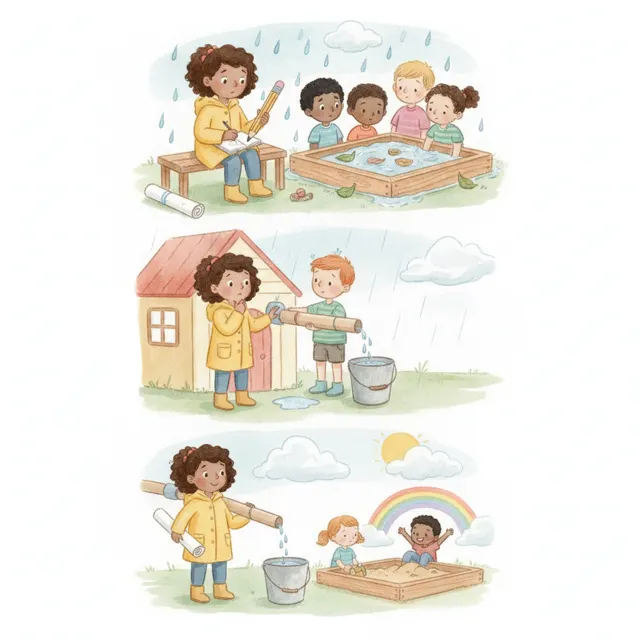
Rain keeps filling the sandbox at Nia's school, so no one can play in it. Nia draws a plan to catch the rain with a pipe. She tests it, finds it too short, and fixes it until the sandbox stays dry.

Moral: You can fix a problem one small step at a time.

Nia watched the rain fill the sandbox at her school. "No one can play in it now," said her friend, Sam. "It is full of water." Nia looked at the puddle. "What if we give the rain somewhere else to go?" she said. She got a big sheet of paper and a crayon. She drew the sandbox. Then she drew a roof over it. "A roof will keep the rain out," she said. Sam shook his head. "We do not have wood for a roof." Nia drew again. She drew a slide for the water. "We can make the water run down a slide into the grass," she said. "How?" asked Sam. "We can use an old pipe," said Nia. They found a long pipe behind the shed. Nia put one end of the pipe high and the other end low. "Water runs down," she said. "So we tip it down." They held the pipe over the sandbox. Rain dripped into the pipe and ran out into the grass. But one corner of the sandbox was still wet. "The pipe is not long enough," said Nia. She added a second pipe to the first one. Now the water ran all the way to the grass. The next day it rained again. The pipe caught the rain. The sandbox stayed dry. "Your plan worked!" said Sam. The sand stayed soft and dry. All the kids ran to play in it at once. "It did not work at first," said Nia. "I had to try again. That is how you fix things."

The Ramp That Reached the Door

Ages 3-84 min readkindness
The Ramp That Reached the Door story for kids illustration

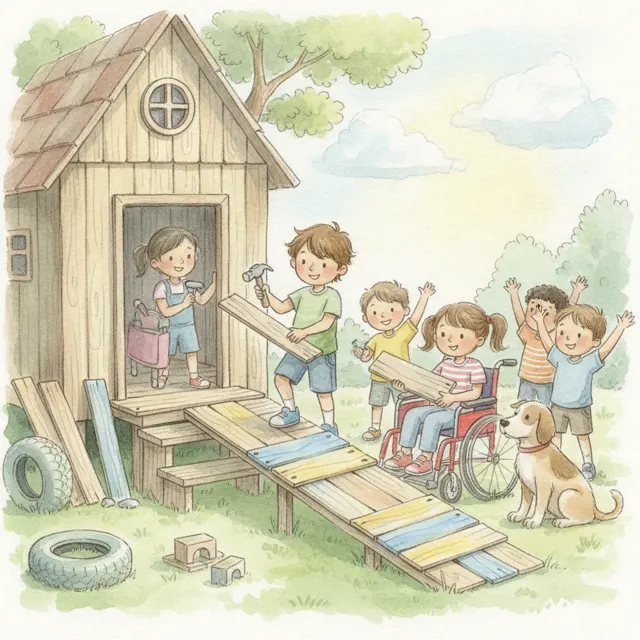
Ben's friend Ana uses a wheelchair and cannot get up the step into the clubhouse. Ben and Ana build a ramp from old wood so Ana can roll right in and play with everyone.

Moral: Small changes can make a big space friendly for everyone.

Ben and his friends had a clubhouse in the yard. It had one big step at the door. "I cannot come in," said Ana. Her wheelchair could not climb the step. "Sure you can," said Ben. "We will fix the door." "How?" asked Ana. "We can build a ramp," said Ben. "A ramp is like a flat road that goes up slow and easy." Ben looked around. He found two long boards behind the shed. "These can be the sides," he said. Ana pointed at the step. "The ramp has to reach the top of the step," she said. "If it is too short, my wheels will bump." They put one end of the boards on the ground. They put the other end on the step. "Now we need a top for the ramp," said Ben. They found one wide board and laid it across the two side boards. Ben pushed on the ramp. It wobbled. "It needs to be strong," said Ana. "A ramp that moves is not safe." They found more nails and tapped them in. Tap, tap, tap. Ben pushed again. This time the ramp did not move. "Try it," said Ben. Ana rolled her chair up the ramp, slow and steady. She rolled right through the door. "I am in!" she said. "Now I can play too." Ana pushed the door open wide. "I helped plan it too," she said. "Next time we can build a ramp for the front step of my house." Ben smiled. "The ramp was not hard to build," he said. "Now everyone can come in and play."

Tom Builds a Boat for Duck

Ages 3-84 min readcaring
Tom Builds a Boat for Duck story for kids illustration

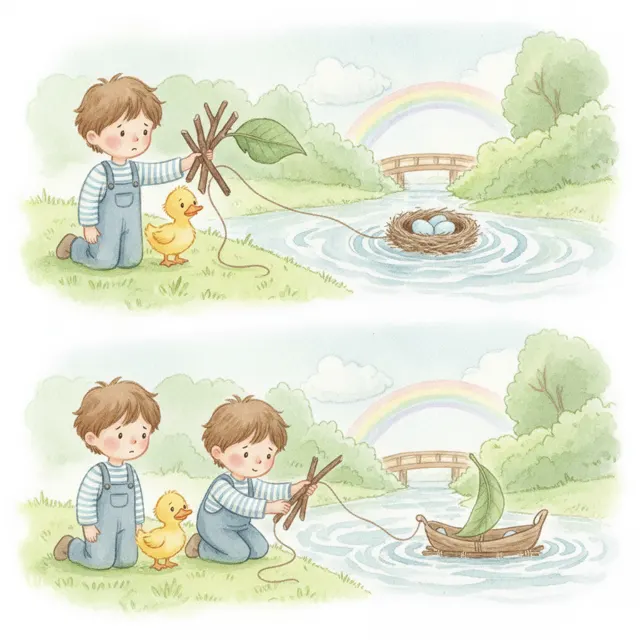
Duck's nest floats away down the stream after a big rain. Tom gathers sticks, a leaf, and string to build a little boat that scoops the nest back to the bank.

Moral: You can use what you have to help a friend.

A big rain came in the night. In the morning, Tom saw Duck quacking by the stream. "What is wrong?" asked Tom. "My nest is floating away!" said Duck. "My eggs are in it!" Tom looked. The nest was a little island of sticks drifting down the water. "I will get it back," said Tom. "I will build a boat." He gathered thin sticks from the ground and tied them together with string. "The boat needs to float," he said. He set it on a puddle. It bobbed, then tipped over. "It tips," said Tom. "It needs a wide bottom." He added more sticks across the middle to make the bottom wide. He set it on the puddle again. This time it floated flat and strong. "Now I need something to catch the nest," he said. He tied a big leaf to the front like a scoop. Tom pushed the little boat into the stream with a long stick. The boat floated out. The leaf scoop bumped the nest. Slowly, Tom pulled. The boat came back with the nest resting safe on the leaf. Duck rushed over and looked at her eggs. "They are safe!" she said. "Thank you, Tom." Tom lifted the boat out of the water and set it on the grass to dry. "We can keep it," he said. "A boat like this might be useful again." Duck nodded. "And now I know to build my nest high up on the bank, safe from the rain." "You are welcome," said Tom. "A good boat just needs a wide bottom and a steady hand."

The Marble Run That Would Not Roll

Ages 3-84 min readperseverance
The Marble Run That Would Not Roll story for kids illustration

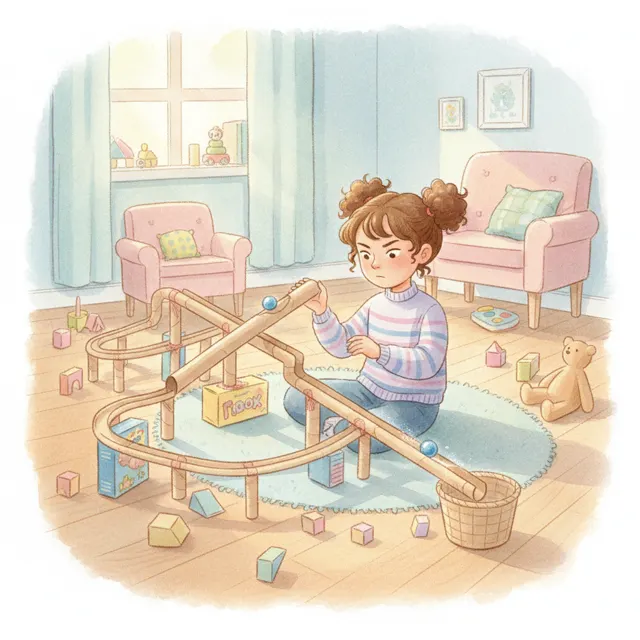
Mia builds a marble run from cardboard tubes, but the marble stops halfway every time. She looks at each piece, finds the flat spot, and lifts it just a little until the marble rolls all the way down.

Moral: When something will not work, look again and try a new way.

Mia wanted to build a marble run out of cardboard tubes. "I will make the marble go from the top of the table to the floor," she said. She taped the first tube to the table. Then she taped more tubes, one after another, all the way down to the floor. "Ready," she said. She dropped the marble in the top. The marble rolled down the first tube. Then it stopped. It sat in the middle of the second tube. "It stopped," said Mia. "Why?" She picked up the marble and tried again. It stopped in the same place. "This tube must have a flat spot," she said. She looked close. The second tube was lying flat, not tipped down. "A marble only rolls down a hill," she said. "This tube is like flat ground." She lifted the end of the second tube and taped a small block under it. Now the tube tipped down. She dropped the marble again. It rolled through the second tube and into the third. But it stopped in the third tube too. Mia laughed. "Every tube needs a little hill," she said. She checked each tube and lifted the flat ones. At last she dropped the marble one more time. It rolled down, down, down, all the way to the floor and into a little cup. She lifted the marble from the cup and dropped it in again, just to be sure. It rolled the whole way down once more. "It works!" said Mia. "I did not give up, and now it rolls the whole way down."

Grandpa's Wobbly Chair Gets Fixed

Ages 3-84 min readcaring
Grandpa's Wobbly Chair Gets Fixed story for kids illustration

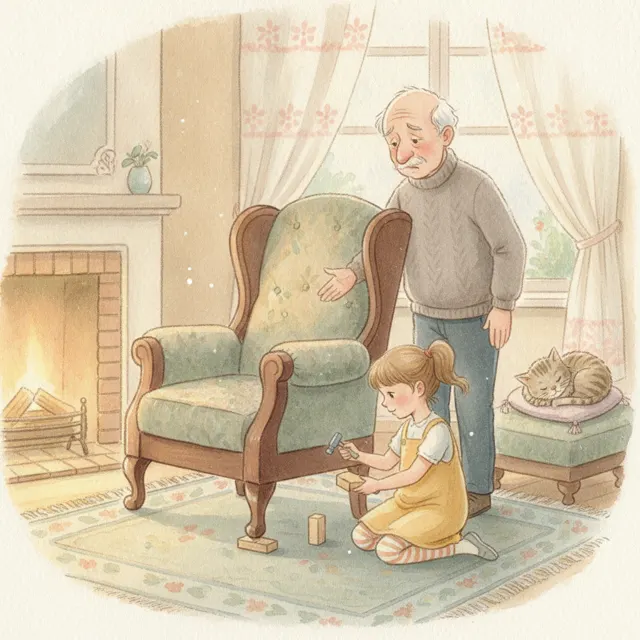
Grandpa's favorite chair has a wobbly leg, so he cannot sit in it. Lena finds a small piece of wood, taps it under the short leg, and makes the chair steady for Grandpa again.

Moral: Fixing a small thing can show someone you care.

Grandpa had a favorite chair by the window. Every day he sat there to watch the birds. But one day the chair wobbled. "I cannot sit in my chair," said Grandpa. "It rocks like a boat on the water." Lena watched Grandpa sit and stand, sit and stand. "One leg is too short," she said. "That is why it wobbles back and forth." "How can you fix a short leg?" asked Grandpa. "I can make it longer," said Lena. "An engineer looks for the one thing that is not right." She went to the shed and found a thin piece of wood. She held it under the short leg. "It is not tall enough," she said. She found a thicker piece. Still too short. So she stacked two thin pieces together. "Two small pieces can be one tall piece," she said. Lena carried a little hammer. She tapped the wood under the leg. Tap, tap, tap. "Try it now, Grandpa," she said. Grandpa sat down slowly. The chair did not rock. It stayed still and steady. "It is steady!" he said. "You fixed it all by yourself." "I had to try three pieces before one was right," said Lena. "But now your chair is safe to sit in." The next morning, Grandpa sat in his chair with his tea. "Not a single wobble," he said. "You are quite the little fixer, Lena." Lena beamed. "I like making things better," she said. Grandpa smiled and settled by the window. "Thank you, Lena," he said. "Now I can watch the birds again, just like before."

Sami's Bridge Over the Puddle

Ages 3-84 min readhelping
Sami's Bridge Over the Puddle story for kids illustration

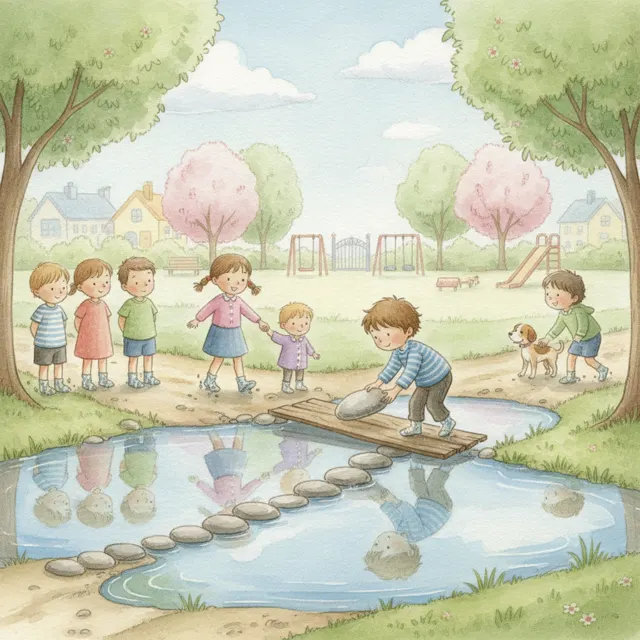
A big puddle blocks the path to the park, and little kids keep getting wet shoes. Sami lays flat stones and a plank across the puddle so everyone can cross with dry feet.

Moral: One person's idea can help the whole street.

After a big rain, a wide puddle sat right in the middle of the path to the park. "Look at that puddle," said Sami. "The little kids cannot get to the park with dry feet." Her little brother, Yusuf, tried to jump over it. Splash! His shoes got wet. "I told you," said Sami. "We need a bridge." "A real bridge?" asked Yusuf. "A small bridge," said Sami. "A bridge just has to go over the water." She found flat stones by the fence. She laid them in the puddle, one after another, like stepping stones. But the puddle was wider than her stones. "I need one more long piece," she said. She found a wide plank of wood by the shed. She laid it across the middle. "Now let us test it," she said. Sami stepped on the first stone, then the plank, then the last stones. Her shoes stayed dry. "It works!" she said. Soon the other kids came. They crossed the puddle one by one, and not one pair of shoes got wet. "You made our path dry again," said a neighbor. "The whole street can say thank you." Yusuf gave her a high five. "You are the best big sister," he said. That afternoon, the sun came out and the puddle dried up. But Sami left the stones and the plank right in place. "You never know when the next big rain will come," she said. Sami smiled. "A bridge is just a road that goes over the water," she said. "Now everyone can play."

The Tower That Leaned Too Far

Ages 3-84 min readpatience
The Tower That Leaned Too Far story for kids illustration

Zoe stacks blocks into a tall tower, but it leans and falls. Instead of giving up, she takes the top down, makes the bottom wide and flat, and builds a tower that stands up tall.

Moral: It is okay to start over and build better.

Zoe wanted to build the tallest block tower ever. "I will build it up to the ceiling," she said. She stacked block on block, higher and higher. When the tower got tall, it started to lean. "Careful," said her friend Dax. "It is leaning to the side." "It will be fine," said Zoe. She put one more block on top. The tower leaned too far. Then it tumbled down. Blocks went everywhere. Zoe sat down. "Now I have to start over," she said in a sad voice. "Look at the bottom," said Dax. "The bottom blocks were small and not flat. A tall tower needs a wide, flat bottom." Zoe looked. Dax was right. The bottom was narrow. So Zoe started again. She put the widest, flattest blocks at the bottom. She made the base big and strong. Then she stacked more blocks on top, one by one, keeping them straight. The tower grew tall again. But this time it did not lean. "It is standing straight!" said Dax. Zoe added the very last block on top. The tower stood tall and still. "Will you build with me next time?" asked Zoe. "Yes," said Dax. "Two builders are better than one. We can make the next tower even taller." Zoe smiled. "And we will always start with a wide, flat bottom." They stacked a few more blocks at the base, just for fun. Then they drew a plan for the next tower on a scrap of paper. "I had to start over," said Zoe. "But now my tower is stronger than before."

Frequently Asked Questions

Turn Your Child Into the Hero of Their Own Story

Upload their photo and watch as AI creates a beautiful, personalized storybook with illustrations that look just like them. From $5.99/month.

✨ Make Your Child the Hero

Plans from $5.99/month