Fish Stories for Kids

Swim along with colorful, curious fish who explore coral reefs, help ocean friends, and discover that even the smallest fish can make the biggest waves of kindness.

โœจ Make Your Child the Hero

Kids are naturally drawn to fish. There is something about the way they glide through the water, their bright colors catching the light, that holds a child's attention. Our fish stories follow friendly fish through coral reefs, underwater caves, and open ocean waters, teaching small lessons about sharing, curiosity, and helping friends. Whether your little one loves a striped clownfish or a sparkly blue tang, these tales bring the sea to life in a gentle, age-appropriate way. With CreateStory.ai, you can drop your child into the story so they become the hero of their own underwater adventure.

How Many Kinds of Fish Live in the Ocean and Lakes?

There are more than 33,000 known kinds of fish in the world (World Animal Protection). That is more than all the birds, mammals, reptiles, and frogs put together. Fish live in oceans, rivers, lakes, and even tiny ponds.

How Do Fish Breathe Under the Water Without Air?

Fish breathe with gills, not lungs. They pull water in through their mouths and push it out over their gills, where air from the water goes into their bodies. That is why a fish can stay under water all day long and never come up for a breath.

Sample Stories

Read these stories, then create a personalized version where your child is the hero

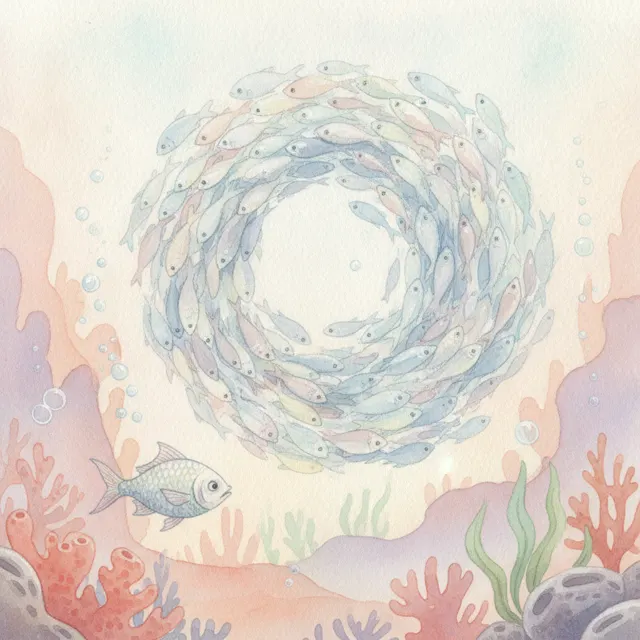
The Fish Who Dared to Swim Alone
Ages 3-84 minindependence
The Fish Who Dared to Swim Alone story for kids illustration

The Silverscale school moved together everywhere. Eating, sleeping, swimming, turning left, turning...

Moral: Sometimes you need to explore on your own to discover what you're capable of.

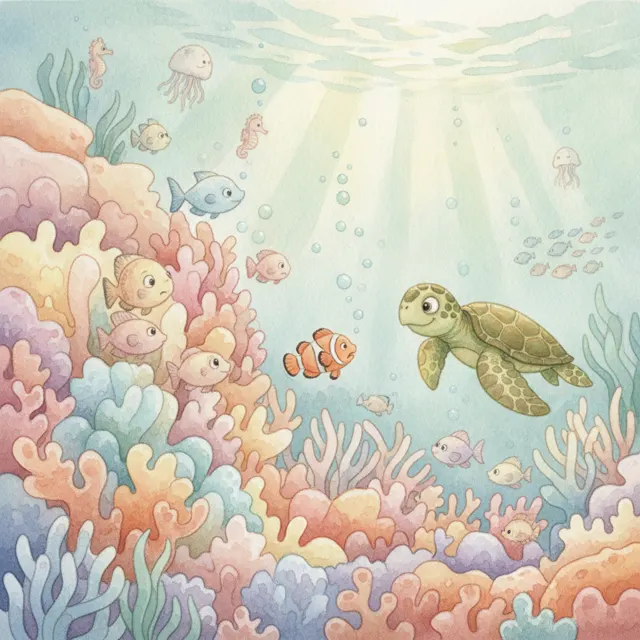
The Silverscale school moved together everywhere. Eating, sleeping, swimming, turning left, turning right: always all together. There were eight hundred of them and they moved like one enormous, shimmering creature. Dip had always moved with them. But sometimes, in the evenings, she found herself looking at the passage between the two great rocks that led to the outer reef. The school never went there. It was unknown. "What's through there?" she asked her friend Fin. "Nothing good," Fin said. "Unknown things." But unknown wasn't the same as bad. One morning, when the school turned left, Dip turned right. Just a little. Just to see. The passage between the rocks was narrow and she had to go slowly. On the other side was the outer reef: bigger corals, bigger fish, and light that came from a different angle and turned the whole water a different blue. She stayed for twenty minutes. She saw a sea turtle drifting in a way she'd never seen, slow and peaceful. She saw coral formations taller than any on the inner reef. She saw light come through the water surface in long pale columns. Then she went back through the passage to the school. Fin was exactly where she'd left her. "You went, didn't you?" Fin said. "Yes," said Dip. "What was there?" Dip told her. Fin was quiet for a moment. "Was it safe?" she asked. "It was fine," Dip said. "Beautiful, actually." Fin thought for a long time. "Maybe," she said slowly, "I'll come next time." "I'll wait for you at the passage," Dip said. "We can look together."
Little Fish, Big Difference

Ages 3-84 minkindness
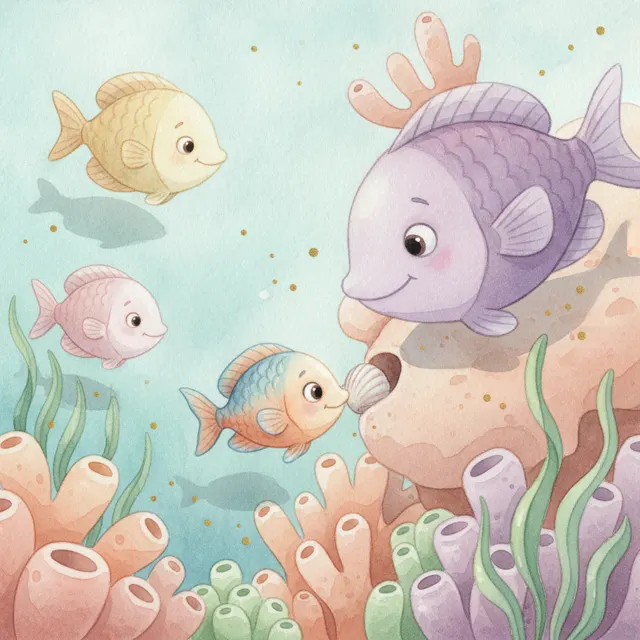
Little Fish, Big Difference story for kids illustration

Dot was the smallest fish in the reef. Barely bigger than a thumbnail, she had to be careful about...

Moral: Even the smallest creature can make a big difference through kindness.

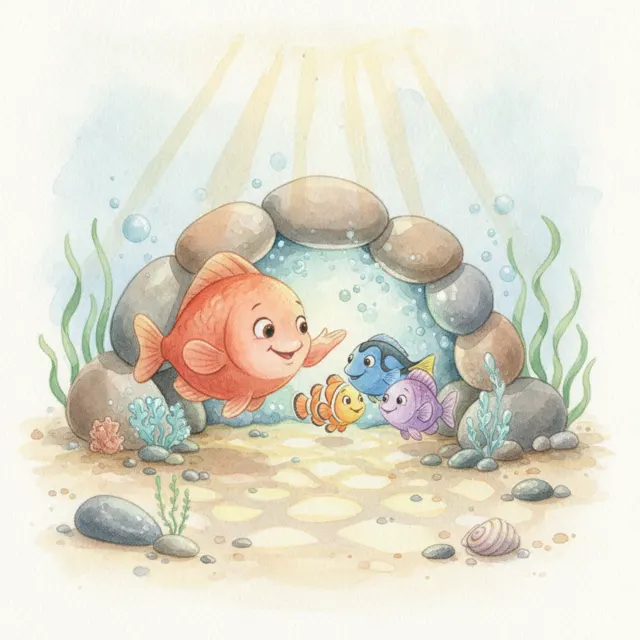
Dot was the smallest fish in the reef. Barely bigger than a thumbnail, she had to be careful about everything: tides, larger fish, current changes, and the ever-present question of whether anything was about to eat her. She was careful, yes. But she was also curious and kind. When she saw a larger fish with a piece of net thread caught on its fin, she didn't have to help. It wasn't her problem. But she went anyway, nibbled carefully at the thread until it came free, and swam away before the larger fish could decide what to make of a tiny helpful stranger. She found a hermit crab whose shell had cracked. She couldn't fix a shell. But she knew where the empty shells collected, in the hollow behind the big red coral. She led the crab there, staying just in front of his pace, until he found a new shell. She was doing these things because it seemed right. She never kept count. One day Dot got swept into a current that carried her fast into an unfamiliar part of the reef. She was spinning and couldn't find the way back. A large grouper swam up beside her. She froze. The grouper spoke. "I've seen you around. You helped my daughter with a piece of net last season." Dot had completely forgotten this. "The back-current runs along the left wall," the grouper said. "Ride it home." He was gone before she could thank him. The back-current carried her home in five minutes. She never would have found it alone. Dot had been doing small kindnesses with no thought of return. The reef, it turned out, had been keeping track.

The Colorful Reef School

Ages 3-84 mininclusion
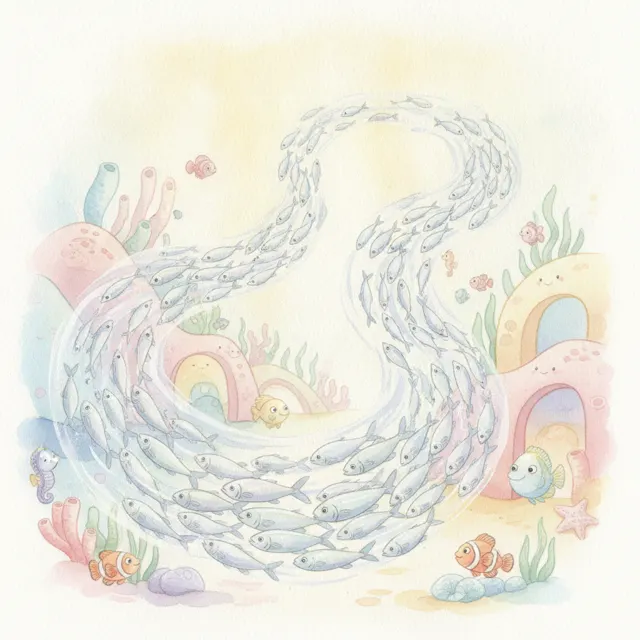
The Colorful Reef School story for kids illustration

The reef school was mostly silverfish. They moved together beautifully, a shimmering ribbon that...

Moral: Every color, shape, and size has something to add to the group.

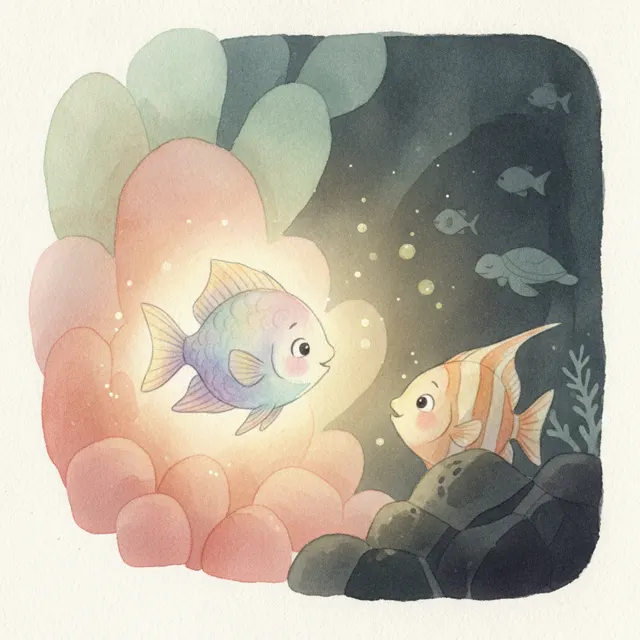
The reef school was mostly silverfish. They moved together beautifully, a shimmering ribbon that twisted and turned in unison. Then one day a striped fish joined. He was orange and white and moved in a way that was slightly different from the silvers. "You're not really one of us," a silver fish said. "I'd like to be," said the striped fish, whose name was Cello. "I'm good at noticing shadows from above. Predators often come from above." The silver school moved on. A week later a large shadow fell from above, a pelican. Nobody saw it in time. The school scattered. Cello had seen it three seconds before anyone else. The next day a small flat fish joined the school uninvited. She moved differently, closer to the sandy floor. "You're odd," a silver said. "I see things coming from below," the flat fish said. "Creatures that come from the sand. Rays and eels." The silvers looked at each other. A silver named Vel spoke up. "We could use someone who watches below. We mostly watch sideways." One by one, over the following weeks, the school grew. A yellow fish who was fast at corners. A dark fish who was near-invisible in shadow water. Cello who watched above. The flat fish who watched below. They moved differently than before. Less like one mirror. More like something alive in all directions at once. They lost fewer fish to predators than any other school on the reef. "We're not all the same anymore," Vel said one evening. "No," agreed Cello. "We're better."

The Fish Who Loved Music

Ages 3-84 mincreativity
The Fish Who Loved Music story for kids illustration

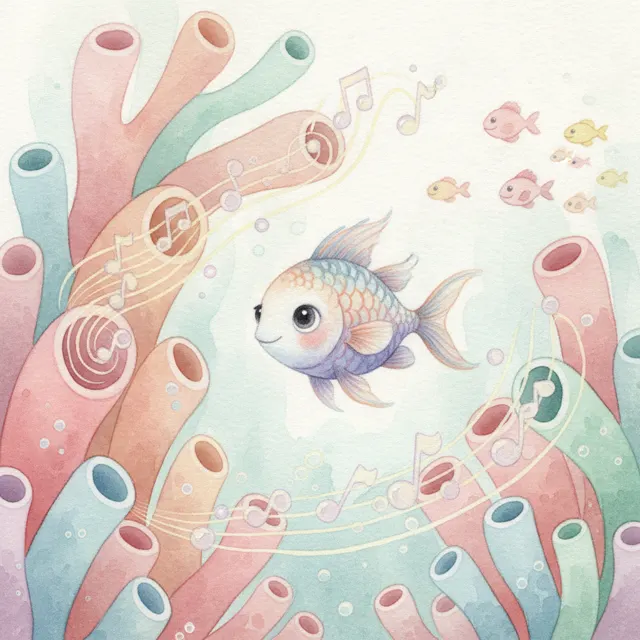
Luna the fish heard music in the reef. Not really music, the sound of water moving through coral...

Moral: Following what you love can lead you somewhere wonderful.

Luna the fish heard music in the reef. Not really music, the sound of water moving through coral channels, the clicks of shrimp, the low hum of the current over rock edges. But to Luna it sounded like music. She swam along the channels listening for her favorite sounds. The narrow channel where the current made a low whistle. The coral arch where two water flows met and made a brief chord. The section of sandy bottom where, when a wave passed above, everything went momentarily, perfectly quiet. The other fish thought this was unusual. "What are you looking for?" a fish asked, watching Luna circle the same coral arch three times. "The sound," Luna said. "Listen." The fish listened. The water moved through the arch. There was, actually, a sound. A sort of tone. "I've never noticed that before," the fish said. "Most people don't stop to listen," Luna said. She began to make maps of sounds, in her own way: she remembered the path from the whistling channel to the chord arch to the silence section. She swam the route at different times of day and found the sounds changed. At sunrise the channel whistle was lower. At midday the arch chord was cleaner. An octopus named Gale had been watching all of this with great interest. "What are you making?" Gale asked. "A route," Luna said. "The most beautiful-sounding route through the reef." "Can I come?" Gale asked. They swam it together. Gale, who could produce clicking sounds with his tentacles, added his own notes at the channel and the arch. Something that wasn't music but was close to it drifted through the reef for twenty minutes that afternoon. Both of them were entirely happy.

When Coral Needs Help

Ages 3-84 minenvironmental care
When Coral Needs Help story for kids illustration

The patch of coral by the northern wall had been the most beautiful part of the reef for as long as...

Moral: Caring for where you live keeps it beautiful for everyone.

The patch of coral by the northern wall had been the most beautiful part of the reef for as long as any fish could remember. It was tall and orange and full of hiding places, and in the morning light it glowed like a piece of the sun had fallen into the sea. This spring it was turning white. Fin the fish noticed first. She went closer and saw the bleached sections clearly: the coral wasn't dead, not yet, but it was pale and struggling. She told the school. Most of them nodded and swam on. She told the older fish. "It happens," one said. "Nothing to do about it." She told the reef doctor, a wrasse named Dr. Hale, who actually did check on things. Dr. Hale came and looked carefully. "It's the warmer water," he said. "It's been stressful for the coral. It needs less disruption while it recovers." "What can we do?" Fin asked. "Clear the algae that's been growing on the struggling sections," Dr. Hale said. "A few hours' work for enough fish. And stop feeding right on the bleached sections. Give it space." Fin went back to the school. "Help or don't," she said plainly. "But this is where we all live." Twenty fish came. They spent an afternoon clearing algae from the pale sections, nibbling carefully. It wasn't a permanent fix. But it helped. Over the following weeks the bleached sections showed small signs of color returning. Not all of it. But some. Fin came to look every morning. On the day she saw the first orange polyp brightening back to its real color, she went very still in the water and looked at it for a long time. The reef was worth caring for. And caring for it started with one fish who decided to try.

The Fish Who Lit Up the Dark

Ages 3-83 min readcourage
The Fish Who Lit Up the Dark story for kids illustration

A little fish named Glow is afraid of the dark part of the reef. When a friend gets lost there, Glow swims into the dark with his tiny light and finds her. He learns he is braver than he thought.

Moral: Even the smallest light can chase away the dark.

Deep in the reef lived a little fish named Glow. He had a tiny light on his head, but he was scared of the dark. "I never swim past the bright coral," he said. "The dark is too scary." One day, his best friend Mina did not come home. The other fish searched the bright part of the reef, but Mina was not there. "She must have swum into the dark cave," said the old turtle. "Oh no," said Glow. "Someone has to go find her. But the dark is so scary." "You have a light on your head," said the turtle. "You can chase the dark away." Glow's fins shook. But he thought of Mina, all alone in the dark. He took a deep breath and swam toward the cave. It was very dark inside. Glow's little light flickered. "Mina?" he called. "Are you in here?" "Glow?" came a tiny voice. "I am stuck behind a rock!" Glow's light pushed back the dark, just a little. He followed the voice. There was Mina, her tail caught under a small rock. "I am so glad you came," said Mina. "It was so dark and scary in here." Glow pushed the rock with all his might. It rolled away, and Mina was free. "You swam into the dark for me," said Mina. "You are so brave." Glow smiled. "I was scared the whole time," he said. "But my little light helped, and so did thinking of you." From that day on, Glow swam into the dark cave whenever a friend needed help. His tiny light grew braver every time.

The Fish Who Shared His Favorite Spot

Ages 3-83 min readsharing
The Fish Who Shared His Favorite Spot story for kids illustration

A fish named Finn has the best sleeping spot in the reef. When a new fish arrives with no home, Finn first says no. Then he shares his spot. He learns that a spot is better with a friend beside him.

Moral: A good spot is better when you share it.

In a warm part of the reef, there was one perfect sleeping spot. It was a soft little nook between two pink rocks, and a fish named Finn lived there. "I found this spot first," Finn would say. "It is the best spot in the whole sea, and it is mine." One day, a new fish arrived. Her name was Coral, and she had come from far away. "Please," said Coral, "I am so tired from my long swim. Is there any room for me to rest?" "No," said Finn. "This is my spot. Find your own." Coral swam away with droopy fins. She found a cold, rocky corner and curled up there all alone. That night, Finn could not sleep. He kept thinking of Coral, tired and far from home, sleeping on the hard rocks. "My spot is big enough for two," he thought. So Finn swam over to Coral. "Coral," he said softly. "Come sleep in my spot with me. It is warm and soft, and there is room for both of us." Coral looked up. "Really?" she said. "Really," said Finn. "A good spot is even better when you share it." They swam back together and curled up in the soft nook. That night, Finn slept better than ever. His favorite spot had never felt so warm. In the morning, Coral smiled at him. "Thank you for sharing," she said. "I will help you find new shells to make our spot even nicer." Finn grinned. "I would like that very much," he said.

The Fish Who Helped the Baby Seahorse

Ages 3-83 min readhelping
The Fish Who Helped the Baby Seahorse story for kids illustration

A little fish is in a hurry to play. A baby seahorse asks for help getting untangled from seaweed. The fish stops and carefully frees the seahorse. He learns that stopping to help matters more than rushing off to play.

Moral: Stopping to help matters more than rushing off to play.

A little fish named Zip swam as fast as he could. "I am going to play in the big current!" he said. "I have no time to stop." As he zoomed past the seaweed, he heard a small voice. "Help, please!" Zip stopped. A baby seahorse was tangled in the green seaweed. "I am stuck," said the seahorse. "Can you help me? I cannot get free." "I am in a hurry," said Zip. "I want to play in the current." "Please," said the seahorse. "The tide will come, and the seaweed will pull me away." Zip looked at the current, all fast and fun. Then he looked at the seahorse's sad little face. "Okay," he said. "I will help. But we have to be careful. If I pull too fast, I might hurt your tail." Slowly, Zip nibbled the seaweed, one strand at a time. He did not rush. Little by little, the seahorse's tail came free. "There," said Zip. "You are out." "Thank you!" said the seahorse. "You were so careful and kind. I was really scared." Zip smiled. "I was about to leave you there," he said. "I am glad I stopped." "Come play with me in the calm pool," said the seahorse. "The current is fast, but the calm pool is full of fun too." So Zip and the seahorse played together in the calm pool until the sun went down. Zip forgot all about the big current, and he did not miss it one bit. "I am glad I slowed down today," he said. "I made a brand new friend."

Frequently Asked Questions

Turn Your Child Into the Hero of Their Own Story

Upload their photo and watch as AI creates a beautiful, personalized storybook with illustrations that look just like them. From $5.99/month.

โœจ Make Your Child the Hero

Plans from $5.99/month