Long Stories for Kids

Rich, immersive stories with proper plots, developed characters, and endings worth waiting for.

โœจ Make Your Child the Hero

Sometimes a quick one-minute story just doesn't cut it. Sometimes you want to settle in, get comfortable, and really go somewhere together. Long stories give children the chance to follow a character through a full journey, feel real stakes, experience setbacks, and celebrate victories. These extended tales are perfect for weekend mornings, rainy afternoons, or when your child is too captivated to let you stop at the usual page. Each story here runs around five hundred words and takes roughly five minutes to read aloud. With CreateStory.ai, you can also create your own personalised long-form adventure where your child is the hero of every twist and turn.

How do long stories build reading stamina in kids?

Longer stories train a child to stay with one idea for many pages, the way a long walk trains strong legs. Renaissance, a reading research company, found children who read 15 to 29 minutes a day meet about 5.7 million words in one year.

That steady time with a longer tale feeds a bigger vocabulary and builds the quiet habit of sitting with one story all the way to its happy end. The child who finishes a long story learns that patience leads to a full, satisfying ending.

What makes a long story easy to follow?

A long story works best when one clear problem runs through it from start to finish. Short chapters, repeated phrases, and one friendly, steady voice all help a child hold the thread without getting lost or confused along the way.

When the same character chases one small goal, kids stay close to the action. They guess what comes next, feel the ups and downs, and beam with pride when the story finally wraps up at the very end of the road.

Sample Stories

Read these stories, then create a personalized version where your child is the hero

The Mountain of Echoes
Ages 5-105 mincourage and family
The Mountain of Echoes story for kids illustration

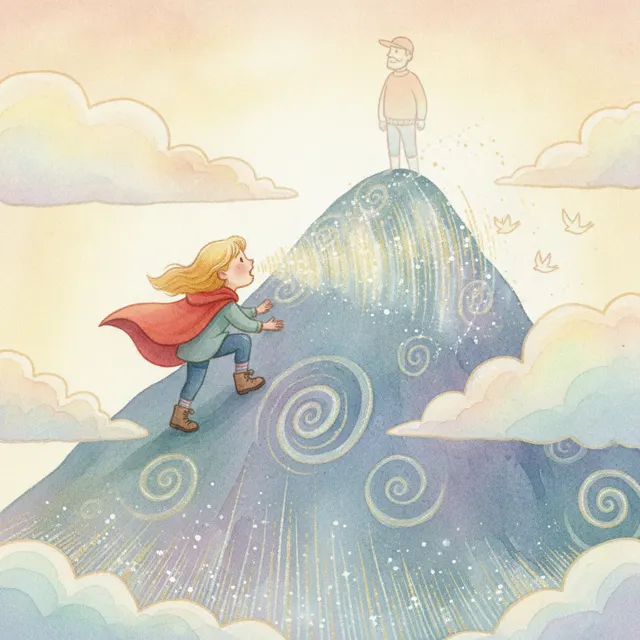
A brave girl climbs a mysterious mountain to find her missing father and discovers the true power of her own voice.

Moral: Courage and love can bridge the distances that fear makes feel impossible.

On the edge of the village of Thornwick stood a mountain so tall that its peak was always hidden in clouds. The villagers called it the Mountain of Echoes, and they said anyone who climbed it would hear the voices of everyone they had ever lost. Mila had never believed those stories. But that was before her father disappeared on a trading journey six months ago. Now she believed everything. She packed her satchel before sunrise, while her mother slept. She left a note on the kitchen table and slipped out into the grey morning. The mountain path began behind the old mill, winding upward through pine forests that smelled of sap and cold earth. By mid-morning, Mila had climbed past the tree line. The wind picked up, sharp and biting. She pulled her coat tighter and kept going. Her legs burned but she didn't stop. At noon she reached a ledge where a strange old woman sat beside a fire, roasting chestnuts. "You're the baker's daughter," the woman said without looking up. "I am," Mila said. "Do you know the way to the top?" The woman pointed up the path. "I do. But I'll only tell you if you can answer my question. What is louder than a shout but softer than a whisper?" Mila thought for a long moment. The wind howled around her. A hawk circled overhead. Then she knew. "A name spoken by someone who loves you," she said. The old woman smiled and pointed to a narrow trail to the left. "That path is shorter. And safer." Mila climbed for another hour. The clouds gathered around her and the air grew thin. Then, at last, she reached a wide flat stone at the summit. The clouds parted, and golden afternoon light poured through. She cupped her hands around her mouth. "Papa!" she shouted. The mountain answered. Not with her own voice echoing back, but with her father's voice, clear and warm, as if he were standing right beside her. "Mila. I'm in Colbridge. I was robbed and taken ill. I'm recovering now. Don't worry. I'm coming home." Tears ran down her cold cheeks. It wasn't a ghost. It wasn't magic. The mountain simply collected sounds from across great distances, like a giant ear pressed to the world. She didn't know how. She didn't need to. She ran all the way back down the mountain, her feet barely touching the ground. She burst through the kitchen door. Her mother looked up from her bread dough with startled eyes. "Papa is in Colbridge," Mila said, breathless and grinning. "He's coming home." Her mother covered her mouth. And then they held each other in the middle of the kitchen, flour on their hands, laughing and crying at the same time. Three weeks later, her father walked through the door with a limp, a new hat, and a story longer than Mila's own. And that night, for the first time in six months, all three of them sat at the table together for dinner. The mountain had given her what she'd gone looking for. Not magic. Just the truth.
The Boy Who Kept Promises

Ages 5-105 minkeeping promises
The Boy Who Kept Promises story for kids illustration

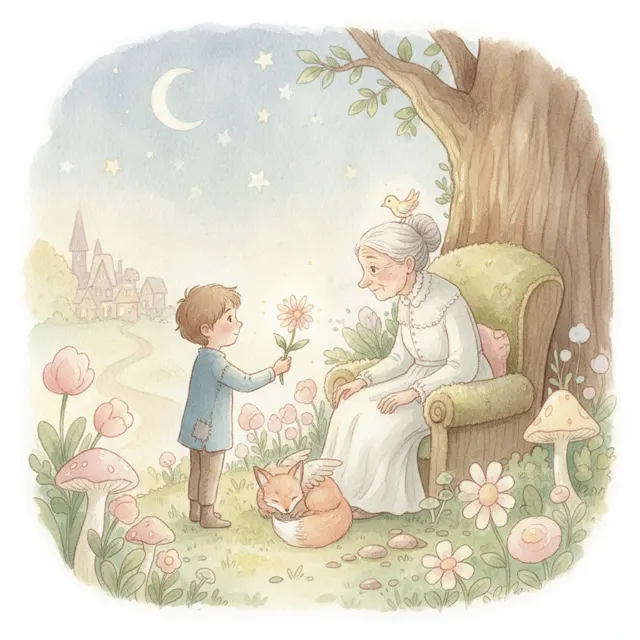
When Leo promises to help three animals in trouble, he learns that keeping your word is more important than convenience.

Moral: A promise is easy to make but your character is built by keeping it.

Leo had a habit of making promises he didn't keep. Not out of meanness, just carelessness. He'd say "I'll be there" and then forget. He'd say "I'll help" and then find something more interesting to do. It had never really cost him anything. Until the day he walked into the Whispering Woods. He was taking a shortcut to his grandmother's house when a robin landed on a branch in front of him. "Please," the bird said in a small, clear voice, "my nest has blown from the tree. Will you help me rebuild it?" Leo was surprised to hear a bird speak, but he said, "Sure, I'll help," and then immediately thought about the warm pie waiting at his grandmother's house. He walked past the fallen nest without stopping. A little farther on, a fox kit sat whimpering beside a stream. Its paw was caught in a tangle of thorny vines. "Please," the kit said, "can you help me get free?" "Of course," Leo said, and walked on. By the third bend in the path, a deer stood trembling, its antler tangled in old wire someone had left across the path. "Young traveler," the deer said quietly, "will you help me?" "Yes," Leo said, and kept walking. He arrived at his grandmother's house, ate two slices of pie, and started the walk home feeling full and content. But as he entered the woods, the trees seemed darker. The path had changed. He walked for a long time but didn't recognise anything. He was lost. He sat down on a mossy log and thought hard. He'd been in these woods a hundred times. What was different? And then he realised. He'd made three promises and broken all three. The woods hadn't changed. He had just stopped paying attention to anything except what he wanted. He went back the way he'd come, slowly this time. He found the deer first. It took twenty careful minutes to unwind the wire without hurting the antler. The deer bowed its head and stepped away gracefully. He found the fox kit next, and gently, patiently, pulled each thorn vine away until the small paw slipped free. The kit licked his hand and bounded away. Finally, he found the robin's nest, muddy and broken on the ground. He gathered soft grass, small twigs, and a few feathers he found nearby. He shaped them carefully into a bowl and wedged it into the fork of the tree where the old nest had sat. The robin flew in and chirped three times. The path home appeared immediately in front of him, clear as day. He told his mother what had happened. She listened quietly and then said, "A promise is a small thing to say and a big thing to keep. The difference between the two is character." Leo wrote that down. He put it on his mirror. He never forgot it again.

The Library at the End of the Street

Ages 6-105 minconfidence and reading
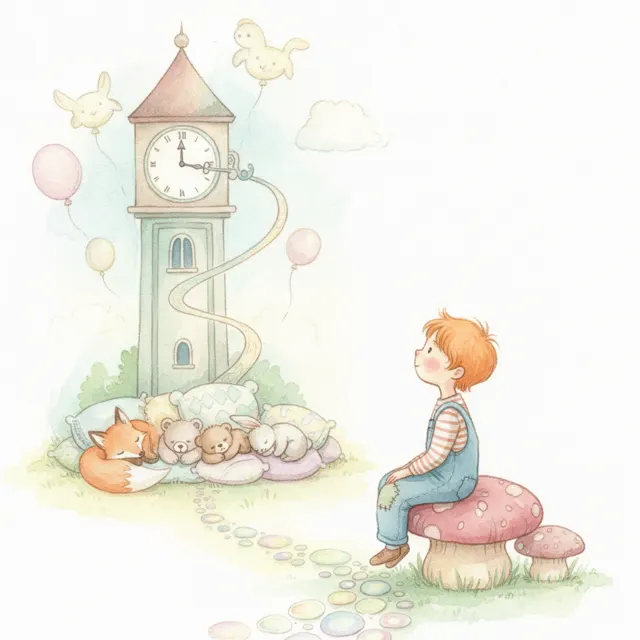
The Library at the End of the Street story for kids illustration

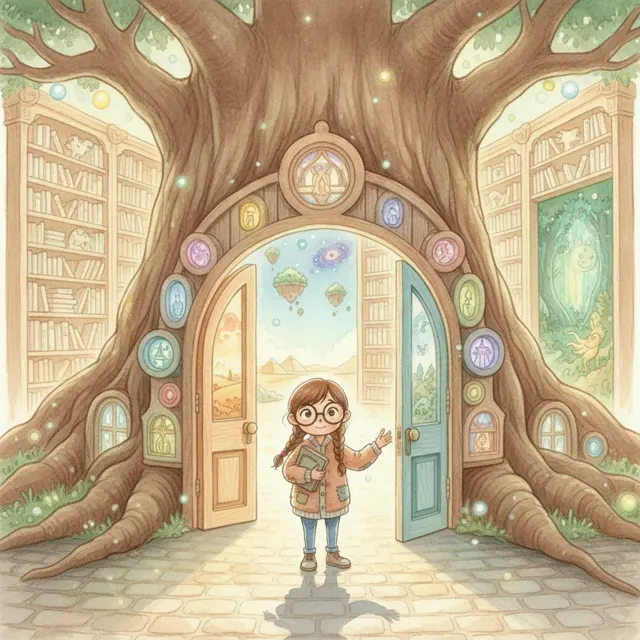
A shy girl discovers a magical library where every book is a door to a different world, and finds her confidence along the way.

Moral: Books don't just tell stories; they teach us who we can be.

At the very end of Pepper Lane, past the bakery and the old clock tower, there was a building that most people walked right past. It had no sign. The door was painted the exact same grey as the wall beside it. But if you looked carefully, and Priya always looked carefully, you could see light seeping under the door even on the cloudiest days. One Tuesday afternoon, Priya pushed the door open. Inside, the smell hit her first: old paper, wood polish, and something warm she couldn't name. The room was larger than the outside suggested, with shelves that went up to a ceiling she couldn't quite see. Every shelf was packed with books, and every book had a coloured spine, deep red and sea blue and forest green and gold. A small man with a neat white beard sat behind a desk. He looked up over his glasses. "First visit?" "Yes," Priya said, barely above a whisper. She was shy around new people, and new places made it worse. "Take your time," he said, and looked back down at his work. Priya walked slowly along the first row. She ran her fingers along the spines. And then one book shivered under her touch. She pulled it out. The cover showed a ship in a storm, and the title read: The Girl Who Sailed the Impossible Sea. She opened to page one. The room vanished. She was standing on the deck of a ship in a howling gale. Waves as tall as houses crashed around her. The crew was shouting. And then a girl her own age ran up beside her and grabbed her arm. "Don't just stand there," the girl yelled with a grin. "Help me with this rope!" Priya grabbed the rope. It pulled hard in her hands. She planted her feet and leaned back with her whole weight. The sail caught the wind properly and the ship steadied. "Good thinking," the girl said. "I'm Captain Sera." "I'm Priya," she said, and realised she'd said it clearly, without hesitating, without the usual embarrassment. They sailed together for what felt like an hour, through the storm and out the other side into calm glittering water. Then Priya turned a page in her mind and she was back in the library, the book still in her hands. "How was it?" the man at the desk asked. "Amazing," she said. And this time her voice was loud and sure. She came back every week after that. She sailed seas, climbed volcanoes, discovered hidden kingdoms, and defended castles. Each book was a different adventure and in each one she had to speak up, make decisions, and trust herself. By the time autumn arrived, her teachers noticed. Her hand went up in class. She answered questions. She made new friends. When people asked what had changed, she'd smile and say, "I just started reading more." Only she and the man behind the desk knew the whole truth of it.

The Dragon Who Was Afraid of Fire

Ages 5-95 minovercoming fear
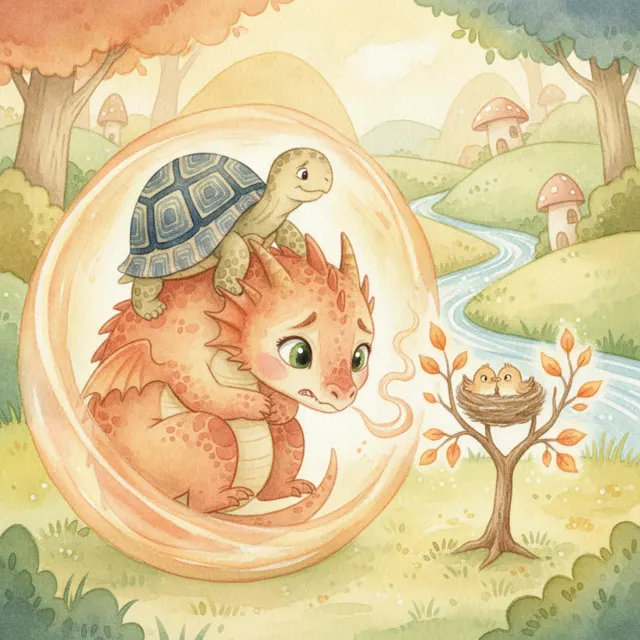
The Dragon Who Was Afraid of Fire story for kids illustration

Ember the young dragon is terrified of his own fire breath, until a clever tortoise helps him see that his greatest fear is also his greatest gift.

Moral: What scares you most might be your greatest gift; the key is learning to use it wisely.

Every dragon in the Scorched Hills could breathe fire. It was simply what dragons did. They breathed fire to warm their caves, to cook their food, and occasionally to light the way on dark paths. Fire was as natural to a dragon as swimming was to a fish. Except for Ember. Ember was seven years old in dragon years, which meant he was about the size of a large horse and should have had a fine, controllable flame by now. But every time his breath warmed up and the heat rose in his chest, Ember panicked and swallowed it back down. The idea of fire coming out of his own mouth terrified him. What if he burned something he loved? What if it got out of control? The other young dragons were patient at first, then puzzled, then unkind. "Firefly," they called him. "The Hissing Heater." Ember stopped coming to the group practice sessions. One morning he sat alone by the river, watching the water ripple over stones. A very old tortoise crawled out of the shallows and sat beside him. "You're the one who won't breathe fire," the tortoise said. "Word travels," Ember muttered. "It does." The tortoise was quiet for a while. Then she said, "I've seen many dragons in my long life. Do you know what the dangerous ones have in common?" Ember shook his head. "They never practiced control. They just let the fire go wherever it wanted." She looked at him with one amber eye. "You're not afraid of fire. You're afraid of being careless. That's actually the smartest thing a young dragon can be." Ember thought about this. "But the answer isn't to hold it forever," the tortoise continued. "It'll build up. That's when accidents really happen." She pointed to a big flat rock in the river. "Try breathing at that. If it sizzles, good. If it scorches, also good. You'll learn the difference with practice." Ember's chest tightened. But he took a breath, held it for a moment, and then let it out. A thin stream of orange flame hit the rock with a soft hiss. The rock was warm to the touch but not cracked, not ruined. He did it again. Then again. Each time, more controlled. Each time, less frightening. By the end of the afternoon, he could sustain a steady flame for a full ten seconds and stop it cleanly. He lit a pile of damp leaves with a single precise breath and watched them catch and crackle. He was grinning so hard his jaw hurt. When he returned to the group sessions the next day, the other dragons stared. His flame wasn't the biggest. But it was the steadiest, the most accurate, the most controlled in the whole group. "Firefly's back," one of them said. "Ember," he corrected calmly. "My name is Ember." He never shied from his fire again. And because he'd spent so long being careful, his control was better than any dragon twice his age.

The Last Seed

Ages 6-105 minpatience and hope
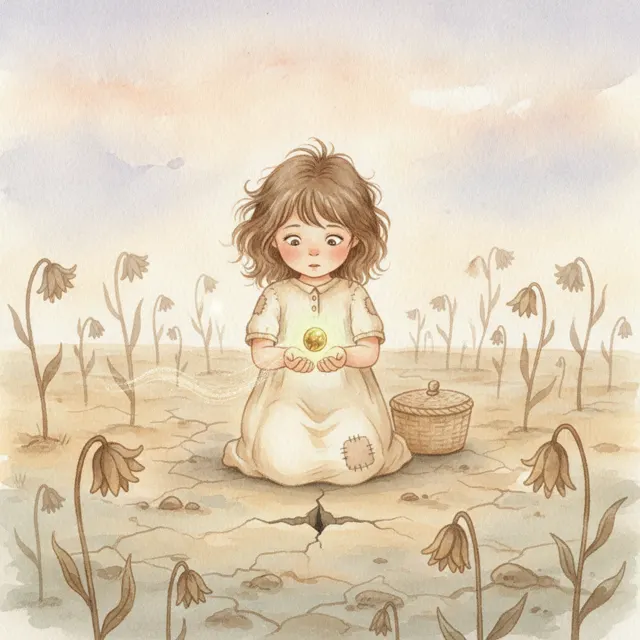
The Last Seed story for kids illustration

In a world where all the flowers have died, a small girl with one magical seed must decide whether to keep it safe or set it free.

Moral: Patience and hope, held long enough, can bring beauty back to a broken world.

The year the flowers died, the world went very quiet. Nobody knew exactly why it happened. One spring the fields didn't bloom. The following year the same. By the third year, every park and garden and meadow was just green grass, and even the grass looked tired. Bees slowed down. Butterflies vanished. Children who had only ever seen flowers in old photographs grew up thinking they were myths. Nola was eight years old when she found the seed. It was in her grandmother's attic, inside a small tin box wrapped in a handkerchief that smelled of lavender. There was a note in the box written in her grandmother's careful handwriting. "This is the last marigold seed I have. It waited. Save it until you know the right time." The seed was tiny, about the size of a nail head, dark brown with a pale tip. Nola held it in her palm and felt a faint warmth. She wanted to plant it immediately. But something made her wait, just like her grandmother's note said. She kept it in the tin box on her nightstand and sometimes took it out to look at. Winter came. She kept the seed. Spring came. She thought about planting it but the ground still felt wrong somehow, grey and sad. She kept the seed. Then one morning in late May, she woke early and opened her window. The air smelled different. Not like grass or earth, but like something trying. She looked down at the garden. And in the corner, where the old rosebush used to grow, a tiny green shoot had pushed through the soil. She ran downstairs barefoot and knelt in the dirt. It wasn't a flower, just a weed. But it was reaching. Really reaching, like it wanted the sky badly. That was the day. Nola dug a small hole with her finger beside the weed, pressed the last marigold seed into the earth, and covered it gently. She watered it from the can her grandmother had left in the shed. She waited. Ten days later, a shoot appeared. Two weeks after that, a bud. On the morning of her ninth birthday, a single bright orange marigold bloomed in the corner of the grey garden. Her neighbours came to look. A photographer from the local paper took a picture. The headline read: "The Last Flower." But it wasn't the last. Because Nola had saved the seeds from that one flower, forty-seven seeds in a small paper envelope. And the following spring, she gave seeds to everyone she knew. The spring after that, there were flowers in every garden on her street. By the time Nola was twelve, the fields were blooming again. Nobody could explain it. Scientists talked about soil conditions and climate cycles. Nola just smiled. She knew that sometimes the world needs someone to hold on to one small thing long enough to give it the right moment to grow.

Milo and the Very Long Wait

Ages 3-87 minutespatience
Milo and the Very Long Wait story for kids illustration

Milo wants a warm cookie, but they are still baking. Waiting feels too hard, so he and Dad set the table and pour milk. When the timer rings, the cookie tastes better than ever, and Milo learns good things come to those who wait.

Moral: The best things are worth waiting for.

Milo wanted a warm cookie. He could smell them baking in the oven. "How much longer?" he asked. "Ten more minutes," said Dad. "The cookies are not done yet." Ten minutes felt like ten whole days to Milo. He sat down. He stood up. He walked in a little circle. "Waiting is so hard," he said. "It is," said Dad. "But good things are worth the wait. Let us do something while we wait." Milo and Dad set the table. They put out two cups. They poured two glasses of cold milk. They wiped the table until it shone. "Is it time yet?" asked Milo. Dad looked at the timer. "Not yet. Three more minutes." Milo tapped his foot. Tap, tap, tap. Then he heard a soft ding. The timer rang. Dad opened the oven door, and the smell of warm cookies filled the whole kitchen. Dad set the tray on the counter. The cookies were golden and round. "We still have to wait for them to cool," said Dad. "Oh no," said Milo. "More waiting!" They counted to ten slowly. One, two, three, four, five, six, seven, eight, nine, ten. Then Dad handed Milo a cookie. It was still a little warm and soft. Milo took one small bite. "This is the best cookie ever," he said. "The wait made it taste so good." "The best things are worth waiting for," said Dad. "And waiting is easier when you have someone to wait with." Milo smiled. "Can we bake cookies again tomorrow?" he asked. "I am getting good at waiting."

The Kite That Would Not Fly

Ages 3-88 minutespersistence
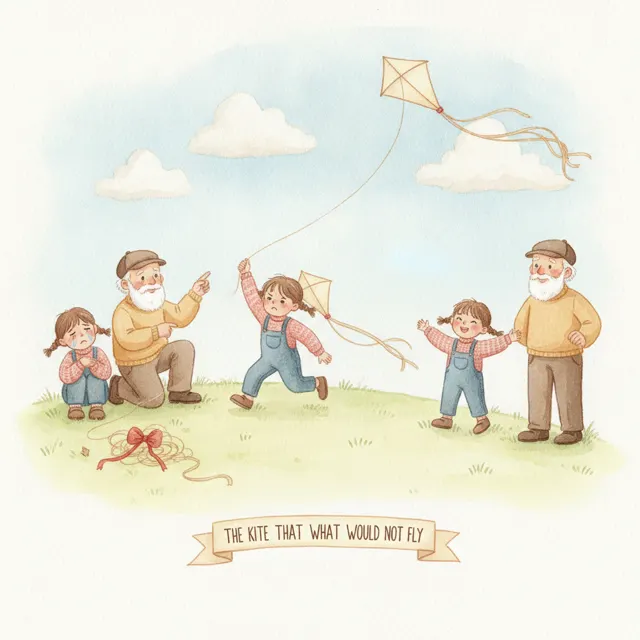
The Kite That Would Not Fly story for kids illustration

Mia's new kite keeps falling, and she wants to give up. Her grandpa helps her try again and again. At last the wind catches the kite and it soars. Mia learns that keeping at something can lead to the best reward.

Moral: Keep trying and you will get there.

Mia got a new kite for her birthday. It was red with a long blue tail. "Let us fly it!" she said. Mia and her grandpa went to the big hill. The wind blew soft. Mia held the string and ran fast. The kite lifted up, then flopped to the grass. "Try again," said Grandpa. Mia ran again. The kite went up a little, then spun and fell. "It will not fly," said Mia. "This kite is broken." "It is not broken," said Grandpa. "Kites need wind and a steady hand. Let us wait for a bigger gust." They waited. The grass moved. The leaves shook. "Now!" said Grandpa. Mia ran with all her might. The kite rose high and climbed. Then the wind stopped, and the kite fell again. Thump. Mia sat down. "I give up," she said. "It will never fly." "You tried two times," said Grandpa. "Good things often take more tries. Let us try once more, together." Mia stood up and took a deep breath. Grandpa held the kite up. Mia ran into the wind. The string pulled tight. The kite rose, wobbled, then caught the wind and soared. "It is flying!" Mia shouted. "It is really flying!" The kite danced against the blue sky. Its long tail waved like a happy ribbon. Mia laughed and laughed. "You did it," said Grandpa. "You kept trying." "If I had stopped," said Mia, "I would have missed this." She held the string tight and watched her kite ride the wind all afternoon.

Grandpa's Box of Old Maps

Ages 3-87 minutesfamily
Grandpa's Box of Old Maps story for kids illustration

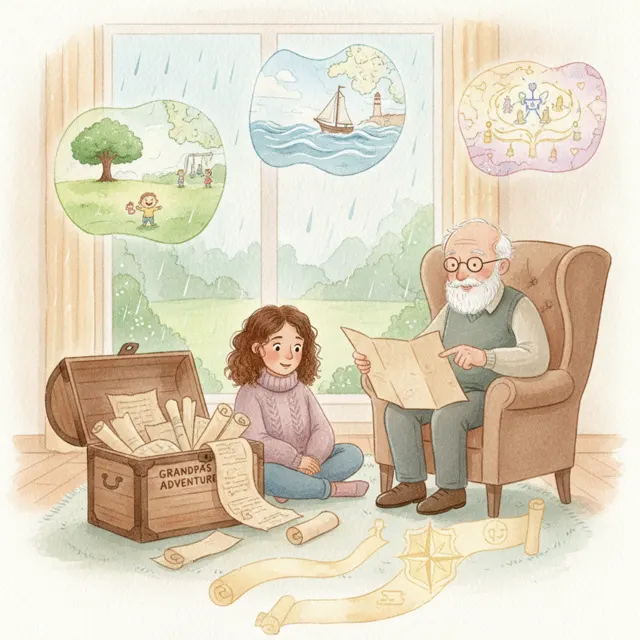
On a rainy day, Dara opens Grandpa's box of old maps. Each map holds a story from his past, from the park that was once a field to the wide sea. Dara learns that family stories are like maps that show where you come from.

Moral: Old stories tie a family together.

Dara loved the big wooden box in Grandpa's closet. It was full of old maps. The paper was soft and yellow, and the corners were folded. "Can we open the box?" Dara asked one rainy day. "Of course," said Grandpa. "But we must be gentle. These maps are older than I am." They sat on the floor and lifted the lid. Dara pulled out a map of the town. "I know this street!" she said. "We walk there for bread." "Yes," said Grandpa. "But look. This map is from when I was a boy. The park was just a field then." Dara's eyes went wide. "The whole park was a field?" "It was," said Grandpa. "I flew my first kite there." He pointed to a small square. "Right here." They opened more maps. A map of the mountains. A map of the river. A map of the sea. Each one held a story. Grandpa told Dara about the trip where he saw the sea for the first time. "The water was so wide," he said, "I thought it went on forever." "Do you still have these places?" Dara asked. "Can we visit them?" "Some we can," said Grandpa. "Some live only in these maps now. But you can keep them alive by hearing the stories." Dara traced the lines with her finger. "Then tell me more," she said. "I want to know them all." They sat for a long, happy hour. Outside, the rain tapped on the window. Inside, old maps turned into new stories. Dara learned that a family's stories are like maps. They show you where you come from.

The Bear Who Walked the Whole Trail

Ages 3-88 minutesdetermination
The Bear Who Walked the Whole Trail story for kids illustration

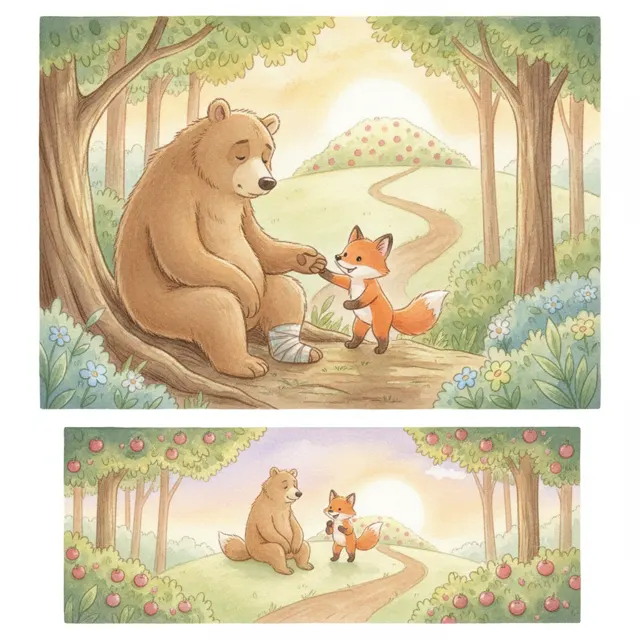
Bruno thinks the trail to berry hill is too long for his sore feet. His friend Penny walks with him, one small step at a time. When they reach the hill of sweet berries, Bruno learns that finishing a long walk is worth it.

Moral: Little steps finish a long road.

Bruno was a big bear with small, tired feet. All the other bears had walked the long trail to the berry hill. Bruno had never gone. The trail was long, and his feet got sore. "Come with us," said his friend Penny. "The berries are the sweetest there." "It is too far," said Bruno. "My feet will hurt." "We will walk slowly," said Penny. "One small step at a time." So Bruno started up the trail. Step, step, step. The path went up and up. His legs felt heavy. "I want to stop," he said. "Look back," said Penny. "See how far we have come." Bruno turned. The forest was far below. "We came all that way?" he said. "One step at a time," said Penny. "Let us rest, then walk a little more." They rested on a warm rock. Then they walked some more. The trail bent around a tall pine. A stream crossed the path. Bruno hopped from stone to stone. Splash, splash. "I did not fall in!" he said, proud. Higher up, the trees thinned and the sky opened wide. "Almost there," said Penny. Bruno's feet ached, but he kept going. One step, then another. Then the trail ended. Before them spread a whole hill of berries, red and sweet and shining in the sun. "We made it," Bruno whispered. He ate one berry, then two. "This is the best berry I have ever had." "The best things are at the end of the walk," said Penny. Bruno smiled. "I almost did not come," he said. "I am glad I kept going. My feet are tired, but my heart is full."

Rosa Plants a Whole Orchard

Ages 3-88 minutesnature
Rosa Plants a Whole Orchard story for kids illustration

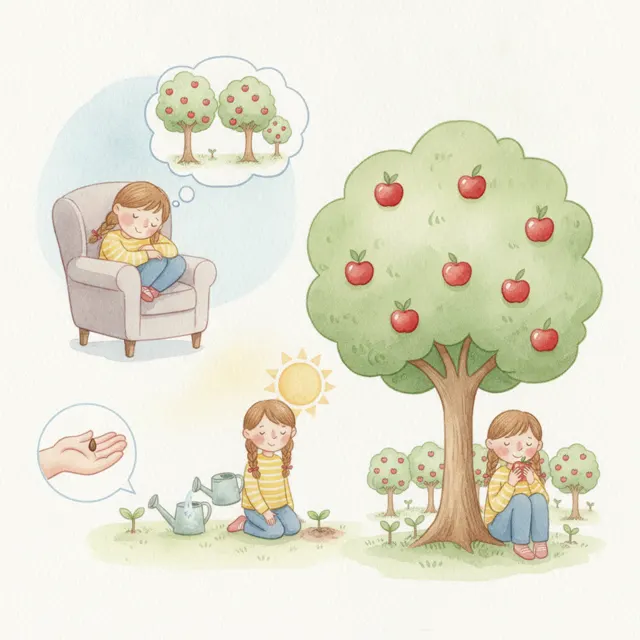
Rosa dreams of a whole orchard but has only one seed. She plants it and waits. With patience, water, and care, the seed becomes a tree that gives sweet apples, and Rosa learns that big things grow from small beginnings.

Moral: Big things grow from small, slow care.

Rosa lived on a farm with one old apple tree. Every fall, it gave small, sweet apples. "I wish we had more trees," Rosa said. "Then plant some," said Papa. "An orchard begins with one seed." "But I am little," said Rosa. "Can I plant a whole orchard?" "You do not plant a whole orchard at once," said Papa. "You plant one seed today, then another, then another. The orchard grows with you." So Rosa planted her first seed. She dug a small hole, dropped the seed in, and covered it with dark soil. She watered it and marked the spot with a stick. Every day, Rosa checked her seed. For a long time, nothing happened. "Is it growing?" she asked. "Roots first," said Papa. "Growing happens under the ground, where you cannot see it." Rosa waited. She planted another seed, then another. She watered them all. She pulled the weeds. She sang to the little mounds of dirt. One morning, a tiny green sprout pushed through the soil. "Papa, look!" Rosa shouted. "My first tree!" "You grew that," said Papa. "With patience and care." More sprouts came up. Each one was small, but each one was hers. Years passed, and the sprouts grew taller. One fall, the first young tree gave three small apples. Rosa bit into one. It was crisp and sweet. "A whole orchard," she said, looking at her little trees. "It began with one seed, and it is still growing, just like me." Rosa looked at the tiny trees and felt very proud. Every seed she planted was a promise of apples to come.

The Lighthouse Keeper's Daughter

Ages 3-88 minutescourage
The Lighthouse Keeper's Daughter story for kids illustration

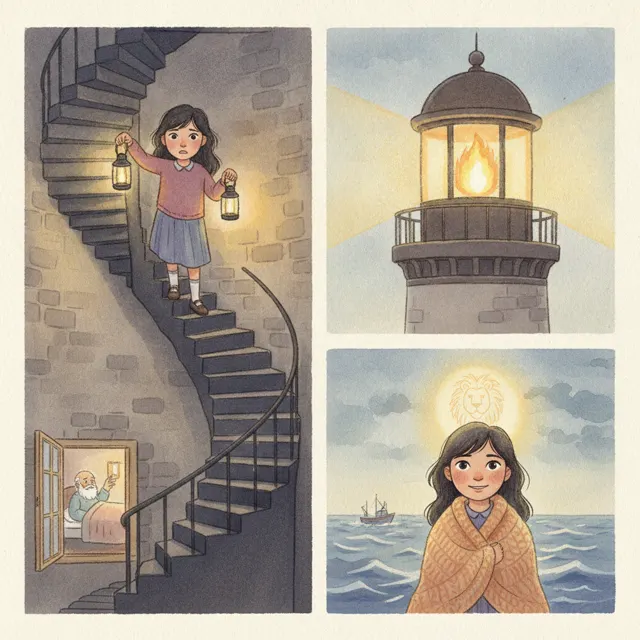
When her father falls ill, Noor must light the lighthouse lamp alone. She is scared, but she climbs the dark stairs and lights the flame. Noor learns that being brave means doing something even when you are afraid.

Moral: Being brave means doing it even when you are scared.

Noor's father kept the lighthouse on the rocky point. Every night, he lit the lamp so ships could find the shore. Noor loved the light. It was strong and steady. One evening, Father felt ill. "The lamp must be lit," he said, worried. "But I cannot climb the stairs tonight." "I will light it," said Noor. "I have watched you a hundred times." "The stairs are long and dark," said Father. "And the lamp is heavy. Are you sure?" Noor's heart beat fast. "I am a little scared," she said. "But ships need the light. I will be brave." She took the small key and started up the winding stairs. The tower was dark and cold. The wind howled outside. Noor's legs shook, but she kept climbing. At the top, she filled the lamp with oil. She struck the match. It flickered and nearly went out. Her hands trembled. She struck again. This time, the flame caught. She touched it to the wick. The lamp glowed, then blazed bright. Noor looked out at the dark sea. The light swept across the water. Far below, a little boat turned toward the safe harbor. "It is lit!" Noor called down to Father. "I did it!" Father smiled from his bed. "You are braver than you know," he said. That night, Noor watched the light spin over the waves. She had kept the ships safe. She had climbed the dark stairs. "Being brave," she whispered, "means being scared and doing it anyway." Far below, the little boat reached the harbor, and its sailors waved up at the tower light.

Sam and the Long Road Home

Ages 3-87 minutesperseverance
Sam and the Long Road Home story for kids illustration

The walk home from Aunt Priya's house feels endless. Sam and his mother play a game of finding colored things along the way. Before he knows it, Sam sees his yellow door and learns that the longest road ends when you keep going.

Moral: Even a long road ends when you keep going.

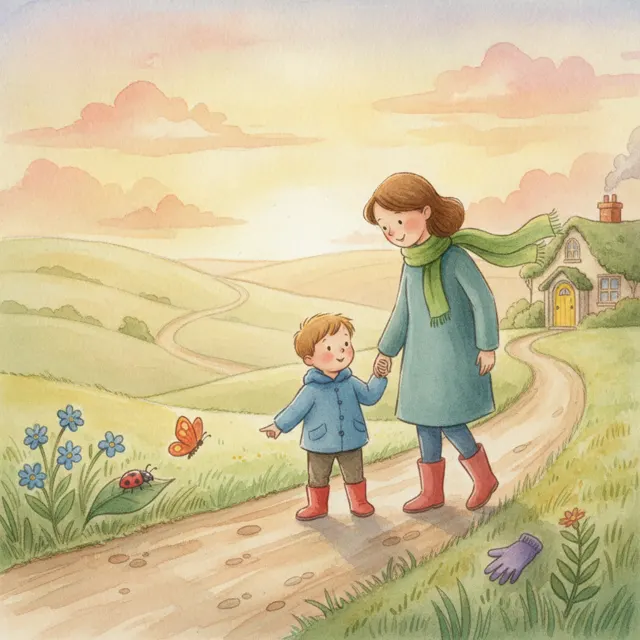
Sam and his mother visited Aunt Priya in the next town. The visit was long and fun. But now the day was done, and the walk home stretched ahead. "It is so far," said Sam. "My feet are tired already." "Then we will take it slow," said Mom. "A long road is just many small steps." They started down the road. Sam counted his steps. One, two, three. He watched a bird hop along a fence. He kicked a small stone. "I miss home," said Sam. "I want to be in my bed now." "I know," said Mom. "Let us play a game. Let us find five red things on the way." Sam looked around. A red mailbox. A red flower. A red bicycle. A red roof. A red ball in a yard. "Five!" he said. "That was fast." They found five blue things next, then five things that were round. The road did not feel so long when there were things to find. They passed the big oak tree. They passed the little bridge. "We are almost home," said Mom. "Do you see our yellow door?" Sam looked ahead. There it was. The yellow door. The warm light in the window. His own house. "We made it!" said Sam. He ran the last few steps and touched the door. "The road was long, but we kept going." "That is the secret," said Mom. "Keep going, and even the longest road ends at home." Sam hugged his mom by the yellow door. "Next time," he said, "I will not say it is too far. I will just start walking."

Frequently Asked Questions

Turn Your Child Into the Hero of Their Own Story

Upload their photo and watch as AI creates a beautiful, personalized storybook with illustrations that look just like them. From $5.99/month.

โœจ Make Your Child the Hero

Plans from $5.99/month