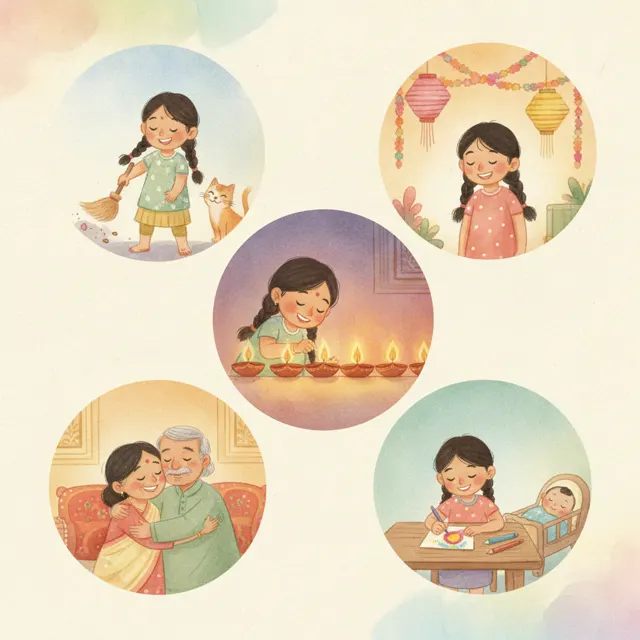
Diwali Stories for Kids

Warm Diwali tales where your little one lights diyas, shares sweets, and learns that one small lamp can brighten a whole room.

✨ Make Your Child the Hero

Diwali is a festival that fills a child's heart with light. There are rows of little oil lamps, bright colors, sweet treats, and family gathered close, and kids love every part of it. These stories turn that joy into gentle bedtime tales about courage, sharing, and the warmth of home. Your child meets families who light their first diya, share sweets with a shy neighbor, and discover that a small light can push away the dark. Each story is soft and warm, perfect for the nights of the festival. With CreateStory.ai, you can make it personal. Upload a photo and your child becomes the hero of their own Diwali story.

How many people celebrate Diwali around the world?

Diwali is the festival of lights. Families light small clay lamps called diyas, draw bright rangoli, and share sweets with the people they love.

More than one billion people celebrate Diwali around the world each year (NPR).

Why do families light small diyas during Diwali?

The small lamps stand for light beating the dark. Long ago, people lit rows of lamps to welcome Rama home. Today, diyas glow on windows and steps to bring good luck and hope.

Sample Stories

Read these stories, then create a personalized version where your child is the hero

The First Diya of Diwali
Ages 3-84 mincourage
The First Diya of Diwali story for kids illustration

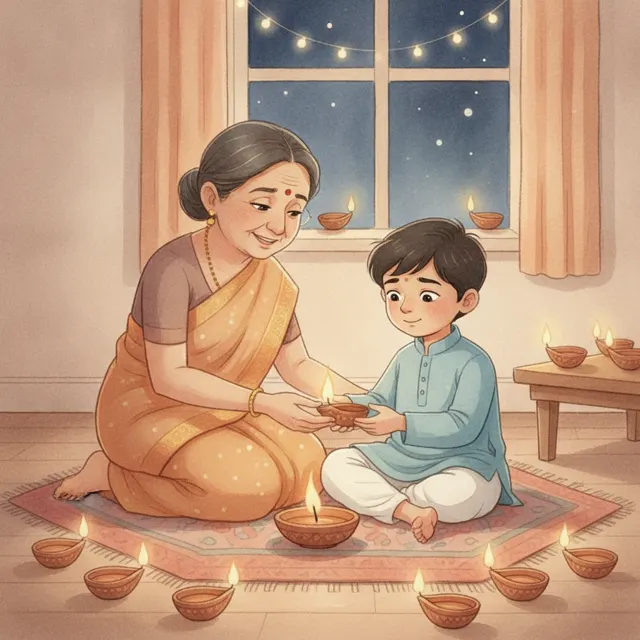
On Diwali night, little Arjun is too scared to light his first oil lamp by himself. With his grandmother beside him and one small flame to guide his hand, he finds the courage to light the lamp that chases the dark away.

Moral: Being brave means trying, even when your hands shake.

On Diwali night, the whole house glowed with color. Little Arjun watched his older sister light row after row of oil lamps, and he wanted to help. But every time he reached for a match, his hand shook. "What if I burn myself?" Arjun whispered. His grandmother sat down beside him. "The first lamp is always the scariest," she said. "I felt the very same way when I was your age." "Really?" Arjun said. "Really," she said. "But I will be right here, and we will light it together." Arjun looked at the small clay lamp in front of him. It held a little wick and a pool of oil, and it looked so small and harmless. "Okay," Arjun said. "Together." His grandmother held the match with him. Their two hands, one big and one small, moved slowly to the wick. The flame caught, and the little diya began to glow. "I did it," Arjun said, his eyes wide. "You did," his grandmother said. "And look how one small light pushes back the dark." Arjun looked around. One diya glowed, then another, then another, until the whole porch was full of tiny flames. The dark did not seem so big anymore. Arjun smiled. "Next year, I will light two," he said. His grandmother laughed and hugged him. "You lit one with courage tonight. That is the brightest light of all." Arjun watched the diyas burn, warm and steady in their little clay cups, and he felt braver than he ever had before.
Sweets for the Shy Neighbor

Ages 3-83 minkindness
Sweets for the Shy Neighbor story for kids illustration

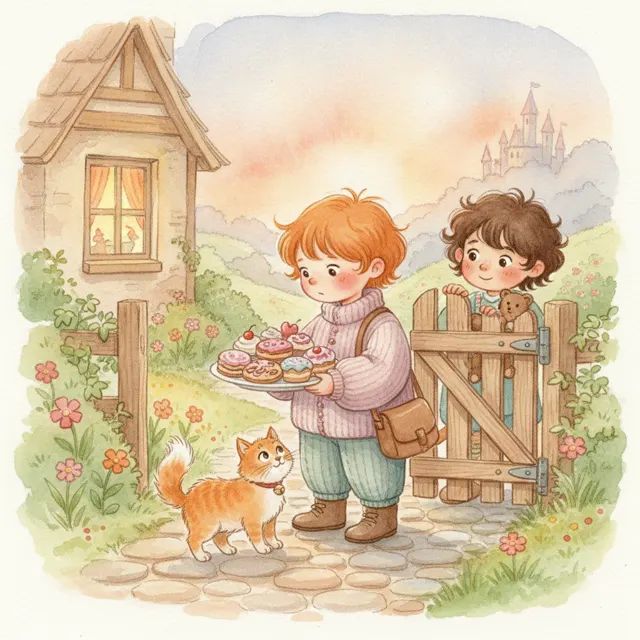
At Diwali, Meera's family makes a big tray of sweets, but she saves the last one for herself. When she notices a new neighbor watching the lights alone, she decides to share her favorite treat and makes a new friend.

Moral: Sharing what you love can turn a stranger into a friend.

It was Diwali, and Meera's kitchen smelled wonderful. Her mother had made a big tray of sweets, round and golden, with little bits of nut on top. Meera loved them more than anything. "Can I have one more?" Meera asked. "Those are for our guests," her mother said. "But you may keep the last one in the corner." Meera tucked the last sweet into a little bowl and promised to save it for later. She carried it to the window, where the street was filling with lights. Then she saw something. A new family had moved in next door, and a small boy stood alone on his porch, watching their diyas glow. He looked shy and a little sad. Meera looked at her sweet, then at the boy, then back at her sweet. It was her favorite, and she really wanted it. But her feet were already walking out the door. "Hi," Meera said. "I am Meera. Would you like a sweet? My mother made them." The boy's face lit up. "Really? Thank you. I am Kiran. We just moved here." They sat on the step and shared the sweet, breaking it in half. It tasted even better than Meera remembered. "My mother says Diwali is about light," Meera said, "but I think it is about sharing the light too." Kiran smiled. "Then we just made it brighter." That night, Meera did not mind that her sweet was gone. She had given it away and gained a friend, and that was sweeter than any treat.

Rangoli Colors for Grandma

Ages 3-84 mingratitude
Rangoli Colors for Grandma story for kids illustration

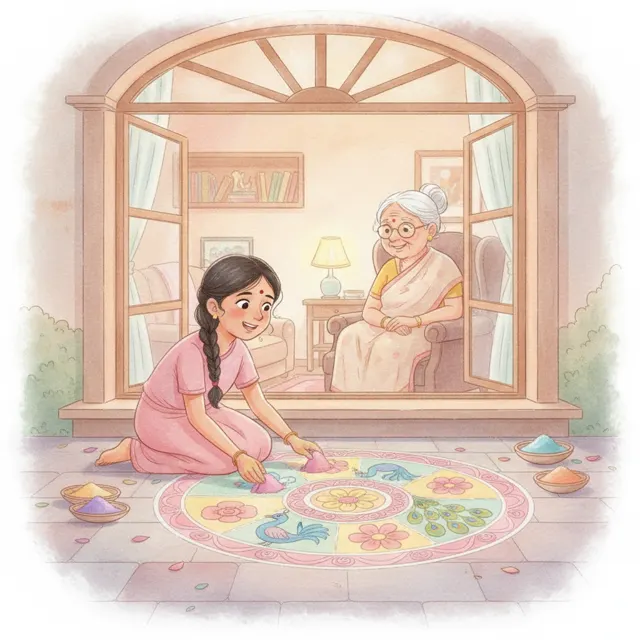
Riya's grandmother cannot come to Diwali this year, so Riya decides to draw a bright rangoli right outside her window. She works all day to make it perfect, and learns that the best gifts are made with your own hands.

Moral: The best gifts are the ones made with your own hands and your whole heart.

Riya was sad. Her grandmother, who always came for Diwali, could not visit this year. She was resting at home, and her leg was not strong enough for the trip. "I wanted to show Grandma my rangoli," Riya said. "Then draw one for her," her mother said. "We can send her a picture." Riya's eyes lit up. She grabbed the colored powders and went to work outside. She drew big circles, small triangles, and little flowers, using red, yellow, green, and blue. She worked slowly, because a good rangoli takes patience. Her little brother ran through it once, and Riya had to fix a whole row. "Sorry!" he called. "It is okay," Riya said. "I will make it even better." By the end of the day, the rangoli was bright and beautiful. Colors swirled in bright patterns like a garden in bloom. Riya's mother took a photo and sent it to Grandma. A few minutes later, the phone rang. It was Grandma, and she was smiling. "Riya, it is the most beautiful thing I have seen," Grandma said. "You made my Diwali." Riya held the phone tight. "I made it for you, Grandma. Every color is because I love you." "Then it is the brightest rangoli in the whole world," Grandma said. Riya looked at her colorful rangoli and felt warm. She had wanted to give her grandmother a gift, and she had. It was made of color and care, and it had reached all the way to Grandma's heart.

The Box of Diwali Chocolates

Ages 3-83 minsharing
The Box of Diwali Chocolates story for kids illustration

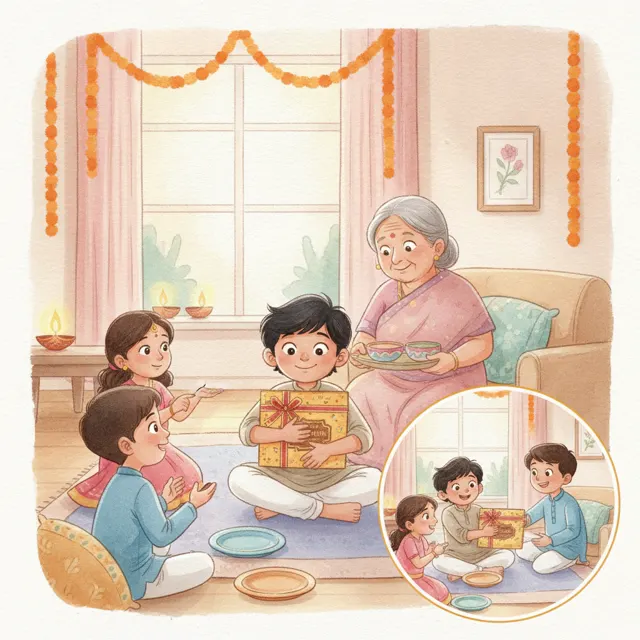
Dev receives a big box of chocolates for Diwali and wants to keep every one for himself. When his cousins come to visit with empty hands, he learns that a box of treats is best enjoyed when it is passed around the room.

Moral: A treat shared with others tastes sweeter than one kept all to yourself.

For Diwali, Dev got a big box of chocolates. They were wrapped in gold and silver, and there were so many that he could not count them all. "These are all mine," Dev said, hugging the box. His mother smiled. "Cousins are coming over tonight. Will you share?" Dev frowned. He loved chocolate more than anything. He tucked the box under his bed, just in case. That evening, the house filled with family. His cousins came in, all smiles, but their hands were empty. They had not brought any sweets. "Do you have anything to share?" his little cousin asked. "We were going to buy treats, but the shop was closed." Dev thought about the box under his bed. His chocolate, waiting just for him. He could keep it all, and nobody would know. But he looked at his cousins' hopeful faces and felt something. He wanted them to be happy too. "Wait here," Dev said. He ran to his room and pulled out the box. "We can share these." His cousins' eyes went wide. "Really? Thank you, Dev!" They passed the box around the room, and everyone took one. His grandmother took two, and she smiled the biggest smile. The room filled with happy crinkling sounds. Dev took one chocolate for himself. It was his favorite kind. But as he looked around at all the smiling faces, he realized something. "This is the best Diwali ever," Dev said. His mother squeezed his shoulder. "A treat tastes sweeter when everyone gets a piece," she said. Dev nodded. He had shared his chocolate, and somehow there was more joy in the room than there had ever been in the box.

Waiting for the Sun to Set

Ages 3-85 minpatience
Waiting for the Sun to Set story for kids illustration

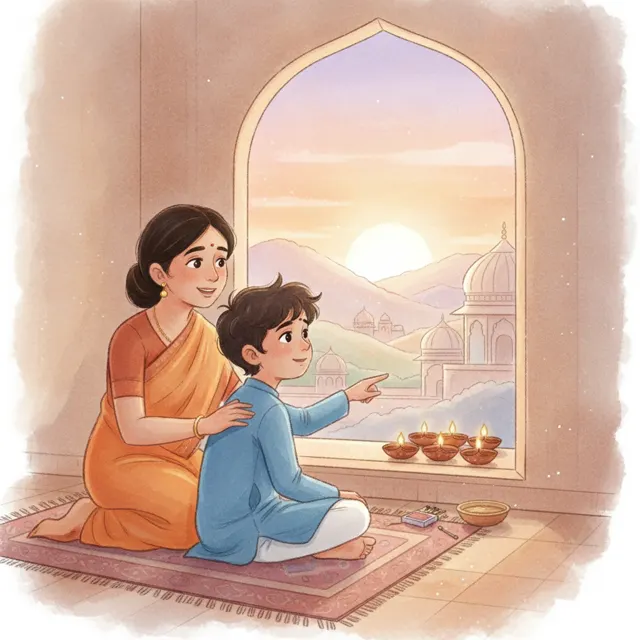
Kiran cannot wait to light the diyas, but his mother says they must wait for the sun to set. As the day stretches on, he learns that some of the best things, like Diwali night, are worth waiting for.

Moral: The best things are worth waiting for.

It was the day of Diwali, and Kiran could not sit still. He wanted to light the diyas right now. "Can we light them yet?" he asked. "Not yet," his mother said. "We must wait for the sun to set." "But that takes forever!" Kiran said. He watched the clock. He watched the sky. The sun seemed to be in no hurry at all. It sat in the sky, bright and slow, as if it did not know that Diwali was waiting. "Why do we have to wait?" Kiran asked his father. "Because a diya shines brightest in the dark," his father said. "If we light it in the daytime, we miss its glow." Kiran sighed. Waiting was hard. He helped his mother sweep the floor. He helped set out the sweets. He even helped his sister finish her rangoli. And still, the sun had only moved a little. Then, slowly, the sky began to change. It turned pink, then orange, then deep purple. The stars came out one by one. "Now?" Kiran asked, almost bouncing. "Now," his mother said. They lit the diyas together, one by one, until the whole porch glowed with soft golden light. Kiran stepped back and looked. It was the most beautiful thing he had ever seen. "See?" his father said. "The wait made the light look even brighter." Kiran smiled. "It was worth it," he said. "Some things are worth waiting for." That night, Kiran watched the diyas glow against the dark sky, and he understood. Patience, he learned, makes the beautiful things even more beautiful.

Diyas for the Dark Lane

Ages 3-84 minuteskindness
Diyas for the Dark Lane story for kids illustration

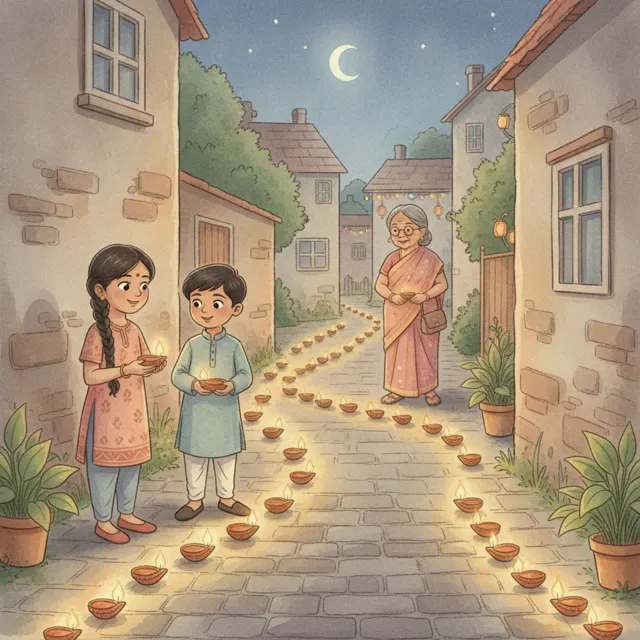
Maya and Rohan notice that the dark lane behind their house has no lights. They line it with glowing diyas so their neighbor Mrs. Shah can walk home safely during the festival of lights.

Moral: A small light can help someone find their way.

Diwali was coming. Maya and her brother Rohan helped Mama clean the house. They hung little lights and set out bowls of sweets. "We need to put diyas on the doorstep," said Mama. "Small clay lamps that hold a flame and glow all night." Maya looked down the dark lane behind their house. "The lane has no lights," she said. "People walk there at night. It is so dark." Rohan nodded. "Old Mrs. Shah walks home that way," he said. "She might trip in the dark." "Then let us line the lane with diyas," said Maya. "Light for everyone, not just for us." They filled small clay lamps with oil and placed a cotton wick in each one. The two children worked side by side until the very last lamp. Then they set them all along the lane, one by one, all the way to Mrs. Shah's gate. It took a long time, but the two of them did not stop. When the sun went down, Maya lit the wicks. A long row of tiny flames glowed in the dark. It looked like a path of little stars leading home. Mrs. Shah came walking home. She stopped and smiled. "Who lit my way?" she asked. "We did," said Maya. "So you would not trip in the dark." Mrs. Shah's eyes filled with happy tears. "You lit more than a lane," she said. "You lit my whole night." Maya felt warm inside. Diwali is the festival of lights. And this year, Maya's little lights showed the whole lane the way home.

The Rangoli That Told a Story

Ages 3-84 minutescreativity
The Rangoli That Told a Story story for kids illustration

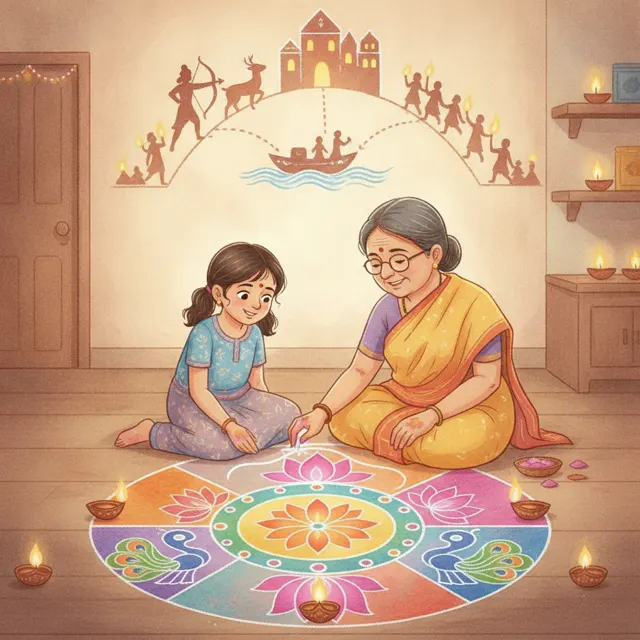
Priya wants to help Grandma make rangoli for Diwali. Grandma teaches her that each bright pattern tells the story of Rama coming home, and Priya learns to draw her own design.

Moral: Art can tell the stories that matter.

Grandma made the most beautiful rangoli every Diwali. She drew bright patterns on the floor with colored powder. "Can I help this year?" asked Priya. "Of course," said Grandma. "But first, let me show you how." Grandma pinched red powder between her fingers and let it fall in a thin, careful line. She drew a big circle, then petals, then tiny dots. "Rangoli is not just pretty," said Grandma. "It tells a story." "What story?" asked Priya. Grandma smiled. "Long ago, Rama came home after many years away. The people lit rows of lamps to welcome him. They drew bright patterns at their doors to show their joy. My rangoli tells that story with shapes and colors." Priya watched Grandma's fingers dance. "The circle is the sun," said Grandma. "The petals are the lamps. The dots are the people who waited for him." Priya picked yellow and green powder. She added tiny dots all around her petals. Then she tried to make her own. Her lines were wobbly at first. But Grandma held her hand and guided her. Soon Priya drew her own small sun with lamp petals. "It looks happy," said Priya. "Rangoli should look happy," said Grandma. "It welcomes good luck and guests into the home." That night, Priya looked at their rangoli glowing in the lamplight. Now she could see the story in it. Her own rangoli told a little piece of the story too. Priya smiled at her bright little design. And she could not wait to draw it again next year.

New Clothes for Little Kiran

Ages 3-84 minutessharing
New Clothes for Little Kiran story for kids illustration

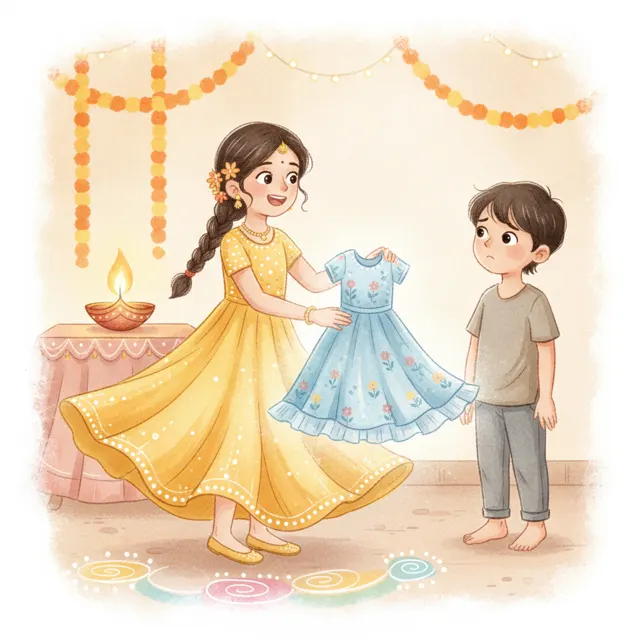
For Diwali, Anya gets a new yellow dress with little mirrors. When she sees her neighbor Kiran has no new clothes, she gives away a dress she loves and learns that sharing is the brightest light.

Moral: Giving to others brings the brightest joy.

For Diwali, families often wear new clothes. Anya's mother bought her a pretty yellow dress with little mirrors on it. Anya spun around and watched the mirrors sparkle. "I love it!" she said. Down the street lived a little boy named Kiran. His family did not have much money. Anya saw him looking at his old shirt. It was faded and a bit too small. "Mama," said Anya. "Kiran has no new clothes for Diwali." Mama nodded. "That is hard. Diwali is a time for new starts." Anya thought about it. She had two nice dresses from last year that still fit. She picked out the bright red one and folded it carefully. Then she put her new yellow dress back in the closet. "Where are you going?" asked Mama. "To see Kiran's mother," said Anya. She gave the red dress to Kiran's mother. "For Diwali," she said. "Maybe someone in your home can use it." Kiran's mother held the dress close. "Bless you, Anya," she said. "My niece has been wishing for a dress just like this." The next morning, Kiran's little cousin came outside wearing the red dress. She spun around, and Anya clapped. That night, Anya wore her yellow dress. But she did not feel like the dress made her special. Giving something away had made her glow more than any mirror could. "Diwali is about light," she told Mama. "And I think sharing is the brightest light of all." Mama hugged her. "That is the truest thing you have ever said."

The Sweet That Smiled Back

Ages 3-83 minutesfamily
The Sweet That Smiled Back story for kids illustration

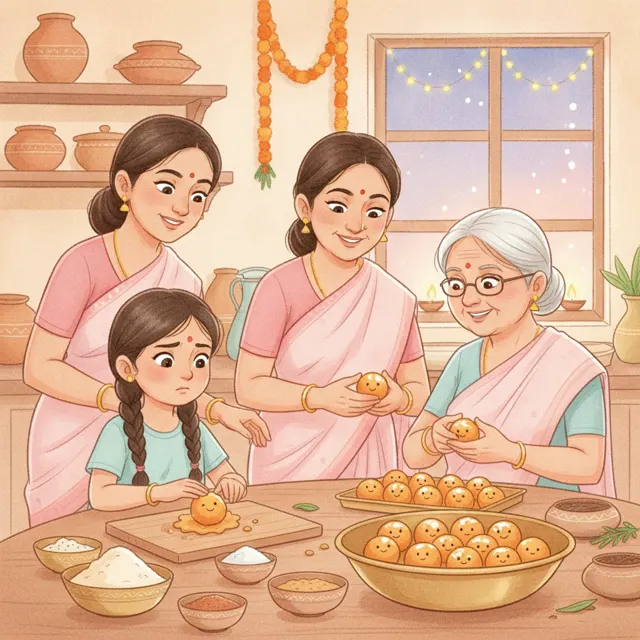
The day before Diwali, Nisha rolls sweet ladoos with her mother, aunt, and grandmother. Her first balls are lumpy, but she learns that making them together is what makes them special.

Moral: Making things together makes them taste better.

It was the day before Diwali. Nisha's family always made sweets called ladoos. They were round and golden and rolled in coconut. Nisha sat at the table with her mother, her aunt, and her grandmother. Big bowls of flour, sugar, and warm butter sat in front of them. The kitchen smelled like warm butter and sweet coconut, and it made Nisha feel cozy. "Roll the dough into balls," said Grandma. She showed Nisha how to press the warm mixture in her palm and roll it into a circle. Nisha's first ball was lumpy. Her second ball was too big. Her third ball was too small. "Mine do not look right," she said. "That is okay," said Auntie. "Every hand makes a different shape. That is what makes them special." Nisha rolled and rolled. Her hands got sticky and sweet. She made ten little balls, then ten more. "Look," said Nisha. "This one looks like it is smiling." Everyone leaned in. One ladoo had two little bumps on top. It really did look like a happy face. "That is the Nisha ladoo," said Grandma. "We will save it for you." That night, the whole family lit diyas and ate the sweets together. Nisha took a bite of her smiling ladoo. It was warm and sweet. "Mine tastes the best," she said. "Because you made it with love," said her mother. Nisha looked around the table at all the smiling faces. This was her favorite part of Diwali. Not the sweets. The family all together.

Rama, Sita, and the Row of Lights

Ages 3-84 minuteshope
Rama, Sita, and the Row of Lights story for kids illustration

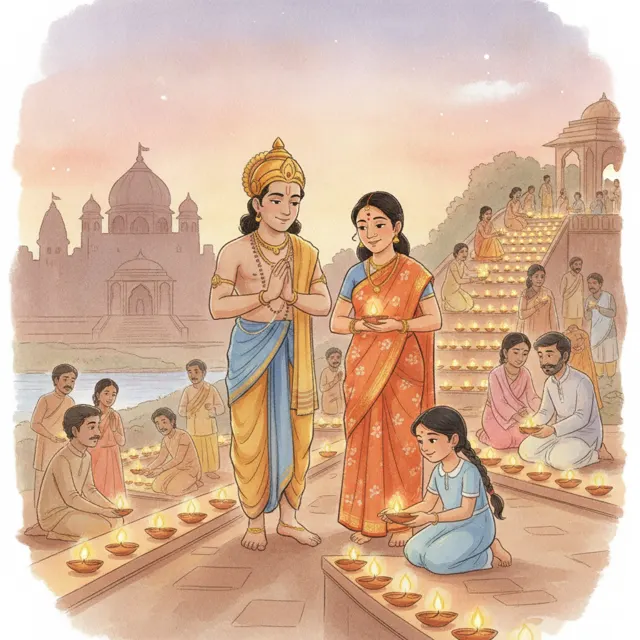
Long ago, good King Rama came home after many years away. A little girl named Asha helps the people light rows of lamps so he can find his way, starting the tradition of Diwali.

Moral: When someone you love comes home, light the way.

Long ago, a good king named Rama was sent far away from his home. He was gone for many years. His wife, Sita, and his brother went with him. The people in his kingdom missed him. They waited and waited. "When will our king come home?" they asked. One day, word came. Rama was coming back! The people were so happy. They wanted to show him the way home. But it was a dark night with no moon in the sky. "We cannot let him walk in the dark," said a little girl named Asha. "Let us light lamps." Everyone ran to their homes. They brought out small clay lamps. They filled them with oil and set them in long rows. The lamps lined the streets, the rooftops, and the palace walls. The whole city glowed like a river of stars. Asha held her lamp high. "I can see him!" she shouted. "He is coming!" Rama walked into the city of light. He smiled at all the bright lamps. Asha ran to the front of the crowd. "Welcome home!" she called. Rama knelt down and smiled at her. "Your small lamp helped me find the way," he said. "You lit the very first light of the city." "You lit the whole world for us," he said. "We waited so long," said Asha. "We wanted you to find your way home." That is why, every year, families light diyas at Diwali. The little flames remind us that love always lights the way home.

The Fireworks That Whispered

Ages 3-84 minutescaring
The Fireworks That Whispered story for kids illustration

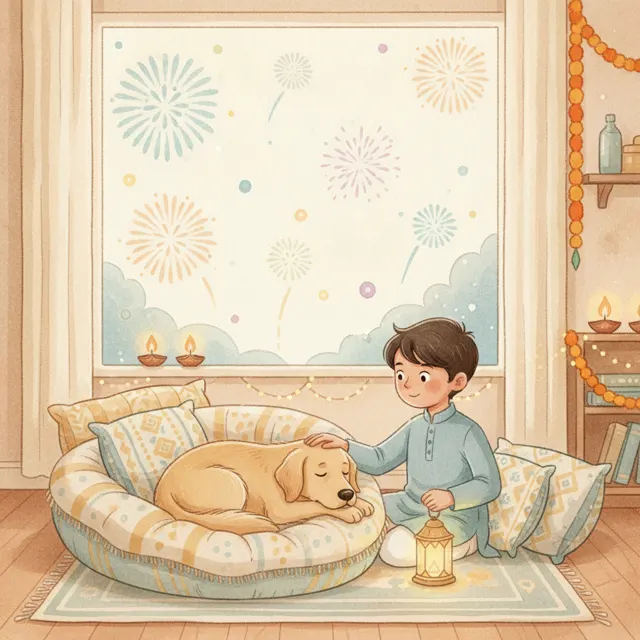
Ravi loves Diwali fireworks, but his dog Moti hides and shakes at the loud booms. Ravi makes a soft nest and stays beside him, learning that being gentle is part of the celebration too.

Moral: Being gentle with animals is part of the celebration.

Diwali night was loud and bright. Fireworks boomed in the sky. Red and green sparks popped over the roofs. Ravi loved the fireworks. But his dog, Moti, did not. Moti hid under the bed and shook. His ears went flat, and his tail curled under him. "Poor Moti," said Ravi. "The booms scare him." Ravi had an idea. He made a soft nest of blankets in the quiet corner of the house. He put Moti's favorite toy inside. Then he sat beside Moti and patted his fur. "It is okay, Moti," he whispered. "I am right here." Moti's shaking slowed down. He put his head on Ravi's lap and let out a soft sigh. Ravi gave him a little treat. "Good boy," he said. "We can be brave together." Moti wagged his tail, just a little. "Some dogs do not like loud fireworks," said Papa. "Being near them helps them feel safe." Outside, another big boom shook the walls. Moti pressed closer to Ravi, but this time he did not run and hide under the bed. Ravi stayed with Moti through the whole show. He talked softly and rubbed Moti's ears. When the fireworks ended, Moti licked Ravi's hand. "Thank you," Ravi whispered. "You were very brave." "Maybe next year we can watch a quieter show from the window," said Mama. Ravi nodded. The fireworks were fun. But taking care of Moti felt even better. Diwali is about light and joy for everyone, even the smallest friends with the softest ears.

Five Days of Little Lights

Ages 3-84 minutestogetherness
Five Days of Little Lights story for kids illustration

Little Veda discovers that Diwali lasts five days, each with its own job. She cleans, decorates, lights diyas, visits family, and makes a card for her brother, learning that family is the best part.

Moral: The best celebrations are shared with family.

Diwali is not just one day. It lasts five whole days. Little Veda learned this as she helped her family get ready. "Day one," said Papa. "We clean the house and shop for sweets." Veda helped sweep the floors. She helped carry the bags from the market. The house began to shine. "Day two," said Mama. "We decorate. We hang lights and draw rangoli." Veda drew a small rangoli of yellow dots and red petals. She hung paper lanterns in the window. "Day three is the big night," said Grandma. "We light diyas and pray. That is when Diwali shines the brightest." Veda lit a diya with Papa. The little flame glowed in her hands. They set out sweets and prayed for good luck and a happy year. "Day four is the new year," said Papa. "We visit family and say happy new year." Veda hugged her cousins and ate sweets at every single house. She tried a new sweet at each door and liked them all. Her cheeks were full of treats. "Day five," said Mama, "is for brothers and sisters. They show love for each other." Veda made a card for her little brother. He drew one for her too. They traded cards and laughed. When the five days were over, Veda sat by the window. The last diya still glowed. "Five days went by so fast," she said. "The best days always do," said Grandma. "But we have each other all year long." Veda smiled. That was the truest thing of all.

Frequently Asked Questions

Turn Your Child Into the Hero of Their Own Story

Upload their photo and watch as AI creates a beautiful, personalized storybook with illustrations that look just like them. From $5.99/month.

✨ Make Your Child the Hero

Plans from $5.99/month