Ramadan Stories for Kids

Warm Ramadan tales where your little one breaks the fast, shares a date, and learns that a giving heart is full.

✨ Make Your Child the Hero

Ramadan is a month of quiet kindness that children understand more easily than we expect. There are long days, shared meals at sunset, and small acts of giving that fill a home with warmth. These stories turn those gentle ideas into bedtime tales about patience, sharing, and caring for others. In them, your child meets families who wait for the moon, break their fast together, and give to someone who has less. Each story is soft and calm, perfect for quiet evenings. With CreateStory.ai, you can make it personal. Upload a photo and your child becomes the hero of their own Ramadan story.

Why Do So Many People Around the World Fast?

Fasting is one of the most shared acts in Ramadan. A Pew Research Center survey of more than 38,000 Muslims in 39 countries found that 93 percent say they fast. From sunrise to sunset, people do not eat or drink. The fast teaches patience and care for people who have less.

How Does Ramadan Bring Out Extra Kindness and Giving?

Many people give more during Ramadan. A study from Indiana University found that 69 percent of Muslim Americans always give to charity during Ramadan. This giving is called zakat and sadaqah. Families share food, money, and time. Small acts of giving make the month feel warm.

Sample Stories

Read these stories, then create a personalized version where your child is the hero

The Moon That Began the Month

Ages 3-84 minpatience
The Moon That Began the Month story for kids illustration

Noor watches the night sky every evening, waiting for the thin crescent moon that begins Ramadan. As the nights pass slowly, she learns that the very best things often take time and patience to arrive.

Moral: Good things come in their own time, and waiting makes them sweeter.

Noor stood on the rooftop every evening, looking up at the sky. Somewhere up there, a thin crescent moon was waiting, and when it appeared, Ramadan would begin. "Is it here yet?" she asked her father. "Not yet," he said. "The moon comes when it is ready." Noor watched the sky grow dark. The first night, the moon was not there. The second night, only stars. Her little brother lost interest and went inside, but Noor stayed. "Why do you wait so patiently?" her mother asked, bringing her a warm blanket. "Because I want to be the first to see it," Noor said. Night after night, Noor watched. She learned the names of the stars and the way the sky changed just before the moon rose. Waiting was hard, but it was also quiet and good. Then, one evening, she saw it. A thin silver crescent, curved like a smile, hanging low in the sky. "I see it! I see it!" Noor called, her voice bright. The whole family came to the rooftop. They looked up at the moon together, and her father smiled. "Ramadan has begun," he said. "And because you waited, you were the very first to welcome it." Noor felt proud. The moon had come in its own time, and the waiting had made its arrival feel like a gift. "Good things," her mother said, "are worth waiting for." Noor nodded, warm under her blanket. She had learned that patience, like the moon, always pays off in the end.
A Date to Share

Ages 3-83 minsharing
A Date to Share story for kids illustration

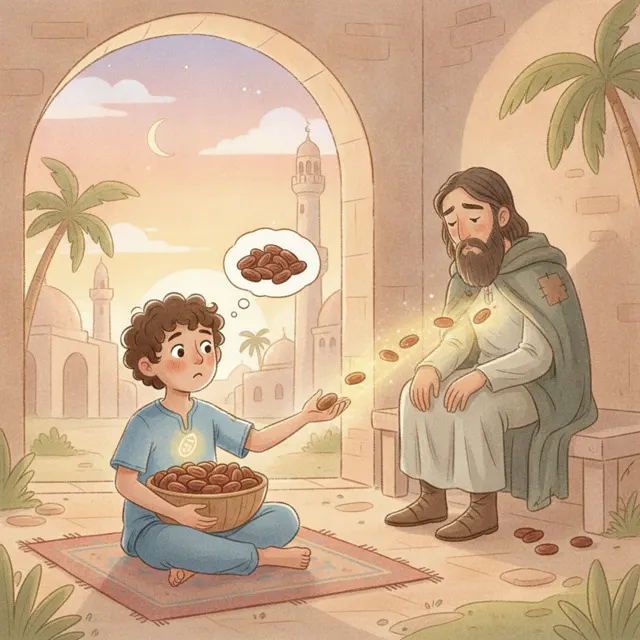
At sunset, little Yusuf is so hungry that he wants to eat his whole bowl of dates. When he sees a tired stranger sitting alone at the mosque, he offers half his share and learns that giving fills you up.

Moral: Giving to someone in need fills your heart, even when your own plate is small.

The sun was sinking, and Yusuf's tummy was rumbling. He had been fasting all day, and now, at last, it was time to break his fast. His mother set a bowl of dates on the table. They were soft and sweet, and Yusuf's hand reached for them at once. "These are mine," he whispered to himself. "I am so hungry." But before he could eat, he looked out the window. In the courtyard of the mosque, a man sat alone. His clothes were dusty, and he looked tired and far from home. He had no food in front of him. Yusuf looked at his bowl of dates. He looked at the man. Then he looked at his mother. "May I take some dates outside?" he asked. His mother smiled. "Of course. But what for?" Yusuf pointed at the man. "He looks hungry too. Maybe hungrier than me." He carried a handful of dates out to the courtyard and sat down beside the man. "Would you like to share my dates?" Yusuf asked. The man looked up, surprised. "Thank you, little one. I have not eaten all day." They broke their fast together, sharing the dates in the fading light. Yusuf ate his half slowly. Somehow, it tasted better than a whole bowl ever could. "Giving to someone who needs it," the man said, "is the best part of Ramadan." Yusuf nodded. His tummy was still not full, but his heart felt bigger than it ever had. Sharing, he learned, feeds you in a way that food alone cannot.

Helping Hands at Iftar

Ages 3-84 minkindness
Helping Hands at Iftar story for kids illustration

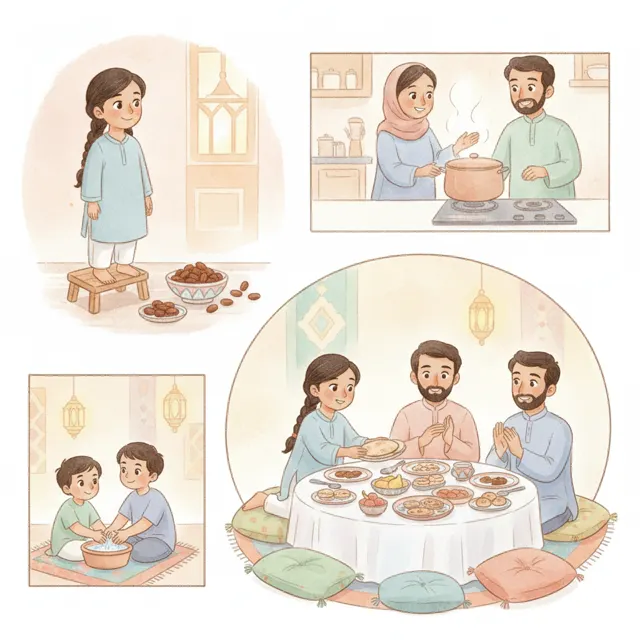
Amina wants to help prepare the iftar meal, but she is too small to carry the heavy pots. She finds her own way to help, one small task at a time, and learns that no kind act is too little to matter.

Moral: No kind act is too small to matter, and every helping hand counts.

Every evening during Ramadan, Amina's family gathered for iftar, the meal that breaks the fast. The kitchen was always busy, and Amina wanted so badly to help. "Can I carry the big pot?" she asked. "It is too heavy for you," her mother said gently. "Can I pour the soup?" "It is too hot," her father said. Amina sat down, feeling small. Everyone had a job, and she had none. She watched her older siblings set the table and carry the dishes, and she felt left out. Then she noticed something. The napkins were still in the drawer. The cups were not filled. The little ones' hands were not yet washed. Amina stood up. "I can do the small things," she said to herself. She folded the napkins and set one at every place. She filled the cups with cool water. She helped her little brother wash his hands before the meal. When the family sat down to eat, her mother looked around and smiled. "Who set these napkins so neatly?" she asked. "And filled all the cups?" "I did," Amina said, beaming. "You helped in the most important way," her mother said. "Every small task made our iftar better." Amina's father nodded. "A big pot of soup is nice, but a kind, helpful heart is the best thing you can bring to the table." Amina sat tall and proud. She had not carried the heavy pots, but she had helped with her own two hands, and that, she learned, was enough.

The Coat for the Boy Who Had Little

Ages 3-85 mingenerosity
The Coat for the Boy Who Had Little story for kids illustration

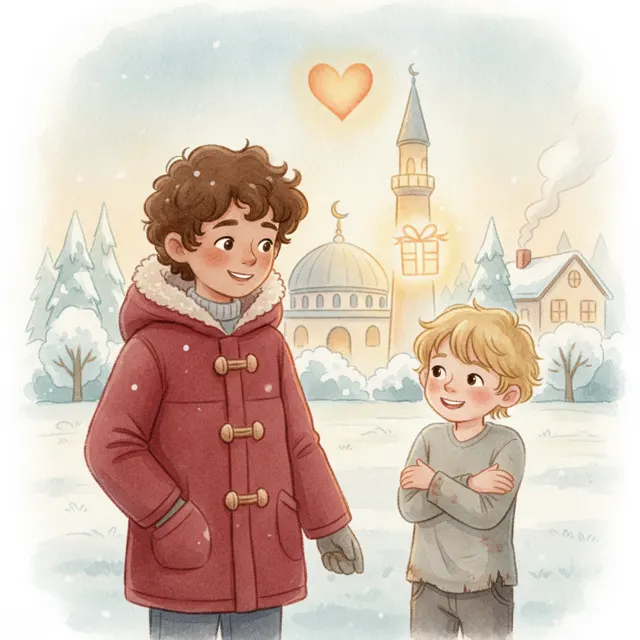
Omar has a warm coat he loves, but he notices a boy at school who shivers without one. During Ramadan, he learns that giving away what you love can warm someone else more than it ever warmed you.

Moral: Giving away what you love can warm someone else, and it warms you too.

Omar had a coat that he loved. It was blue and warm, with a soft hood, and it had been his favorite for two winters. He wore it every cold day. One morning at school, Omar noticed a boy in his class named Bilal. Bilal had no coat. He walked to school with his shoulders hunched, and when the wind blew, he shivered. "Does not Bilal have a coat?" Omar asked his mother. "His family does not have much," his mother said quietly. "That is why Ramadan asks us to give." Omar thought about that all day. During Ramadan, his family gave food and money to people in need. But Omar had never given away something of his own that he truly loved. That evening, Omar looked at his blue coat hanging by the door. He still fit it, but it was getting a little tight in the arms. He imagined Bilal walking home in the cold wind. "Mother," Omar said, "can I give my blue coat to Bilal?" His mother's eyes grew soft. "That is a very generous thing, Omar. But are you sure? It is your favorite." "I am sure," Omar said. "He needs it more than I do." The next day, Omar gave the coat to Bilal. Bilal's face lit up, and he hugged the coat tight. "Thank you, Omar," he said. "Now I will be warm all winter." Omar walked home in his other jacket, and even though it was cold, he felt warm all over. Giving away his favorite coat, he learned, had warmed him more than the coat ever had.

The Empty Tummy and the Full Heart

Ages 3-84 minempathy
The Empty Tummy and the Full Heart story for kids illustration

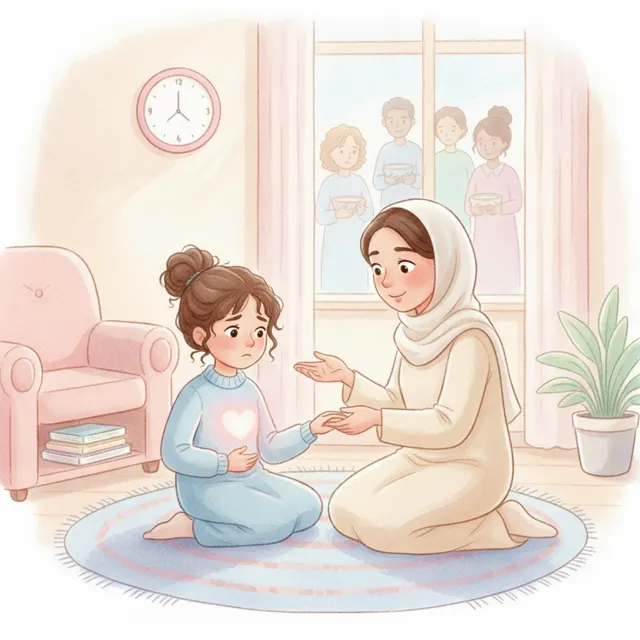
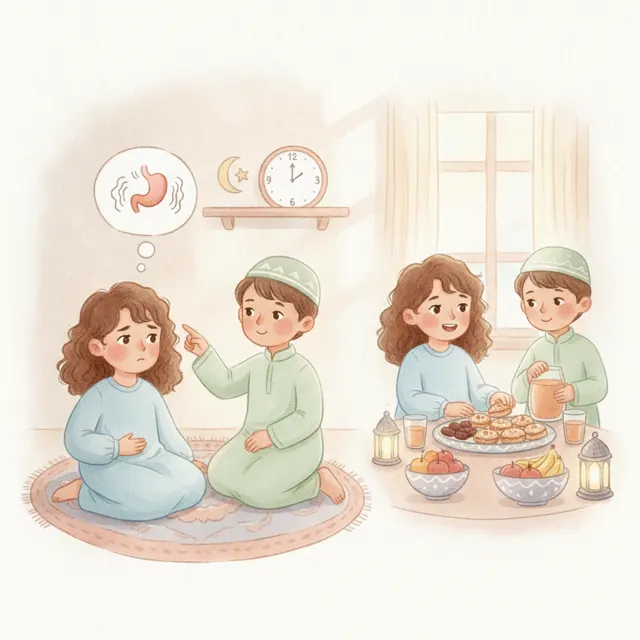
On her first day of fasting, little Hana feels hungry by noon and wants to give up. Her mother gently helps her understand what it feels like to go without, and Hana's heart opens to people who are hungry every day.

Moral: Understanding how others feel is what makes a heart grow kind.

It was Hana's first time fasting for Ramadan. By noon, her tummy was growling so loudly that she was sure the whole house could hear it. "I am so hungry," Hana said. "Can I eat just a little?" Her mother smiled and sat beside her. "I know it is hard. But feeling this hunger is part of the lesson." "What lesson?" Hana asked, rubbing her tummy. "Think about people who are hungry every single day," her mother said. "Not just for a few hours, but all the time. When we fast, we feel a little bit of what they feel." Hana was quiet for a moment. She had never thought about it that way. "Does someone out there feel this hungry right now?" Hana asked. "Yes," her mother said softly. "And that is why we share our food and our money during Ramadan. So that fewer people have to go to bed hungry." Hana looked at her empty plate and thought hard. Her hunger suddenly did not feel so unfair. It felt like a way to understand other people. That evening, when it was time to break the fast, Hana did not rush to eat first. She helped her mother pack a basket of food for the family down the street. "This is for them," Hana said. "Because now I know how it feels." Her mother hugged her. "You have learned the most important lesson of all, Hana. A heart that understands others is a full heart." Hana smiled. Her tummy was still empty, but her heart felt fuller than it ever had before.

The Night the Moon Was Found

Ages 3-84 mincrescent moon
The Night the Moon Was Found story for kids illustration

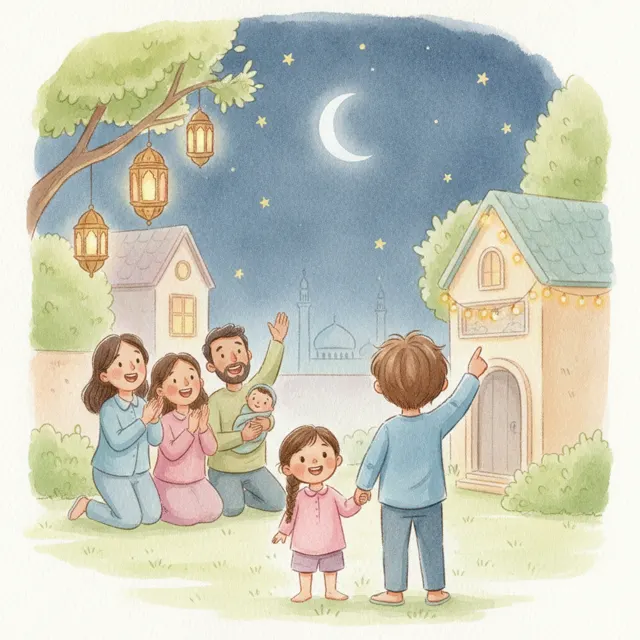
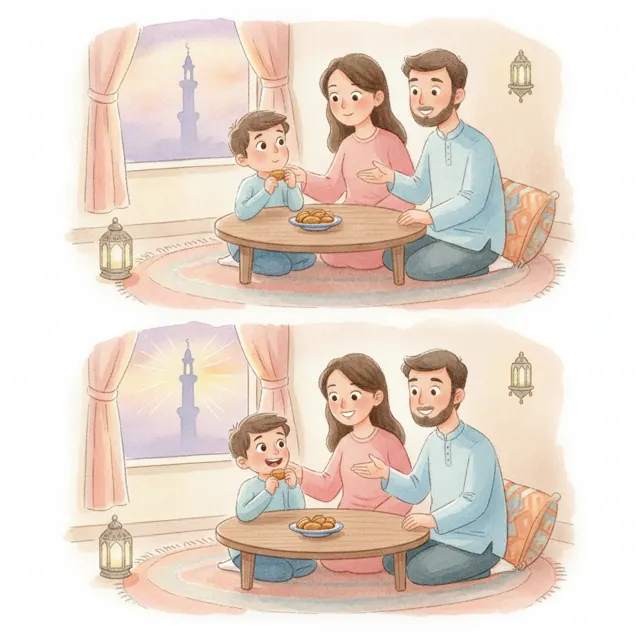
Ramadan starts when the new moon appears. Sami and his sister Noor stand in the yard and search the dark sky. When they spot the thin silver curve, the family cheers. Ramadan has begun, and a month of fasting, praying, and sharing lies ahead.

Moral: Small moments of faith, like spotting the new moon, can fill a whole family with joy.

Sami pressed his nose to the cold window. "Is it dark enough yet?" he asked. "Not yet," said Mama. "We must wait a little more." Tonight the family looked for the new moon. A new moon means Ramadan has come. His sister Noor held his hand. "The new moon is very thin at first," she said. "It looks like a tiny smile in the sky." Papa put on his coat. "Come outside," he said. "The sky is clear tonight." The family stood in the yard. The stars blinked above them. Everyone looked up at the deep blue sky. "I see it!" Sami shouted. He pointed to a thin white curve. "You found it!" said Mama. She clapped her hands with joy. "Yes, that is the new moon," said Papa. "Ramadan begins tomorrow." Sami jumped up and down. Noor hugged Mama tight. "Tomorrow we will fast," said Papa. "We will eat before the sun comes up. That early meal is called suhoor." "And we will eat again when the sun goes down," said Noor. "That meal is called iftar." "I want to help make the food," said Sami. Mama smiled. "You can help me set the table and fill the cups with water." The family looked at the moon a little longer. It was small but very bright. "Thank you for the moon," Noor whispered. They walked back inside, warm and happy. A whole month of fasting, praying, and sharing was about to begin. "Good night, little moon," said Sami. "See you tomorrow." The next morning, before the sun came up, the whole family woke for suhoor. They ate together in the quiet dark. Ramadan had begun.

Lina's First Fast

Ages 3-84 minfasting
Lina's First Fast story for kids illustration

Lina wants to fast like her big brother Yusuf. Her tummy rumbles by noon, and she learns a half fast is okay. She tries her best, helps at iftar, and feels proud. Trying a little at a time matters.

Moral: You can learn about fasting a little at a time, and every try counts.

Lina watched her big brother Yusuf drink his water before sunrise. "I want to fast too," she said. "You are still small," said Mama. "But you can try a half fast. You can eat at noon." "No!" said Lina. "I can fast the whole day. I am strong." Mama smiled. "Let us see how you feel." The sun came up. Lina played with her blocks. She drew a picture of the moon. The morning was easy. By noon, her tummy rumbled. "I am a little hungry," she said in a small voice. "You may eat now," said Papa. "A half fast is a good fast for a small child." Lina thought for a moment. "Okay. I will eat a little." She ate a soft piece of bread and some dates. She drank a cup of milk. "I did a half fast," she told Yusuf. "Is that good?" "It is very good," said Yusuf. "You tried. Next year you can try a little more." At sunset, the family sat for iftar. Lina helped pass the dates around. She filled the water glasses too. "You fasted bravely today," said Mama. "A small fast with a big heart is a wonderful thing." Lina felt proud. She was not as strong as her big brother yet. But she had tried. And that mattered a lot. "One day I will fast the whole day," she said. "One day you will," said Papa. "And we will all be proud of you." Lina smiled. She bit into a sweet date and felt warm inside.

The Little Lantern's Light

Ages 3-84 minsharing
The Little Lantern's Light story for kids illustration

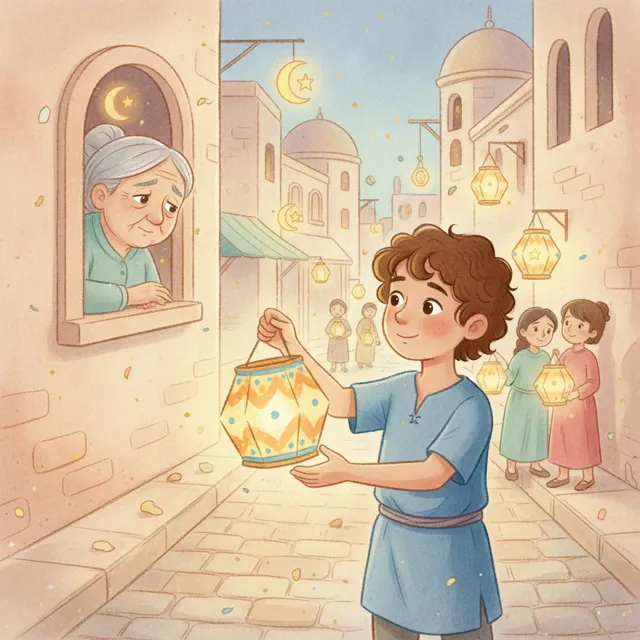
Omar makes a crooked paper lantern for Ramadan. He learns lanterns are for sharing, not winning. He gives his lantern to a lonely neighbor, and the whole street fills with small warm lights.

Moral: A small light shared with others can make a whole street feel warm.

Omar sat at the table with paper and glue. He wanted to make a lantern. In many places, children make bright lanterns called fanoos during Ramadan. "I will make the best lantern on our street," Omar said. His sister Aya laughed. "Lanterns are not for winning. They are for sharing light." Omar worked all afternoon. He cut the paper. He folded the edges. He glued the sides. His lantern looked a little crooked. "It is not straight," Omar said with a frown. "It does not need to be straight," said Aya. "It needs to glow." Omar put a small light inside. The lantern glowed with soft, warm light. It looked beautiful. That evening, the family walked outside. Many neighbors held lanterns too. The whole street filled with little lights. An old neighbor, Mr. Hadi, sat alone on his step. He had no lantern. "Can he have mine?" Omar asked Mama. "If you like," said Mama. "It would be a kind gift." Omar walked over. "This is for you," he said. Mr. Hadi smiled wide. "Thank you. Now I can share the light too." Omar felt proud. His crooked lantern was now the best light on the street. "See?" said Aya. "Lanterns are for sharing." Omar nodded. He watched the street glow with many small, happy lights. Mr. Hadi held the lantern up. Its warm light fell on his smiling face. Omar sat down on the step next to him. They watched the street together. "You made my night bright," said Mr. Hadi. Omar's cheeks grew warm. "I am glad," he said.

Suhoor with Grandpa

Ages 3-84 minfamily
Suhoor with Grandpa story for kids illustration

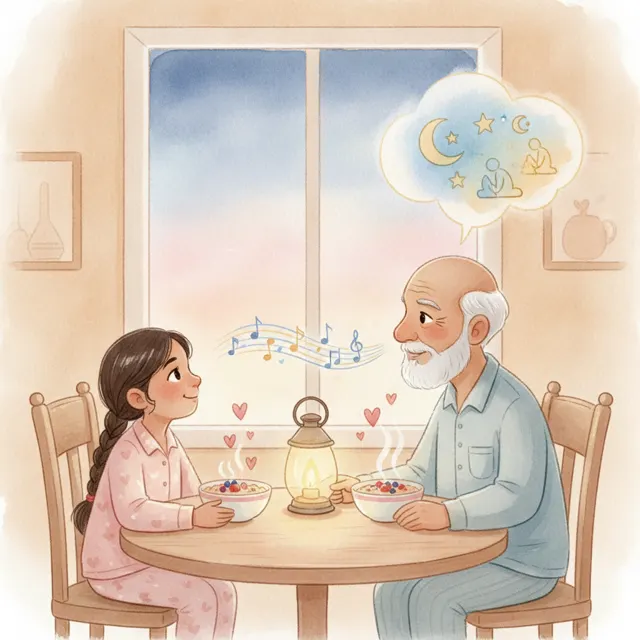
Maya wakes before sunrise to eat suhoor with Grandpa. They share warm oats and a soft song. Grandpa explains why people fast. Maya learns the early meal is a time for love and thanks.

Moral: Waking early for the people you love makes a meal taste even better.

Maya woke before the sun. The house was dark and quiet. A soft light came from the kitchen. Grandpa was there, making tea. "Good morning, little one," he said. "It is suhoor time." Maya rubbed her eyes. "Why do we eat so early?" "We eat before the sun so we can fast all day," said Grandpa. "The early meal gives us strength." Maya sat on a tall chair. Grandpa gave her a bowl of warm oats and a cup of milk. They ate together in the quiet. Outside, the sky was still dark blue. "When I was small, my mother woke me for suhoor," said Grandpa. "She would hum a soft song." "Will you hum it for me?" asked Maya. Grandpa hummed a soft, slow tune. Maya smiled. The kitchen felt warm and safe. "Why do we fast, Grandpa?" she asked. "To feel close to God," he said. "And to remember people who have little food. It teaches us to be grateful." Maya thought about that. "I am grateful for you," she said. Grandpa laughed softly. "And I am grateful for you, Maya." Soon the sky turned pink at the edge. The sun was coming. "Time to stop eating," said Grandpa. "The fast begins." They put away the bowls. Maya hugged her grandpa. "I like suhoor with you," she said. "So do I," said Grandpa. "Now let us greet the new day." Maya felt warm inside, even though the morning was cool. The day had begun with love. Grandpa ruffled her hair. "You are my best suhoor helper," he said. Maya beamed with pride. She helped put the cups in the sink.

The Rice That Fed the Street

Ages 3-84 mincharity
The Rice That Fed the Street story for kids illustration

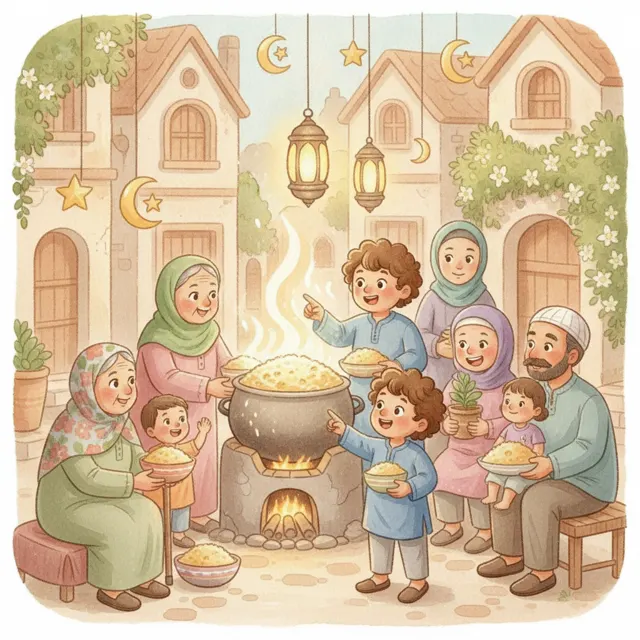
On a Friday in Ramadan, Adam's family cooks a huge pot of rice for iftar. Neighbors who are old, new, or alone all come to share it. Adam sees that sharing food fills many hearts.

Moral: Sharing what you have, even a simple meal, can fill many hearts.

On the last Friday of Ramadan, Mama filled a very big pot with rice. "This is a lot of rice," said Adam. "It is for sharing," said Mama. "Many neighbors will break their fast with us tonight." Adam stirred the pot with a long spoon. The rice smelled warm and good. "Can I help?" asked his little sister Hana. "You can wash the dates," said Mama. Hana washed the sweet dates and put them in a bowl. Soon the whole kitchen was busy. Papa cut vegetables. Adam carried plates to the table. At sunset, the call to prayer rang out. It was time for iftar. Neighbors came to the door. Old Mrs. Amina came with a cane. The Khan family came with three children. Mr. Yusuf, who lived alone, came too. "Welcome, welcome," said Papa. "Come and eat." Everyone sat at one long table. They passed the rice, the dates, and the soup. "This is the best rice I have ever had," said Mr. Yusuf. "It tastes even better because we eat it together," said Mrs. Amina. Adam smiled. The pot of rice had fed many people. No one went home hungry. "When can we do this again?" asked Hana. "Next Friday," said Mama. "And every Friday until the month ends." Adam looked around the full, happy table. Sharing food, he thought, was the best part of Ramadan. After the meal, the neighbors stayed a while. The children played together on the rug. The grown-ups drank tea and talked. The big pot was empty, but the room was full of warm voices. "Come back next Friday," Adam said. "We will make more rice."

A Basket of Dates for Layla

Ages 3-84 minkindness
A Basket of Dates for Layla story for kids illustration

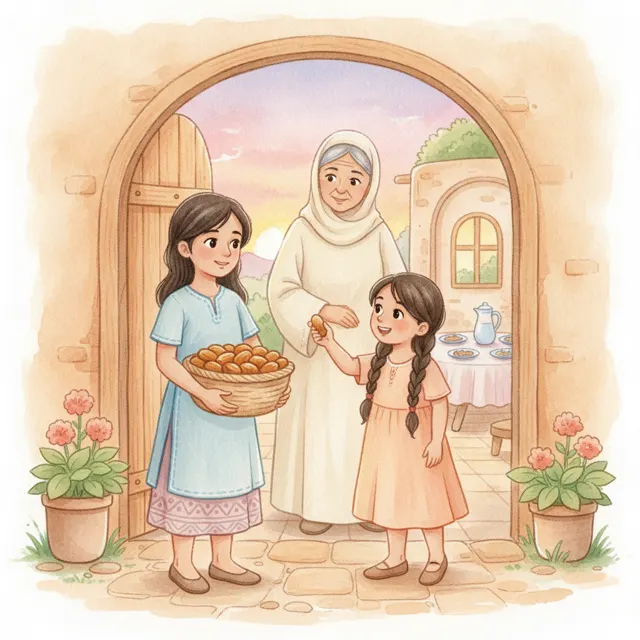
A new family moves next door to Layla. She fills a basket with sweet dates and brings it to them for iftar. The small gift turns the two girls into fast friends.

Moral: A kind gift, even a small one, can make someone feel at home.

A new family moved in next door. Layla watched them from her window. They had a little girl about her age. "That family is new," said Layla. "They might not have any dates for iftar." Dates are a special food in Ramadan. Many people break their fast with a date first. Layla picked a small basket. She filled it with soft, sweet dates from the kitchen. "Can I bring these next door?" she asked Mama. "What a kind idea," said Mama. "Go on." Layla walked to the neighbor's door. She knocked softly. A woman opened the door. "Hello," she said with a smile. "Hi," said Layla. "I am Layla. I brought dates for your iftar. Welcome to our street." The woman's eyes grew soft. "That is so kind. Come meet my daughter, Nura." Nura came to the door. She smiled at Layla. "Thank you for the dates," said Nura. "We love dates." "Me too," said Layla. That evening, the two families ate iftar together in the yard. Layla and Nura sat side by side and shared the basket of dates. "You are my first friend here," said Nura. "And you are mine," said Layla. They each ate a sweet date and laughed. A small basket of dates had made two new friends. The next evening, Nura came to Layla's door with a bowl of her family's soup. "For your iftar," she said. "You shared your dates. Now we share our soup." Layla's face lit up. "Thank you!" The two girls ate soup and dates together. One kind gift had grown into a warm friendship.

Hassan Waits for the Call

Ages 3-84 minpatience
Hassan Waits for the Call story for kids illustration

Hassan sits at the iftar table and waits for the call to prayer. Waiting is hard, but his family teaches him patience. When the call comes, the first date tastes sweeter than ever.

Moral: Waiting a little longer often makes the reward feel sweeter.

Hassan sat at the iftar table. The food was ready. The soup steamed. The bread smelled warm. "Can we eat now?" he asked. "Not yet," said Papa. "We wait for the call to prayer. It tells us the sun has set." Hassan looked at the clock. The hands moved so slowly. "My tummy is growling," he said. "Mine too," said his sister Lina. "But we wait together." Hassan sighed. He watched the juice glasses. He counted the dates on the plate. "Waiting is hard," he said. "Waiting makes us patient," said Mama. "And patience is a gift we practice in Ramadan." Hassan closed his eyes. He took a slow breath. Then another. "Look at the sky," said Papa. "The sun is going down." Hassan looked out the window. The sky turned pink and gold. Then, from the mosque down the street, came the sound. The call to prayer rang out over the roofs. "Now?" asked Hassan, his eyes wide. "Now," said Papa with a smile. Hassan reached for a date first, just like they always did. He bit into it. It was sweet and soft. "This is the best date ever," he said. The family ate together. The soup was warm. The bread was soft. "Waiting was hard," said Hassan. "But it made the food taste better." Mama smiled. "That is what patience does, Hassan." The next evening, Hassan sat at the table again. He did not ask to eat. He waited quietly and watched the sky. "You are patient tonight," said Papa. "I am practicing," said Hassan. "It gets a little easier." The call came, and the family ate together once more.

The Water Boy of Iftar

Ages 3-84 mingiving
The Water Boy of Iftar story for kids illustration

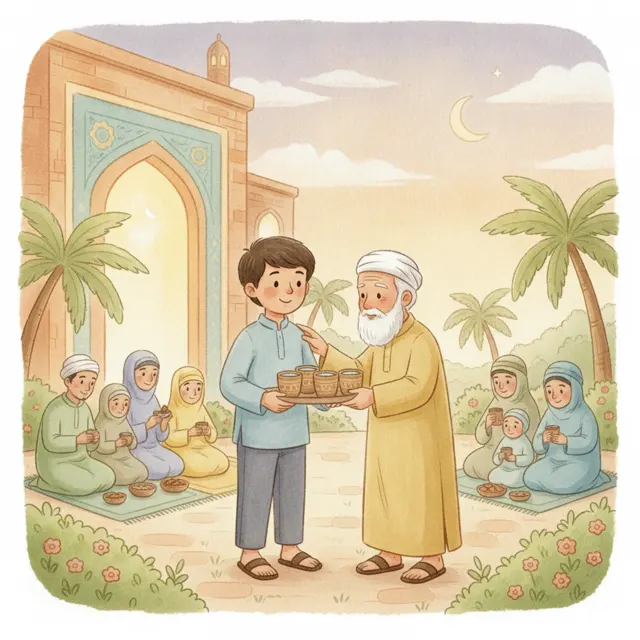
Every evening, Omar hands out cool water to people who come to break their fast at the mosque. He helps an old man and learns why giving water is one of the kindest things you can do.

Moral: Giving water to others is a simple act that shows great care.

Every evening during Ramadan, Omar went to the mosque. He had an important job. "I hand out water," he told his friend. "Everyone is thirsty after fasting." Omar stood by the long tables. He filled paper cups with cool water. He handed them to the people who came to break their fast. "Thank you, Omar," said the men and women. "You are welcome," Omar said each time. One evening, a very old man came in. He walked slowly with a cane. He looked tired. "Please sit here," said Omar. He brought the man a cup of water and a date. The old man smiled. "You are a good boy," he said. "Water is a great gift when you are thirsty." Omar watched the man drink. The man's face grew calm and happy. "Why is water so special?" Omar asked his father later. "Water gives life," said Papa. "Giving water to a thirsty person is one of the kindest things you can do." Omar thought about that. The next evening, he filled even more cups. He gave them out with a big smile. "This is my favorite part of Ramadan," Omar told his father. "Giving water?" asked Papa. "Yes," said Omar. "It is a small thing, but it helps so many people." Papa hugged him. "Small things done with love are the biggest things of all." The next evening, Omar filled the cups extra full. He smiled at every person. "Water for you," he said again and again. A little girl came with her mother. "Thank you," she said in a small voice. Omar felt proud to help. His small cups of water were making a big difference.

Zayd's Empty Pocket

Ages 3-84 mincharity
Zayd's Empty Pocket story for kids illustration

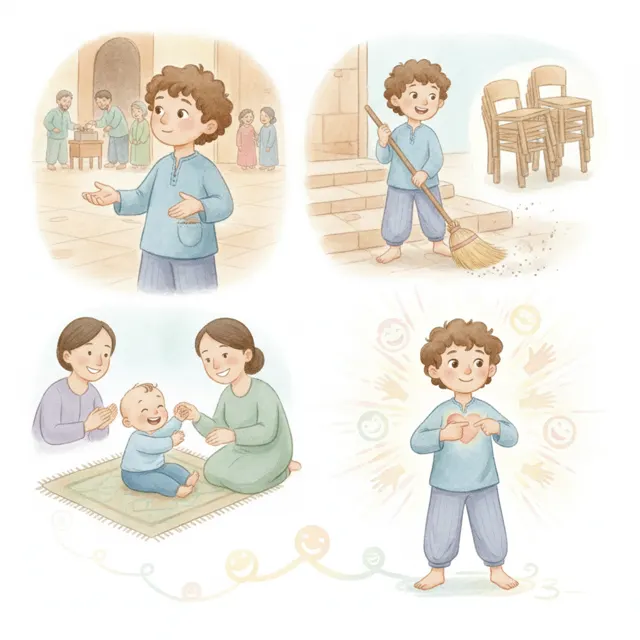
Zayd has no coins to give for zakat, so he gives his time and help instead. He sweeps a step, stacks chairs, and plays with a baby. He learns there is always something to give.

Moral: You can give even when your pockets are empty, by giving your time and your help.

Zayd wanted to give money for zakat. Zakat is a gift Muslims give to help people in need. But Zayd's pocket was empty. He had no coins. "I have nothing to give," he said sadly. "You have hands," said Mama. "And you have time. Those are gifts too." Zayd thought about that. He went to old Mrs. Rania's house. He swept her front step for her. He went to the mosque. He helped stack the chairs after prayers. He went to the neighbor with a new baby. He played with the baby so the mother could rest. At the end of the day, Zayd was tired but happy. "Did you give anything?" asked Mama. "I gave my time and my help," said Zayd. "But is that real giving?" Mama smiled. "It is very real. Zakat can be money. But kindness can be many things. You gave what you had." The next day, Mrs. Rania came by. "Zayd, thank you for sweeping my step. My knees hurt, and you helped me so much." Zayd felt his heart grow warm. His pocket was still empty. But his heart was full. "I will give my time every day," Zayd said. "There is always something to give." The next morning, Zayd made a list of kind things to do. He would water a plant. He would hold a door open. He would smile at people who looked sad. "My pocket is still empty," he said. "But my hands are never empty of help." Mama nodded. "A heart that gives is never empty, Zayd."

The Cousins' Quiet Table

Ages 3-84 minfamily
The Cousins' Quiet Table story for kids illustration

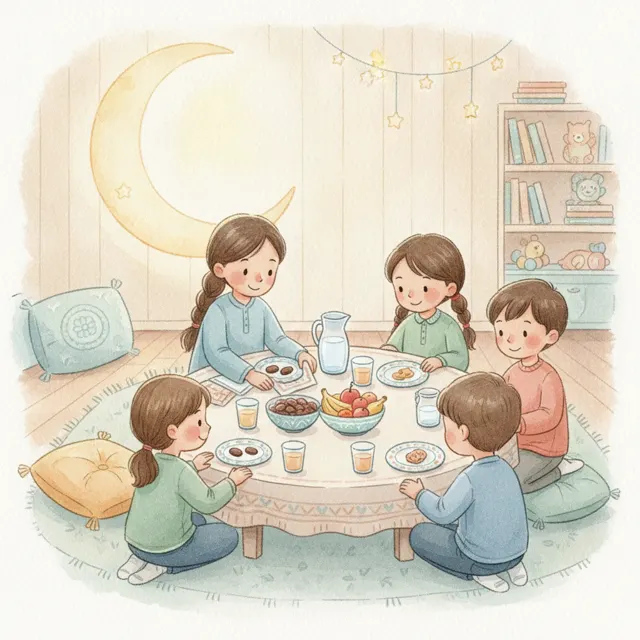
Six cousins gather for iftar. They set the table together, then share a calm, happy meal. Fatima sees that a quiet table full of family is the happiest kind of table.

Moral: Coming together to share a meal turns an ordinary evening into something special.

Tonight, all the cousins came for iftar. There were six of them. The house was loud with laughter. "Let us help set the table," said Fatima. The cousins worked together. Ali laid the plates. Hana folded the napkins. Yusuf filled the water glasses. "This table is for all of us," said Ali. "It has to be ready before the sun sets," said Fatima. They set out the dates, the soup, and the warm bread. The table looked full and nice. At sunset, the call to prayer came. Everyone grew quiet. The loud room became calm. They broke their fast together, just like always. They passed the food around. They shared the soup. "This is the best part," said Yusuf. "Everyone is here." Fatima smiled. "A quiet table with family is a happy table." They ate slowly. They told stories. The little cousins laughed. The older ones shared their food. "I wish we could do this every night," said Hana. "Me too," said Ali. "But we can do it every Ramadan." After the meal, the cousins washed the dishes together. They sang a soft song while they worked. "Even washing dishes is fun with you," said Fatima. The night ended with hugs at the door. The quiet table had brought the whole family close. Before bed, the cousins promised to set the table again next week. "We will make it even prettier," said Hana. "And we will share the soup again," said Ali. Fatima smiled as they waved goodnight. Family, she thought, is the best part of any meal.

The Moon-Spotting Picnic

Ages 3-84 minhope
The Moon-Spotting Picnic story for kids illustration

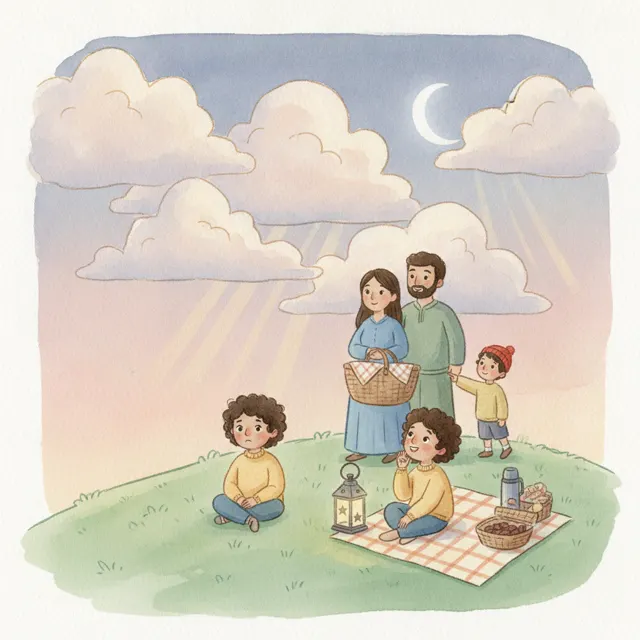
Sami's family climbs a hill for a picnic to spot the new moon. Clouds hide it at first, and Sami learns to wait. When the clouds part, the thin moon shines, and Ramadan begins.

Moral: Sometimes you must wait a little longer for the thing you hope to see.

Tonight, Sami's family went to the hill for a picnic. They wanted to see the new moon that starts Ramadan. "Will the moon come out?" asked Sami. "I hope so," said Papa. "But clouds may hide it." They spread a blanket on the grass. Mama brought a basket of snacks. "We can wait here and watch the sky," she said. The sun went down. The sky turned dark. But big, soft clouds rolled in. "I cannot see the moon," said Sami. His voice was sad. "We must wait a little longer," said Papa. "Sometimes the moon needs time." They sat on the blanket. They watched the clouds move slowly. Sami ate a snack and looked up. "Look!" shouted his sister Noor. "The clouds are opening." A small gap appeared in the clouds. Through it, a thin silver moon shone. "There it is!" said Sami. "The new moon!" The family cheered. They clapped and hugged. The thin moon smiled down at them. "Ramadan has begun," said Papa. "It was worth the wait," said Sami. "Good things often are," said Mama. They packed up the picnic. Sami looked at the moon one last time. "Good night, moon," he whispered. "See you all month long." The family walked home under the thin, bright moon, full of hope for the month ahead. On the way home, Sami held Noor's hand. "I almost gave up," he said. "But you waited," said Noor. "And the moon came." "Next year, I will wait even longer if I have to," said Sami. Mama smiled. "Patience is a gift, Sami. And tonight, it brought us the moon."

A Prayer for the Hungry

Ages 3-84 minempathy
A Prayer for the Hungry story for kids illustration

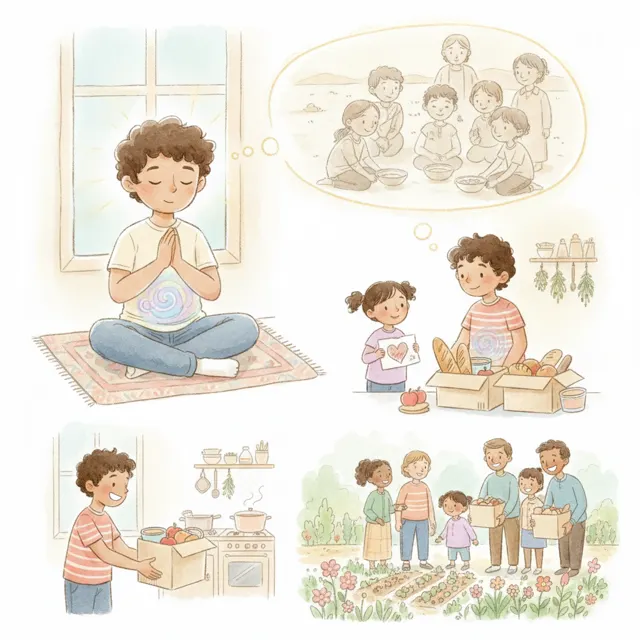
While fasting, Yusuf feels hungry and thinks of people who have no food at all. He prays for them and packs food boxes to share. He learns fasting teaches us to care for others.

Moral: Feeling hungry can teach you to care for people who are hungry every day.

It was the middle of the day. Yusuf was fasting. His tummy rumbled. "I am so hungry," he thought. Then he stopped. He thought of people who feel hungry every day. They do not have food at sunset. They do not have a warm iftar to wait for. Yusuf felt sad for them. He sat on his bed and made a quiet prayer. "Please help everyone who is hungry," he whispered. "Help them find food and warmth." At iftar that evening, Yusuf looked at the full table. There was soup, bread, rice, and dates. "We have so much," he said to Mama. "We do," she said. "And we must share it." The next day, Yusuf and Mama packed boxes of food. They filled each box with rice, dates, and bread. They gave the boxes to a center that feeds people who need food. "Someone will have a better iftar because of you," said Mama. Yusuf smiled. His tummy still rumbled a little while he fasted. But now he understood. "Fasting taught me something," he said. "When I am hungry, I remember others who are hungry too. And I can help them." "That is one of the deepest lessons of Ramadan," said Mama. Yusuf nodded. His heart grew full, even as his tummy stayed empty until sunset. That night, Yusuf wrote a small note and put it by his bed. It said, "Remember the hungry." Every day for the rest of Ramadan, he looked at the note. It helped him remember to be thankful and to share. "I cannot feed the whole world," Yusuf said. "But I can help one person at a time."

The Little Cook's First Iftar

Ages 3-84 minhelping
The Little Cook's First Iftar story for kids illustration

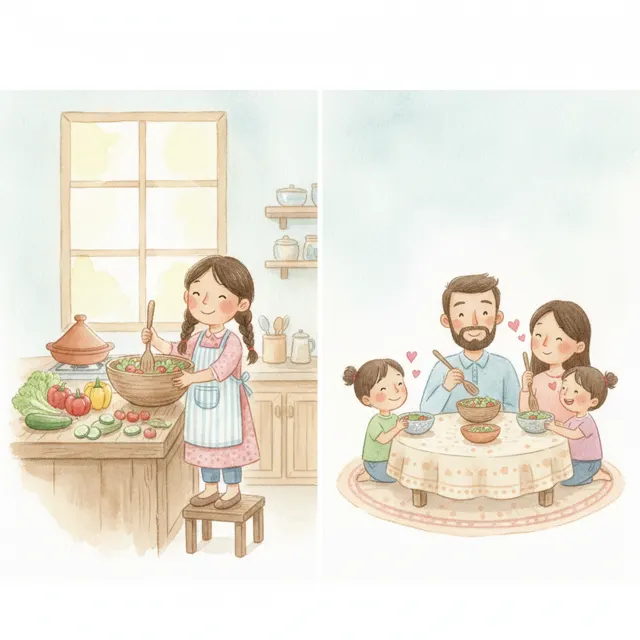
Amira is finally old enough to help cook iftar. She makes the salad all by herself. When the family eats it and smiles, she learns food made with love tastes best.

Moral: Helping in small ways makes the family meal feel like your own.

This Ramadan, Amira was finally old enough to help cook iftar. "What can I make?" she asked Mama. "You can make the salad all by yourself," said Mama. "Wash the tomatoes and cucumbers. Tear the lettuce. I will watch." Amira washed her hands. She washed the tomatoes until they shone. She tore the lettuce into small, soft pieces. "Good," said Mama. "Now mix it gently." Amira mixed the salad in a big bowl. She added a little lemon and salt. "It looks beautiful," she said. "It looks like your own special dish," said Mama. At sunset, the family sat for iftar. The table was full of food. In the middle sat Amira's salad. "Who made this salad?" asked Papa. "I did!" said Amira, beaming. Everyone took some. They ate it with the warm bread. "This is the best salad," said her brother. Amira felt proud. She had made something for her family with her own hands. "Next year I will make two dishes," she said. "Maybe a soup too," said Mama, laughing. After the meal, Amira helped wash the dishes. She felt tired but very happy. "Helping is hard work," she said. "But it is my favorite part of Ramadan." "Because you share it with us?" asked Mama. "Yes," said Amira. "Food made with love tastes best." The next day, Amira practiced making the salad again. She cut the cucumbers into little moons. She added a pinch of salt and a squeeze of lemon. "You are becoming a real cook," said Mama. Amira smiled. "Next year, I will cook a whole iftar by myself." "And I will help you," said Mama, hugging her.

Grandma's Suhoor Surprise

Ages 3-84 minfamily
Grandma's Suhoor Surprise story for kids illustration

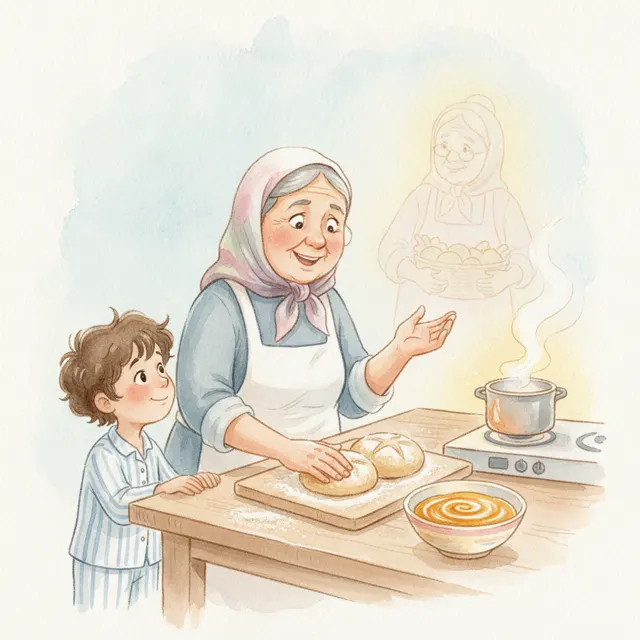
Before sunrise, Rayan finds Grandma in the kitchen making soft bread and warm honey. She tells him about her own grandma. Rayan learns that food made with love gives you strength.

Moral: A meal made with love, even before the sun, starts the day with joy.

Before the sun came up, the house smelled sweet. Grandma was in the kitchen. "What are you making?" asked little Rayan, rubbing his eyes. "A suhoor surprise," said Grandma. "Soft bread and warm honey." Rayan climbed onto his chair. Grandma gave him a warm piece of bread. She drizzled honey on top. "This is the best suhoor ever," said Rayan. "It is a family recipe," said Grandma. "My own grandma made it for me." Rayan ate slowly. The honey was golden and sweet. "Tell me about your grandma," he said. "She woke before the sun, just like us," said Grandma. "She made this bread with love. She said food made with love gives you strength." Rayan looked at his bread. "Is that why it is so good?" Grandma laughed. "Maybe. Love is the secret thing." They ate together in the quiet dark. Outside, the first birds began to sing. "The sun is coming," said Grandma. "Time to finish." Rayan ate his last bite. He hugged Grandma tight. "Thank you for the surprise," he said. "Thank you for waking up with me," said Grandma. Rayan went back to bed with a full, warm tummy. He dreamed of golden honey and soft bread. And he dreamed of his grandma's smile. The next morning, he woke first. "Grandma," he said. "Can we make suhoor together tomorrow?" Grandma smiled. "Of course we can, my little cook." The next morning, Rayan woke before Grandma. He laid out the bread and the honey jar. When Grandma came to the kitchen, she clapped her hands. "Look at you!" she said. "You made suhoor ready for me." Rayan beamed. "Food made with love, Grandma. Just like you said."

The Thank-You Table

Ages 3-84 mingratitude
The Thank-You Table story for kids illustration

Tariq writes thank-you notes for everyone who helps make iftar. He puts one note at each place on the table. The meal tastes sweeter, and Tariq learns saying thanks makes people feel big.

Moral: Saying thank you to the people who help makes a shared meal even warmer.

Every night during Ramadan, Mama cooked a big iftar. She worked very hard. "Thank you, Mama," said Tariq. "You are welcome, my dear," said Mama. But Tariq wanted to do more. "I will make a thank-you table," he said. He took paper and crayons. He wrote little notes. Each note said thank you to someone. He made a note for Mama, who cooked. A note for Papa, who set the table. A note for his sister, who filled the water cups. He even made a note for the neighbor who shared dates with them. At iftar, Tariq put the notes on the table, one at each place. "What is this?" asked Papa. "It is a thank-you table," said Tariq. "I wanted to thank everyone who helps." Papa read his note and smiled. "Thank you, Tariq." Mama read hers. Her eyes grew soft. "This is the kindest thing," she said. His sister read hers and gave Tariq a hug. "You help too," she said. "You make our table happy." Tariq smiled. The meal tasted sweeter that night. "Saying thank you is a small thing," he said. "But it makes people feel big." "That is true," said Mama. "And Ramadan is a good time to remember it." From then on, Tariq made a thank-you note every night. The table stayed full of kind words and warm food. One night, Tariq found a note at his own place. It said, "Thank you, Tariq, for making us feel loved." He read it twice and smiled wide. "Someone thanked me!" he said. "Kind words always come back to you," said Mama.

Frequently Asked Questions

Turn Your Child Into the Hero of Their Own Story

Upload their photo and watch as AI creates a beautiful, personalized storybook with illustrations that look just like them. From $5.99/month.

✨ Make Your Child the Hero

Plans from $5.99/month