Garden Stories for Kids

Step into a sunny garden where seeds, bees, and little hands learn that good things grow when you care for them.

✨ Make Your Child the Hero

A garden is a place where small things grow into something wonderful. It teaches kids to wait, to care, and to notice the tiny changes that happen day by day. In these stories, your child meets a seed that takes its time, a bee trying his first garden, a worm discovering what he is good at, and a little girl who learns to remember her chores. Each tale is soft, warm, and just long enough for bedtime. With CreateStory.ai, you can make it personal. Upload a photo and your child becomes the hero of their own garden story.

Why is gardening so good for young children?

Digging, planting, and watering teach patience and care. A child who grows a plant learns that good things take time, and that a little care each day adds up.

Studies reviewed by KidsGardening found that garden programs helped children ages two to fifteen eat more fruits and vegetables. Hands in the dirt also build wonder about how food grows.

How do bees and bugs help a garden grow?

Bees, butterflies, and worms each have a job in a garden. Bees carry pollen from flower to flower so plants can make seeds and fruit.

The United Nations says 71 of the 100 crops that feed most of the world are pollinated by bees. A garden story makes that big fact feel small and friendly.

Sample Stories

Read these stories, then create a personalized version where your child is the hero

The Seed That Waited for the Sun
Ages 3-84 minpatience
The Seed That Waited for the Sun story for kids illustration

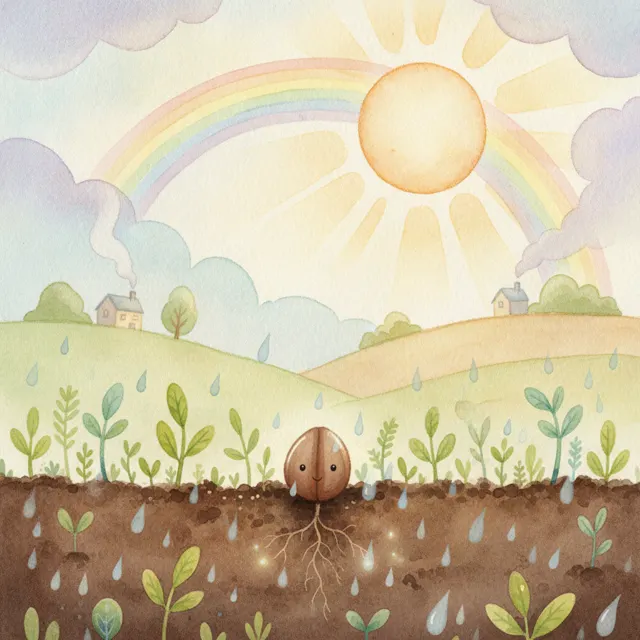
Pip is a tiny seed who refuses to rush. While every other seed sprouts, he waits in the warm soil, drinking rain slowly and growing strong deep down. When he finally pushes into the light, he learns that good things come to those who are patient.

Moral: Good things come to those who wait and keep trying a little every day.

Deep in a garden, under a blanket of soft brown soil, lay a tiny seed named Pip. Pip was small and round, and he was in no hurry at all. Every morning, the sun called down to him. "Wake up, Pip! Time to grow!" But Pip just snuggled deeper into the soil. "Not yet," he whispered. "I am not ready." The rain tapped on the ground. "Come out, Pip! The world is waiting." Pip only stretched a little. "Soon," he said. "I need more time." The other seeds around him pushed up green shoots and waved hello to the sky. A little worm wiggled by and asked, "Pip, why are you still sleeping? You will miss the whole spring." Pip thought for a moment. "I am not sleeping," he said. "I am getting ready. I want to be strong when I finally grow." So Pip waited. He drank the rain slowly. He felt the warm sun on the soil above him. He did not rush and he did not worry. Each day he grew a little stronger, deep down where nobody could see. Then one bright morning, Pip felt a tickle in his heart. "Now," he whispered. "I think it is time." He pushed and pushed until a tiny green sprout broke through the soil. The sun shone on him, and it felt just right. The rain fell, and it tasted sweet. Day by day, Pip grew taller and greener. Soon he was a fine plant with leaves that reached for the sky. A little girl named Mina watered him and smiled. "You grew up so beautifully," she said. Pip swayed in the breeze. He had waited for the right time, and now he was exactly where he belonged.
Willa's Sunflower Surprise

Ages 3-85 minkindness
Willa's Sunflower Surprise story for kids illustration

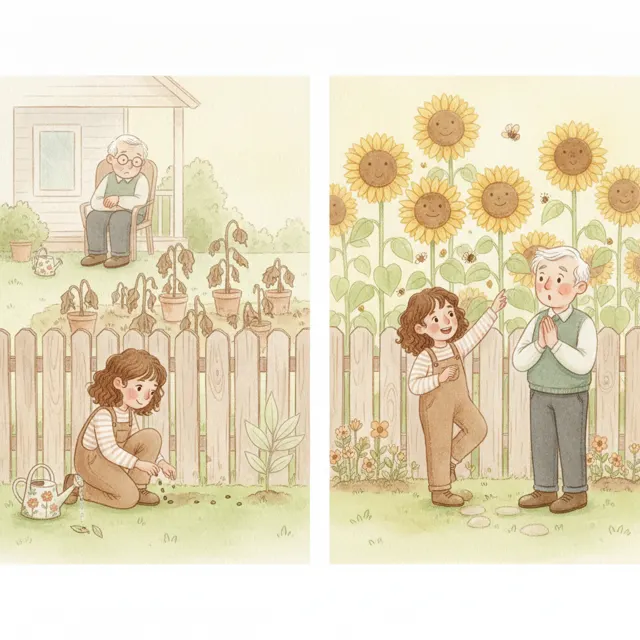
Willa notices her neighbor Mr. Frank looks sad because his garden wilted. So she quietly plants a row of sunflower seeds along his fence and waters them every morning. When golden flowers bloom, she learns that kindness can grow into something beautiful for everyone.

Moral: Being kind to someone who is sad can grow into something beautiful for everyone.

Willa lived in a little yellow house with a big, empty garden. Every day after school, she sat on the back step and looked at all the bare dirt. "This garden is so quiet," she sighed. One afternoon, she saw her neighbor Mr. Frank sitting on his porch. Mr. Frank looked sad. His own garden had wilted in the hot summer, and now he had nothing but dry, brown stems. "Hello, Mr. Frank," said Willa. "Are you okay?" "Hello, Willa," he said softly. "I am just a little tired. I miss my flowers." That evening, Willa had an idea. She took her little packet of sunflower seeds and tiptoed to the fence. She planted a whole row of them along the edge of Mr. Frank's garden, right where he could see them from his porch. Then she watered them quietly every single morning before school. Weeks passed. One day, Willa heard a knock at her door. It was Mr. Frank, and he was smiling. "Willa," he said, "do you see those sunflowers by my fence? I did not plant them, but they are the tallest, happiest flowers in the whole block." Willa grinned. "They must like you, Mr. Frank." "Well," he said, "I think someone very kind planted them for me. And now I have flowers to look at all day long." The two of them walked to the fence together. The sunflowers stood up straight and golden, turning their faces toward the sun. Mr. Frank's smile was bigger than all of them. "Thank you," he said. Willa's heart felt warm. Her own garden was still empty, but she did not mind one bit. Some gardens grow in the dirt, and some gardens grow right in a person's heart.

Benny the Bee's Very First Garden

Ages 3-84 mincourage
Benny the Bee's Very First Garden story for kids illustration

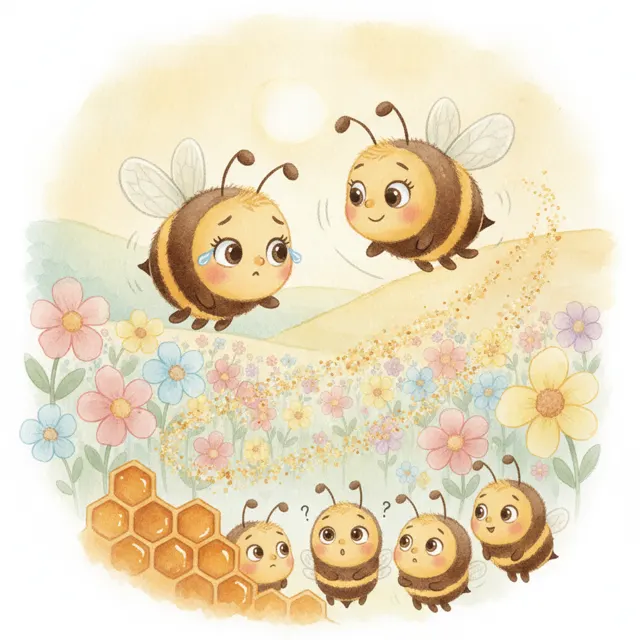
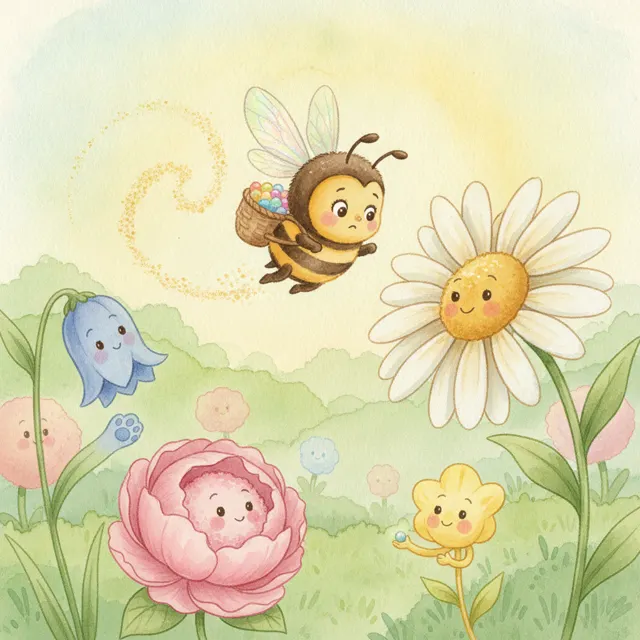
Benny is a little bee with brand new wings, and today is his first day of work. Nervous about flying wrong, he takes a deep breath and jumps anyway. With help from kind flowers, he fills his basket and finds out that trying his best is all anyone can ask.

Moral: Trying something new is scary, but doing your best is all anyone can ask.

Benny was a little bee with big, brand new wings. Today was his very first day of work, and he was nervous. "Come on, Benny!" buzzed his mother. "The flowers are waiting for you." Benny looked down at the wide, colorful garden below the hive. It was enormous. "What if I fly the wrong way?" he asked. "What if I forget which flowers to visit?" "Every bee worries on their first day," said his mother. "You just try your best. That is all anyone can ask." Benny took a deep breath. He stretched his wings, and then he jumped. For a second, he wobbled. The wind pushed him left, then right. But soon his wings found a steady rhythm, and he was flying. He landed on a red tulip. "Hello!" said the tulip. "Are you new?" "I am," said Benny, a little out of breath. "I am here to collect pollen." "Well, you came to the right place," the tulip laughed. "Take your time." Benny collected a little pollen. Then he flew to a daisy, then a marigold, then a bright blue morning glory. Each flower was kind, and each one showed him the way. By the end of the day, Benny was tired but proud. He flew home to the hive and landed with a happy buzz. "How was your first day?" asked his mother. Benny smiled. "I was scared at first," he said. "But I tried my best, and the flowers helped me. I think I am going to like being a bee." His mother hugged him with her little arms. "I knew you would." That night, Benny fell asleep with a full basket of pollen and a heart full of courage.

The Worm Who Found His Job

Ages 3-83 minhelpfulness
The Worm Who Found His Job story for kids illustration

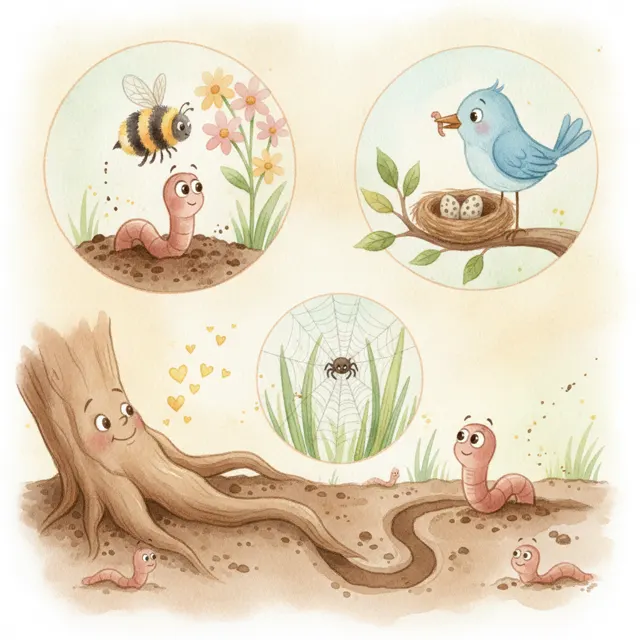
Wally the worm watches the bees, birds, and spiders do their jobs while he just wiggles in the dirt. He does not know what he is good for, until a root thanks him for making tunnels. Wally discovers that everyone has something special they can do to help.

Moral: Everyone has something special they can do to help others.

Wally was a worm who lived under the garden. Every day, he watched the other animals do their jobs. The bees made honey. The birds caught bugs. The spiders spun webs. But Wally just wiggled in the dirt, and he did not know what he was good for. "I do not have wings, so I cannot fly," Wally said. "I do not have a beak, so I cannot sing. What am I supposed to do?" He wiggled sadly through the soil. As he went, the soil loosened up behind him. He did not even notice. A root spoke up. "Thank you, Wally!" Wally stopped. "Thank me? For what?" "When you wiggle through the dirt, you make little tunnels," said the root. "Those tunnels let air and water reach us. You help us grow!" Wally looked around. Sure enough, everywhere he had wiggled, the soil was soft and crumbly. The plants above him stood up a little taller. "I had no idea," said Wally. "I was just moving around." "That is your job," said the root. "You are a soil helper. Without worms like you, this whole garden would be hard and dry." Wally felt a little spark of pride. He wiggled a little faster. He made tunnels here and tunnels there, and the garden drank up the rain like a thirsty sponge. A robin hopped by and chirped, "Great tunnels, Wally!" Wally smiled up at her. "Thank you," he said. "It turns out I am good at something after all." And from that day on, Wally wiggled with a purpose. He did not need wings or a beak. He just needed to be himself, and that was more than enough.

Lily and the Watering Can

Ages 3-85 minresponsibility
Lily and the Watering Can story for kids illustration

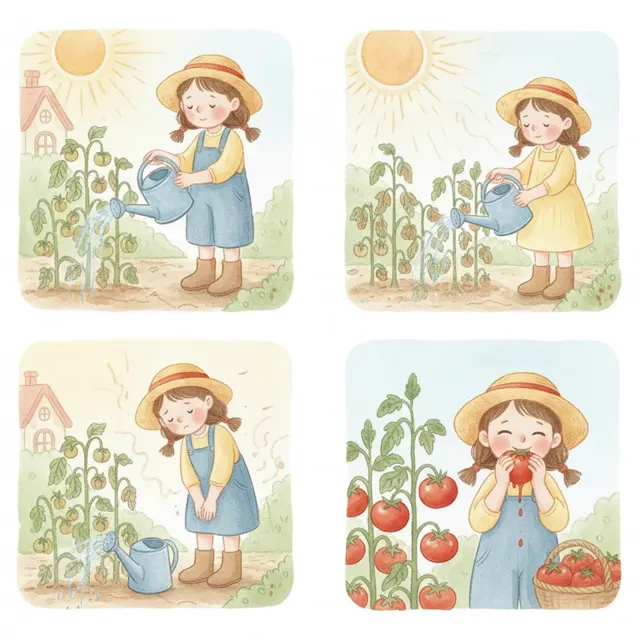
Lily has one job: water the tomato plants each morning. When she forgets for three hot days, the tomatoes droop, and she learns a hard lesson. She shows up every day after that and watches her care turn into the sweetest tomatoes she has ever tasted.

Moral: Taking care of something every day teaches you to be dependable.

Lily was seven years old, and she had one very important job. Every morning, she watered the tomato plants in her family's garden with a little green watering can. At first, she loved it. She hummed while she worked, and she made sure every plant got a good drink. But after a few weeks, she started to forget. One hot morning, Lily slept in late. She ran outside to play with her friend, and she did not water the tomatoes at all. The next day, she forgot again. By the third day, the tomato plants looked droopy. Their leaves hung low, and the soil was cracked and dry. "Lily," said her mom gently, "the tomatoes look thirsty. Did you water them this morning?" Lily looked at the ground. "I forgot," she said quietly. "I am sorry." "It is okay to forget sometimes," said her mom. "But these plants are counting on you. When you take care of something, you have to show up for it, even on the days you do not feel like it." Lily nodded. She picked up her little green watering can and filled it to the top. Then she walked slowly to the garden and gave every plant a long, cool drink. "I am sorry, tomatoes," she whispered. "I will not forget you again." And she did not. Every morning after that, rain or shine, Lily was the first one in the garden. She watered the tomatoes, pulled the little weeds, and talked to the plants while she worked. One day, she saw a tiny green tomato. Then another, and another. Soon the plants were heavy with red, ripe fruit. "Look, Mom!" Lily called. "They grew!" "They did," said her mom, smiling. "Because you took care of them. That is what happens when you are responsible." Lily smiled and took a big bite of the sweetest tomato she had ever tasted.

The Tomato That Would Not Turn Red

Ages 3-84 minutespatience
The Tomato That Would Not Turn Red story for kids illustration

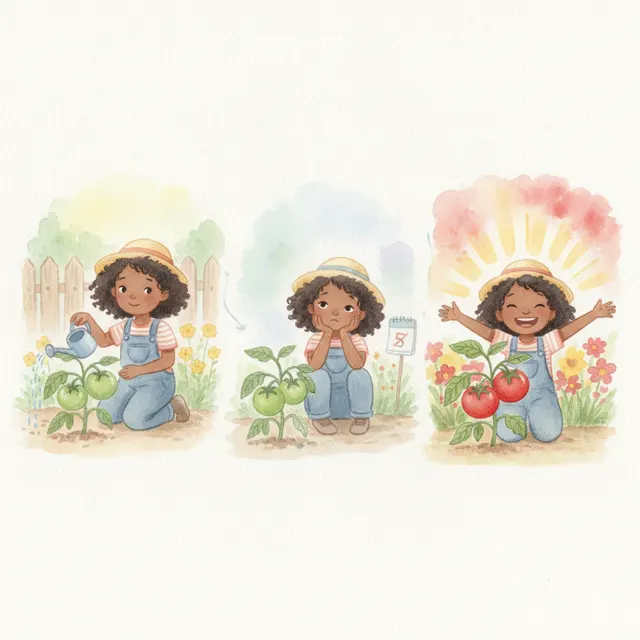
Nia plants a tomato and waits for it to turn red. The green tomato stays green for days. Nia keeps watering and waiting, and at last it turns a bright, ripe red.

Moral: Good things come to those who wait.

Nia planted a little tomato plant in the garden. It grew tall and green. Soon one small tomato hung from a stem. It was round and green. "When will you turn red?" asked Nia. The tomato did not answer. It just hung there, green as a leaf. Nia waited one day. The tomato was still green. She waited three days. Still green. She waited a whole week. The tomato was green and hard. "Why will it not turn red?" asked Nia. "I want a red tomato!" "Tomatoes take their time," said her grandma. "They turn red only when they are ready. You cannot rush them." Nia did not like waiting. She wanted to pick the tomato right now. But Grandma said no. "A green tomato is not ready to eat. Wait, and it will be sweet." So Nia waited. Every day she watered the plant. Every day she looked at the little green tomato. She talked to it too. "Turn red when you are ready," she said. "I can wait." Days went by. The tomato grew a little bigger. Then one morning, Nia saw a tiny spot of pink on its side. "Grandma! It is changing!" she called. Day by day, the pink spread. The tomato turned from green to pink, then pink to red. One morning it hung there, bright red and glowing in the sun. "It is red!" shouted Nia. "It is finally red!" Grandma smiled. "Good things come to those who wait," she said. "Now we can pick it and eat it." Nia picked the red tomato. It was warm from the sun. She bit into it, and it was the sweetest tomato she had ever tasted. It was worth every day of waiting.

The Snail Who Took His Time

Ages 3-84 minutespatience
The Snail Who Took His Time story for kids illustration

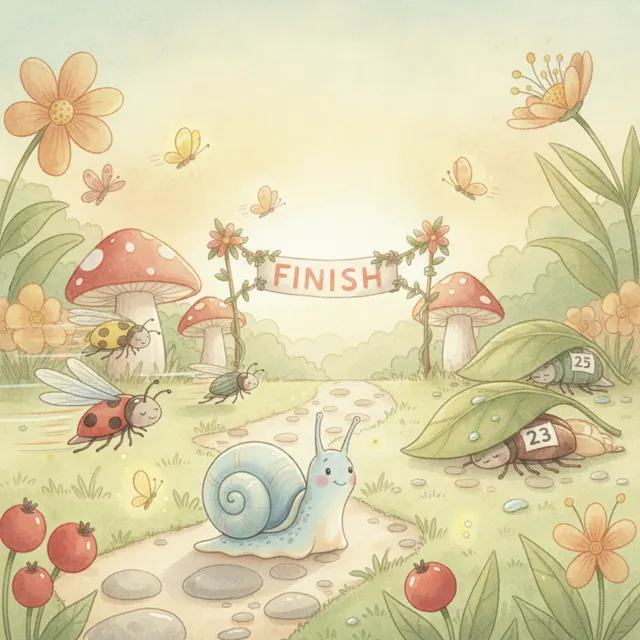
Speedy the snail is slow, and the other bugs race past him. One day a race across the garden is held. Speedy walks steady while the fast bugs stop to nap. He wins.

Moral: Slow and steady wins the race.

Speedy was a snail, but he was not speedy at all. He moved very, very slowly. The ants ran past him. The beetle flew over him. The butterfly zoomed by. "Hurry up, Speedy!" they laughed. "You are so slow!" Speedy did not mind. He liked to look at the garden. He saw the dew on the leaves. He smelled the roses. He noticed the little cracks in the path. One day, the bugs held a big race across the garden. The prize was the first bite of a ripe strawberry. "Come race, Speedy!" said the ant. "It will be easy to beat you." "I will race," said Speedy. "But I will go at my own pace." The race began. The ant dashed off. The beetle zoomed ahead. The butterfly fluttered far in front. Speedy just slid along, slow and steady. One tiny step after another. Soon the ant got tired. "I will rest for a minute," he said, and he sat down under a leaf. He fell asleep. The beetle stopped to eat a crumb. The butterfly stopped to rest on a flower. One by one, the fast bugs stopped. But Speedy kept going. He did not stop. He did not rush. He just slid on, one slow step at a time. When the ant woke up, he looked ahead. Speedy was almost at the strawberry! "No!" cried the ant. He ran fast, but it was too late. Speedy reached the strawberry first and took a tiny, sweet bite. "How did you win?" asked the ant. "You are the slowest of us all." "You were fast," said Speedy. "But you stopped. I just kept going. Slow and steady wins the race." The bugs all nodded. From that day on, no one called Speedy slow. They called him steady.

The Butterfly Who Lost Her Way

Ages 3-84 minutescourage
The Butterfly Who Lost Her Way story for kids illustration

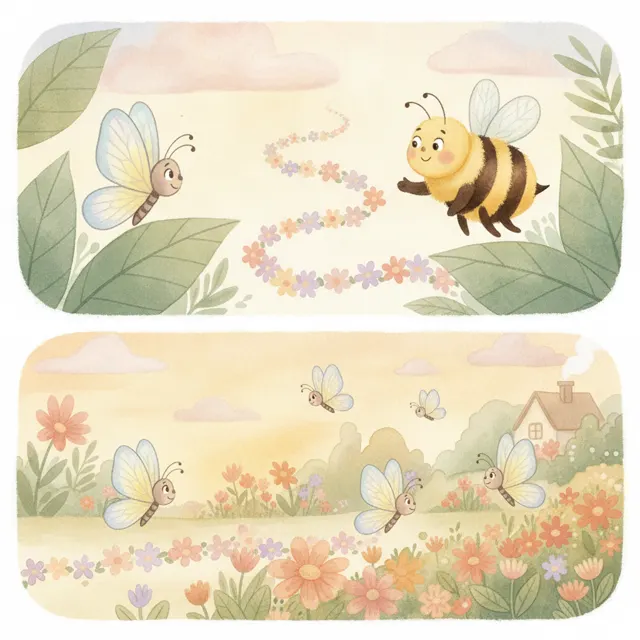
Bella the butterfly flies far from her garden and cannot find her way home. A friendly bee shows her to follow the bright flowers, and she finds her way back.

Moral: When you are lost, keep going and you will find your way.

Bella was a blue butterfly. She lived in a pretty garden full of pink and yellow flowers. One morning, a strong wind blew, and Bella flew farther than ever before. She landed in a strange field and looked around. "Where is my garden?" she said. "Nothing looks the same." Bella flew left. She saw only tall grass. She flew right. She saw only gray rocks. Her home was nowhere in sight. "I am lost," said Bella. "I will never find my flowers again." A bee buzzed over and landed near her. "Why do you look so sad?" he asked. "I flew too far," said Bella. "Now I cannot find my garden." "Do not worry," said the bee. "Follow the flowers. Flowers grow in a path that leads to your garden. Bright colors will show you the way home." Bella looked around. Far off, she saw a patch of yellow flowers. She flew to them. Beyond them, she saw a row of pink ones. She flew to those too. "I am getting closer," she said. "I can feel it." She followed flower after flower. Yellow, pink, red, and purple. Each patch led her a little closer to home. Then she saw the tall green hedge she knew. "There it is!" she cried. "There is my garden!" Bella flew over the hedge and landed on her favorite pink flower. Her wings were tired, but her heart was happy. The bee buzzed up beside her. "See?" he said. "The flowers showed you the way." "Thank you, bee," said Bella. "I was scared, but I kept going. And now I am home." She learned that even when you are lost, you can find your way back one small step at a time.

Grandpa's Magic Bean

Ages 3-84 minutespatience
Grandpa's Magic Bean story for kids illustration

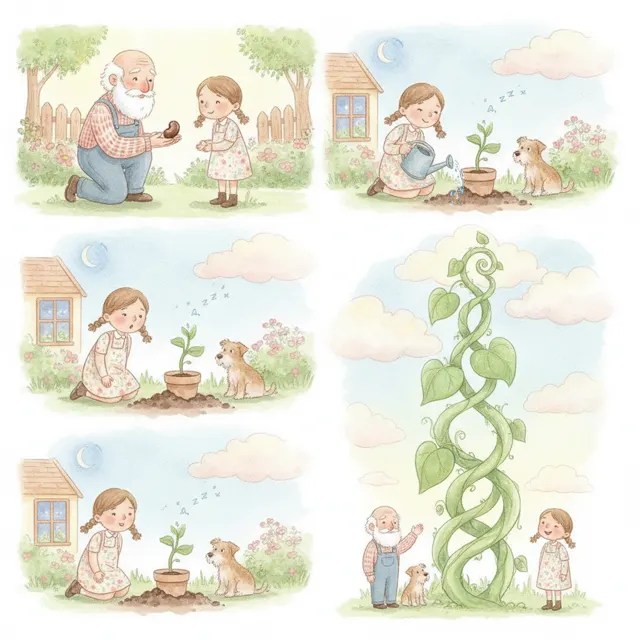
Grandpa gives Ella one small bean to plant. Ella waters it and waits. Nothing happens for days. Then a tiny green sprout grows into a tall bean plant that reaches the sky.

Moral: The real magic is in the caring and the waiting.

Grandpa handed Ella one small brown bean. "Plant this," he said. "It is a magic bean." "What does it do?" asked Ella. "You will see," said Grandpa with a wink. "Give it water and sun and love." Ella dug a little hole in the garden. She dropped the bean in and covered it with soft dirt. Then she watered it with her small green cup. "Now grow, magic bean," she said. She checked the next morning. Nothing. She checked the next day. Still nothing. A whole week went by, and the dirt was flat and empty. "It is not magic at all," said Ella. "It is just a plain bean that will not grow." "Beans are shy," said Grandpa. "They grow in the dark where you cannot see them. Give it time." Ella kept watering. She kept waiting. She even sang to the dirt a little, when no one was watching. Then one morning, a tiny green sprout poked up through the soil. It had two little leaves. "Grandpa! It grew!" shouted Ella. The bean plant grew a little more every day. It climbed up a stick Grandpa put in the ground. It grew leaves, then flowers, then long green pods. "Look how tall it is!" said Ella. "It is going to reach the sky!" The plant grew taller than Ella. Then taller than Grandpa. It climbed and climbed toward the sun. "What is the magic?" asked Ella. Grandpa smiled. "The magic is not in the bean," he said. "It is in the waiting and the caring. You made it grow." Ella looked at her tall plant. Grandpa was right. The real magic was all around her, and it had come from her own two hands.

The Ladybug's Rainy Day

Ages 3-84 minutesgratitude
The Ladybug's Rainy Day story for kids illustration

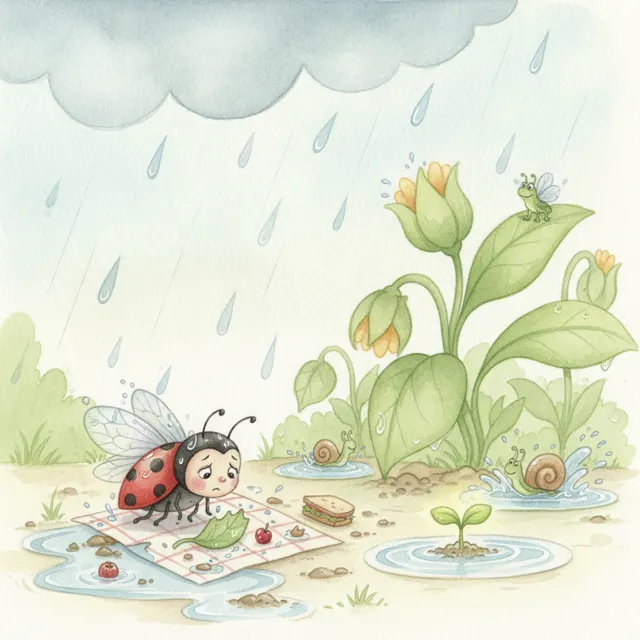
Lola the ladybug hates the rain. It ruins her picnic and makes her wings wet. Then she sees the rain filling the garden with water, and she learns the rain helps things grow.

Moral: Even a rainy day helps things grow.

Lola the ladybug woke up and looked outside. Gray clouds covered the sky. Big drops of rain fell on the leaves. "Oh no," said Lola. "It is raining. I wanted to have a picnic on the rose today." She had planned a fine picnic with a crumb of bread and a drop of nectar. But the rain spoiled everything. Her little red wings got wet just looking at it. "I hate the rain," said Lola. "It is cold and wet and it ruins everything." She sat under a big leaf and watched the rain fall. Drip, drop, drip, drop. It made puddles in the garden path. It made the flowers droop and shine. A worm poked its head out of the wet soil. "Wonderful rain!" said the worm. "The soil is soft now. I can dig my tunnels again." A flower lifted its head. "Lovely rain," it said. "Now my roots can drink. I was so thirsty." A little seed in the ground whispered, "Thank you, rain. Now I can grow." Lola looked around. Everyone was happy about the rain. The garden was not sad at all. It was drinking and growing and coming alive. "I did not see it that way," said Lola. "The rain is not ruining the garden. It is helping it." She watched the rain a little longer. It was not so bad after all. It made the garden green and fresh. "Maybe rain is not my favorite," said Lola. "But it helps my garden home. I can have my picnic tomorrow." And she waited under her leaf, warm and dry, while the rain sang its soft song on the leaves.

The Carrot That Hid Too Deep

Ages 3-84 minutesteamwork
The Carrot That Hid Too Deep story for kids illustration

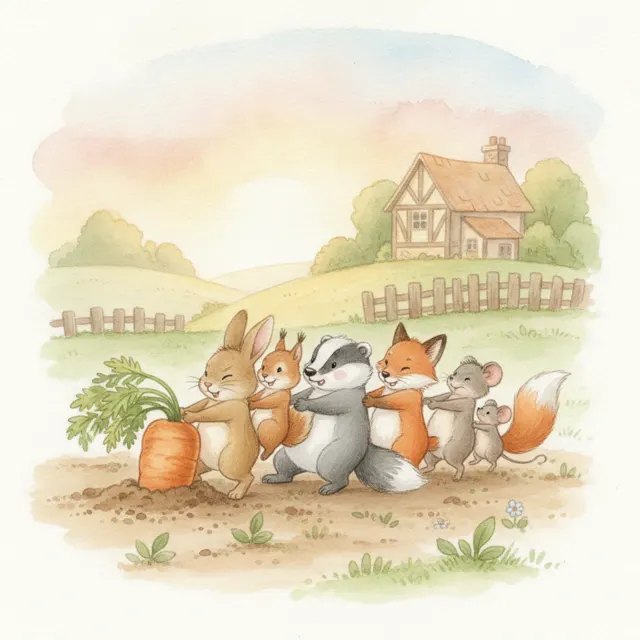
Pip the rabbit tries to pull a big carrot from the ground, but it will not budge. His friends come to help, one by one, and together they pull the carrot free.

Moral: Together we can do what one cannot do alone.

Pip the rabbit found a big green top sticking out of the garden soil. It was a carrot top, and it was huge. "What a big carrot!" said Pip. "It will make a fine dinner." Pip grabbed the green top and pulled. The carrot did not move. He pulled harder. Still nothing. The carrot was stuck deep in the ground. "This carrot is too strong for me," said Pip. "I need help." His friend Molly the mouse came by. "Let me help," she said. She grabbed Pip around the waist, and they pulled together. Heave! Ho! The carrot did not budge. "We need more help," said Pip. Benny the badger came over. He was big and strong. He grabbed Molly, and Molly grabbed Pip, and they all pulled. Heave! Ho! Heave! Ho! The carrot stayed in the ground. "We need more help!" they all said. Soon a whole line of friends was pulling. The squirrel, the hedgehog, and even a little bird all joined in. They grabbed each other and pulled as one. "One, two, three, PULL!" shouted Pip. Everyone pulled together. The ground rumbled. Then, with a big pop, the carrot flew out of the ground. It was the biggest carrot any of them had ever seen. "We did it!" they all cheered. The carrot was so big that there was more than enough for everyone. They all sat down and shared a fine carrot dinner. "One animal could not pull it," said Pip. "But all of us together could. That is the power of friends." And they all agreed, munching happily on the sweet orange carrot.

Finn and the Friendly Scarecrow

Ages 3-84 minutesfacing fears
Finn and the Friendly Scarecrow story for kids illustration

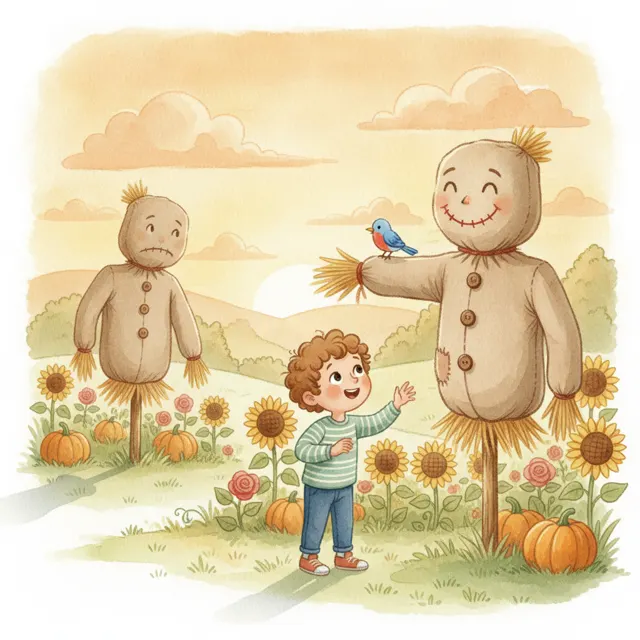
Finn thinks the scarecrow in the garden is scary. One day he finds a bird sitting on its arm, and the scarecrow smiles. Finn learns the scarecrow is kind, not scary.

Moral: Things are less scary when you look closer.

In the middle of the garden stood a tall scarecrow. He wore an old hat and a patched coat. His arms stuck out wide, and his stitched mouth looked like a frown. Finn was a little boy who was afraid of the scarecrow. Every time he walked past, he ran a little faster. "He looks so scary," said Finn. "He watches me with his button eyes." "He is just a scarecrow," said his mom. "He stands there to keep the birds from eating the seeds. He is not real." But Finn was still scared. The scarecrow looked too real, with its big hat and long arms. One day, Finn was playing near the garden when he saw something. A little bird landed on the scarecrow's arm. The bird did not fly away. It sat there and sang. Finn watched. Then another bird landed on the scarecrow's hat. Then a third perched on his shoulder. "Why are the birds not scared?" asked Finn. "I thought he scared the birds away." Finn walked a little closer. The scarecrow did not move. The birds stayed on his arms, chirping happily. The scarecrow's stitched mouth did not look like a frown anymore. It looked like a smile. "Hello, scarecrow," said Finn in a small voice. "You are not scary at all, are you?" The wind blew, and the scarecrow's coat flapped. It looked like he was waving hello. Finn smiled. "The birds trust you," he said. "So I will too." He sat down in the garden next to the scarecrow. It felt calm and nice. Finn had been afraid of a friend all along. "You watch over the garden," said Finn. "And now I will help you watch too." From that day on, Finn was not afraid. He and the scarecrow kept the garden safe together.

The Flower That Opened Late

Ages 3-83 minutespatience
The Flower That Opened Late story for kids illustration

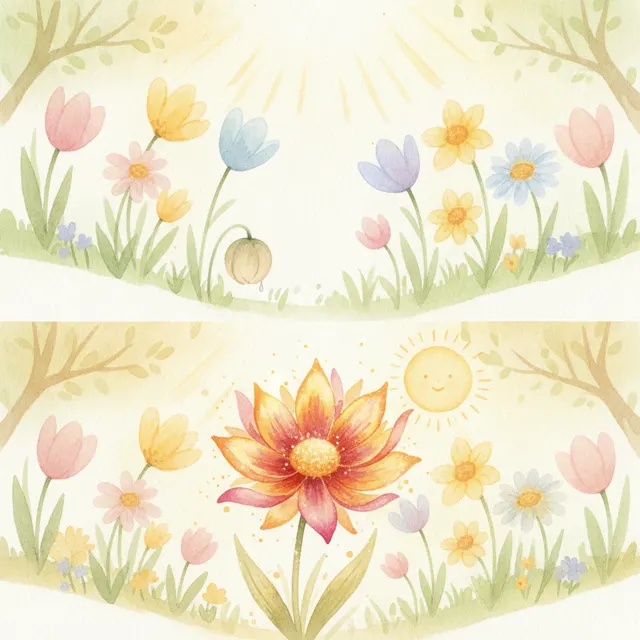
All the flowers in the garden bloom in spring, but one little bud stays closed. It feels left behind. When summer comes, it opens into the brightest flower of all.

Moral: Everyone blooms in their own time.

In a sunny garden, all the flowers bloomed in spring. The roses opened first, red and pink. Then the tulips, yellow and bright. Then the daisies, white and cheerful. But one little bud stayed closed. It was tight and green while all the others opened their petals to the sun. "Why are you not blooming?" asked a rose. "Everyone is open but you." "I do not know," said the little bud. "I am trying. I am just not ready yet." The tulips whispered, "Maybe it will never bloom." The little bud felt sad. It wanted to open like the others. It tried hard, but its petals stayed closed. Days passed. The spring flowers began to fade. Their petals fell to the ground one by one. The garden grew quieter. Then summer came with long warm days. And the little bud began to open. Slowly, its petals unfolded. They were purple and gold, with a soft glow in the middle. The little flower opened wide to the summer sun. "Look!" cried the gardener. "A flower in summer! It is the brightest one in the whole garden!" The other flowers looked over. The late flower really was beautiful. It stood tall and proud while the spring flowers rested. "You bloomed after all," said the rose. "And you are the brightest of us all." The little flower swayed in the warm breeze. "I was not late," it said. "I was just waiting for my own time." And it bloomed all summer long, long after the others had gone to sleep.

The Ant's Garden Parade

Ages 3-83 minutesteamwork
The Ant's Garden Parade story for kids illustration

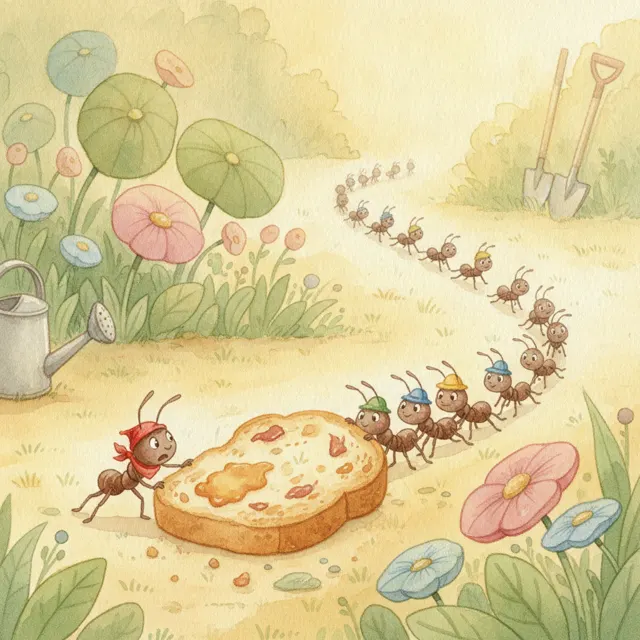
Anton the ant finds a dropped picnic crumb too big to carry alone. He calls his friends, and they march in a long line, working together to bring the crumb home.

Moral: Many hands make light work.

Anton the ant was marching across the garden when he found something big. It was a whole crumb of cake, dropped from a picnic. It was bigger than Anton's head. "What a feast!" said Anton. "This will feed my whole family." He tried to lift the crumb. It was too heavy. He pushed it. It did not move. He pulled it. It stayed put. "I cannot carry this alone," said Anton. "I need my friends." He hurried back to the nest. "Everyone, come quick!" he called. "There is a big crumb by the picnic spot!" Soon a long line of ants marched out of the nest. One behind the other, they followed Anton across the garden path. They went around the big stones and under the tall grass. It was a grand ant parade. When they reached the crumb, all the ants gathered around. "One, two, three, lift!" called Anton. All together, the ants lifted the crumb. It was still heavy, but now there were many legs to carry it. They marched back toward the nest, the big crumb swaying above them. "We are doing it!" said Anton. "Keep going, everyone!" The parade crossed the path and reached the nest. With one last push, the ants carried the crumb inside. "We did it together," said Anton. "One ant could not move it. But many ants could." That night, the whole nest shared the sweet crumb. It tasted even better because they had carried it home as a team. "The best work is shared work," said Anton. And every ant agreed.

Rosie and the Wiggly Worm

Ages 3-83 minutescuriosity
Rosie and the Wiggly Worm story for kids illustration

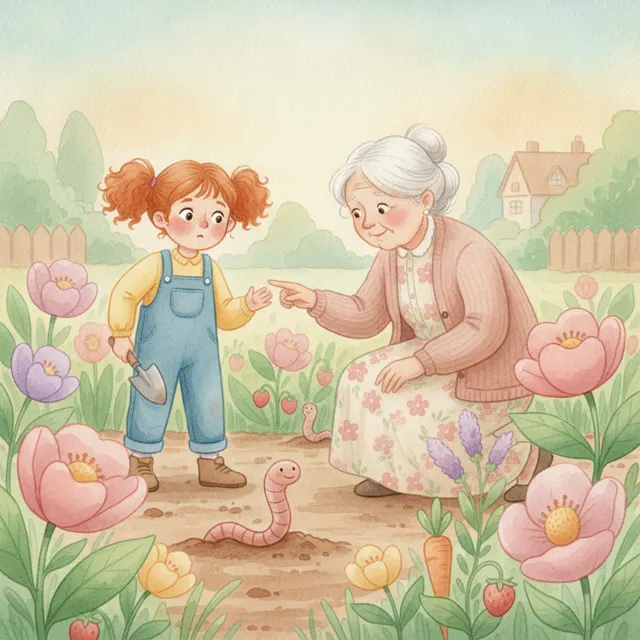
Rosie finds a wiggly worm in the garden and feels a little scared. She watches it dig into the soil. Her grandma tells her worms help the garden, and Rosie learns to like them.

Moral: A closer look can turn a scare into a friend.

Rosie was digging in the garden when she saw something pink and wiggly in the dirt. She jumped back. "Ew! What is that?" she cried. "That is a worm," said her grandma. "He is a good friend to the garden." Rosie was not so sure. The worm wiggled and squirmed and slid back into the soil. It did not look like a friend at all. "Worms are yucky," said Rosie. "Let me tell you a secret about worms," said Grandma. "They dig little tunnels in the dirt. The tunnels let air and water reach the roots of the plants. And worm droppings feed the soil." "Worms do all that?" asked Rosie. She looked at the spot where the worm had gone. It did not seem so yucky now. "Watch," said Grandma. "He is working right now." Rosie kneeled down and watched. The worm pushed through the soil, making a tiny tunnel. It was busy and strong. "Hello, little worm," said Rosie. "I did not know you were helping." She found another worm and gently held it in her hand. It tickled as it wiggled. Rosie giggled. "It tickles!" she said. "It is not scary at all." "Worms are the garden's quiet helpers," said Grandma. "Without them, the soil would be hard and the plants would be hungry." Rosie set the worm back in the dirt. "Thank you for helping my garden," she said. The worm wiggled away into the dark soil, happy to be back at work. And Rosie smiled, glad to have a new wiggly friend.

The Bee Who Forgot Her Dance

Ages 3-84 minuteshelping
The Bee Who Forgot Her Dance story for kids illustration

Buzzy the bee forgets the waggle dance that tells other bees where the flowers are. Her friend teaches her again, and she leads the hive to a field of sweet flowers.

Moral: Everyone needs a little help sometimes.

Buzzy was a little bee. Her job was to find flowers and tell the other bees where they were. Bees tell each other by doing a special dance called the waggle dance. One morning, Buzzy found a whole field of sweet clover flowers. She flew home fast to tell everyone. "Everyone, listen!" she buzzed. "I found flowers!" The other bees gathered around. But when Buzzy tried to do the waggle dance, her wings froze. She could not remember how it went. "Is it wiggle, then wag?" she said. "Or wag, then wiggle?" She tried one way, then another. The other bees looked confused. "I forgot my dance!" cried Buzzy. "Now no one will find the flowers!" Her friend Zelda flew over. "Do not worry," said Zelda. "I will help you remember. The dance is easy. You walk in a figure eight and waggle in the middle." Zelda showed her the dance, slow and clear. Buzzy watched carefully. Then she tried it herself. Wiggle, waggle, turn. Wiggle, waggle, turn. "You did it!" said Zelda. "Now show everyone where the flowers are." Buzzy did the dance again, this time full of joy. The other bees understood at once. They knew exactly where to fly. "Follow me!" buzzed Buzzy. And the whole hive flew out together. They reached the field of clover. It was covered in sweet purple flowers. The bees worked all day, gathering nectar and pollen. "Thank you for remembering the dance," said Zelda. "Thank you for teaching me again," said Buzzy. "Everyone needs a little help sometimes." And that night, the hive was full of sweet honey, all because a friend had helped Buzzy remember.

The Bird's Secret Nest

Ages 3-83 minutespatience
The Bird's Secret Nest story for kids illustration

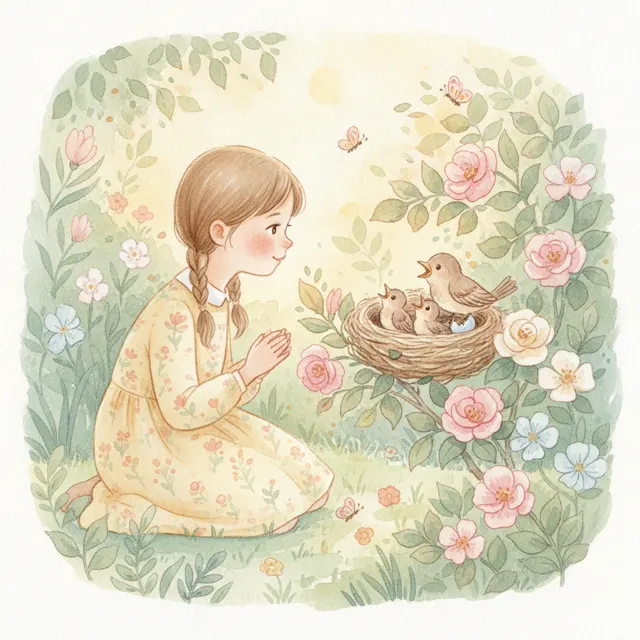
Ava finds a little bird building a nest in her garden. She watches quietly every day and does not touch it. When the eggs hatch, she sees three tiny baby birds.

Moral: Some things grow best when you watch and wait.

Ava found a small bird in her garden one morning. It carried twigs and grass in its beak. It flew to a low branch and tucked the twigs into a little cup of grass. "It is building a nest," Ava whispered. She wanted to run closer and look. But her mom put a finger to her lips. "Shhh," said Mom. "We must be very quiet. The bird is working hard, and she needs to feel safe." So Ava watched from far away. Every day the bird came back with more twigs and soft grass. The nest grew bigger and rounder. "Can I touch it?" asked Ava. "No," said Mom. "If we touch the nest, the bird might get scared and leave. We watch with our eyes, not our hands." Ava watched every day. She saw the bird sit in the nest, very still. "What is she doing?" asked Ava. "She is keeping her eggs warm," said Mom. "Soon there will be baby birds." Ava waited and waited. Then one morning, she heard tiny cheeping sounds. She looked up and saw three little beaks poking out of the nest. "Babies!" she whispered. "There are three baby birds!" Every day the baby birds grew bigger. Their mother flew back and forth, bringing them worms and seeds. "They are growing because we left them alone," said Ava. "That is right," said Mom. "Some things need quiet and patience to grow." Ava watched the birds all spring. She did not touch the nest, not even once. And she learned that some of the best things happen when you just watch and wait.

The Pumpkin That Shared the Sun

Ages 3-84 minutessharing
The Pumpkin That Shared the Sun story for kids illustration

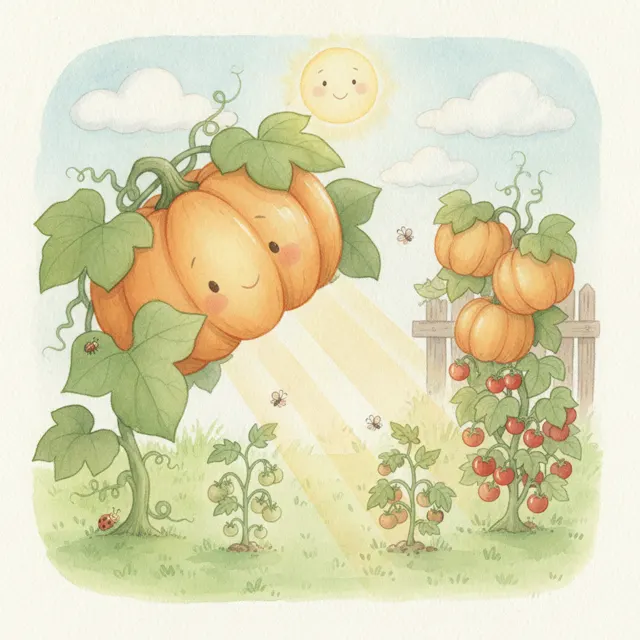
A big pumpkin plant spreads over the garden and blocks the sun from a little tomato plant. The pumpkin leans over to make room, and both plants grow big and strong.

Moral: There is enough light for everyone when we share.

In the garden grew a big pumpkin plant. Its leaves were wide and green, and it spread out across the soil. Right next to it grew a small tomato plant. The pumpkin grew bigger every day. Soon its big leaves covered the tomato plant and blocked the sun. "I cannot see the sun," said the little tomato. "Your leaves are in my way." "I am sorry," said the pumpkin. "I did not mean to. I am just so big and I need to spread out." "But I need the sun to grow," said the tomato. "Without it, I will stay small and pale." The pumpkin felt bad. It did not want to hurt its neighbor. But its leaves were already over the tomato. "What can I do?" asked the pumpkin. "My vines are heavy and hard to move." "Maybe we can share the sun," said the tomato. "If you lean a little this way, I can get the morning sun. Then in the afternoon, you can have the rest." The pumpkin tried. Slowly, it turned one of its big vines a little to the side. It was hard work, but it made a small gap. Sunlight fell on the little tomato plant. "Thank you!" said the tomato. "Now I can feel the sun on my leaves." Day by day, both plants grew. The tomato turned red and ripe. The pumpkin grew round and orange. They shared the sun all summer long. "See?" said the tomato. "There is enough sun for both of us. We just had to share." "You are right," said the pumpkin. "A garden is happier when everyone gets a little light." And the two plants grew side by side, big and strong, all through the warm summer.

Mia's Rainbow Row of Flowers

Ages 3-83 minutespatience
Mia's Rainbow Row of Flowers story for kids illustration

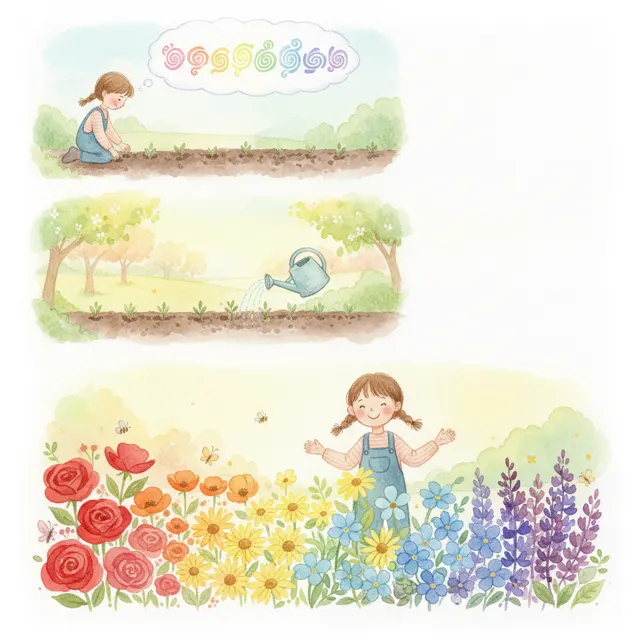
Mia plants a row of seeds and dreams of a rainbow of flowers. She waters and waits all spring. When summer comes, the flowers bloom in red, orange, yellow, blue, and purple.

Moral: A dream grows when you plant it and wait.

Mia wanted to plant a rainbow. She had a little packet of seeds, one for each color of the rainbow. She dug a long row in the garden. "This seed will be red," she said, patting the dirt. "This one orange, this one yellow, and this one blue." She planted every seed in a neat row and covered them with soil. Then she watered them with her little can. "Now we wait," said Mia. "A rainbow takes time." Every day she watered the row. Every day she looked for green sprouts. At first there was nothing but brown dirt. Mia waited and hoped. Then tiny green shoots poked up, one by one. Mia cheered. "They are growing!" The little plants grew taller each day. They grew leaves and stems and little buds. Mia watered them every morning and sang to them sometimes. One warm summer morning, Mia ran outside and gasped. The first flower had opened. It was bright red. The next day, an orange flower bloomed. Then a yellow one, then blue, then purple. "It is a rainbow!" cried Mia. "My row of flowers is a rainbow!" Her mom came out and smiled. "You did it, Mia. You planted a rainbow and waited for it to grow." Mia looked down the row of colors. Red, orange, yellow, blue, purple. It was even more beautiful than she had dreamed. "Rainbows grow from little seeds," said Mia. "You just have to plant them and wait." All summer, the rainbow row bloomed. And every time Mia saw it, she remembered the day she planted a dream and watched it come true.

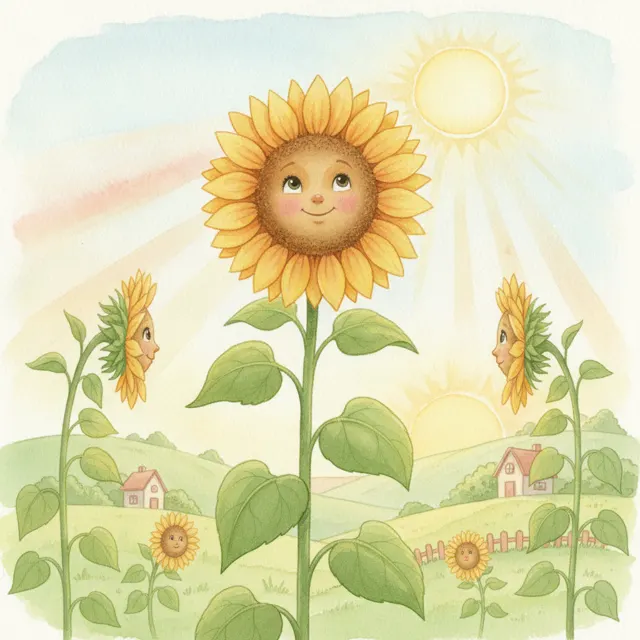
The Sunflower Who Followed the Sun

Ages 3-83 minuteswonder
The Sunflower Who Followed the Sun story for kids illustration

Sally the sunflower turns her face to follow the sun across the sky all day long. She learns that facing the light makes her grow tall, strong, and bright.

Moral: Face the light and you will grow tall and strong.

In the garden grew a young sunflower named Sally. Every morning, when the sun came up, Sally turned her face toward it. All day long, she followed the sun as it moved across the sky. "Why do you always look at the sun?" asked a little daisy beside her. "The sun is warm and bright," said Sally. "When I face it, I feel strong. It helps me grow." The daisy just looked down at the ground. "I do not bother," it said. "The sun is up there, and I am down here. It is too much work to turn." Sally kept following the sun. In the morning, her face pointed east. At noon, it pointed straight up. In the evening, it pointed west, watching the sun go down. Day after day, Sally grew. Her stem grew tall and thick. Her leaves spread wide and green. And one morning, a big yellow flower opened on top of her head, bright as the sun itself. "Look at you!" said the daisy. "You are so tall and bright. How did you grow so much?" "I faced the light," said Sally. "Every single day. The sun gave me what I needed to grow." "I wish I had done that," said the daisy. It had stayed small and pale in the shade. "It is not too late," said Sally. "The sun comes up every day. Just turn your face toward it." So the daisy tried. It lifted its little head toward the sun. The warm light fell on its petals, and it began to feel stronger too. "You were right," said the daisy. "The light really does help." Sally smiled. She had learned the best secret of the garden. Face the light, and you will grow tall and bright and strong.

Frequently Asked Questions

Turn Your Child Into the Hero of Their Own Story

Upload their photo and watch as AI creates a beautiful, personalized storybook with illustrations that look just like them. From $5.99/month.

✨ Make Your Child the Hero

Plans from $5.99/month