Space Stories for Kids

Starry space tales where your little one meets friendly planets, follows glowing comets, and finds that even the smallest star shines.

✨ Make Your Child the Hero

Space is the biggest, most beautiful mystery a child can imagine. It is full of twinkling stars, slow turning planets, and comets streaking across the sky like ribbons of light. Space stories take all that wonder and make it gentle enough for little ears, turning the vast night sky into friendly characters children love. These tales follow stars who learn to shine in their own way, planets who make new friends, and comets who discover the joy of slowing down. Each one is calm and warm, perfect for bedtime. With CreateStory.ai, you can make it personal. Upload a photo and your child becomes the hero, floating among the stars.

Where does outer space begin above the Earth?

Space is not far above your head. There is no wall, but scientists picked a line where the sky gets too thin for planes to fly.

That line is called the Karman line, about 62 miles or 100 kilometers above the ground, says Space.com. Past that line, you are in outer space.

Why is outer space so dark and so quiet?

Space is dark because there is no air to scatter sunlight the way our sky does. There are also no sounds, because sound needs air to travel.

That means no one can hear you in space. Even a big boom would be silent, since there are not enough tiny air bits to carry the sound.

Sample Stories

Read these stories, then create a personalized version where your child is the hero

The Star That Felt Too Small
Ages 3-84 mincourage
The Star That Felt Too Small story for kids illustration

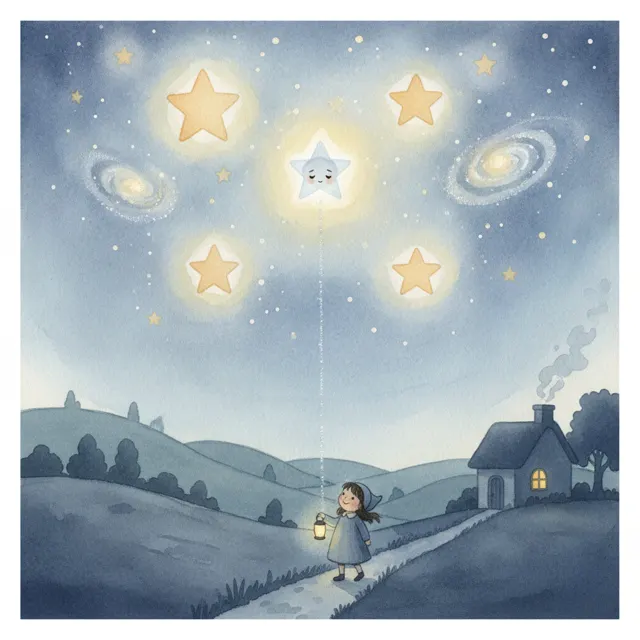
Lumen is the smallest star in a big, bright sky, and she worries she is too dim to matter. When a little girl on Earth needs a light in the dark, Lumen learns that even the smallest star can guide someone home.

Moral: You do not have to be the biggest to matter to someone.

Lumen was the smallest star in the night sky. All around her, big bright stars blazed and sparkled, and Lumen felt very small and very dim. "They are so bright," Lumen sighed. "And I am just a little dot." "No one will ever notice me," she said, and she dimmed her light a little more. One clear night, far below, a little girl named Mia could not sleep. She sat by her window and looked up at the sky. The clouds covered the bright stars, and the sky was mostly dark. But then, through a small gap in the clouds, Mia saw a tiny twinkle. It was Lumen, shining quietly in her corner of the sky. "There you are," Mia whispered. "I was hoping to see a star tonight." Mia smiled and felt less alone. She waved at the little twinkle, and somehow, Lumen felt it. "Did you see that?" Lumen said, surprised. "She saw me. She was looking right at me." Lumen gathered all her courage and shone as brightly as she could. It was not a big, blazing light like the other stars, but it was steady and true and just enough for one little girl. The next night, Mia looked for Lumen again, and there she was, twinkling in the same spot, like a friend who always comes back. "Thank you," Mia whispered, and this time Lumen was sure she heard it. "I am small," Lumen said happily, "but I am just right for someone." And every night after that, she twinkled for Mia, her one special friend.
The Planet Who Made a Friend

Ages 3-83 minfriendship
The Planet Who Made a Friend story for kids illustration

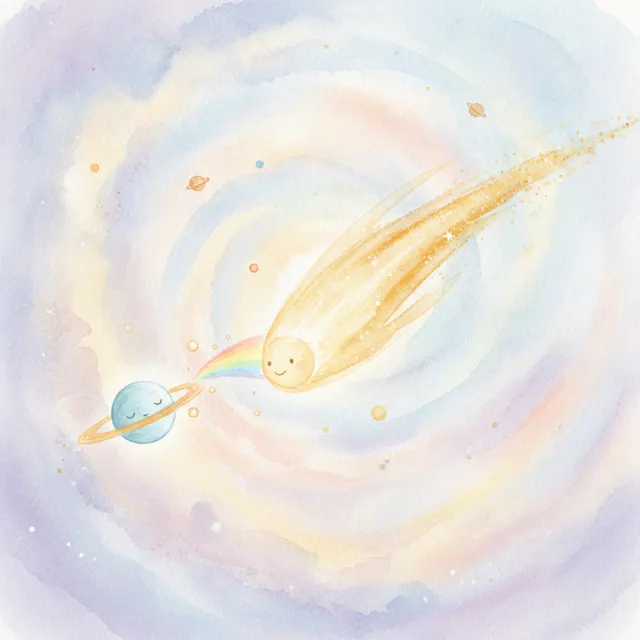
Ringo is a quiet little planet who spins alone on the edge of the solar system, too far from everyone to make a friend. When a friendly comet passes by, Ringo learns that friendship can find you, even in the quietest places.

Moral: A friend can find you even in the quietest places.

Ringo was a small, quiet planet who spun all alone at the edge of the solar system. The other planets were far away, and Ringo could only watch their faint lights from a distance. "It must be nice to have a neighbor," Ringo said to himself. "Someone to wave to, someone to talk to." But Ringo was so far out that no one ever came by. Or so Ringo thought. One day, a bright comet came streaking through the sky, leaving a trail of sparkling light behind it. It slowed down as it passed Ringo. "Hello there!" the comet called. "I am Cinder. What is your name?" Ringo blinked in surprise. "You stopped? Nobody ever stops." "I always stop for a new friend," Cinder said. "And I have never met a planet so far out here before. You must see the most wonderful things." Ringo's heart lifted. "Would you like to stay and watch the stars with me? They look so beautiful from here." "I would love to," Cinder said. So the two new friends floated side by side, watching the stars wheel slowly overhead. Cinder told Ringo stories about the places the comet had passed, and Ringo showed Cinder the quiet, lovely view from the edge of space. When it was time for Cinder to go, the comet promised to come back. "I was so lonely," Ringo said. "I did not think anyone would ever want to be my friend." "Friends find you," Cinder said, "even way out here. Especially way out here." Ringo watched Cinder streak away, and for the first time, the little planet did not feel alone at all.

The Comet Who Never Slowed Down

Ages 3-85 minpatience
The Comet Who Never Slowed Down story for kids illustration

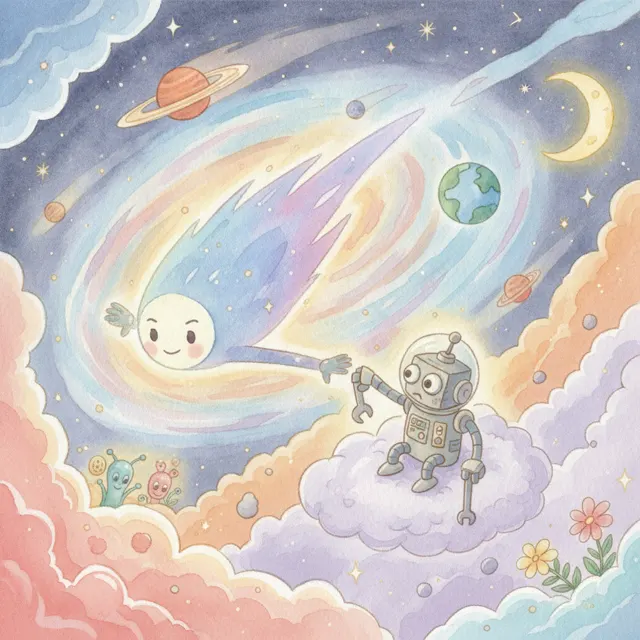
Dash the comet zooms through space so fast that he never stops to see anything. When he finally slows down to help a tired little space robot, he discovers all the beauty he has been missing.

Moral: Slowing down lets you see the beauty all around you.

Dash was the fastest comet in the whole sky. He streaked from one end of space to the other, leaving a bright trail of light behind him. He was proud of how fast he could go. "Slow down!" the stars would call. "Enjoy the view!" But Dash never did. He was always racing, always rushing, always chasing the next far away place. One day, as Dash zoomed past, he heard a small, tired voice. "Help. Please help." Dash skidded to a stop, which was very hard for a comet to do. There, floating all alone, was a tiny space robot with a blinking red light. "I am lost," the robot said. "My batteries are low, and I do not know the way home." Dash looked at the robot. For the first time, he stopped moving and really looked at where he was. "Come with me," Dash said gently. "We will go slowly." And for the first time in his life, Dash flew slowly. And as he flew, he saw things he had never noticed before. A field of stars twinkling like a friendly crowd. A swirling pink cloud shaped like a flower. A tiny moon with rings that sparkled like glass. "It is all so beautiful," Dash whispered. "I have been rushing past it my whole life." The little robot nodded. "Sometimes you have to slow down to see where you are." Dash delivered the robot safely home, and the little robot's family cheered. Then Dash looked up at the wide, wonderful sky. "From now on," Dash promised, "I will fly fast when I need to. But I will also stop to look."

The Two Stars Who Shared a Sky

Ages 3-84 minsharing
The Two Stars Who Shared a Sky story for kids illustration

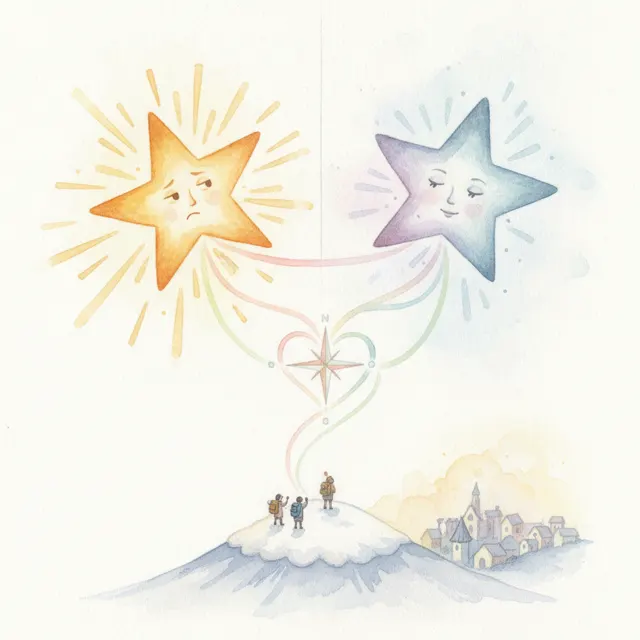
Two stars, one bright and one soft, must share the same corner of the night sky, and they argue over who shines where. When they learn to share the light, they create a constellation that guides lost travelers home.

Moral: There is room for everyone to shine, and we shine brighter together.

In one quiet corner of the night sky lived two stars. The first was a bright, bold star named Blaze. The second was a soft, gentle star named Glow. "This is my corner of the sky," Blaze said. "I was here first." "I was here too," Glow said. "The sky is big enough for both of us." But Blaze did not want to share. He pushed his light out wide, so bright that Glow's soft light was nearly lost in the glare. "You are too dim," Blaze said. "Move along." Glow felt small and sad. But instead of leaving, Glow stayed in her spot and shone quietly, just a little, just enough. One night, a group of travelers crossing a wide desert looked up for a sign. The sky was dark, and they could not find their way. "Look," one traveler said, "there is one bright star, and just beside it, a soft one. Together they point the way north." The travelers followed the two stars and found their path home. From that night on, people called the two stars a constellation, and told stories about the bright star and the soft star who pointed the way together. Blaze looked over at Glow. "They only found their way because of both of us," he said. "Your soft light mattered too." "I told you," Glow said gently. "The sky is big enough for us both." And Blaze finally moved over and made room, and the two stars shone side by side, brighter together than either had been alone.

The Little Astronaut Who Counted Stars

Ages 3-83 mincuriosity
The Little Astronaut Who Counted Stars story for kids illustration

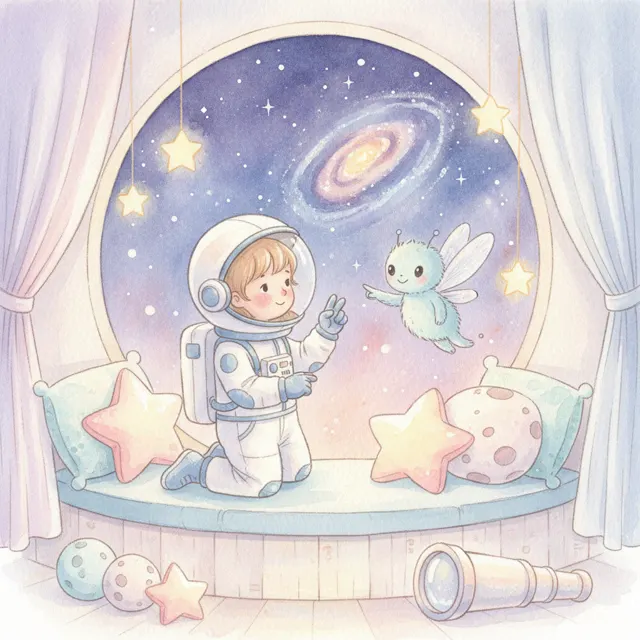
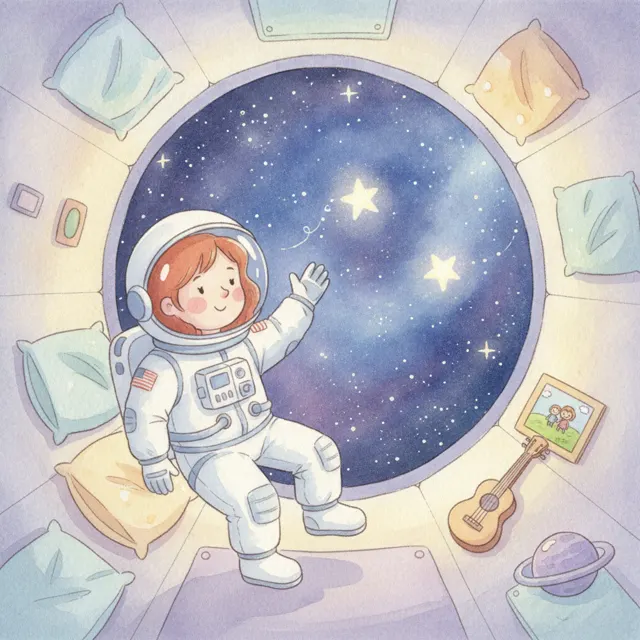
Astronaut Ava floats in her spaceship and tries to count every star in the sky, but there are too many. A wise old comet helps her see that some wonders are best enjoyed, not counted.

Moral: Some wonders are meant to be enjoyed, not counted.

Ava was a little astronaut, and she had a big mission. She was going to count every single star in the sky. "One, two, three, four..." she began, floating by her spaceship window. But the stars went on and on. She counted a hundred, then a thousand, and there were still more. Her pencil grew short, and her list grew long, and still the sky was full of uncounted stars. "This is impossible!" Ava said, throwing up her hands. "There are too many." A wise old comet drifted by and saw Ava frowning. "What is wrong, little astronaut?" it asked. "I am trying to count all the stars," Ava said, "but I cannot. There are simply too many." The comet chuckled softly. "And why do you want to count them?" "Because I want to know how wonderful the sky is," Ava said. "Ah," the comet said. "You cannot count wonder. You can only feel it." Ava thought about that. She put down her pencil and looked out the window, not to count, but to see. The stars did not look like numbers anymore. They looked like old friends, twinkling hello. "You are right," Ava said. "They are not meant to be counted. They are meant to be enjoyed." That night, Ava floated by the window and simply watched the sky, and it felt bigger and more beautiful than it ever had before. "Some things are too big to count," Ava whispered, "and that is exactly why they are so special."

The Rocket Who Was Scared to Launch

Ages 3-82 min readcourage
The Rocket Who Was Scared to Launch story for kids illustration

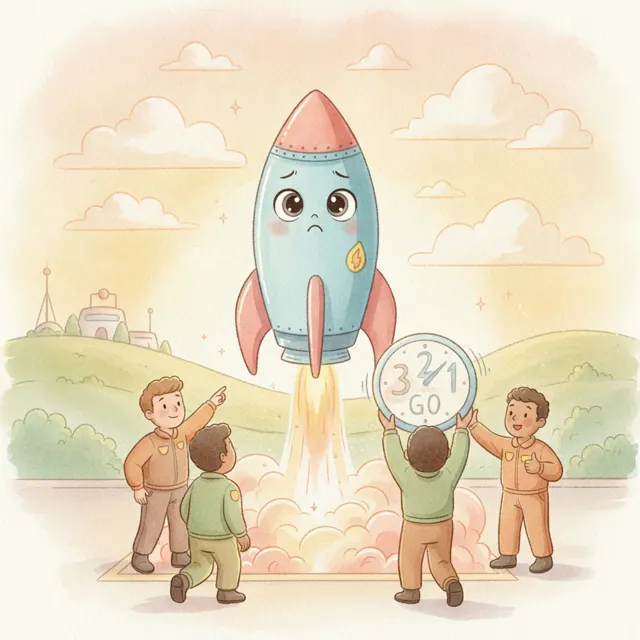
A little rocket named Rory is ready for its first launch, but it is scared of the loud boom and the big blast. With help from the ground crew, Rory counts down and finds the courage to lift off.

Moral: It is okay to be scared before you do something big.

Rory was a little rocket. He was shiny and new and ready for his very first launch. He stood on the launch pad, pointing up at the big blue sky. But Rory was scared. "What if the boom is too loud?" Rory asked. "What if the blast is too big? What if I fall?" A voice came over the radio. It was the ground crew. "Hello, Rory," said a kind voice. "This is Mission Control. How do you feel?" "Scared," said Rory. "My engines are all rumbling inside." "That is okay," said Mission Control. "Even big rockets feel scared before a launch. It means you are ready and you care." "But I do not want to fall," said Rory. "You will not fall," said Mission Control. "We checked every part of you. You are strong and steady. And we will be right here, talking to you the whole way." Rory took a deep breath. "You will stay with me?" he asked. "Every second," said Mission Control. "Now, let us count down together. Ten, nine, eight..." Rory felt his engines get warm. "Seven, six, five," they counted. "Four, three, two, one!" LIFT OFF! Rory shot up into the sky with a great big boom. The ground shook. Rory climbed higher and higher, past the clouds, into the blue, and then into the black of space. "I did it!" Rory shouted. "I am in space! And I did not fall!" "You did it," said Mission Control. "How do you feel now?" Rory smiled all over. "Brave," he said. "I was scared, but I launched anyway."

The Tiny Rover on the Red Planet

Ages 3-82 min readcuriosity
The Tiny Rover on the Red Planet story for kids illustration

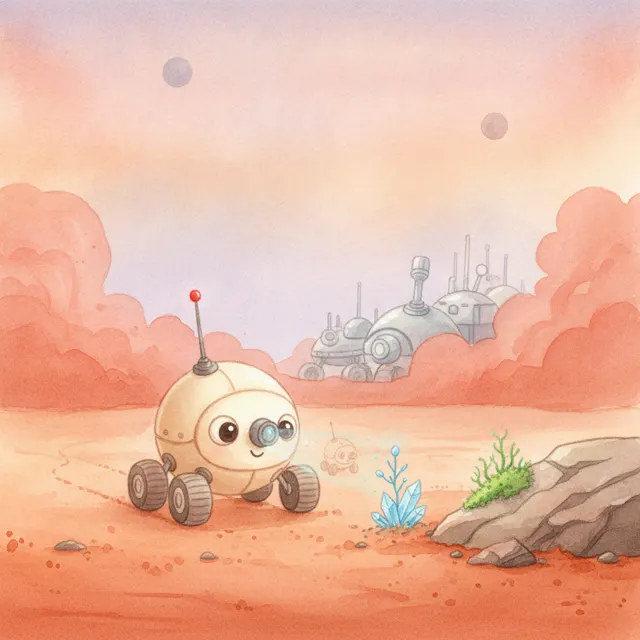
A little rover named Pebble lands on a red planet and rolls slowly over the dusty ground. It is small, but it sends back pictures and finds things the big machines miss. Small does not mean weak.

Moral: Even the smallest helper can do big and important things.

Pebble was the smallest rover ever sent to the red planet. When it rolled off the landing ship, the other rovers looked down at it. "You are so small," said one big rover. "What can you do?" "I can look and learn," said Pebble. "And I can go where you cannot fit." The big rovers rolled away over the wide, dusty ground. They were strong and fast. Pebble rolled slowly behind them, its little wheels turning. The red planet was quiet and cold. Dust covered everything. There were rocks of all sizes and big hills far away. "I will look in the small spaces," said Pebble. It rolled into a narrow crack between two rocks. The big rovers could not fit in there. Inside the crack, Pebble found something wonderful. There were marks in the rock, like ripples left by water long ago. Pebble took pictures and sent them back to Earth. The scientists on Earth got the pictures. "Water once flowed here!" they said. "Pebble found proof in a tiny crack that the big rovers could not reach." The big rovers rolled back. "You found it," they said. "And we could not even fit in that crack. You are small, but you did a big thing." Pebble's little lights blinked with pride. "Small is not weak," Pebble said. "Small can go where big cannot. And small can still make a big discovery." Pebble rolled on, curious and bright, exploring the big red planet one small crack at a time, finding new wonders every single day.

The Astronaut Who Waved at the Stars

Ages 3-82 min readkindness
The Astronaut Who Waved at the Stars story for kids illustration

An astronaut named Ana floats in the space station and misses home. She waves at the stars each night to feel less alone. One night the stars seem to wink back, and Ana feels a little less far from home.

Moral: A small act of kindness can reach very far.

Ana was an astronaut on the space station. It floated high above the Earth, far from her home. Ana loved space, but some nights she missed her family and her little dog. One night, Ana looked out the window. The Earth was below, blue and bright. The stars were everywhere, like spilled sugar on black paper. Ana waved at the stars. "Hello up there," she said softly. It made her feel a little less alone. The next night she waved again. And the next. It became her little ritual. "Why do you wave at the stars?" asked her friend on the radio. "It makes me feel close to home," Ana said. "Maybe someone down there is looking up and waving back." One night, as Ana waved, she saw a star twinkle extra bright. It seemed to wink at her. Then another star winked. And another. Ana laughed. "They are waving back!" she said. The truth was, Ana knew the stars did not really wave. But it did not matter. It felt good to send a little kindness out into the dark, even to the stars. That night, Ana wrote in her notebook: "When you feel far from home, wave. Send a little hello out into the world. Kindness travels a long way, even to the stars." She looked out the window one more time. Below her, a tiny light blinked on the Earth. Maybe it was a child waving at the sky. Ana waved back with all her heart, and the sky felt a little closer.

Frequently Asked Questions

Turn Your Child Into the Hero of Their Own Story

Upload their photo and watch as AI creates a beautiful, personalized storybook with illustrations that look just like them. From $5.99/month.

✨ Make Your Child the Hero

Plans from $5.99/month