Good Friday Stories for Kids

Stories that help children understand the meaning of Good Friday with gentleness, love, and hope.

โœจ Make Your Child the Hero

Good Friday is one of the most significant days in the Christian calendar, but it can be hard to explain to young children. The themes of loss, sacrifice, and love run deep, and they require the gentleness that only a good story can provide. Our Good Friday stories for kids approach this sacred day with care, using age-appropriate language to help children understand what happened, why it matters, and how it connects to the joy of Easter Sunday. These stories are rooted in love and told with warmth, making them suitable for family reading, church settings, and any home looking to help children understand this important occasion.

What can young children learn from Good Friday stories?

Good Friday stories can teach little ones about love, kindness, and forgiveness in a soft and gentle way. They hear about people who helped, stayed close, and said sorry, which are ideas even the youngest child can hold onto.

The focus stays on love, never on scary details.

How do families observe Good Friday together at home?

Many families share a quiet meal, read a gentle Bible story, or attend a church service. A Gallup poll found that between 62 and 64 percent of Americans say they plan to attend church on Easter, and Good Friday services are often the first quiet moment of that weekend.

At home, simple crafts and calm story time work well for young children.

Sample Stories

Read these stories, then create a personalized version where your child is the hero

The Day the Sun Went Quiet
Ages 6-124 minlove and sacrifice
The Day the Sun Went Quiet story for kids illustration

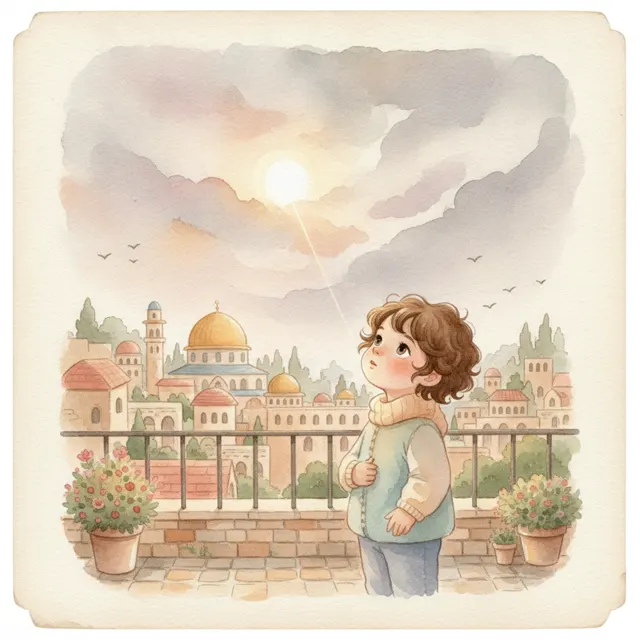
A story told from a child's perspective in Jerusalem on Good Friday, exploring the events of that day through eyes full of love and wonder.

Moral: The deepest love sometimes means giving everything, and even the darkest day can give way to morning.

My name is Hannah, and I was nine years old on the day the sun went quiet. I lived in Jerusalem with my mother and my uncle. Our house was near the market. I could hear the crowds every morning before I even opened my eyes. That Friday was different from the start. Mother woke me before dawn and told me to stay close. The streets were full of people but nobody was talking the way people usually talked. The voices were low and urgent, like something important was happening and nobody wanted to miss it. I'd seen Jesus before. He had come to our neighbourhood once and touched the hand of the sick man who lived near the well. The sick man stood up and walked home that afternoon. Everyone on our street talked about it for weeks. Now people were saying terrible things were going to happen to him. I didn't understand why. Mother held my hand very tightly as we stood at the edge of the crowd. I saw a man carrying a heavy cross up the road. He was tired and the crowd was not kind. I started to cry. Mother crouched down beside me. "Why?" I asked her. She was quiet for a moment. "Because he loves us," she said. "More than we understand." I didn't understand then. But I remembered her words. Later that afternoon, the sky went dark even though it was midday. The sun went quiet, like it was bowing its head. Our neighbours came inside and nobody lit their lamps. The city was still. Two days later, on Sunday morning, everything changed again. The news came quickly, whispered from house to house, person to person. He wasn't in the tomb. He had risen. My mother lifted me up and spun me around in the kitchen and for the first time in three days she was laughing. I still didn't understand all of it. But I understood love. And I understood that something greater than sadness had won. Years later, when I was grown, I would tell my own children about that Friday and the quiet sun. I'd tell them that sometimes love asks the hardest thing of all. And then Sunday comes.
The Three Crosses on the Hill

Ages 7-124 minsacrifice and understanding
The Three Crosses on the Hill story for kids illustration

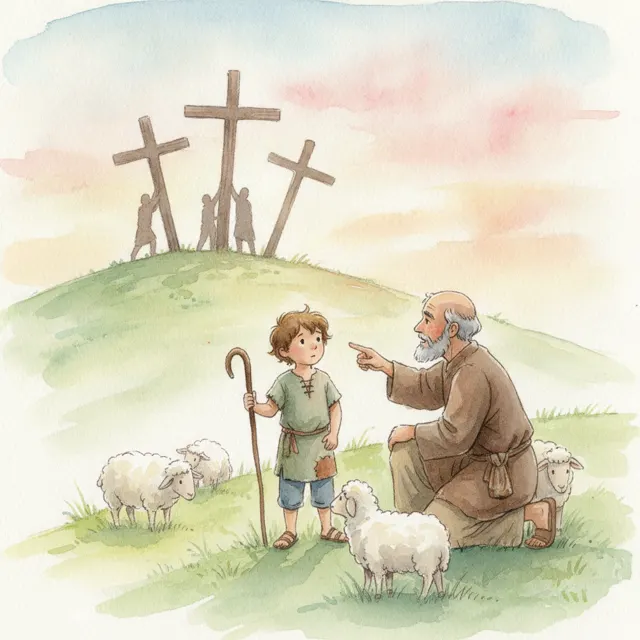
A shepherd boy watches from a distance as three crosses are raised on a hill, and his grandfather explains the meaning of what he sees.

Moral: Love that doesn't count the cost is the rarest and most precious kind.

Eli was tending his family's sheep on the hills outside the city when he saw them raise the three crosses. He watched from a distance, too far to hear the words being spoken, close enough to see the shapes against the grey sky. His grandfather came and stood beside him, leaning on his staff. "Grandfather," Eli said, "who is on the middle cross?" "A man called Jesus," his grandfather said. "Many people loved him. A teacher. A healer. Some believed he was the promised one." Eli watched for a while in silence. "Then why?" he asked. His grandfather was quiet for a long time. "Because sometimes those who love the most are the ones who pay the highest price for it." Eli didn't fully understand this. He was twelve years old. He understood sheep and weather and the price of grain. He understood family. "Did he do something wrong?" Eli asked. "No," his grandfather said firmly. "He did something right. He loved people who were told they weren't worth loving. He sat with the sick. He talked to people others ignored. That was enough for some to want to silence him." The sky darkened while they stood there. The sheep pressed close together, which they always did when they sensed something important. Animals knew, Eli thought. They always knew. When they walked home that evening, the city was hushed. But Eli thought about what his grandfather had said. About love that doesn't count the cost. That night he prayed for the first time in a long time, really prayed, not the words he'd memorised but his own words, quiet and unsure but honest. Three days later, the city wasn't quiet anymore. It was singing.

The Seed and the Stone

Ages 4-83 minhope and resurrection
The Seed and the Stone story for kids illustration

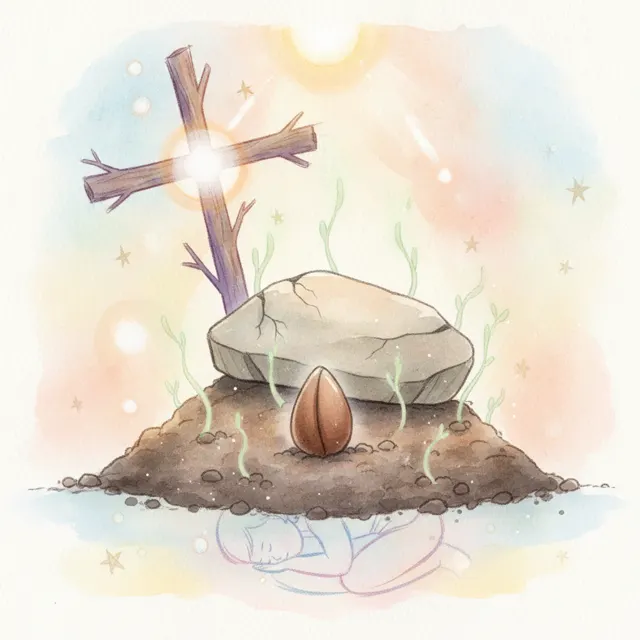
A gentle parable for young children that uses the image of a seed buried in dark earth to explain the hope of Good Friday and Easter Sunday.

Moral: Darkness is not the end of the story. The most beautiful things grow in the hard places.

A long, long time ago, there was a seed that was placed in the dark earth. It was a cold Friday. The sky was grey. The people who placed the seed in the ground were sad. They missed the thing they had loved. They didn't understand why it had to be this way. The seed sat in the darkness. Saturday came. Everything was still and quiet. The people waited, though they didn't know what they were waiting for. Then Sunday morning came. And something extraordinary happened. The seed burst open. From the darkness, from the cold and the quiet and the waiting, something new and alive and bright pushed through the earth and reached toward the light. It was more beautiful than anything that had come before it. Sometimes, children, the things we love most have to go into the dark for a little while. We don't always understand why. It can feel like the end of everything. But the seed knows something the sad people standing over the dark earth didn't know yet. The darkness is where the growing happens. Good Friday is the day of the dark earth. But Sunday is coming. And Sunday is the most beautiful morning in the whole story of the world. When we see a flower pushing up through the ground this Easter, let's remember the seed. Let's remember the dark. And let's remember that no darkness, not even the very worst kind, can hold back a love that strong.

The Broken and the Mended

Ages 6-103 minbrokenness and restoration
The Broken and the Mended story for kids illustration

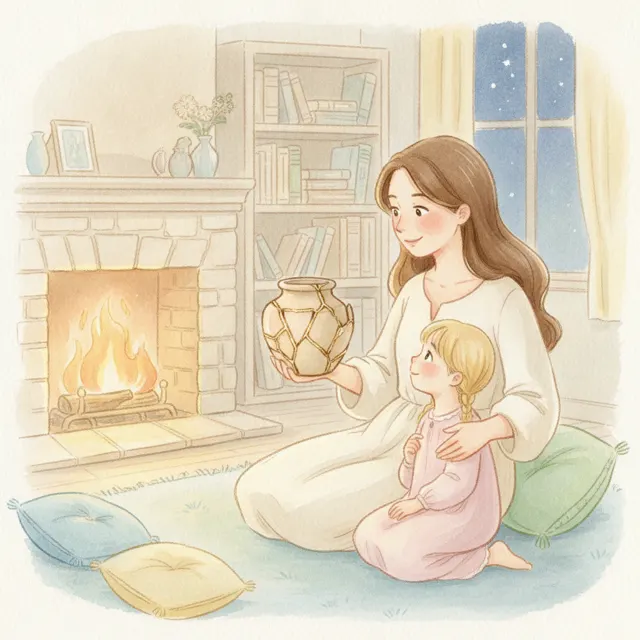
A mother tells her daughter the story of Good Friday using a broken clay pot that she mends with gold, teaching her about beauty in brokenness.

Moral: The broken places in us aren't the end of the story; they're where the light gets in.

Lily's mother had a pot on the shelf that was cracked all the way across, held together with lines of gold. "Why don't you throw it away?" Lily asked one afternoon. Her mother sat down beside her. "Because of what it taught me," she said. She turned the pot carefully in her hands. "In Japan they have a tradition called kintsugi. When something breaks, instead of hiding the crack or throwing it away, they fill it with gold. The broken place becomes the most beautiful part." Lily touched one of the golden lines carefully. "Good Friday," her mother said quietly, "is a broken day. It's the day we remember that the person who loved the most was hurt by the very people he came to help. It's sad. It's supposed to feel sad. We don't rush past it." Lily looked at the gold lines. "But something happens after?" she asked. "Something extraordinary happens after," her mother said. "Easter Sunday is what happens when God takes the most broken thing in the world and fills it with something better than gold." Lily held the pot in her lap. It was heavy and smooth and warm from the afternoon sun. "So Good Friday isn't the end," she said. "No," her mother said. "It's the crack. And the crack is where the light gets in." Lily set the pot back on the shelf carefully, right in the spot where the afternoon sun caught the gold lines best. She understood now. The broken things were sometimes the most beautiful ones.

The Garden in the Dark

Ages 6-124 minwaiting, hope, and resurrection
The Garden in the Dark story for kids illustration

The story of Good Friday told through the eyes of the garden, which watched everything and waited for Sunday.

Moral: The longest nights are followed by the most extraordinary mornings.

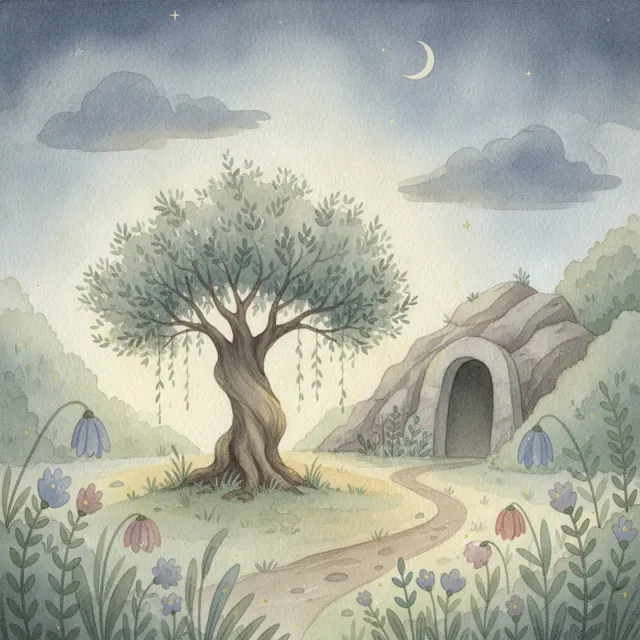
The garden had seen a great deal in its years. It had seen celebrations and arguments, children playing and old men sleeping under its olive trees in the afternoon heat. It had seen storms and sunshine and everything in between. But it had never seen a night like that Thursday night. The man came in late, with his friends. They'd been eating together somewhere in the city and they came here, to this familiar quiet place, to rest and think and pray. The garden watched as the friends fell asleep and the man stayed awake. He prayed for a long time, there under the oldest olive tree. The garden could feel his sadness like a deep root pulling at the earth. The garden didn't want what came next to happen. When the soldiers arrived with their torches, the garden held very still, wishing it could hide the man between its trees. But it couldn't. Friday was dark. Saturday was the quietest day the garden had ever known. The city on the other side of the wall barely breathed. But the garden had been alive for a long time, and it knew something about seeds. It knew that dark and quiet were not the same as over. It knew that the earth held things gently. It knew that waiting had a purpose. On Sunday morning, the garden woke early. Before the sun came up, before the first birds, before the footsteps of the women arriving with their spices and their grief. And then something happened that made every branch and blade and stone in the garden feel like singing. He was there. Alive. Standing in the morning light. The garden had waited and it had not waited in vain.

The Garden Where Jesus Prayed

Ages 3-84 minutesprayer
The Garden Where Jesus Prayed story for kids illustration

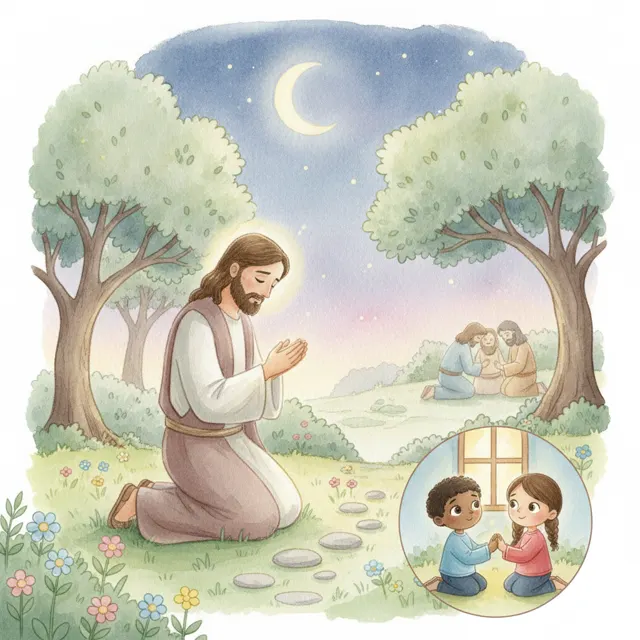
On a quiet night, Jesus goes to a garden to pray while his friends wait nearby. He feels sad, but he talks to God and feels strong. Children learn that praying helps when we are scared or sad.

Moral: Talking to God helps us feel strong when we are sad or scared.

One night, a long time ago, Jesus walked to a quiet garden with his friends. The sky was dark, and the trees were still. "Wait here for me," Jesus said in a soft voice. "I need to talk to God for a little while." His friends sat down under an olive tree. Jesus walked a little farther into the garden. He felt sad and heavy, like a big stone was on his heart. Jesus knelt down and prayed. "Dear God," he said, "this is very hard for me. But I want to do what is right. Help me be brave." The garden was very still. Even the leaves did not move. Jesus prayed for a long time. When he stood up, he did not feel so heavy anymore. He felt calm and strong. He walked back to his friends. They had fallen asleep under the tree. "Wake up," Jesus said gently. "It is time to go." His friends rubbed their eyes and stood up. Jesus looked at them with love. Even though he was sad, he was not alone. God had heard him. Jesus learned that when your heart feels heavy, you can talk to God. And talking helps. It makes the sad and scared feelings smaller. It makes room for peace. And that is the lesson of the quiet garden. When we are scared or sad, we can pray. We can tell God how we feel. And God is always listening. And from that night on, whenever his friends felt scared, they remembered the quiet garden, and they prayed too.

The Kind Man Who Helped Carry

Ages 3-84 minuteshelping
The Kind Man Who Helped Carry story for kids illustration

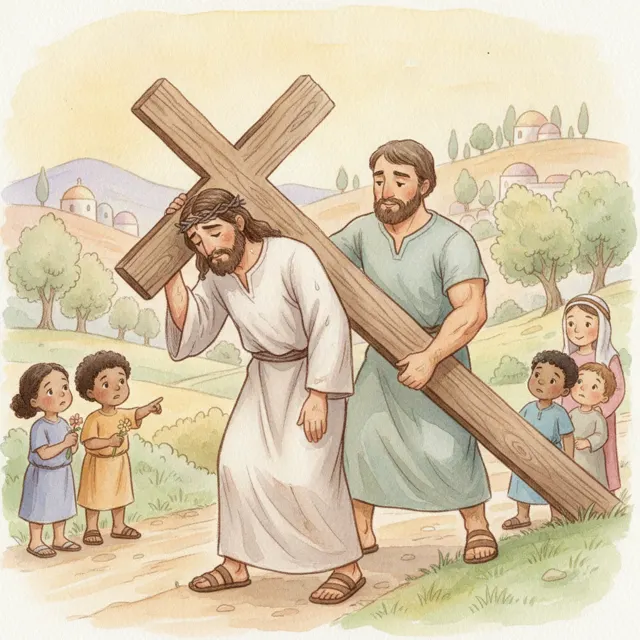
Jesus is tired and the load he carries is too heavy. A kind stranger named Simon steps forward to help him carry it. Children learn that helping someone who is tired is a loving thing to do.

Moral: Helping someone who is tired is a kind and loving thing to do.

On a hot day, Jesus walked along a dusty road. He was very tired. He had been up all night, and now he carried a heavy load on his back. The load was too heavy. Jesus stumbled. His legs shook. The soldiers looked around for someone to help. A man named Simon was walking by. He had come to the city from a farm far away. He did not know Jesus. But when he saw how tired Jesus was, his heart went soft. "You there," a soldier said. "Help this man carry his load." Simon could have said no. He could have walked away. But he looked at Jesus and saw how much he needed help. So Simon stepped forward. "I will help," Simon said. He lifted one end of the heavy load. Together, they carried it down the road, step by step. Jesus looked at Simon. He did not say much, but his eyes said thank you. Simon did not ask for anything in return. He just helped. Later, Simon told his family about that day. "I helped a very kind man who was too tired to walk alone," he said. "And it made my heart feel full." Simon learned something that day. When you see someone who is tired or sad or carrying too much, you can help. You do not have to be strong or important. You just have to be kind. A little help from one person can make a heavy load feel lighter. And Simon was never the same after that day. He had learned the deep joy of helping someone in need.

The Bread and the Cup

Ages 3-84 minutessharing
The Bread and the Cup story for kids illustration

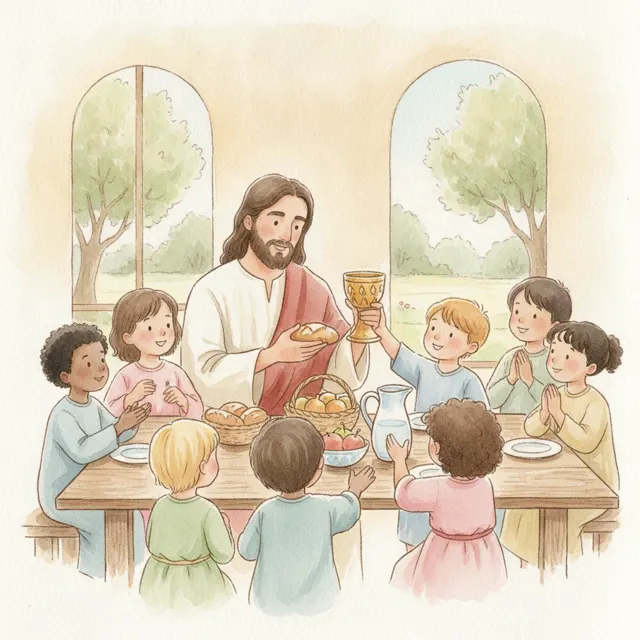
Jesus shares a special meal with his friends. He breaks bread and passes a cup, and he asks them to remember him with love. Children learn that sharing a meal with people we love brings us close.

Moral: Sharing a meal with people we love brings us close together.

One evening, Jesus sat down to eat with his closest friends. The room was warm, and the table was set with bread and a cup. "I have wanted to share this meal with you," Jesus said. "It is a very special night." He picked up a piece of bread. He looked at his friends with love. Then he broke the bread into pieces and gave a piece to each of them. "Take this and eat it," Jesus said. "When you eat bread, remember me. Remember that I love you, always." His friends took the bread quietly. They did not understand everything, but they felt how much Jesus loved them. Then Jesus picked up the cup. He gave thanks to God. He passed the cup around the table. "Drink from this cup," Jesus said. "And when you drink, remember me too. Remember that I am with you, always." Each friend took a sip. The room was very quiet and very full of love. That night, the friends learned something important. Sharing a meal is more than eating. When you break bread with someone, you share your heart with them. You say, "I am glad you are here. You are not alone." And so, when families sit down to eat together, they are doing what Jesus did that night. They are saying, with every bite, "I love you. I am glad you are here." So the next time you sit down for dinner, look around the table. That is where love lives. That is what Jesus wanted his friends to remember.

The Sky That Grew Dark

Ages 3-84 minuteshope
The Sky That Grew Dark story for kids illustration

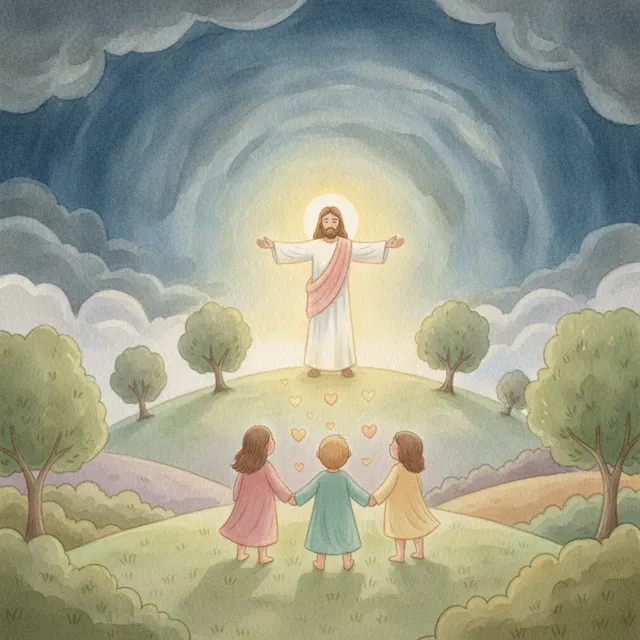
In the middle of the day, the sky turns dark while Jesus is on the hill. Even in the darkness, his love stays bright. Children learn that even when things feel dark, love is still with us.

Moral: Even when things feel dark, love is still with us.

It was the middle of the day, but the sky began to grow dark. The sun hid behind heavy clouds. The birds stopped singing. The whole world seemed to hold its breath. On a hill outside the city, Jesus was on a cross. People watched quietly. Some were sad. Some did not understand. The darkness spread over the land. It was dark like night, even though it was noon. A little boy held his mother's hand. "Why is the sky dark, Mama?" he asked. "Something very sad is happening," his mother said softly. "A very kind man is showing us how much he loves us." The boy looked up at the dark sky. "Is love supposed to feel this dark?" he asked. "No, my love," his mother said. "But sometimes love costs a lot. And even in the dark, love is still there. It does not go away." The boy thought about that. He thought about how the dark comes every night, but the morning always comes back. The sun always rises again. After a while, the darkness began to lift. A little light came back. The world was still sad, but the sadness was mixed with hope. Even today, when the sky grows dark or when we feel sad, we can remember that love stays with us. The dark does not last forever. Morning always comes. And love is the light that never goes out. And the boy never forgot what his mother told him that day. Even in the dark, love is still there. It is the light that never goes out.

The Thief Who Said Sorry

Ages 3-84 minutesforgiveness
The Thief Who Said Sorry story for kids illustration

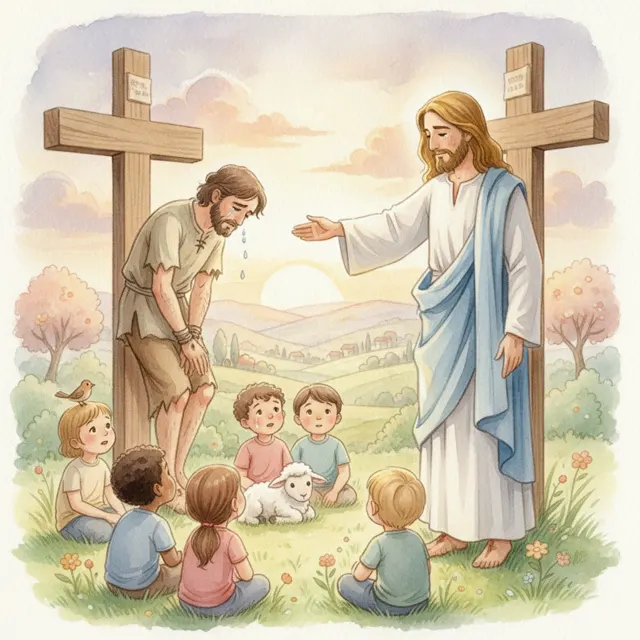
A man who did wrong things hangs near Jesus and is sorry for what he did. Jesus forgives him with kind words. Children learn that it is never too late to say sorry and be forgiven.

Moral: It is never too late to say sorry and be forgiven.

On the hill that day, there were three crosses. Jesus was in the middle. On each side of him was a man who had done wrong things. One of the men was angry. He shouted mean words. But the other man was quiet. He thought about his whole life and all the wrong things he had done. Then the second man spoke to the angry one. "We are being punished for the wrong things we did," he said. "But Jesus has done nothing wrong at all." Then the man turned to Jesus. His voice was soft and shaky. "Jesus," he said, "I am sorry for all the bad things I did. Will you remember me?" Even though Jesus was in great pain, he looked at the man with love. He did not scold him. He did not say, "It is too late for you." Instead, Jesus said kind words. "Today you will be with me in a good and happy place," he said. "You are forgiven." The man's heart felt light for the first time in a long time. All his life he had done wrong. But in one moment, with one honest sorry, everything changed. That is the beautiful thing about saying sorry. It is never too late. No matter what we have done, when we are truly sorry, Jesus is ready to forgive us and welcome us with open arms. That man on the hill had done many wrong things. But the one right thing he did, saying a true and honest sorry, was enough to change everything.

The Friends Who Fell Asleep

Ages 3-84 minutesfriendship
The Friends Who Fell Asleep story for kids illustration

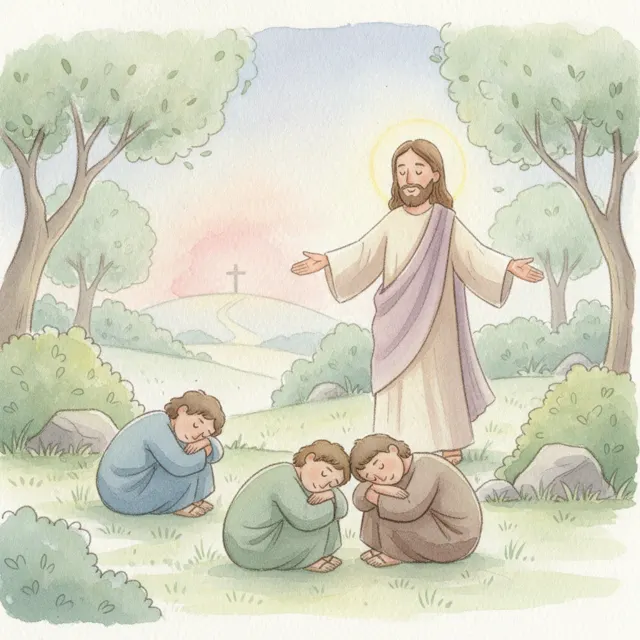
Jesus asks his friends to stay awake with him, but they fall asleep. When he finds them, he is not angry. He forgives them with a gentle smile. Children learn that good friends forgive us when we make mistakes.

Moral: Good friends forgive us when we make mistakes.

On the night before the sad day, Jesus went to a garden to pray. He brought three of his best friends with him. "Please stay awake with me," Jesus said. "I am very sad tonight. I need my friends near me." His friends nodded. "We will stay awake," they promised. "We will stay right here with you." Jesus walked a little way into the garden and knelt to pray. He prayed for a long time, telling God how sad and scared he felt. When Jesus came back, he found his friends asleep. Their eyes were closed. They were leaning against each other, snoring softly. Jesus could have been angry. He had asked them for one thing, and they had not done it. But he was not angry. He looked at them with love. "Could you not stay awake for just a little while?" Jesus asked gently. But he said it the way a kind parent talks to a sleepy child. His friends woke up, ashamed. "We are sorry," they said. "We tried, but we were so tired." Jesus did not scold them. He forgave them right away. "It is okay," he said. "I love you anyway." And that is what good friends do. When we make mistakes, they forgive us. They do not stay mad. They love us anyway, just like Jesus loved his sleepy friends. The next morning, the friends felt bad about falling asleep. But Jesus did not bring it up again. He just loved them the same as always. That is what real friendship looks like.

The Mothers Who Stayed Close

Ages 3-84 minuteslove
The Mothers Who Stayed Close story for kids illustration

When Jesus is on the hill, his mother and her friends stay near him. They do not run away. Their love stays close. Children learn that love stays close to us, even in hard times.

Moral: Love stays close to us, even in hard times.

On the hill that day, when the sky grew dark, many people ran away. But some people stayed. They could not leave the one they loved. Jesus's mother stood near the cross. Her name was Mary. Her heart was breaking, but her feet would not move. She could not leave her son alone. Next to Mary stood a few kind women. They were her friends. They held her hands. They did not say much, because there were no words. They just stayed. One of Jesus's friends, a young man named John, stood there too. Jesus looked down and saw them all. Even in his pain, he wanted to take care of his mother. Jesus spoke to John. "Please take care of my mother," he said. "Treat her like your own mother." John nodded. From that day on, John took Mary into his home and cared for her. It was a promise of love. The women on the hill teach us something very important. When someone we love is hurting, we do not run away. We stay close. We hold their hand. We do not need to fix everything. We just need to be there. Love is not only for the happy days. Love is for the hard days too. And that is when it matters the most. Stay close to the people you love, and they will stay close to you. So when someone you love is sad, be like the mothers on the hill. Stay close. Hold their hand. You do not need many words. Your being there is the whole gift.

Frequently Asked Questions

Turn Your Child Into the Hero of Their Own Story

Upload their photo and watch as AI creates a beautiful, personalized storybook with illustrations that look just like them. From $5.99/month.

โœจ Make Your Child the Hero

Plans from $5.99/month