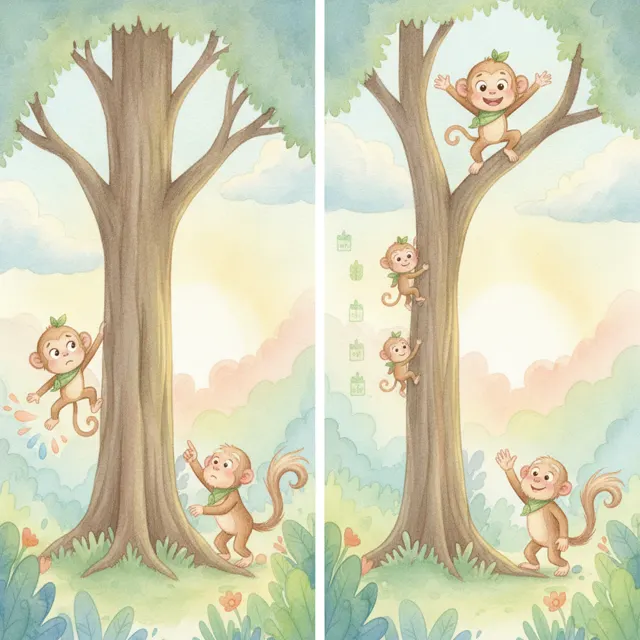
Monkey Stories for Kids

Swing through the jungle with cheeky, curious monkeys who get into playful mischief, discover the value of thinking before acting, and celebrate the joy of learning.

โœจ Make Your Child the Hero

Monkeys bring energy and laughter to every story they join. Kids adore their swinging, their silly faces, and the cheerful chaos of jungle life. A monkey can climb anywhere, get into anything, and still end the day with a big grin. Our monkey stories follow curious little monkeys through treetops and riverside markets, learning lessons about listening, sharing, and thinking before you leap. Whether they are chasing a runaway banana or helping a friend in trouble, there is always a gentle lesson waiting at the end. With CreateStory.ai, your child swings right into the action and becomes the hero of their own jungle tale.

How Loud Is a Howler Monkey's Big Call?

A howler monkey makes one of the loudest calls of any land animal (Smithsonian's National Zoo). Its big, deep call can be heard about 3 miles away through the forest. That is how it tells other monkeys where its family group lives.

How Many Different Kinds of Monkeys Are There?

There are almost 200 different kinds of monkeys in the world (Britannica). They live in warm places like Africa, Asia, and South America. Some are tiny and some are big, but almost all of them have a long tail and love to climb trees.

Sample Stories

Read these stories, then create a personalized version where your child is the hero

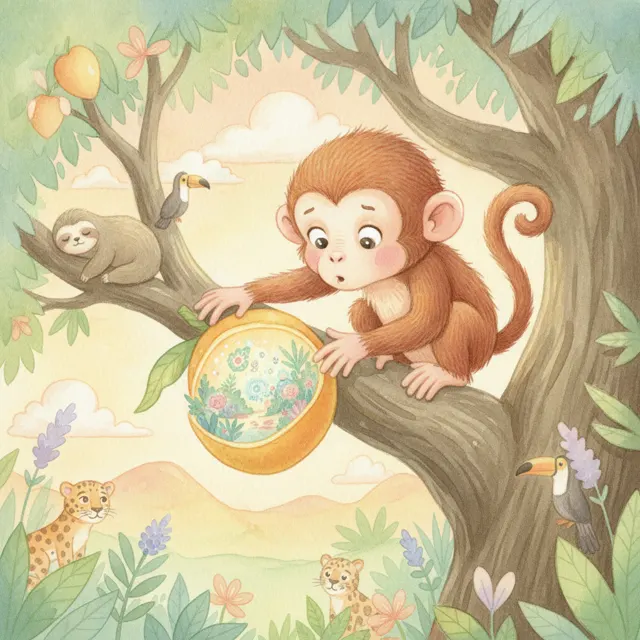
Mango the Too-Curious Monkey
Ages 3-84 minthinking before acting
Mango the Too-Curious Monkey story for kids illustration

Mango the monkey was the most curious creature in the whole jungle. He had to know what was in...

Moral: Stop and think before you leap. It saves a lot of trouble.

Mango the monkey was the most curious creature in the whole jungle. He had to know what was in every nest, what every smell was, and what would happen if he pulled on that particular vine. He usually found out the hard way. The vine incident brought down a bees' nest. The poking-the-sleeping-leopard incident required very fast climbing. The tasting-the-funny-colored-berries incident made him hiccup for an entire afternoon. His grandmother watched all of this with patient eyes. She had raised six young monkeys and they had all been exactly like this. One day Mango came to her. "I want to cross the river to the mango trees on the other side," he said. "The trees here are empty." "How will you cross?" she asked. "Jump on the stepping stones!" "Which stepping stones?" Mango pointed. There were five large flat rocks visible above the waterline. "What happens if one is slippery?" Nana asked. Mango had not considered slippery rocks. "What's at the other bank? Any animals in that territory?" Mango had not looked. "What will you do if the river rises while you're over there?" Mango opened his mouth and then closed it. Nana smiled. "Three questions before every adventure," she said. "What could go wrong? What am I going to do if it does? And who else should know where I'm going?" Mango thought about all three. He noticed from the high branch that the third stepping stone looked wet and slick. He looked at the far bank and found it empty. He told Nana where he was going. Then he went. He avoided the slippery third stone by leaping past it. He got to the mango trees. They were, as he'd suspected, excellent. He brought some back for Nana. It was, he had to admit, a more satisfying adventure than the bee incident.
Zazu and the Stuck Pot

Ages 3-84 minasking for help
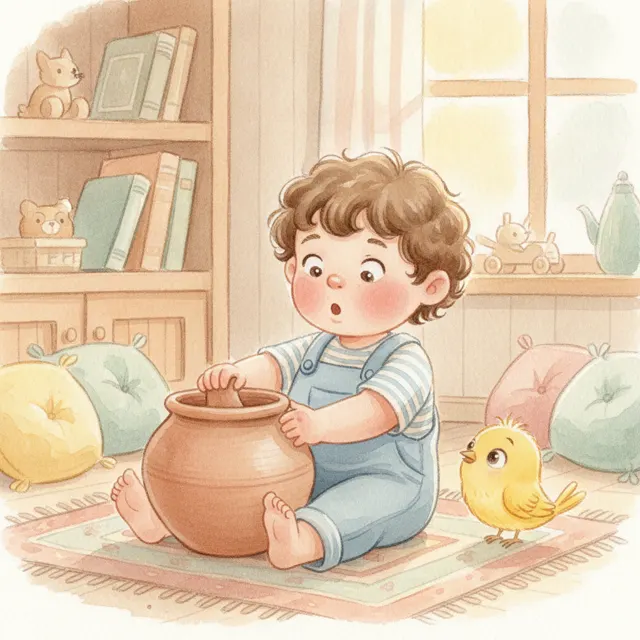
Zazu and the Stuck Pot story for kids illustration

Zazu had put his hand into a clay pot to feel what was inside, and now his hand was stuck. This...

Moral: There's no shame in asking for help. Everyone gets stuck sometimes.

Zazu had put his hand into a clay pot to feel what was inside, and now his hand was stuck. This had been entirely predictable to everyone except Zazu. He'd felt something interesting in the pot. He'd reached in. His fingers had closed on a smooth round thing, probably a pebble, and when he tried to pull his hand out, his fist with the pebble was too wide for the opening. He had two options: let go of the pebble, or get help. He very much wanted to keep the pebble. He tried turning his wrist. He tried going slowly. He tried quickly. He tried both hands pulling in the same direction, which didn't help as much as he'd hoped. He sat with his arm in a pot for twenty minutes trying to solve this alone. His cousin Tari found him. Tari had seen this before, because Zazu did this every few months and it was always something different. "Let go of whatever's in there," Tari said. "But it might be a good pebble," Zazu said. "And your hand is stuck," Tari pointed out. Zazu opened his fist. His hand came free immediately. He looked into the pot. The pebble was ordinary. "If you'd asked me first," Tari said, "I'd have told you to check what was inside before reaching in. There's a way to tip the pot. Here." She showed him how to tilt it so the contents rolled to the opening and could be seen first. "Oh," said Zazu. "Yes," said Tari. Zazu was quiet for a moment. "I keep trying to solve everything myself," he said. "I know," Tari said. "And you're good at lots of things. But 'asking someone who's done it before' is also a skill." Zazu thought this was fair.

The Monkey Who Made Everyone Laugh

Ages 3-84 minusing gifts wisely
The Monkey Who Made Everyone Laugh story for kids illustration

Koko the monkey was the funniest creature in the forest. He could do a perfect impression of every...

Moral: Your gifts are most wonderful when they bring joy instead of trouble.

Koko the monkey was the funniest creature in the forest. He could do a perfect impression of every bird, make faces that caused the young ones to fall over laughing, and had a gift for finding the funny side of absolutely anything. He used this gift to play pranks. He hid the tortoise's best leaf under a log. He confused the parrots by mimicking their calls from the wrong direction. He balanced a large fruit in a tree so it fell the moment old Gus walked underneath. The pranks were funny, to Koko. Less funny, he gradually noticed, to the animals they landed on. The turning point was the young deer, Fern, who had come to the forest new and nervous, and Koko's impression of a panther made her run into a tree. She wasn't badly hurt. But she was very scared and very upset. Koko felt something he hadn't felt before after a prank. He felt bad. He went to Fern and apologized, which also felt unusual but also right. Then the forest elder, old Maka, found him sitting in a tree looking thoughtful. "Funny isn't the problem," Maka said. "Funny is a gift. It's what you do with it." "I made Fern run into a tree," Koko said. "Yes. But remember when you did your parrot voices during the dry season when everyone was miserable? The whole forest laughed for an hour. It lifted everyone." Koko remembered. That had felt different. Bigger. "Funny shared is a gift," Maka said. "Funny at someone's expense is just a prank." Koko thought about his gift differently after that. He developed a whole set of voices and faces that he performed for the young ones on festival evenings. He made the elders laugh with perfect timing and not one fright. It was, he found, considerably better.

Blue Sky Thinking

Ages 3-84 mincreativity
Blue Sky Thinking story for kids illustration

The mango season was late. The trees had fruit but it was all at the very tops, higher than any...

Moral: Imagination and trying new things can solve old problems.

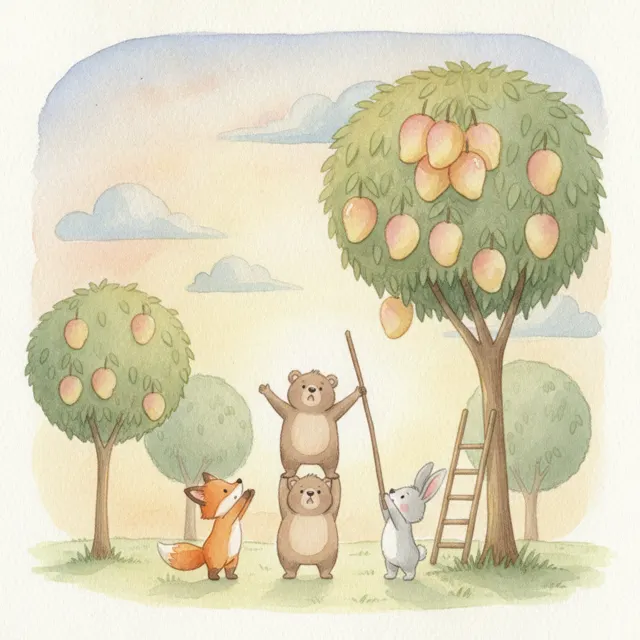
The mango season was late. The trees had fruit but it was all at the very tops, higher than any monkey had been able to reach because the lower branches had broken in the storms. Every monkey looked at the mangoes. Every monkey scratched their head. "Wait for them to fall," said one. They always fell eventually. "But that takes weeks," said another, "and we're hungry now." Young Bim was quiet, looking at the trees. He was thinking something that felt a bit silly. He decided to say it anyway. "What if we made a long stick?" Everyone looked at him. "A long stick," he said, "from two shorter sticks tied together. And at the end, a forked branch to hook the fruit stalk." Silence. Then his friend Zola said, "Would that reach?" "If it's long enough," Bim said. They tried it. The first attempt was too wobbly. The second attempt was stronger because they chose thicker sticks. The third attempt, with a proper fork at the end, worked. The first mango fell from the top branch and landed softly in the leaves below. The whole group stared. Then everyone was making long forked sticks and the mango harvest was on. By afternoon they'd collected more than they could eat in a week. The oldest monkey in the group, silver-furred Ren, found Bim and put a hand on his shoulder. "We've been waiting for mangoes to fall for a hundred seasons," she said. "How did you think of this?" "I wondered what we could do differently," Bim said. "I kept asking 'what if' until I found something." "Remember that," Ren said. "'What if' is the most useful question there is."

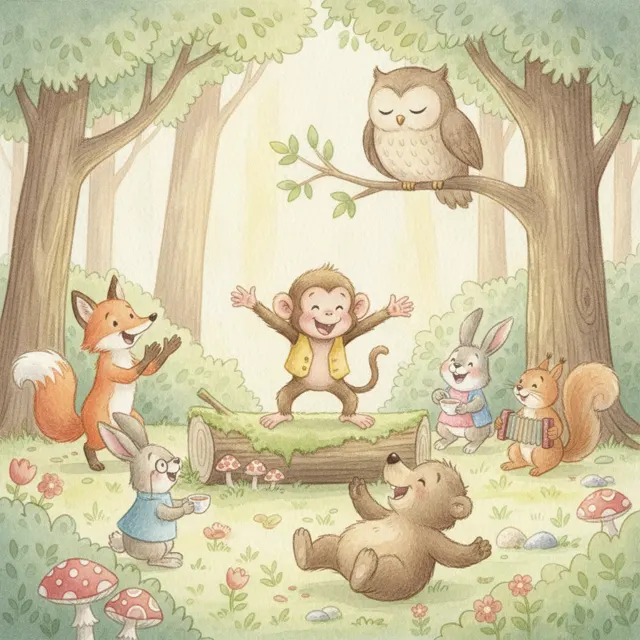
Milo's Big Show

Ages 3-84 minsharing talents
Milo's Big Show story for kids illustration

Milo the monkey was an extraordinary dancer. Not just bouncing up and down, but real dancing, with...

Moral: Sharing your talent with others multiplies the joy.

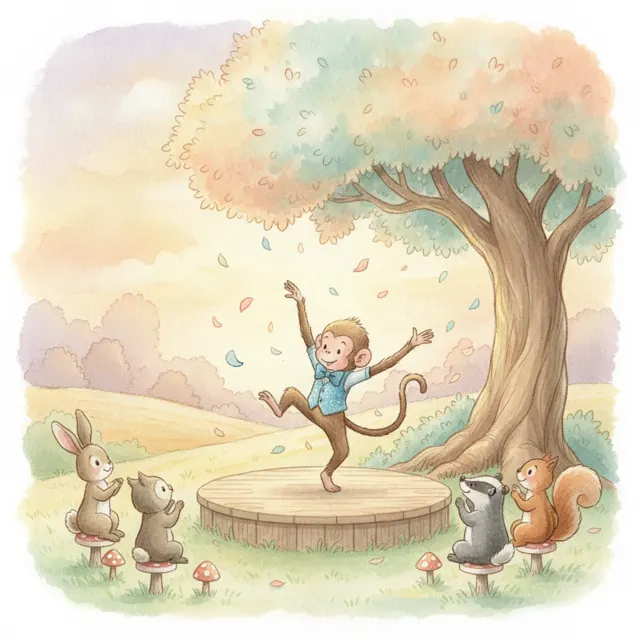
Milo the monkey was an extraordinary dancer. Not just bouncing up and down, but real dancing, with rhythm and timing and moves that somehow told a story. He could make a leap look like surprise, a spin look like joy, and a slow pause look like sadness. But Milo danced alone, deep in the forest, where nobody could see. He was afraid people would laugh. Not the good kind of laughing, the kind where they were laughing because they were happy. The other kind. His sister Lena saw him dancing once and he stopped immediately. "Don't stop," she said. "It's stupid," he said. "It's beautiful," she said. Milo sat in the tree for a long time after that. The forest held its end-of-wet-season gathering each year. Animals came from across the area. There were games and fruit and the young ones showed things they'd made or grown. Lena put Milo's name on the list. He was furious. Then terrified. Then, on the day of the gathering, he almost didn't come. But Lena was there, and she looked at him without saying anything, and somehow that was enough. He danced. The clearing went completely silent. Every animal watched as Milo moved, telling the story of the season just gone: the dry heat, the first rains, the flood scare, the recovery, the new green. When he finished, nobody moved for a moment. Then the clearing erupted. Milo stood in the middle of it, shaking a little, heart going fast. A small younger monkey ran up to him. "Can you teach me?" she said. That was the moment he understood that talent kept hidden helps only yourself. Talent shared, it turns out, grows.

Rollo Waits for the Mango

Ages 3-83 min readpatience
Rollo Waits for the Mango story for kids illustration

Rollo the monkey finds a green mango that is not ripe yet. He wants to eat it right away, but it is hard and sour. His mother teaches him to wait for the mango to turn soft and sweet. Rollo learns that waiting is worth it.

Moral: Some things taste best when you wait for them.

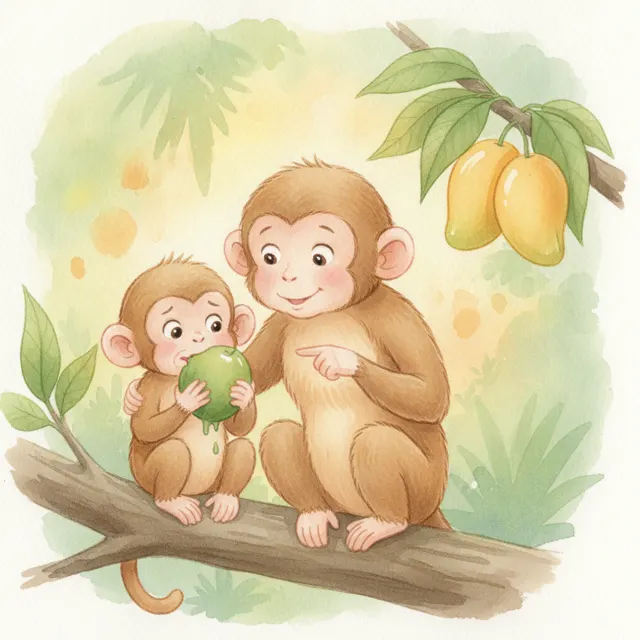
Rollo the monkey swung through the trees and found a big green mango hanging from a branch. "Yum!" he said. "A mango just for me." He pulled it off and bit into it. Blah! It was hard and sour. His face scrunched up. "This mango is no good," said Rollo. "It is hard as a stone." His mother swung over and looked at the mango. "It is not no good," she said. "It is just not ripe yet. You ate it too soon." "But I want a sweet mango now," said Rollo. "A green mango needs time," said Mama. "It must stay on the tree in the sun until it turns soft and yellow and sweet." Rollo looked at the half-eaten green mango. "So I wasted it?" "No," said Mama. "Look over there." She pointed to another mango, small and green. "This one is not ready either. But if we leave it on the tree and wait, it will turn sweet." "How long do we wait?" asked Rollo. "Until it is ready," said Mama. "Good things take time." So Rollo waited. He checked the mango every day. It stayed green and hard. He waited some more. It stayed green. One morning, the mango looked different. It was turning yellow and soft. "Is it ready now?" asked Rollo. "Taste it," said Mama. Rollo pulled it off and took a bite. Juice ran down his chin. It was sweet and warm and wonderful. "The waiting made it perfect," said Rollo. "Now I know why Mama says good things take time."

Four Hands for One Banana

Ages 3-84 min readteamwork
Four Hands for One Banana story for kids illustration

Two monkeys, Kiki and Momo, both want the same big bunch of bananas at the top of a tall tree. Each tries to get it alone and fails. When they work together, one holds the branch while the other grabs the bananas.

Moral: Two monkeys working together can do more than one alone.

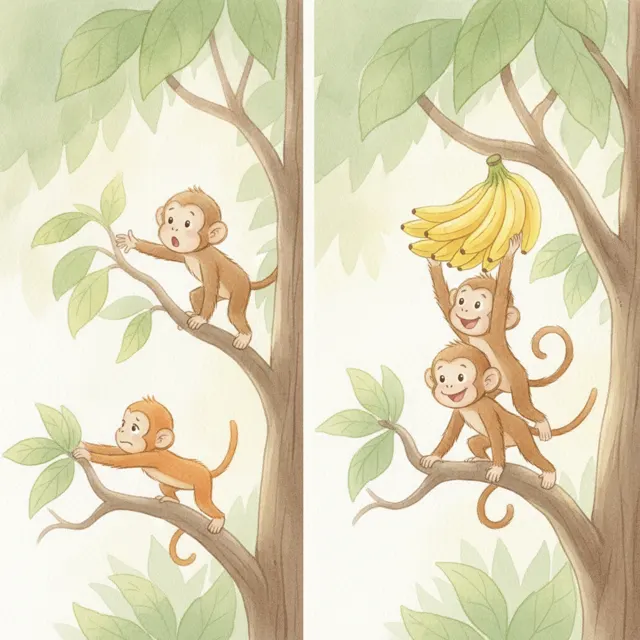
High in a tall tree hung the biggest bunch of bananas Kiki had ever seen. They were yellow and plump and perfect. "I saw them first!" said Kiki. "No, I did!" said Momo. They both climbed up to the thin branch where the bananas hung. But the branch was too thin for two monkeys. "I will get them myself," said Kiki. She reached out. The branch bent down and down. She could not reach the bananas, so she climbed back. "Let me try," said Momo. He reached out too. The branch bent the other way. He could not reach them either. "This branch is too wobbly," said Momo. "We will never get the bananas." Kiki sat and thought. "Maybe we do not need to fight," she said. "Maybe we need to help each other." "What do you mean?" asked Momo. "You hold the branch still," said Kiki. "I will crawl out and grab the bananas. Then we share them." Momo nodded. "That is a good plan." Momo held the branch tight with both hands. Kiki crawled out along it, slow and careful. The branch did not wobble at all. "I can reach them!" said Kiki. She picked the whole bunch and crawled back. They sat together on a wide branch and split the bananas. Half for Kiki and half for Momo. "Working together was much better than fighting," said Momo. "It sure was," said Kiki, with a mouth full of sweet banana. "Two monkeys are stronger than one." They both laughed with full, happy bellies.

The Missing Berries

Ages 3-84 min readhonesty
The Missing Berries story for kids illustration

Tiki the monkey eats all the berries his mother was saving for a family meal. He hides the empty basket and blames a bird. When his mother asks again, Tiki tells the truth. His mother forgives him, and Tiki learns honesty matters.

Moral: It is better to tell the truth than to hide a mistake.

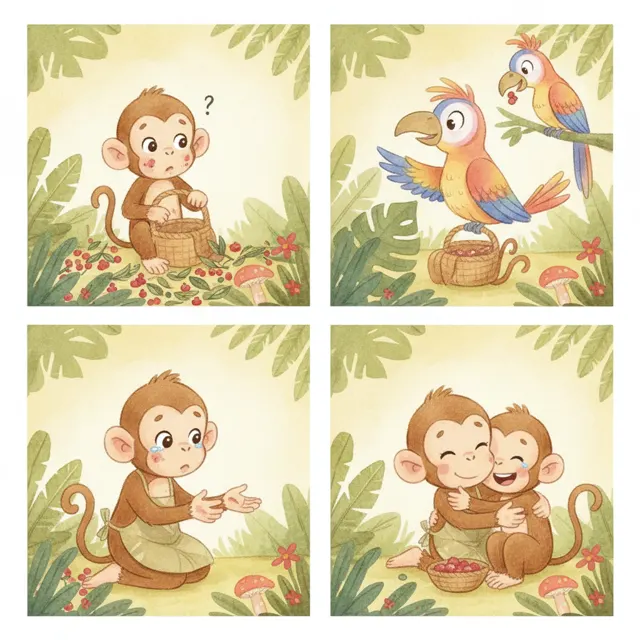
Tiki the monkey found a basket full of juicy red berries in the tree house. They were for the family meal that night. "Just one little berry," he said to himself. He ate one. It was sweet. He ate another. Then another. Before he knew it, the whole basket was empty. "Oh no," said Tiki. "Mama will be so cross with me." He hid the empty basket behind some leaves. Then he sat down and tried to look busy. That evening, his mother came to get the berries. "Tiki, where is the basket of berries I put up here?" she asked. "I do not know," said Tiki. "Maybe a bird took them." "A bird?" said Mama. "A bird ate a whole basket of berries?" Tiki looked at his feet. His tummy felt heavy. He could still taste the sweet berries on his tongue. "No," he said very softly. "It was not a bird. It was me. I ate them all. I am sorry, Mama. I told a lie." Mama sat down beside him. "Thank you for telling me the truth, Tiki. That was very brave." "But now we have no berries for the meal," said Tiki. "We can pick more tomorrow," said Mama. "A basket of berries is easy to find. A monkey who tells the truth is worth a hundred baskets." Tiki felt his heavy tummy grow light. "Next time I want a snack, I will ask you first," he said. "And I will never tell a lie again." Mama pulled him close. "That is my honest boy."

Momo and the Tired Old Turtle

Ages 3-84 min readkindness
Momo and the Tired Old Turtle story for kids illustration

Momo the monkey is busy playing with his friends when he sees an old turtle stuck on his back. Everyone laughs, but Momo stops to help him roll over. Later the turtle returns the kindness. Momo learns that helping others is never wasted.

Moral: Helping someone who needs it is always worth your time.

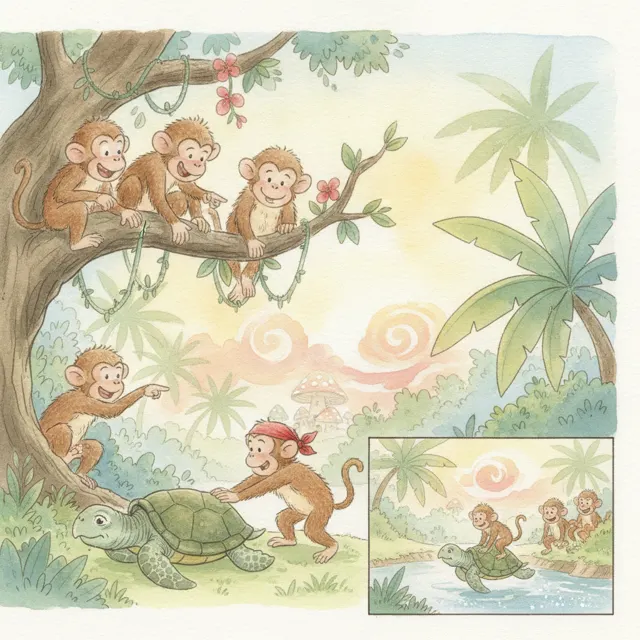
Momo the monkey was swinging and laughing with his friends. They chased each other from branch to branch. Then Momo saw something on the ground below. An old turtle was lying on his back, waving his legs in the air. He could not roll over. "Look at the silly turtle!" laughed one monkey. "He is stuck like a round rock." All the monkeys giggled. But Momo did not laugh. He climbed down the tree and stood beside the turtle. "Are you okay?" asked Momo. "I fell off a log and now I cannot get up," said the turtle. "My legs are too short to push me over." Momo put his hands on the turtle's shell. "I will help you roll over," he said. He pushed with all his strength. Slowly, the turtle tipped onto his side, and then onto his feet. "Thank you, kind monkey," said the turtle. "You stopped to help when no one else did. One day I will repay your kindness." Momo climbed back up the tree. His friends looked confused. "Why did you help that silly turtle?" they asked. "Because he needed help," said Momo. "That is enough." The very next day, Momo was picking fruit and he slipped off a branch. He fell onto a soft, round shell below. It was the old turtle, right under the tree. "I saw you climbing," said the turtle. "I came to stand here just in case." Momo laughed. "It is a good thing I helped you roll over yesterday," he said. "Kindness always comes back around," said the turtle.

The First Big Swing

Ages 3-83 min readcourage
The First Big Swing story for kids illustration

Pico the little monkey is scared to swing from the high vines. His friends make it look easy, but the drop looks too far. His big sister swings beside him and shows him the way. Pico takes his first big swing.

Moral: You can be scared and still do brave things.

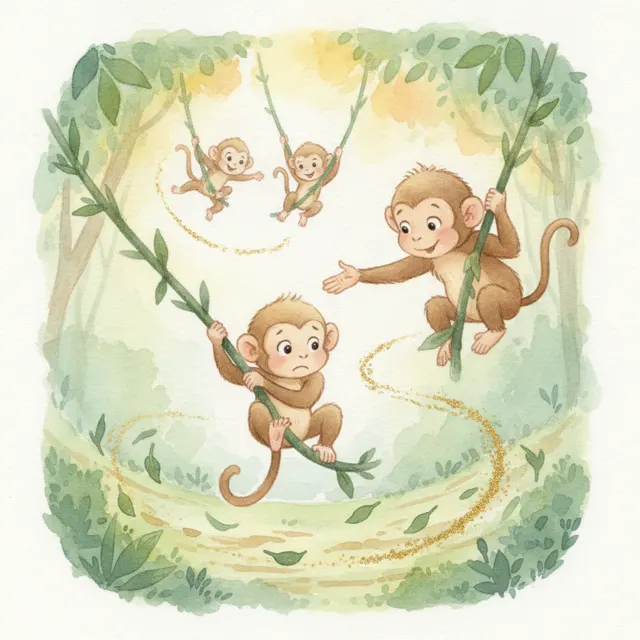
Pico the little monkey watched his friends swing from the high vines. They flew through the air, laughing and whooping. "Come on, Pico!" they called. "Swing with us!" But Pico stayed on his branch. He looked down at the ground far, far below. His tummy felt wobbly. "I am too scared," said Pico. "The vines are too high." His big sister, Zara, landed softly beside him. "I was scared too, on my first big swing," she said. "Every monkey is." "Really?" said Pico. "But you make it look so easy." "That is because I practiced," said Zara. "And I started with small swings. Watch me. I will swing right beside you." Zara grabbed a vine and swung in a slow, gentle arc. Back and forth. Back and forth. "Now you try," she said. "Just a small swing first. You do not have to go high or fast." Pico took hold of a vine with both hands. His fingers were shaking. He took a deep breath. "Here I go," he whispered. He pushed off. The vine carried him in a small, gentle arc. The wind brushed his fur. It felt like flying. "I am swinging!" he shouted. "Zara, I am really swinging!" "Now a little higher," said Zara. "I am right here beside you." Pico swung higher and higher. His fear melted away, little by little. Soon he was whooping and laughing with the rest of the monkeys. "I was so scared," said Pico. "But I did it anyway." "That is what brave means," said Zara.

The Monkey Who Could Not Whistle

Ages 3-84 min readself-acceptance
The Monkey Who Could Not Whistle story for kids illustration

Fifi the monkey can do many tricks, but she cannot whistle like her friends. She feels left out at the big forest party. Then she shows everyone her special drumming, and they all cheer. Fifi learns her own talent is just as good.

Moral: You have your own special talent to share.

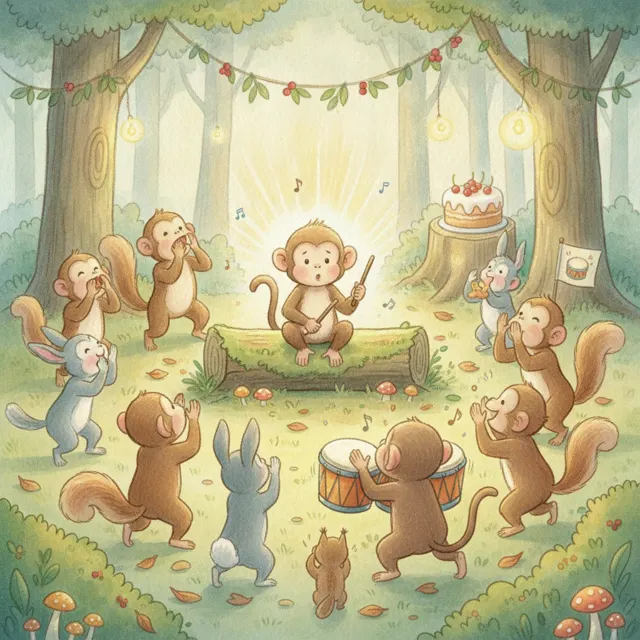
All the monkeys in the forest were getting ready for the big party. They were going to whistle a happy song together. "Fifi, you whistle too!" said her friends. Fifi tried. She pursed her lips and blew. Nothing came out but a puff of air. "Pfft," went Fifi. No whistle at all. She tried again. "Pfffft." Still nothing. Her friends giggled. "Every monkey can whistle," said one. "Why can you not?" Fifi felt her cheeks turn hot. "Maybe I am not a very good monkey," she said. She sat alone on a branch, far from the party. She felt small and left out. Then she saw a hollow log on the ground. She picked up two sticks and began to tap them on the log. Tap, tap, tap. It made a happy sound. She tapped faster. Tap-tap, tap-tap, tap-tap-tap. It sounded like a little drum. The other monkeys stopped whistling and listened. "What is that wonderful sound?" they asked. "It is Fifi!" said one. "She is drumming!" They all gathered around. Fifi tapped and drummed on the log, and the monkeys clapped along. "You have your very own music, Fifi!" said a friend. "We can whistle, but none of us can drum like you." Fifi smiled so wide her cheeks hurt. "I may not whistle," she said. "But I can make my own kind of music." They whistled and drummed together all night long. It was the best party the forest had ever seen. Fifi kept the beat for the whole happy song.

Gogo Tries the Big Climb

Ages 3-85 min readperseverance
Gogo Tries the Big Climb story for kids illustration

Gogo the young monkey wants to climb the tallest tree in the jungle. He slips and falls many times and wants to give up. His grandpa teaches him to climb a little higher each day. Gogo keeps trying and reaches the top.

Moral: You can reach the top if you keep climbing.

Gogo the young monkey looked up at the tallest tree in the jungle. Its top touched the clouds. "I want to climb to the very top," said Gogo. He grabbed the trunk and began to climb. Up and up he went. Then his hand slipped on the smooth bark. Down he slid, all the way to the ground. "This tree is too hard," said Gogo. "I quit." His grandpa swung over. "No monkey climbs the tallest tree on the first try, Gogo. Even I fell many times when I was young." "You did?" said Gogo. "Many, many times," said Grandpa. "But I climbed a little higher every day. That is the secret." Gogo stood up and brushed off the dirt. He climbed again. This time he got a little higher before he slipped. He climbed every single day. Each day he went a little bit higher than the day before. Some days his hands hurt. Some days the rain made the bark slippery. But Gogo did not quit. One bright morning, Gogo looked up and saw the top of the tree just a few branches away. He climbed with all his might. Higher and higher, until at last he reached the very top. "I did it!" he shouted. "Grandpa, I am at the top of the tallest tree!" His grandpa climbed up beside him. "I knew you could do it, Gogo. You did not give up, and now look where you are." From the top, Gogo could see the whole jungle. It was the most wonderful view in the world.

Frequently Asked Questions

Turn Your Child Into the Hero of Their Own Story

Upload their photo and watch as AI creates a beautiful, personalized storybook with illustrations that look just like them. From $5.99/month.

โœจ Make Your Child the Hero

Plans from $5.99/month