Tiger Stories for Kids

Follow bold, striped tigers who learn that true bravery means protecting others, that every stripe tells a story, and that fierce can also mean fiercely kind.

โœจ Make Your Child the Hero

Tigers have a special hold on children. The bold stripes, the steady walk, and the way a big cat can be both fierce and gentle at once. There is something about a tiger that makes little ones lean in and listen. Tiger stories are a lovely way to talk about courage, being careful with your strength, and caring for wild places. A tiger can teach a child how to be brave without being loud, and how to stand up for smaller friends. With CreateStory.ai, you can put your child right into a tiger tale, so they become the hero of their own story beside the great cat.

How Many Wild Tigers Are Left in the World?

Today there are about 5,500 wild tigers left in the whole world (WWF). A hundred years ago, there were around 100,000. Tigers now live in only a small part of the land they used to roam, so people work hard to keep them safe.

How Far Can a Tiger's Roar Be Heard?

A tiger's roar is so loud that it can be heard about 3 kilometers away (WWF). That is like hearing someone shout from very far across a city. Tigers roar to talk to other tigers and to warn them to stay out of their space.

Sample Stories

Read these stories, then create a personalized version where your child is the hero

Stripe's First Day Alone
Ages 3-84 mincourage
Stripe's First Day Alone story for kids illustration

Stripe the young tiger had always explored with her mother. Every hunting lesson, every path...

Moral: Facing new and scary things makes you braver for next time.

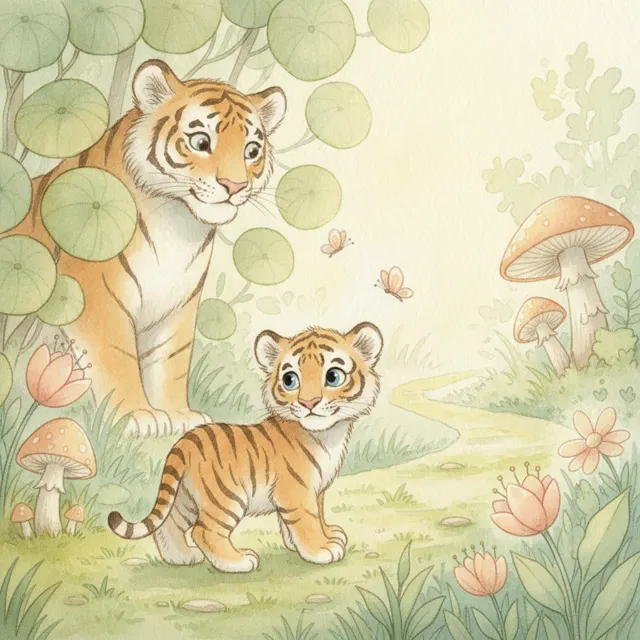
Stripe the young tiger had always explored with her mother. Every hunting lesson, every path through the tall grass, every river crossing, her mother had been there, quiet and sure. Then came the morning her mother said: "Today you go alone." Stripe stood at the edge of the tall grass and looked at the wide land. It felt enormous. She walked. The first hour was full of startling herself. Her own footstep sounded too loud. A bird launched from nearby grass and she spun around. A shadow crossed the ground and she crouched. She felt embarrassed with herself. Tigers weren't supposed to be startled by birds. But she kept walking. She found water. She drank, checking the bank first, the way her mother had shown her. She practiced stalking. She was clumsy at first. On the fourth try she moved quietly enough to get close to a group of deer before they noticed her. She didn't try to catch one. She was just practicing the silent part. By afternoon she was less startled by her own footsteps. She found her way back to the family territory by the smell of the marking trees. Her mother was waiting where the path narrowed. "How was it?" her mother asked. Stripe thought about the bird-scare and the shadow-crouch. She thought about the fourth stalking attempt and the clean drink from the riverbank. "Hard at first," she said. "Better later." Her mother walked beside her. "That's how brave works," she said. "The more times you do the scary thing, the less frightening it becomes and the more you trust yourself." Stripe looked back at the wide land she'd crossed. It didn't look quite as enormous as it had this morning.
The Tiger Who Protected the Forest

Ages 3-84 minresponsibility
The Tiger Who Protected the Forest story for kids illustration

Rajan the tiger was the largest, strongest animal in the bamboo forest. He knew every path, every...

Moral: Those who are strong have a responsibility to protect those who are not.

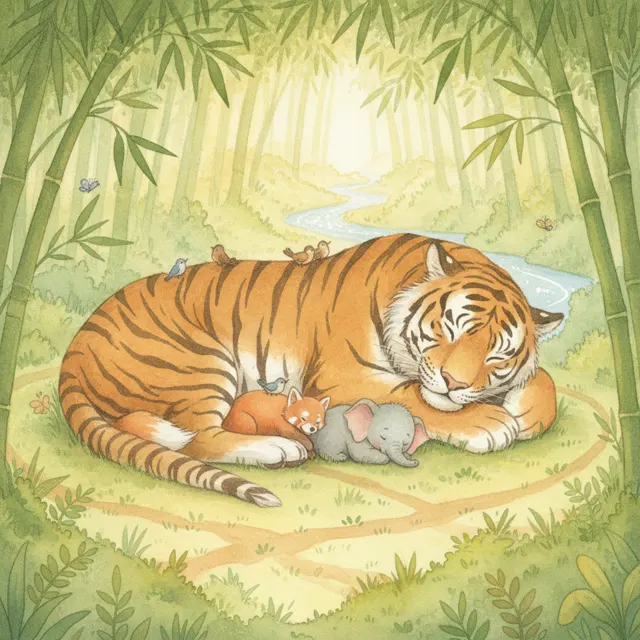
Rajan the tiger was the largest, strongest animal in the bamboo forest. He knew every path, every water source, and every good resting place. He'd always thought of the forest as his. His territory, his hunting ground, his home. Then the poachers came and set traps in the eastern section, and a young deer got caught in a snare near the river. Rajan found the deer in the morning. It was a young thing, a calf really, with wide frightened eyes. It had hurt its leg struggling against the snare. Rajan could have walked on. The deer wasn't related to him. It wasn't his problem. He sat and looked at it for a while. Then he bit through the snare rope. The calf lay still for a moment, then scrambled up. It looked at him. He stepped aside to let it go. It ran. Rajan followed the line of the trap wire to find its source. He followed it back and found three more snares. He destroyed each one. He came back to those paths every day for a week. He destroyed every new trap he found. His presence alone started to discourage the poachers, who didn't want to be near a tiger at work. The other animals in the forest noticed. The deer family moved back to the eastern section. The small pig family used the river crossing again. An old elephant named Sanu stopped beside Rajan one evening. "You didn't have to do that," she said. "Someone had to," he said. "Why you?" Rajan looked at the forest. His forest. Their forest. "Because I can," he said. "And because it's mine to protect. All of it." Sanu walked on without comment, which from a very old elephant was as good as a compliment.

Two Tigers and One Territory

Ages 3-84 minconflict resolution
Two Tigers and One Territory story for kids illustration

Two young tigers, Kala and Yev, both thought the same section of the valley was their territory. It...

Moral: Talking through a problem together usually works better than fighting.

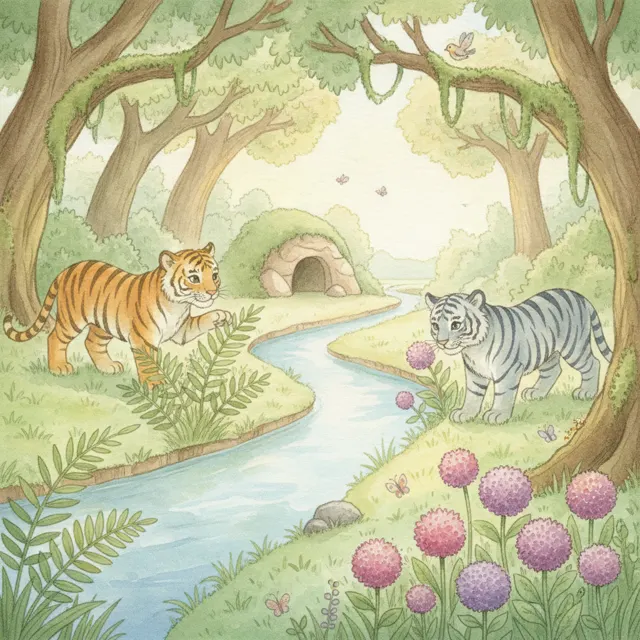
Two young tigers, Kala and Yev, both thought the same section of the valley was their territory. It was an excellent section: good water, good shade, and the deer came through twice a day. They had been circling each other for a week, growling and marking and not eating well because they were too busy worrying about the other one. An old tiger named Sul watched from a hilltop. On the seventh day she came down. "This is going to end with one of you hurt," she said. "And neither of you needs to be hurt." "She keeps crossing my boundary," Kala said. "His boundary," Yev said at the same time. Sul looked at them. "Show me where your boundaries are." They walked her around the section. Their claimed territories overlapped by about a third, in exactly the middle area with the best shade tree and the deer path. "Is the whole section actually necessary for either of you?" Sul asked. Both tigers thought about this reluctantly. "The water's what I need," Kala admitted. "I need the deer path access," Yev said. Sul looked at the map in her mind. The water was on the west side. The deer path was on the east side. "Divide it north to south," she said. "Kala takes the west, Yev takes the east. You both get what you actually need. You share the middle shade tree in the afternoon, alternating days." Both tigers looked at the middle shade tree. "Alternate days," Kala said. "Even days for me, odd days for you," Yev said. Sul watched them agree. "Was that easier than a week of growling?" she asked. The silence suggested yes.

Tiger in the Rain

Ages 3-84 minpersistence
Tiger in the Rain story for kids illustration

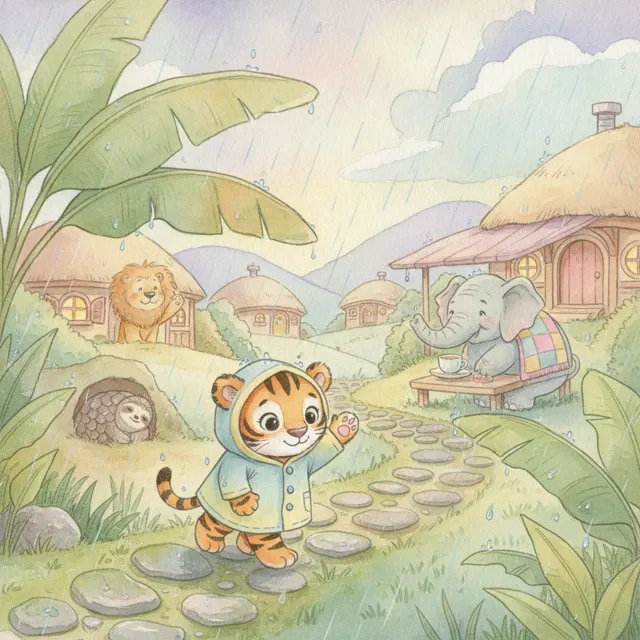
Priya the tiger had promised to check on the older animals in the valley during the monsoon season....

Moral: Don't let bad conditions stop you from doing what needs to be done.

Priya the tiger had promised to check on the older animals in the valley during the monsoon season. It was a thing her mother had done, and her grandmother before that. When the rains came hard, some of the older or smaller animals couldn't always get to the water sources safely. On the worst rain day of the season, the kind where water ran in sheets and the paths turned to rivers, Priya looked out from under her rock shelf. It would have been very easy to stay. She went anyway. The rain plastered her fur flat within seconds. The paths were slippery and cold. She slipped twice in the first ten minutes. She found old Barak the porcupine first, huddled under an insufficient bush. She helped him find a better rocky overhang nearby, walking slowly beside him while he moved. She found the fox family's den flooded at the base. They'd moved uphill but one kit was separated. She tracked it by sound and guided it back to its family. She found the small deer herd sheltering under the big fig tree. They skittered when she arrived, but she moved slowly and kept her distance and they settled. They had water and shelter and were fine. She turned home. She was soaked to the bone, cold, tired, and she'd slipped so many times she'd lost count. She also felt something that didn't have a name exactly but was the opposite of regret. Her mother had called it rightness, the feeling of having done what needed doing because it needed doing, regardless of whether it was comfortable. Priya ate well and slept deeply. The rain hammered the roof all night and she didn't mind it even a bit.

The Tiger Cub's Stripes

Ages 3-84 minidentity
The Tiger Cub's Stripes story for kids illustration

Mali the tiger cub had more stripes than any tiger in the family. While other cubs had clean, even...

Moral: Your unique traits are part of what makes you wonderfully yourself.

Mali the tiger cub had more stripes than any tiger in the family. While other cubs had clean, even stripes, Mali's were uneven, thick in some places and thin in others, and on her left side there was a cluster of stripes that made a shape a bit like a bird. The other cubs had noticed. "Why are yours so messy?" one asked. "They're not messy," Mali said. But when she looked at her reflection in the still water, she wasn't sure. She went to her grandmother, who was very old and had stripes that had faded almost to gold with age. "My stripes are wrong," Mali said. Her grandmother didn't argue or immediately reassure. She looked at Mali's stripes carefully. "Come," she said. They walked to the tall grass. Grandmother walked in first. Mali followed. In the grass, with the sun coming through in lines and patches, Mali looked down at herself. Her uneven stripes matched the uneven pattern of light and shadow in the grass exactly. She disappeared. Grandmother beside her, with neat even stripes, was slightly more visible, a hint of pattern at the edges. "Your stripes are yours," grandmother said. "In this kind of grass, yours works better. Every tiger's markings fit something. You have to find what yours fits." Mali moved through the tall grass slowly, watching herself vanish. She stopped thinking of her stripes as messy. They were hers. The bird shape on her left side was hers. They were the pattern of her own particular self, built exactly right for something even if she was still finding out what. She came out of the grass feeling considerably more herself.

The Tiger Cub Who Roared Too Loud

Ages 3-83 min readself-control
The Tiger Cub Who Roared Too Loud story for kids illustration

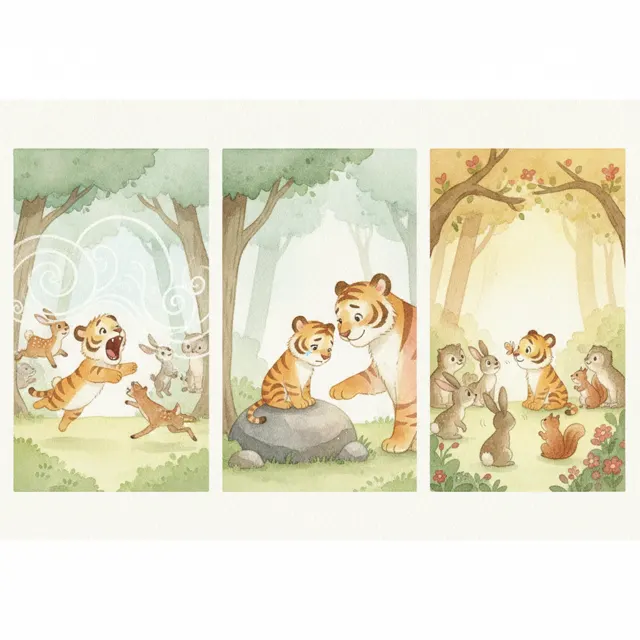
A little tiger cub roars so loudly that he scares all the forest animals away. He feels lonely. His mother teaches him to use a soft voice. He learns that being gentle brings friends back.

Moral: A soft voice can be strong too.

A little tiger cub named Raja had the loudest roar in the forest. He loved to roar. "ROAR!" he would shout, just to hear the echo. But every time Raja roared, the birds flew away, the rabbits hid, and the deer ran deep into the trees. "Why does everyone run from me?" Raja asked his mother one day. "Because your roar is so loud it scares them," she said. "Try using a soft voice. You might make a friend." Raja thought about it. He really wanted a friend. So the next day, when he saw a little rabbit, he opened his mouth to roar. Then he stopped. He took a deep breath and said, very softly, "Hello." The rabbit froze. Then it looked up at Raja. "Did you just say hello?" it asked. "Yes," whispered Raja. "I am trying to be gentle." The rabbit hopped a little closer. "That is much better than a roar," it said. "I am Pip. Want to sit with me in the sun?" Raja sat down very, very softly. "I like this," he said. "I did not know a soft voice could feel so nice." "Your roar is strong," said Pip. "But your soft voice is strong too, in a different way. And sometimes a quiet purr is the nicest sound of all." Raja purred softly, and the little rabbit smiled. From that day on, he saved his big roar for when he was far away and alone, and he used his soft voice with his friends.

Two Tiger Brothers Share the River

Ages 3-83 min readsharing
Two Tiger Brothers Share the River story for kids illustration

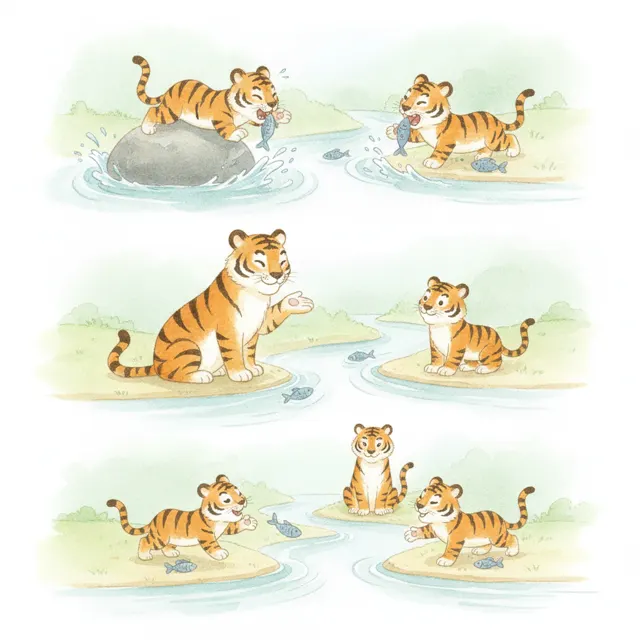
Two tiger brothers fight over who gets the best fishing spot in the river. Their mother shows them they can fish on opposite banks and share the fish. They learn that sharing makes everyone happy.

Moral: Sharing a river is better than fighting over it.

Two tiger brothers, Sam and Ben, loved to fish in the same river. But they both wanted the same spot, where the big fish swam. "I was here first!" said Sam. "No, I was!" said Ben. They growled and pushed each other. The fish all swam away. "Now look what you did," said Sam. "The fish are gone." "You scared them," said Ben. "Not me." Their mother came down to the river. "Why are you two fighting?" she asked. "We both want the best spot," said Sam. "There is one best spot," said Ben, "and it is mine." Mother looked at the wide river. "The fish swim all over this river," she said. "Sam, you fish by that big rock. Ben, you fish by the log. Then you can both catch fish, and no one has to fight." The brothers looked at each other. "Okay," they said. Sam went to the big rock. Ben went to the log. Before long, both of them had caught a fish. "Look!" said Sam, holding up a big silver fish. "Mine is even bigger!" said Ben. They laughed. Then they laid their fish side by side on the grass. "There is enough for both of us," said Sam. "Sharing is better than fighting," said Ben. "And now we have twice as many fish." That evening, they carried their fish home and shared them with the whole family. "Two tigers working side by side catch far more than two tigers fighting," said Sam. Ben nodded. "Next time, we will share the river from the start."

The Tiger Who Helped a Lost Fawn

Ages 3-83 min readkindness
The Tiger Who Helped a Lost Fawn story for kids illustration

A big tiger finds a lost fawn crying in the forest. Instead of being scary, he walks her home. Other animals are surprised a tiger can be kind. The fawn learns that big and strong can also be gentle.

Moral: Strong and kind is the best way to be.

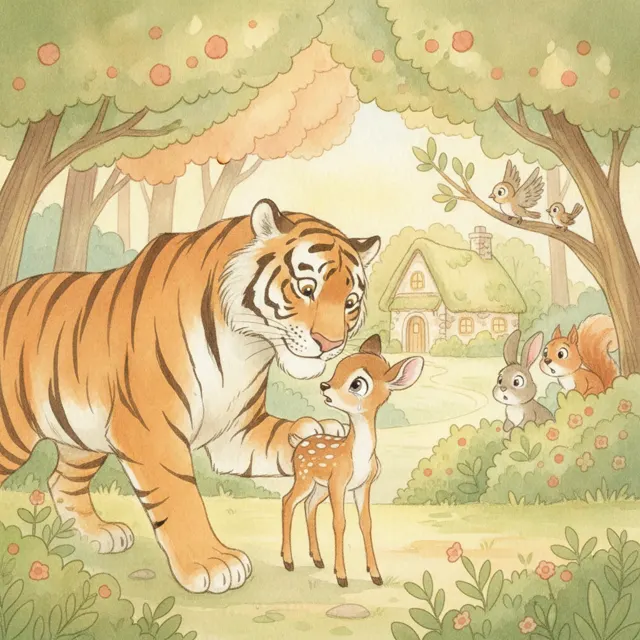
One evening, a big tiger named Kavi was walking home when he heard a soft cry. "Help me!" came a tiny voice. "I am lost." Kavi followed the sound. He found a little fawn sitting under a bush, shaking. "Please do not eat me," said the fawn, with big scared eyes. "I do not want to eat you," said Kavi. "I want to help you. Where is your home?" The fawn pointed with her nose. "That way, past the tall trees. But it is dark, and I cannot find the path." "Come," said Kavi. "I will walk you home. Stay close to me." The fawn walked beside the tiger, right under his warm shoulder. Other animals peeped from the trees. They had never seen a tiger walk so gently with a fawn. "Why are you helping me?" asked the fawn. "You are so big and strong." "Being big and strong does not mean being mean," said Kavi. "The strongest animals are the kindest ones." Soon they reached the tall trees. The fawn's mother came running out. "You found her!" she cried. "Thank you, kind tiger." Kavi bowed his big head. "She found her way," he said. "I just walked with her." The fawn's mother smiled. "A kind tiger is welcome in our home any time," she said. "Would you like to stay for some sweet berries?" "I would like that very much," said Kavi. As he walked home later, the whole forest watched him with new eyes. The biggest, strongest animal was also the gentlest.

Frequently Asked Questions

Turn Your Child Into the Hero of Their Own Story

Upload their photo and watch as AI creates a beautiful, personalized storybook with illustrations that look just like them. From $5.99/month.

โœจ Make Your Child the Hero

Plans from $5.99/month