Teacher Stories for Kids

Learn alongside inspiring teachers who spark curiosity, celebrate every student's unique gift, and show that learning is one of life's greatest adventures.

โœจ Make Your Child the Hero

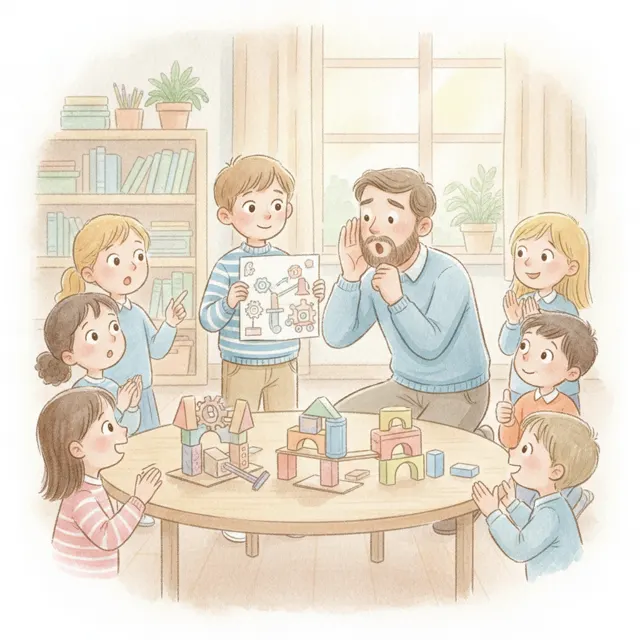
Teachers hold a special place in a child's world. They are the people who help kids learn to read, count, and ask big questions. A teacher story flips the classroom and lets your child stand at the front, sharing what they know with a classroom full of eager students. It is a wonderful way to build confidence, celebrate kindness, and show how helping others learn is its own kind of superpower. With CreateStory.ai, you can create personalized teacher stories where your child becomes the hero of the classroom, guiding their own little class through a day of discovery.

How Many Teachers Work in Classrooms Across America?

About 3.8 million public school teachers work in America's classrooms, according to the Pew Research Center. That is a very big team. Each one helps kids learn to read, write, count, and be kind to one another, every single day at school.

Teachers do so much more than give lessons. They read stories out loud. They teach numbers and letters. They help kids make friends and sort out little problems. School would not be the same without them each and every day.

How Many Days Do Kids Go to School Each Year?

Most K-12 public schools in the United States are in session close to 180 days each year, according to the Pew Research Center. That is a lot of school days, and each one is a fresh chance to learn more.

Every school day is a chance to learn something new and to ask a good question. Kids read books, write words, and count numbers. They play, make friends, and grow a little bit every single day, all through the school year.

Sample Stories

Read these stories, then create a personalized version where your child is the hero

The Day Nia Found Her Voice
Ages 3-84 minconfidence
The Day Nia Found Her Voice story for kids illustration

Ms. Park had twenty-three students in her class, and she knew every single one of them. Not just...

Moral: Every student has something wonderful to offer. A good teacher finds it.

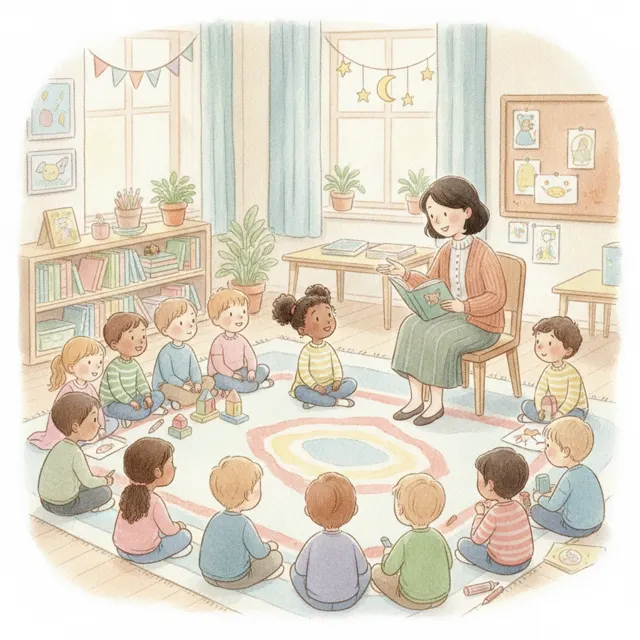
Ms. Park had twenty-three students in her class, and she knew every single one of them. Not just their names and grades. She knew which ones needed quiet to think and which ones needed to talk it through. She knew who came in tired on Monday and who was always hungriest before lunch. Nia was the quiet one who sat in the second row and always looked like she had something to say but couldn't quite get there. Her written work was extraordinary. Her classroom participation was nearly zero. Ms. Park noticed. On a Tuesday afternoon she asked Nia to stay a few minutes after class. "I read your writing about the rainforest," Ms. Park said. "It was the best essay in the class." Nia looked at her shoes. "I read it to myself three times," Ms. Park said. "Did you know that much about rainforests already, or did you research it?" Nia looked up. "I research everything. I have a notebook." "Can I see your notebook?" Nia hesitated. Then she took a worn spiral notebook from her bag. It was full of drawings and notes and facts organized by color. Ms. Park turned through it slowly. "Nia," she said, "this is incredible." She asked Nia if she'd like to share one page from her notebook each Friday. Not a presentation. Just her notebook, on the document camera, while she talked about it. The first Friday was terrifying for Nia. She spoke quietly, staring at the notebook. By the fifth Friday, she was answering questions the class asked. By the end of the year, she was one of the most engaged students in the room. Ms. Park hadn't changed anything about Nia. She'd just found the door that was already there.
Mr. Rivera's Extra Hour

Ages 3-84 mindedication
Mr. Rivera's Extra Hour story for kids illustration

Mr. Rivera taught fifth grade math, and he loved it. He loved the moment when a student's face...

Moral: Teachers who go beyond their job change lives.

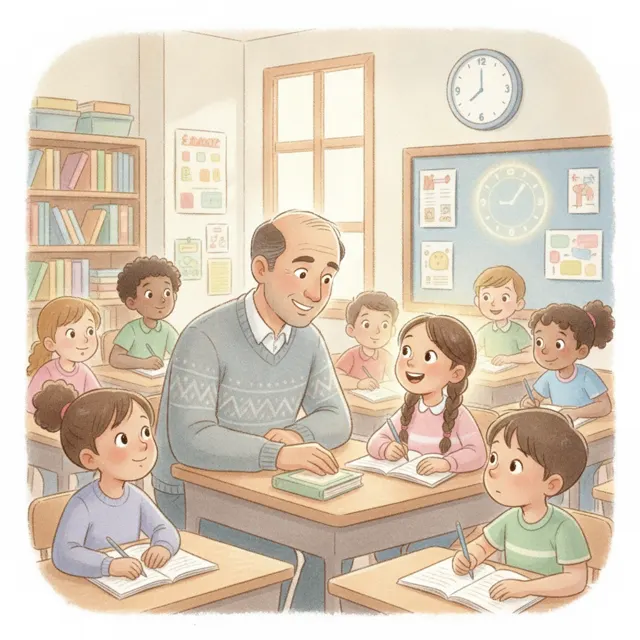
Mr. Rivera taught fifth grade math, and he loved it. He loved the moment when a student's face changed from confused to understanding, that exact second when the light came on. He'd been teaching for twelve years and that moment still made him happy every single time. Miguel had been struggling all year. Not because he was trying less, but because something about the way the numbers fit together wasn't clicking. At parent conferences, Miguel's dad said: "We work on it at home but he gets frustrated." "He's not behind," Mr. Rivera said. "He thinks differently. Let me try something." After school on Tuesdays, Mr. Rivera spent an extra hour with Miguel. Not drilling problems. He used different methods: physical blocks for multiplication, visual models for fractions, games for the facts that needed to be fast. Miguel started to find the patterns. One afternoon in March, Miguel came running into the classroom before the bell. "I figured out the shortcut for nines," he announced, out of breath, backpack still on. "You multiply by ten and subtract. It always works." Mr. Rivera looked at him. "Show me," he said. Miguel showed him. It worked. "Where did you get that?" Mr. Rivera asked. "I was in the car and just thinking and I saw it," Miguel said. Mr. Rivera wrote it on the board: Miguel's Rule. Miguel stared at his name on the board. The class learned Miguel's Rule that day. The class used it for the rest of the year. Twelve years of teaching, and this was still one of Mr. Rivera's favorite days. Not because of the shortcut. Because of the look on Miguel's face when he saw his name on the board and understood that he had something to teach the room.

The Substitute Who Surprised Everyone

Ages 3-84 minopen-mindedness
The Substitute Who Surprised Everyone story for kids illustration

When Ms. Torres was sick for a week, Class 3B got a substitute teacher. His name was Mr. Webb and...

Moral: Keep an open mind. New people and new ways might surprise you.

When Ms. Torres was sick for a week, Class 3B got a substitute teacher. His name was Mr. Webb and he was tall and wore a bow tie and had the kind of enthusiastic energy that made some children nervous. The class had decided before he arrived that substitute weeks were boring. They'd done worksheets with the last substitute. And the one before that. Mr. Webb arrived and did not hand out worksheets. "We're going to do a project this week," he said. "You're going to design an animal. You'll pick its habitat, what it eats, what it's afraid of, and what makes it special. By Friday you'll have a poster and you'll tell me why your animal could survive." The class stared at him. "Can the animal be made up?" asked one student. "Preferred," said Mr. Webb. The week went somewhere no one expected. A girl named Priya invented a deep-sea creature that ate light. She had to research how other creatures survive without sunlight, which led to a very intense day on the ocean floor section of the library website. A boy named Tommy designed a desert bird that collected dew on its feathers. He wanted to know how other animals survived droughts, which led to two hours of genuinely compelling reading. By Friday every student had made something they were invested in. Mr. Webb was only there for one week. But that week several students started library cards. One girl decided she wanted to be a marine biologist. One boy spent the following weekend reading about deserts entirely of his own choice. Ms. Torres came back to find her class talking about made-up animals with the enthusiasm usually reserved for recess. She left a thank-you note for Mr. Webb in the office. She also asked for his email, because she wanted the animal design project for herself.

When Learning Was Hard

Ages 3-84 minempathy
When Learning Was Hard story for kids illustration

Reading was hard for Tom. He was in third grade and reading was still hard, and he knew everyone...

Moral: A teacher who notices when you're struggling and helps without judgment is a gift.

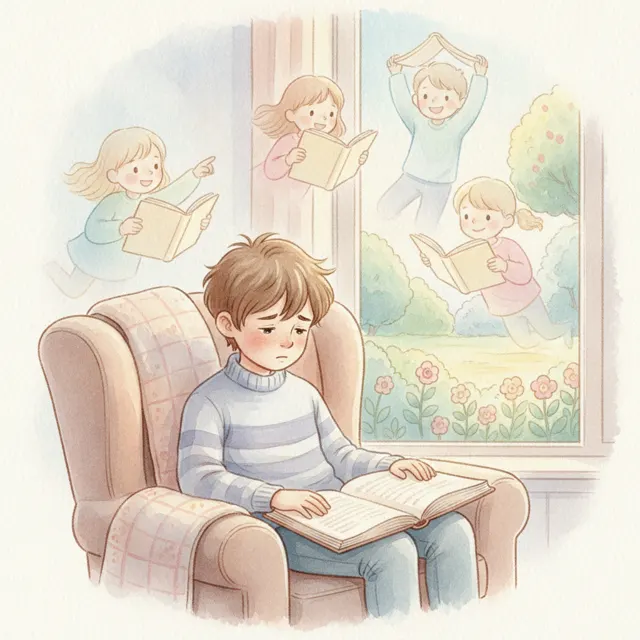
Reading was hard for Tom. He was in third grade and reading was still hard, and he knew everyone else found it easier. He'd developed strategies for hiding it: always pretend you're busy when it's time for read-aloud. Volunteer for math instead. Laugh if someone else mispronounced a word, becauseit distracted from his own struggles. His teacher Ms. Crane noticed anyway. She noticed because she was paying attention. She noticed which students tracked the page with their finger and which ones pretended to. She noticed that Tom always had a "stomachache" on read-aloud Fridays. She didn't call him out. She didn't tell his parents in front of him. She asked him to stay for five minutes after class on a Thursday. "I've noticed reading is sometimes frustrating," she said. "That's not a problem with you. Some people's brains work with letters differently." Tom stared at his hands. "I struggled with math tables until seventh grade," Ms. Crane said. "My teacher told me I was slow. She was wrong, by the way. I just needed a different approach." She gave Tom a different reading program, one with sounds and visual patterns instead of look-and-say. She gave him audio versions of books they were studying so he could hear the story while following along. She moved his read-aloud slot to a quieter pair activity rather than in front of the class. Tom didn't suddenly love reading. It was still hard. But it became less of a secret shame and more of a challenge he was working on. By the end of the year he was reading two full levels ahead of where he'd been in September. At the end-of-year card he gave Ms. Crane, he wrote: "You noticed. That's everything." Ms. Crane kept that card in her desk for fifteen years.

The Last Day of School

Ages 3-84 mingratitude
The Last Day of School story for kids illustration

The last day of school always felt different. Desks cleared of their usual mess. Artwork taken down...

Moral: Saying thank you and meaning it is one of the most important things you can do.

The last day of school always felt different. Desks cleared of their usual mess. Artwork taken down from walls. The classroom that had been full of daily life all year suddenly looking temporary, like a tent that was coming down. Mr. Chen had taught fourth grade for eight years. Every last day felt like this. Complete and a little sad and full. He'd been their teacher since September. He knew which ones had struggled early and found their feet. He knew who'd changed most. He'd watched Lily go from someone who panicked at math to someone who helped others. He'd watched Sam go from bully to someone who stood up for the smaller kids. At noon the students would leave for summer. At ten o'clock, Priya raised her hand. "Mr. Chen, can we say something before we go?" He nodded. She stood up with a piece of paper. She'd clearly prepared. "You remembered everyone's birthday," she said. "Even the ones that were on weekends. You always came back Monday and asked how it was." Another student stood. "You never made anyone feel dumb for asking a question. Even me when I asked about that thing in science." And another: "You stayed after school when I needed help with the report and you never made me feel bad for not getting it the first time." One by one, ten students stood and named one specific thing. Mr. Chen sat at his desk and listened to ten small specific memories, one from each child who wanted to speak. When they were done there was quiet. "Thank you," he said. He meant it for their whole year, not just the morning. At noon they left. The room was quiet. Mr. Chen sat at his desk for a while, looking at the empty room. Next September, twenty-four new students would arrive. He'd learn their names within a week. He'd find out who needed quiet and who needed movement. He'd pay attention, the way he always did. That was the job. That was the whole beautiful, difficult, extraordinary job.

The Teacher Who Learned to Draw

Ages 3-84 min readgrowth
The Teacher Who Learned to Draw story for kids illustration

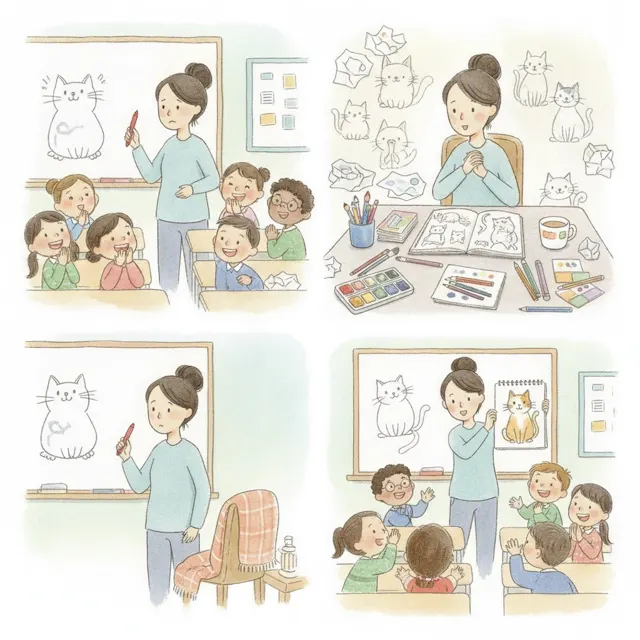
Miss Lin is a good teacher, but she is not good at drawing. When her students ask her to draw a cat, she tries and it comes out wrong. Miss Lin keeps practicing and shows her class it is never too late to learn.

Moral: It is never too late to learn something new.

Miss Lin was a wonderful teacher. She could read stories and count and sing. But there was one thing Miss Lin could not do. She could not draw. One day, a boy named Theo asked, "Miss Lin, can you draw a cat for our story?" Miss Lin felt her face get warm. "I am not very good at drawing," she said. "Please?" said the whole class. So Miss Lin picked up a marker and drew. She drew a circle for a head. Then she drew a body. Then four legs. The class looked at the drawing. It looked more like a lumpy potato with sticks. "That is a very funny cat," said Theo, trying to be kind. Miss Lin laughed. "It is not a good cat. I told you I am not good at drawing." "But you can learn," said a girl named Maya. "You always tell us we can learn anything if we practice." Miss Lin smiled. "You are right. I should practice too." So Miss Lin practiced drawing every night. She drew cats and dogs and trees. Some were bad. Some were better. She did not give up. Two weeks later, Miss Lin said, "Theo, can you draw a cat for our story?" Theo drew a cat with big ears and a long tail. It was wonderful. Then Miss Lin held up her own drawing. It was a cat with whiskers and a curled tail. It looked like a real cat! "Wow!" said the class. "You did it, Miss Lin!" Miss Lin smiled. "I practiced, just like I tell you to. It is never too late to learn something new."

Maya's Shaky First Day

Ages 3-84 min readcourage
Maya's Shaky First Day story for kids illustration

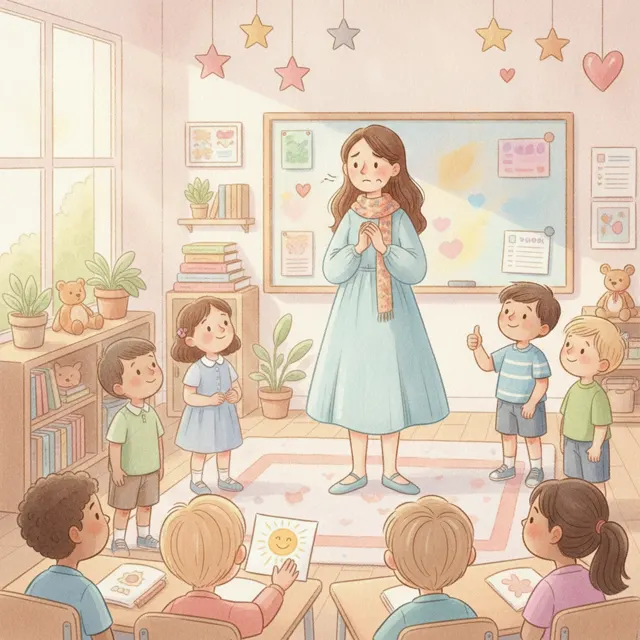
Maya is a brand new teacher, and she is very nervous on her first day. Her hands shake and her voice wobbles. But the kids are kind, and Maya learns that first days are hard for everyone.

Moral: The first day is hard, but you can do it.

Maya stood by the classroom door. Her hands were shaking. Today was her very first day as a teacher. "What if the kids do not like me?" she whispered. "You will be great," said the teacher next door. Maya took a deep breath and opened the door. A room full of small faces looked up at her. "Good morning, class," she said. Her voice wobbled a little. "Good morning," the kids said back. Maya wrote her name on the board, but the marker slipped and made a long squiggle. "Oh no," she said. A boy in the front row smiled. "That is okay. My name is hard to write too." Maya smiled back. "Thank you. That makes me feel better." Then Maya read a story, but she skipped a page by mistake. A girl raised her hand. "Miss, I think you missed a page." Maya's face turned red. "You are right. Let me go back." The girl said, "It is okay. Even my mom makes mistakes." By the end of the day, Maya had read, drawn, and played with the whole class. Her hands were not shaking anymore. At the last bell, a boy ran up to her. "Miss Maya, this was the best first day ever." Maya's heart felt full. "You know what?" she said. "It was my first day too." The boy's eyes went wide. "You were a new kid just like me?" "I was," said Maya. "And you all made it wonderful." The boy smiled. "Then we were new together."

The Quiet Kid's Big Idea

Ages 3-84 min readlistening
The Quiet Kid's Big Idea story for kids illustration

Leo is the quietest kid in Mr. Tom's class. He never raises his hand. But when Mr. Tom really listens, Leo shares a big idea that saves the class project.

Moral: Quiet voices can have big ideas.

Leo was the quietest kid in Mr. Tom's class. He never raised his hand. He never shouted out answers. He just sat in the back and watched. One day, Mr. Tom said, "We need an idea for our class project. Who has one?" Hands shot up. Kids called out ideas. "A dinosaur!" "A rocket ship!" "A big cake!" Mr. Tom looked at the back of the room. Leo was drawing in his notebook. He had not said a word. After class, Mr. Tom walked over to Leo. "Can I see what you are drawing?" he asked. Leo slid the notebook over. It was a picture of a garden with a little bridge and a bench where birds could rest. "This is beautiful," said Mr. Tom. "What is it?" "It is a school garden," said Leo in a tiny voice. "We could plant flowers and watch them grow. And the birds would come." Mr. Tom's eyes lit up. "Leo, this is the best idea I have heard all day. Will you share it with the class tomorrow?" Leo looked nervous. "I do not like talking in front of everyone." "That is okay," said Mr. Tom. "I will stand with you. We can do it together." The next day, Leo stood at the front with Mr. Tom. He showed his drawing and told the class about the garden. "Let us do it!" the class cheered. Leo smiled. His quiet voice had a big idea after all. "Quiet voices can have big ideas," said Mr. Tom. "We just have to listen."

The Teacher's Lost Pencil Box

Ages 3-84 min readhonesty
The Teacher's Lost Pencil Box story for kids illustration

Miss Ada's special pencil box goes missing, and everyone is worried. A boy named Ravi took it because he wanted it. He learns that telling the truth and saying sorry makes things right.

Moral: Telling the truth makes things right.

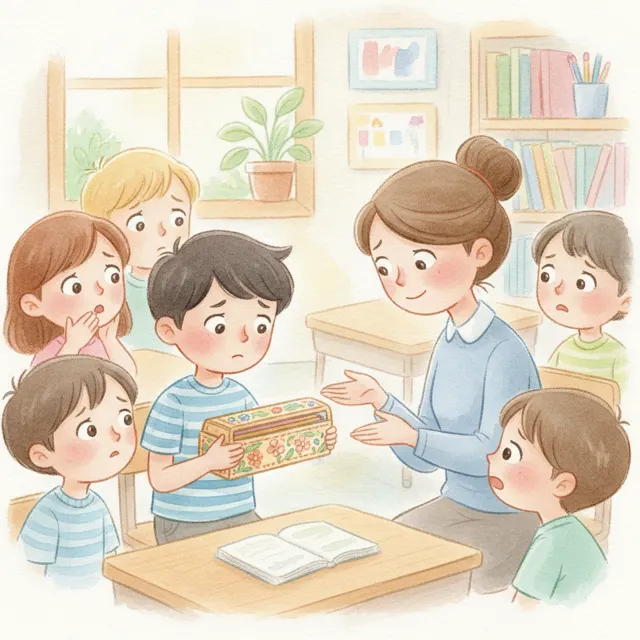
Miss Ada's class was quiet. Her special pencil box was gone. It was bright green with a red lid, and it was full of the best pencils. "Has anyone seen my pencil box?" asked Miss Ada. Everyone shook their heads. But a boy named Ravi looked down at his desk. Ravi had seen the pencil box. It was so pretty. He wanted it. So he had put it in his bag. That night, Ravi could not sleep. The green pencil box sat under his bed. He felt a heavy feeling in his tummy. The next morning, Ravi walked into class. He put the pencil box on Miss Ada's desk. "Miss Ada," he said in a small voice. "I took your pencil box. I am very sorry." Miss Ada looked at Ravi. She did not look angry. She looked kind. "Thank you for telling me the truth," she said. "That was very brave." "But I did a bad thing," said Ravi. "Are you mad at me?" "I am not mad," said Miss Ada. "Everyone makes mistakes. But telling the truth and saying sorry is how we make it right." Ravi felt the heavy feeling lift a little. "I will never take things that are not mine again." "I believe you," said Miss Ada. "Now, how about you help me sharpen all these pencils? That can be your way of making it right." Ravi smiled. "I can do that." All morning, Ravi sharpened every pencil until the tips were perfect. It felt good to help. "See?" said Miss Ada. "When we tell the truth, everything gets better."

The Class That Planted a Garden

Ages 3-84 min readpatience
The Class That Planted a Garden story for kids illustration

Miss Ada's class plants tiny seeds in the school yard. The kids want the plants to grow right away, but they learn to wait and care for them. Good things grow when we work together.

Moral: Good things grow when we work together.

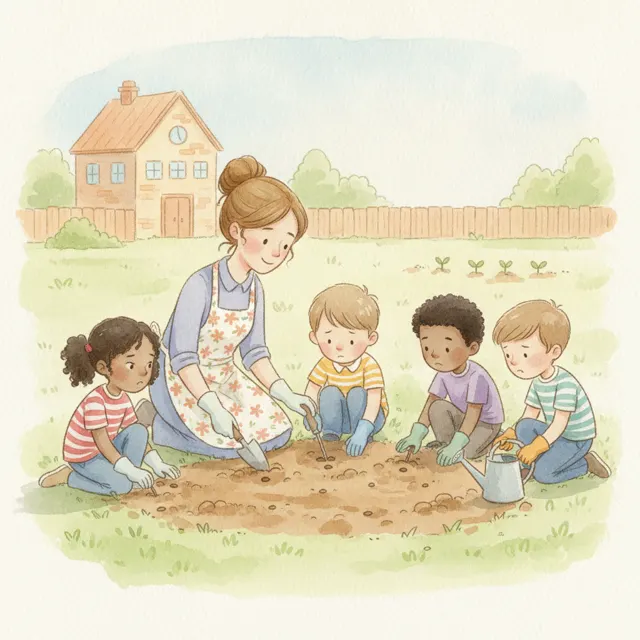
Miss Ada held up a tiny brown seed. "Today," she said, "we are going to plant a garden." The class cheered. They went outside to the school yard with little shovels and a watering can. "Where are the flowers?" asked a girl named Zoe. "They are inside these seeds," said Miss Ada. "First we dig a small hole. Then we put the seed in. Then we cover it with dirt and give it water." The kids dug holes and planted their seeds. Then they stood back and waited. "I do not see anything," said a boy named Kai. "It takes time," said Miss Ada. "A seed needs dirt, water, and sun. And it needs patience." The next day, Kai ran to the garden. "Nothing grew!" he said. "Not yet," said Miss Ada. "Good things take time." So the class waited. Every day they watered the soil and pulled the weeds. They worked together. Zoe held the watering can. Kai pulled the weeds. Everyone took a turn. Then one morning, Zoe shouted, "Look! Green!" Tiny green stems were poking out of the dirt. The class cheered and clapped. Day by day, the stems grew taller. Then little buds appeared. Then the buds opened into red, yellow, and purple flowers. "We did it!" said Kai. "We did," said Miss Ada. "You waited, you worked together, and now look at what grew." The class stood and looked at their garden. It was the most beautiful thing in the whole school yard. And they had grown it all by themselves, with a little help from each other.

The New Boy

Ages 3-84 min readkindness
The New Boy story for kids illustration

A new boy named Omar joins the class and does not speak much English. At first he sits alone at lunch. The teacher and the kids find kind ways to help him feel at home.

Moral: A warm welcome makes everyone feel at home.

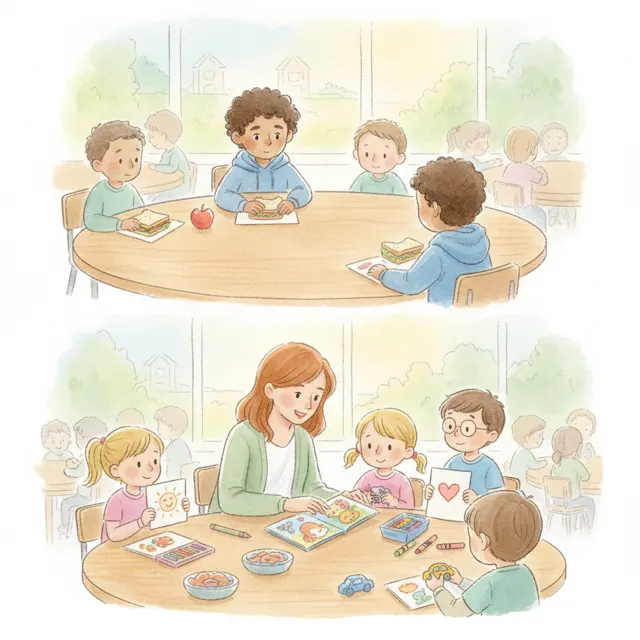
A new boy came to Mr. Tom's class. His name was Omar. He did not speak much English, and he looked at the floor a lot. At lunch, Omar sat alone at the end of the table. He ate his food and did not say a word. "Omar is lonely," whispered a girl named Lily. "We should help him," said Mr. Tom. "But how?" "I can show him where the crayons are," said Lily. "I can share my snack with him," said a boy named Ben. "I can teach him a word," said Mr. Tom. "And he can teach us a word in his language." The next day, Lily walked over to Omar and pointed to the crayons. "Crayons," she said. Omar smiled and picked up a blue one. Ben sat next to Omar at lunch and gave him half of his cookie. Omar smiled and shared a piece of his bread. Mr. Tom pointed to himself and said, "Friend." Then he pointed to Omar. Omar's eyes lit up. "Friend," he said. "Friend!" the whole class said together. Every day, Omar learned a new word, and the class learned a new word from him too. Soon Omar was laughing and playing with everyone. One day, Omar raised his hand. "Thank you," he said in English. "You are my friends." Lily smiled. "You are our friend too, Omar." "A warm welcome makes everyone feel at home," said Mr. Tom. "And now our class is a little bigger and a little kinder."

The Teacher's Rainy Day

Ages 3-84 min readkindness
The Teacher's Rainy Day story for kids illustration

It rains all day and the class is stuck inside. The kids are gloomy until Miss June turns the rainy day into a day of games, music, and paper boats. Kindness brightens a cloudy day.

Moral: Kindness brightens a cloudy day.

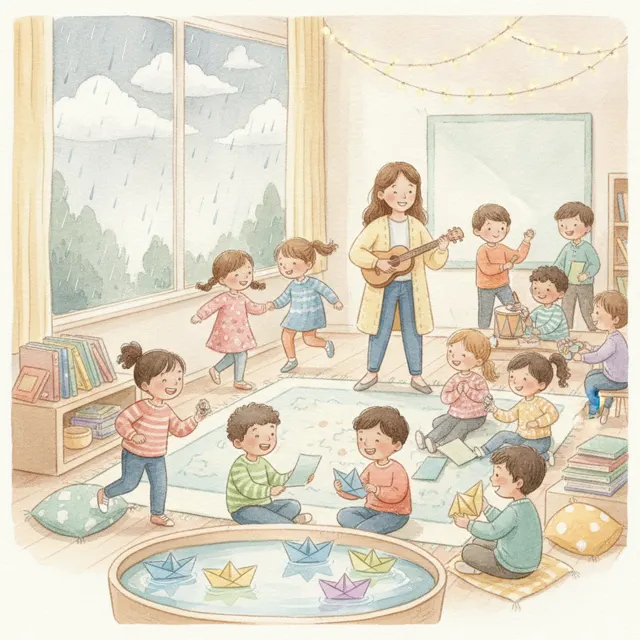
It rained all morning. And all afternoon. The kids in Miss June's class pressed their noses to the window and watched the rain fall. "We cannot go outside," said a boy named Sam. "This is the worst day." Everyone looked gloomy. Miss June looked around the room. Then she smiled. "Who says a rainy day has to be boring?" she said. "We can make our own fun inside." Miss June turned on some music. "Let us dance like the rain!" she said. The kids laughed and danced around the room. Then Miss June passed out paper. "Let us make paper boats," she said. "Then we can sail them in a big bowl of water." The kids folded their paper into little boats. They floated the boats in a big blue bowl and blew on them to make them move. "This is fun!" said Sam. Next, Miss June read a story about a frog who loved the rain. The kids made rain sounds by tapping their fingers on the desks. Tap, tap, tap. By the end of the day, the rain was still falling. But nobody was gloomy anymore. "I liked today," said a girl named Ana. "Even though it rained." Miss June smiled. "Rainy days are not bad. They are just different. And different can be fun." When the last bell rang, Sam ran to Miss June. "Thank you for today," he said. "You made a rainy day feel sunny." The other kids nodded. "Best rainy day ever," said Ana. Miss June laughed. "Kindness can brighten any cloudy day."

Frequently Asked Questions

Turn Your Child Into the Hero of Their Own Story

Upload their photo and watch as AI creates a beautiful, personalized storybook with illustrations that look just like them. From $5.99/month.

โœจ Make Your Child the Hero

Plans from $5.99/month