Beach Stories for Kids

Warm sand, rolling waves, and a child who becomes the hero of every gentle seaside tale about courage and kindness.

✨ Make Your Child the Hero

There is something about a beach that wakes up every kid. The warm sand under your toes, the waves that chase you back and forth, the shells that hide like tiny treasures. Beach stories give your child a front row seat to all of it, from building castles that reach for the sky to rescuing a lost turtle before the tide comes in. With CreateStory.ai, we turn that seaside wonder into something personal. Upload a photo, and your child becomes the hero of their very own beach story, standing right there in the sand, learning big lessons through small seaside adventures.

What can a child learn from a day at the beach?

The beach is a big outdoor classroom. Kids find shells, watch waves, and dig in wet sand. Each one is a small science lesson they can touch.

The ocean covers more than 70 percent of Earth, according to the National Oceanic and Atmospheric Administration. A beach story turns that big blue world into something small a child can hold.

Why do calm beach stories help kids wind down?

Soft waves and slow tides make gentle bedtime stories. A quiet tale about the sea helps a busy child relax before sleep, and it gives a tired mind a calm place to rest.

The American Academy of Pediatrics says parents should read aloud to children starting from birth. A calm beach story is an easy way to build that daily habit.

Sample Stories

Read these stories, then create a personalized version where your child is the hero

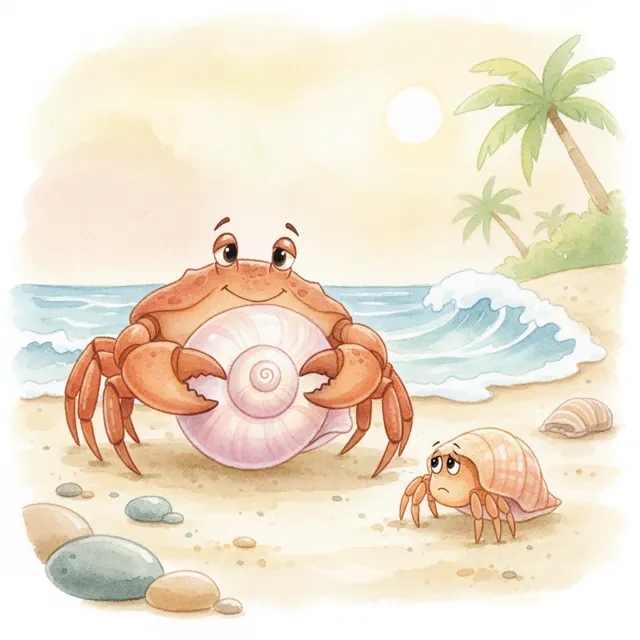
The Crab Who Shared His Best Shell
Ages 3-84 minsharing
The Crab Who Shared His Best Shell story for kids illustration

Crusty the crab finds the most beautiful pink shell on the whole beach. But when he spots a tiny hermit crab with no shell at all, he faces a hard choice. A warm story about why sharing feels good.

Moral: Sharing what you love feels better than keeping it all to yourself.

Crusty the crab had searched all morning. He scurried past driftwood and dodged a wave, and then, half buried in the sand, he saw it. A shell. The most beautiful pink shell on the whole beach. "It is perfect," he whispered, and slipped inside. It fit just right. Crusty paraded up and down the shoreline. "Have you ever seen a shell like this?" he asked the gulls. The gulls just squawked and flew off. He did not mind. He had the best shell in the world. Then he heard a small, sniffly sound behind a rock. A tiny hermit crab was sitting there with no shell at all. Her eyes were wet. "What is wrong?" Crusty asked. "My shell broke," she said. "The waves rolled a big stone over it. Now everyone can see me, and I feel so small." Crusty looked at his pink shell. Then he looked at the little crab. His heart did something funny, like a flip. "Try this one," he said, and stepped out. The little crab's eyes went wide. "But it is yours. It is the prettiest shell on the beach." "You need it more than I do," Crusty said. "Go on." She slipped inside, and the pink shell glowed against the sand. "Thank you!" she cried. "I have never felt so happy." Crusty found a plain brown shell a little farther down the beach. It was not pink, and it was not fancy. But somehow, walking home with his new friend, Crusty felt bigger and warmer than he had all morning. "You know," he said, "this is the best day ever." "Me too," said the little crab. "And you are the best friend ever." And from that day on, whenever Crusty saw something wonderful on the sand, the first thing he thought was, I cannot wait to show someone.
Luna and the Too-Tall Sandcastle

Ages 3-83 minpatience
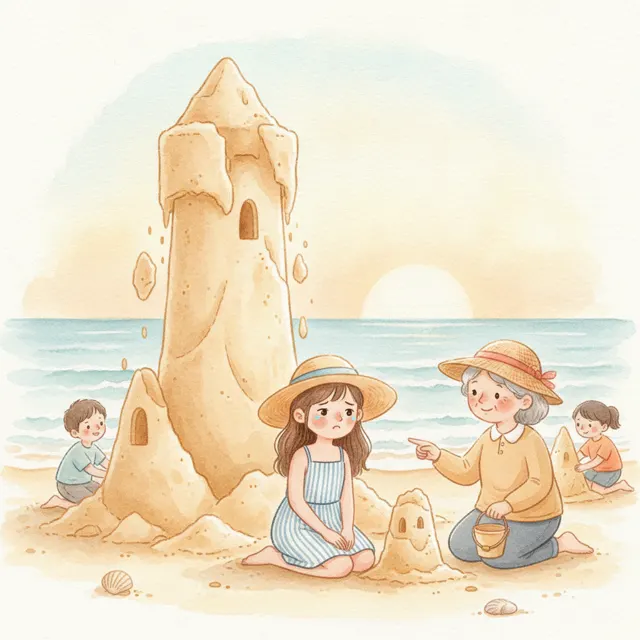
Luna and the Too-Tall Sandcastle story for kids illustration

Luna wants to build the tallest sandcastle on the beach, but it keeps crumbling before her eyes. With a little help and a lot of patience, she learns the secret to building something strong.

Moral: A great sandcastle is built one careful bucket at a time.

Luna stomped her feet in the sand. "I am going to build the tallest sandcastle ever!" she announced. Her little brother Nico clapped. "Can I help?" "Maybe later," Luna said. "First I need it to be taller than me." She piled sand high. Higher and higher. It reached her knees, then her waist. She stood on tiptoe to pat the top. And then, whoosh. The whole thing slid into a pile. "Again!" Luna cried. She built it taller this time, and faster. Whooosh. Down it went again. Luna sat down hard in the sand. "This is impossible." Nico shuffled over with a little bucket. "Mama says wet sand sticks better," he said quietly. Luna frowned. "How do you know that?" "I watched the man over there," Nico said, pointing to a lifeguard patting wet sand into a tower. Luna looked. The lifeguard was not in a hurry. He packed each bucket, tapped it, and lifted it slowly. "Maybe slow is the secret," Luna said. Together, they filled the bucket with wet sand. Pack it. Tap it. Lift it. One tower. Then another. Then another. It took a long, long time. When the sun began to sink low, Luna stepped back. The castle stood taller than her waist, with four towers and a flag made of seaweed. "You did it!" Nico shouted. "We did it," Luna said, and she gave him the biggest, sandiest hug. "Slow and careful wins. And I am glad you helped." "Me too," said Nico. "Even the seaweed part."

Milo and the Great Big Wave

Ages 3-84 mincourage
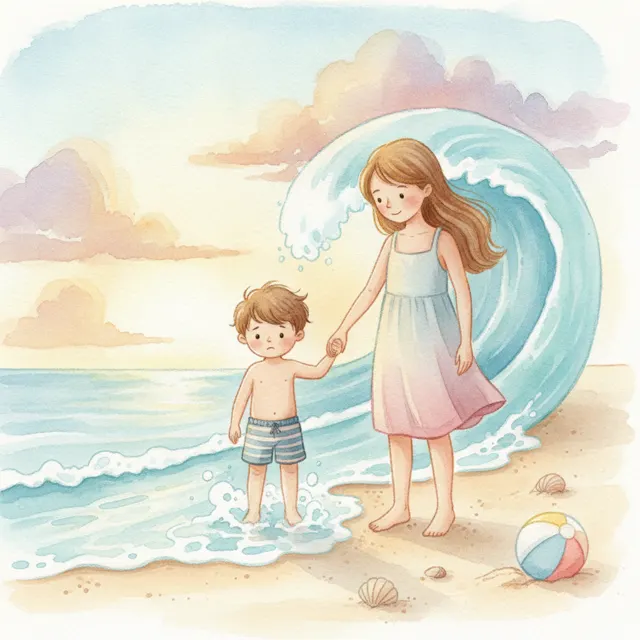
Milo and the Great Big Wave story for kids illustration

Milo loves the beach but stays far from the water, sure the waves will knock him over. With his big sister's hand to hold, he tiptoes in and finds out the ocean is not so scary after all.

Moral: Being brave does not mean you are not scared, it means you try anyway.

Milo loved the beach. He loved the warm sand and the ice cream truck and building rivers that filled with seawater. But the waves? Milo kept a safe distance from the waves. "Come swim with me!" his big sister Ana called from the water. "No thank you," Milo said, digging a hole. "The waves are too big. They will knock me over." Ana walked out of the water, dripping. "The waves are not trying to get you," she said. "Watch. They come in, and then they go back out." Milo watched from his hole. A wave rolled up the sand, stopped, and slid back. Another came, and another. None of them reached his feet. "They never come past their line," Milo said slowly. "Because the beach tells them when to stop," Ana said. "Want to try the edge? Just your toes. I will hold your hand." Milo's heart thumped. But he stood up and took Ana's hand. They walked to where the water touched the sand. A small wave slid over Milo's toes. It was cool and tickly. "It is not so bad," Milo whispered. "Now your knees?" Ana asked. Milo walked a little deeper. The water swirled around his knees. Then a wave came, bigger than the rest. Milo squeezed Ana's hand tight. The wave lifted him gently, and set him down again. It did not knock him over at all. "I did not fall!" Milo shouted, laughing. "You floated a little," Ana said. "That is what water does. It holds you up." Milo looked out at the ocean, wide and blue and not so scary anymore. "Maybe tomorrow," he said, "we go to my belly button."

Whiskers the Seagull's Big Rescue

Ages 3-83 minkindness
Whiskers the Seagull's Big Rescue story for kids illustration

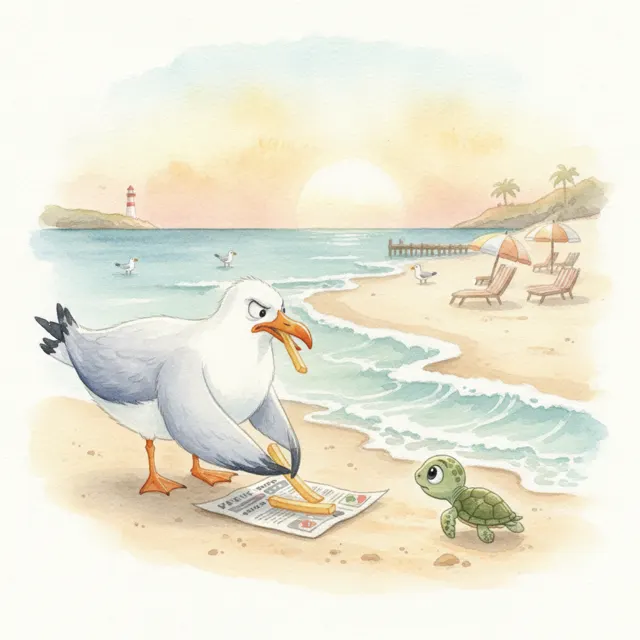
Whiskers the seagull only cared about stealing snacks. But when he finds a baby sea turtle walking the wrong way, he puts down his french fry and becomes an unexpected hero.

Moral: Helping someone smaller than you is the biggest thing you can do.

Whiskers the seagull was famous on the beach. Famous for one thing. Stealing snacks. He had swiped chips, cookies, and half a sandwich. The other gulls said he was the fastest wing in town. Whiskers just laughed and crunched his latest cracker. One evening, as the sun turned the sky orange, Whiskers spotted a big, lonely french fry near the dunes. He swooped down. And stopped. In the sand, right by the fry, sat a tiny sea turtle. It was not moving toward the water. It was waddling the wrong way, toward the road. "Hey," Whiskers said. "The ocean is that way, little one." The turtle looked up with big, tired eyes. "I got lost," she said. "The lights by the road look like the moon, and I followed them. Now I cannot find the water." Whiskers looked at the french fry. It was a very good fry. Then he looked at the turtle, so small and so lost. "Follow me," he said. "And stay close." Whiskers waddled ahead, turning his head every few steps to check the turtle was still behind him. They passed the dunes and the driftwood. The turtle was slow, but Whiskers did not rush her. "There," he said at last. "See the moon on the water?" The turtle's face lit up. "The real moon! Thank you, bird." She crawled into the waves, and the sea carried her home. Whiskers flew back to the french fry. It was still there, a little sandy but fine. He ate it slowly, and for the first time, he thought it tasted better after a good deed.

The Starfish Who Asked Too Many Questions

Ages 3-85 mincuriosity
The Starfish Who Asked Too Many Questions story for kids illustration

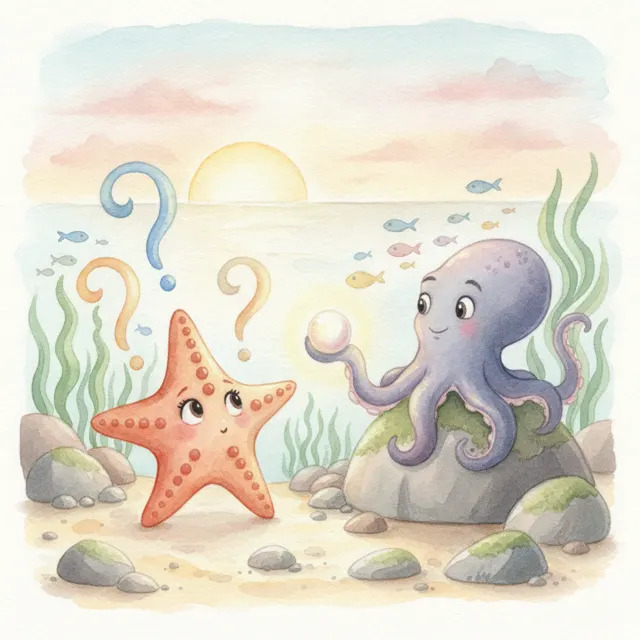
Stella the starfish never stops asking why. Why does the tide go out? Why is the sky blue? Her many questions lead her to a surprising friend who knows all the answers.

Moral: Asking questions is how we learn the biggest things.

Stella the starfish asked questions all day long. "Why does the tide go out?" she asked the crab. "I have no idea," said the crab. "I just scuttle." "Why is the sky blue?" she asked a passing fish. "No time for questions," said the fish. "Swim fast or be eaten." "Why are there so many shells?" she asked a snail. The snail yawned. "Could you ask quieter questions?" Stella sighed. Nobody had time for her questions. But the questions kept coming, because that is how Stella was made. One day, a big old whale drifted into the cove. "Why do the waves never stop?" Stella asked him. "Because the moon pulls the water," said the whale, "and the water is always trying to go home." Stella gasped. "The moon pulls the water? From all the way up there?" "Every single day," said the whale. "What else do you want to know?" And Stella asked everything. Why fish swim in schools. Why seaweed dances. Why the whale's song sounds sad and happy at the same time. The whale answered every question, slow and patient, like he had all the time in the world. "You know a lot," Stella said. "I have asked a lot of questions," said the whale. "Never stop asking, little star. Every answer you find will lead you to ten more questions. That is the best way to live." When the whale swam away, Stella did not feel small anymore. She felt full of wonder, which is the very best feeling a starfish can have. "Why is the sky blue?" she whispered to the water. "I will find out tomorrow."

The Turtle Who Found a Friend

Ages 3-83 minutesfriendship
The Turtle Who Found a Friend story for kids illustration

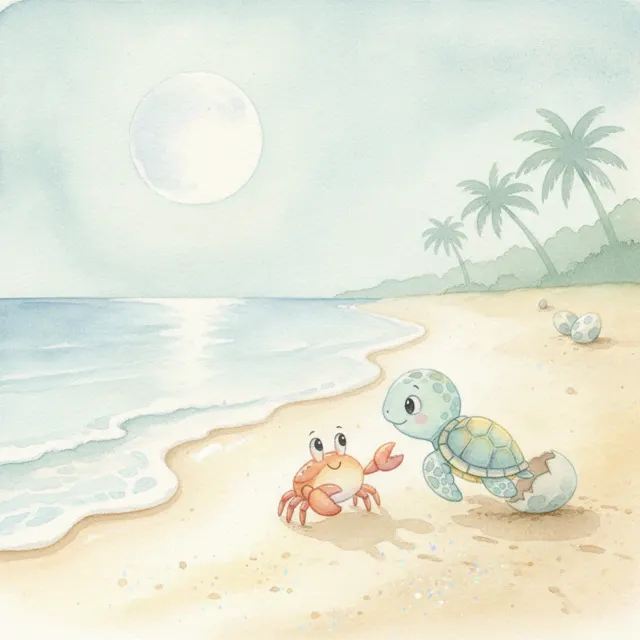
Tino the baby turtle hatches on a moonlit beach and must crawl to the sea all alone. A small crab joins him on the sand. They help each other reach the water and become fast friends.

Moral: A friend makes the hard path feel easy.

Tino was a baby turtle. He pushed out of his egg on a warm beach at night. The sand was soft under his little flippers. The big sea was far away. It looked dark and wide and scary. "I have to reach the water," said Tino. "But I am so small." He started to crawl. Flip, flip, flip. His flippers dug into the sand. The sea looked so far away. He was tired already. Then he saw a small crab. "Hello," said the crab. "Where are you going all alone?" "I am going to the sea," said Tino. "But it is far, and I am small." "I am small too," said the crab. "Let us go together." So Tino and the crab crawled side by side. The crab walked sideways. Tino flipped his flippers. They did not stop. When Tino felt tired, the crab said, "Keep going. We are almost there." When the crab felt scared of a big bird, Tino said, "Stay close to me." At last, they reached the water. A soft wave rolled over Tino's feet. It felt cool and good. "We made it!" said Tino. "I could not have done it alone." "Me neither," said the crab. "A friend makes the hard path feel easy." Tino slipped into the sea. The crab waved from the shore. "Come visit me!" called Tino. "I will!" said the crab. "Goodbye, friend!" Tino swam into the blue water. He was not alone anymore. And the sea did not feel scary at all.

Sam's Sandcastle Flag

Ages 3-83 minutesteamwork
Sam's Sandcastle Flag story for kids illustration

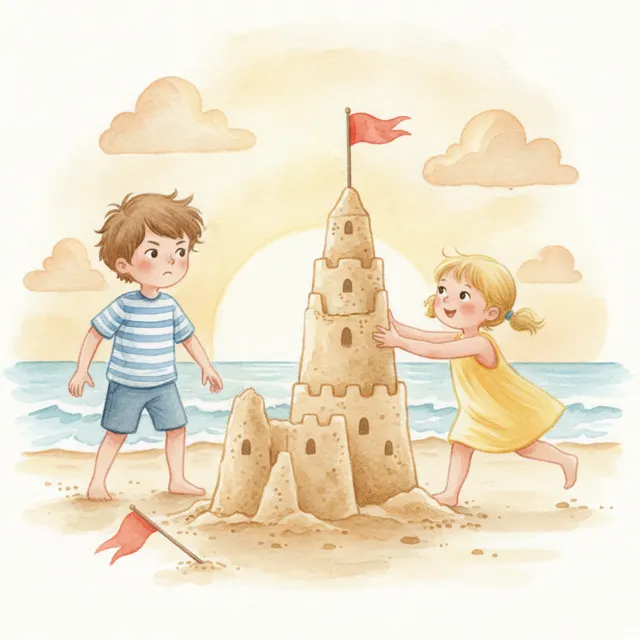
Sam builds a tall sandcastle and wants to put a flag on top all by himself. The tower keeps falling. His little sister helps hold the walls, and together they raise the flag.

Moral: Two hands can hold more sand than one.

Sam sat in the sand with his red bucket. Today he would build the best sandcastle on the whole beach. He packed the sand tight and turned the bucket over. A tall tower stood up. "I will make it the tallest castle ever," said Sam. He built four walls and a big gate. He dug a moat all around it. Then he put a small stick on top. It was time for the flag. Sam held a little blue flag. He stood on his toes and reached up. But the tower was too tall. The wet sand began to slide. "Oh no!" said Sam. The tower leaned over and fell into a pile. Sam tried again. He packed the sand and built the tower back up. He reached for the top. Down it fell again. "This is too hard," said Sam. He sat down in the sand with a sad face. His little sister Mia came over. "Can I help?" she asked. "It is a one person job," said Sam. "Two hands can hold more sand," said Mia. "I can hold the walls while you put the flag on." Sam thought about it. "Okay," he said. "You hold this side." They built the tower one more time. Mia held the wet walls with both hands. Sam stood on his toes and reached up. He set the little blue flag on top. "It stayed up!" shouted Sam. "We did it!" Mia clapped. "It is the best castle ever," she said. The flag waved in the wind. Sam smiled at his sister. "You were right," he said. "Two hands really can hold more sand." From then on, Sam and Mia built every castle together. And every flag stayed up.

The Little Tide Pool

Ages 3-84 minutescuriosity
The Little Tide Pool story for kids illustration

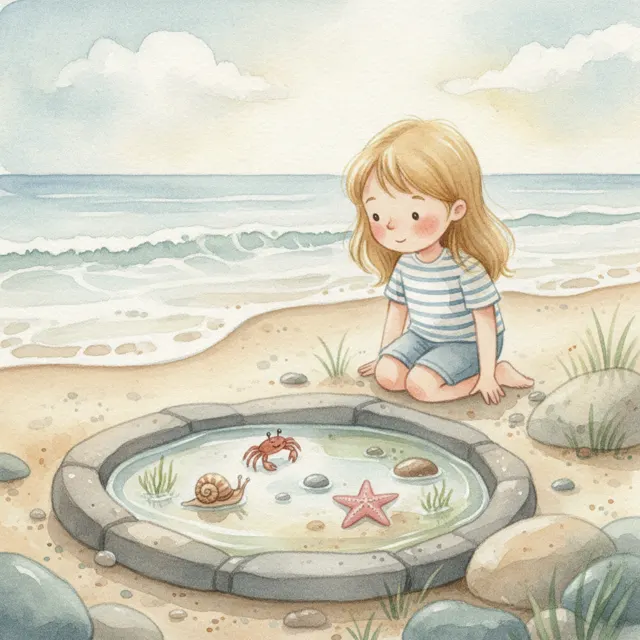
Nina finds a small pool of water left behind by the tide. Inside she sees a tiny crab, a snail, and a pink sea star. She watches them and learns the sea leaves little worlds behind.

Moral: Look closely and you will find a little world.

Nina walked along the beach with her grandpa. The tide had gone out, and the sand was wet and smooth. Between two big rocks, Nina saw a small pool of clear water. "Grandpa, look!" she said. "A little pond!" "That is a tide pool," said Grandpa. "The sea leaves a little bit of itself behind when the tide goes out." Nina kneeled down and looked close. At first she saw only water and a few shells. Then something moved. A tiny crab scuttled across the bottom and hid under a stone. "There is a crab in there!" said Nina. "And look, a snail!" The snail slid slowly over a rock, leaving a shiny trail. Then Nina saw the best thing of all. A pink sea star lay still at the bottom, its five arms spread out like a small sun. "Why are they all in this little pool?" asked Nina. "They are waiting," said Grandpa. "When the tide comes back, the water will rise and they will be part of the big sea again." Nina sat and watched for a long time. She did not touch anything. She only looked. The crab peeked out. The snail kept sliding. The sea star stayed still. "Can we come back and see them again?" asked Nina. "Every day the tide makes new pools," said Grandpa. "And every pool has its own little world." Nina smiled. She had found a whole world hiding between two rocks. She could not wait to see what the next tide would bring.

Pearl the Shell's Long Trip

Ages 3-84 minutespatience
Pearl the Shell's Long Trip story for kids illustration

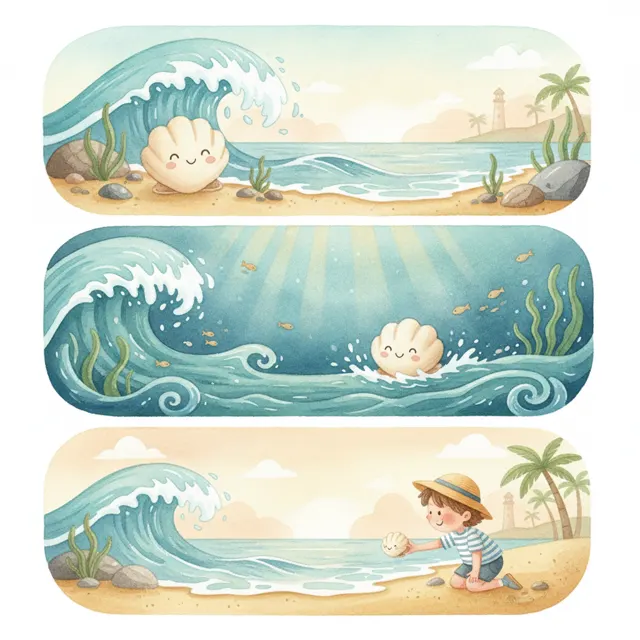
Pearl the shell is washed off the shore by a big wave and carried far out to sea. She drifts a long time before a gentle wave brings her back to a new beach, where a child finds her.

Moral: Wait through the hard part and you will find a new home.

Pearl was a small white shell. She lived on a quiet beach where the waves were soft. Every day the water rolled over her and tickled her smooth back. One day, a big wave came. It lifted Pearl up and carried her out to sea. Pearl tumbled and spun in the cold water. "Where am I going?" she said. "I want to go home!" The wave did not answer. It carried her far, far out. Pearl floated past fish and seaweed. The water grew deep and dark below her. "I am lost," said Pearl. "I will never see my beach again." Days passed. Pearl drifted with the current. She met a friendly fish. "Do you know the way home?" she asked. "The sea decides where shells go," said the fish. "Just wait. The waves will carry you somewhere new." Pearl did not like waiting. But she had no choice. So she floated on. She watched the sun rise and set. She rode one wave and then another. Then, one morning, a gentle wave lifted Pearl and pushed her toward a sandy shore. She rolled onto the warm sand and stopped. "I made it," she said. "I am on a beach again." It was not her old beach. But the sand was soft and the sun was warm. A little girl walked by and saw her. "Look at this pretty shell!" the girl said. She picked Pearl up and put her in a small bag with other shells. "You will live on my shelf now," said the girl. Pearl felt happy. She had waited through the long trip, and the sea had brought her to a good new home.

Kai and the Driftwood Boat

Ages 3-83 minutestrying again
Kai and the Driftwood Boat story for kids illustration

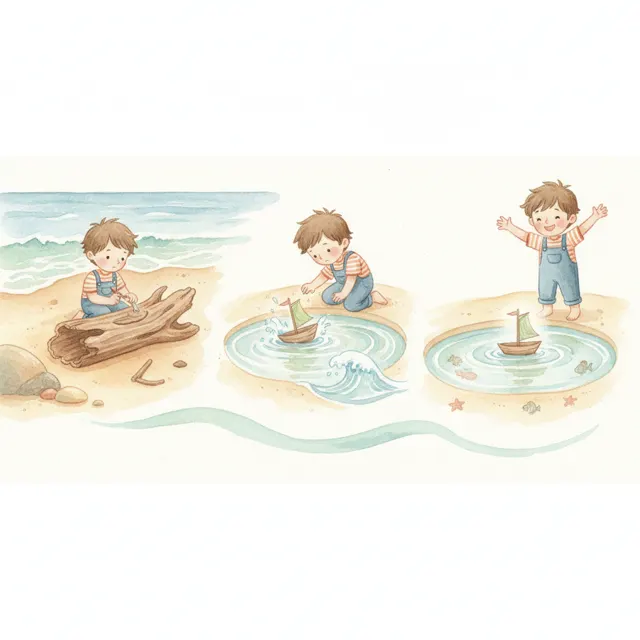
Kai finds a piece of driftwood and makes it into a little boat. The boat sinks at first, then tips over. Kai keeps fixing it until it sails straight across the tide pool.

Moral: Fixing a problem one small step at a time works.

Kai found a piece of driftwood on the beach. It was smooth and light and shaped a little like a boat. "I will make this into a real boat," he said. He stuck a twig in the middle for a mast. He tied a green leaf to the twig for a sail. Then he ran to a calm tide pool and set the boat in the water. Plop. The boat went under and floated back up sideways. The leaf sail was wet and heavy. "It is broken," said Kai. "It will not float." He pulled it out and shook the water off. "I will try again," he said. He made a new sail from a dry leaf. He set the boat in the water again. This time it floated. But then it tipped over and the mast fell out. "Not again!" said Kai. He wanted to give up. He sat on a rock and frowned. His mom walked over. "What is wrong?" she asked. "My boat keeps sinking," said Kai. "I tried and tried." "A real boat maker tries many times," said Mom. "What can you fix next?" Kai looked at his boat. He saw the problem. The mast was too tall and made the boat tip. He broke the twig shorter and tied the leaf lower. "Now I will try one more time," he said. He set the boat on the water. It bobbed up. It did not tip. A tiny breeze pushed the leaf sail, and the boat glided across the pool. "It is sailing!" shouted Kai. "My boat works!" Kai grinned from ear to ear. He had not given up, and now his driftwood boat sailed straight and true.

The Hermit Crab's New Home

Ages 3-84 minutesgrowing up
The Hermit Crab's New Home story for kids illustration

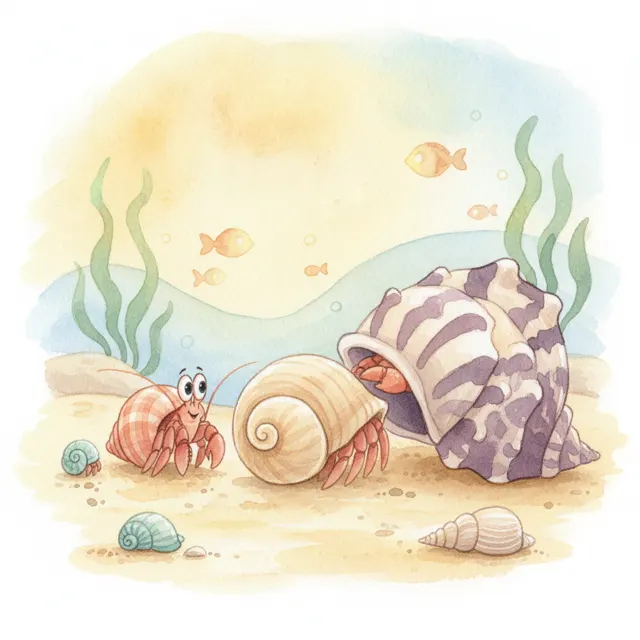
Rex the hermit crab grows too big for his shell. He looks for a new one and finds many shells that are too small or too big. At last he finds one that fits just right.

Moral: Growing up means finding the home that fits you.

Rex was a hermit crab. He lived in a little brown shell that he carried on his back. But Rex was growing, and his shell felt tight. "This shell is too small," said Rex. "I need a new home." He crawled along the sand looking for a shell. Soon he found a tiny pink one. He tried to climb in. His legs stuck out. "Too small," he said. He walked on. Next he found a big white shell. He climbed in, but he slid all the way to the bottom. He could not see out. "Too big," he said. He crawled back out. Rex looked all morning. Some shells were cracked. Some were too heavy. Some were just not right. He began to feel tired and sad. "Maybe I will never find a home," he said. A sea snail slid by. "Why are you sad?" she asked. "I am too big for my old shell," said Rex, "and I cannot find a new one." "Keep looking," said the snail. "The right shell is out there. You will know it when you feel it." So Rex kept crawling. He looked under seaweed and behind rocks. Then he saw it. A smooth gray shell with a round opening. Not too small and not too big. Rex slid inside. It fit just right. He could see out, and his legs were tucked in warm and safe. "This is it!" he said. "This is my new home." He walked along the beach, proud and comfy. Growing up had felt hard, but now he had a shell that was just right. And it felt good to grow.

Nora and the Shy Dolphin

Ages 3-84 minuteskindness
Nora and the Shy Dolphin story for kids illustration

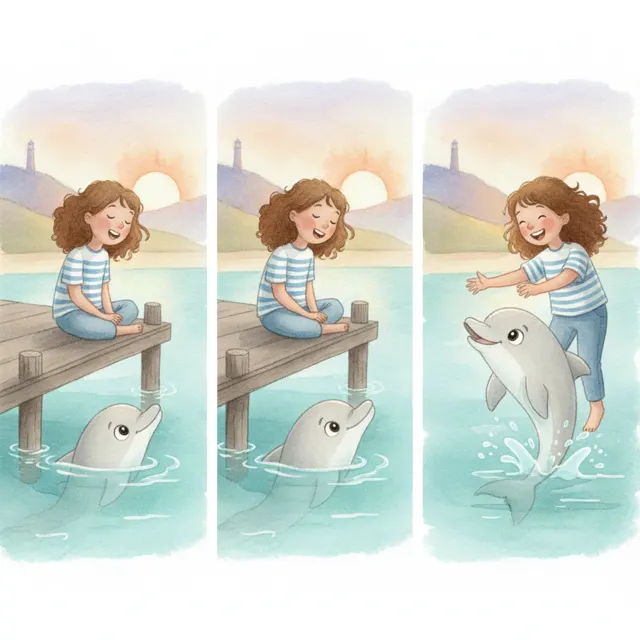
Nora sits on a pier and sings a soft song. A shy dolphin swims closer to listen. Nora sings every day, and the dolphin learns to trust her and comes to play.

Moral: Being patient and kind wins a shy heart.

Nora liked to sit on the wooden pier and sing. The sea was calm there, and the gulls listened from the rails. One day, Nora saw a gray fin rise out of the water, far away. "Grandpa, what was that?" she asked. "That is a dolphin," said Grandpa. "A shy one. It stays far from people." Nora sang her song again, soft and slow. The fin came a little closer, then sank back down. "It likes my song," said Nora. "It came closer when I sang." So Nora sang every day. Each day the dolphin came a little nearer. It swam in slow circles. It still did not come close to the pier. "Why will it not come play with me?" asked Nora. "Trust takes time," said Grandpa. "You do not push a shy friend. You wait." Nora kept singing. She sang the same soft song every single day. She never called the dolphin or splashed the water. She just sang and waited. Then one afternoon, the dolphin swam right up to the pier. It lifted its head out of the water and made a happy clicking sound. Nora laughed with joy. "You came!" she said. "You came to say hello!" The dolphin clicked again and rolled over in the water. It was not shy anymore. It stayed and played near the pier while Nora sang. "I knew you would come when you were ready," said Nora. Grandpa smiled. "You were patient and kind," he said. "That is how you win a shy heart." From that day on, the dolphin came every day to hear Nora sing. And Nora sang her soft song for her new friend.

The Lighthouse Keeper's Little Helper

Ages 3-84 minuteshelping
The Lighthouse Keeper's Little Helper story for kids illustration

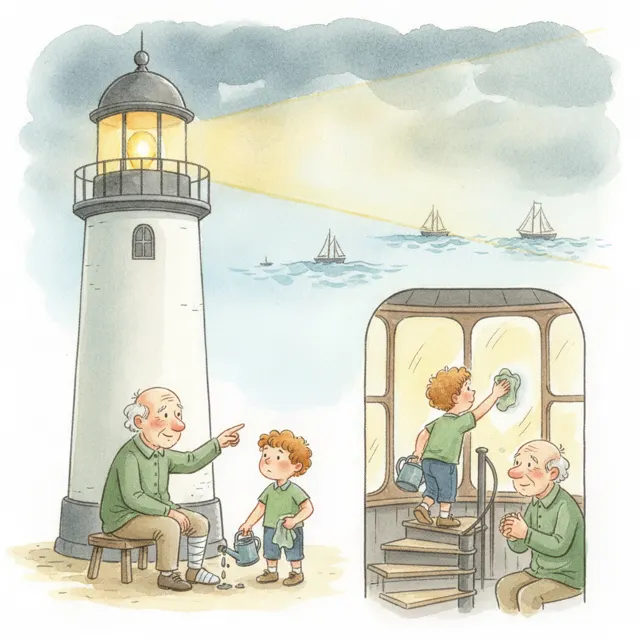
Old Captain Finn keeps the lighthouse light shining. When he hurts his leg, a boy named Theo offers to help carry oil and clean the big glass. They work together and keep ships safe.

Moral: A little helper can keep a big light shining.

Captain Finn was the lighthouse keeper. Every night he climbed the tall stairs and lit the big lamp. Its light swept across the sea so ships could find their way home. One day, Captain Finn tripped on the rocks and hurt his leg. He sat down with a heavy sigh. "The light must be lit tonight," he said. "But I cannot climb the stairs." A boy named Theo lived in the village below. He came to the lighthouse with a basket of bread. "Captain Finn, are you okay?" asked Theo. "I hurt my leg," said the captain. "And the lamp still needs oil and a clean glass before dark." "I can help," said Theo. "Tell me what to do." So Theo carried the heavy oil can up the tall stairs. He climbed one step at a time, just like the captain showed him. Then he climbed back down for a cloth and a bucket of water. "Wipe the glass in big circles," said Captain Finn from his chair. "The light must shine clear." Theo wiped the big round glass until it sparkled. He filled the lamp with oil. When the sun went down, Theo struck the match and lit the wick. The great lamp glowed bright. Its beam swept out over the dark sea. "Look at it shine!" said Theo. "You did it," said Captain Finn. "Ships far away will see that light and sail home safe tonight. Because of you." Theo felt proud. "Can I help again tomorrow?" he asked. "Every night, if you like," said the captain. "A little helper is a fine thing." From then on, Theo helped light the lamp. And every night, the lighthouse shone bright over the sea.

The Sand Dollar's Quiet Song

Ages 3-83 minuteslistening
The Sand Dollar's Quiet Song story for kids illustration

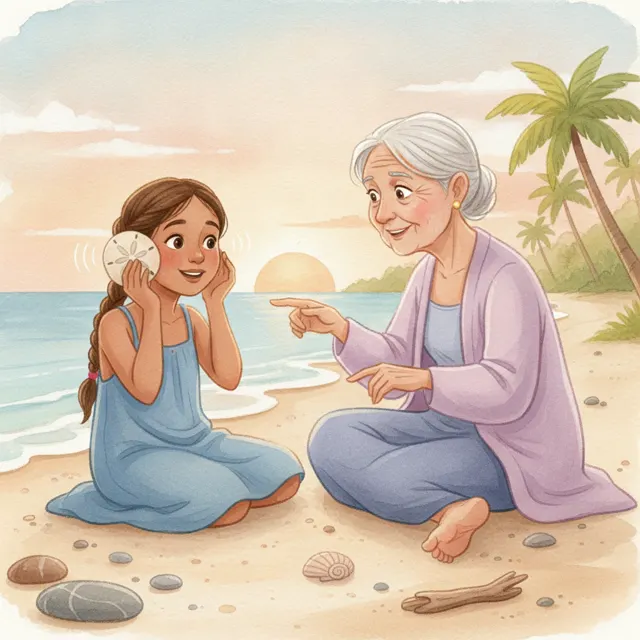
Maya finds a sand dollar on the beach and holds it to her ear. She thinks she hears the sea. Her grandma teaches her to sit still and listen to the quiet sounds all around.

Moral: Being still helps you hear the quiet song.

Maya found a flat white shell on the beach. It was round and smooth with a little star shape in the middle. "What is this, Grandma?" she asked. "That is a sand dollar," said Grandma. "Some people say if you hold it to your ear, you can hear the sea." Maya held the shell to her ear. She heard a soft whisper, like wind over water. "I hear it!" she said. "The sea is singing!" Grandma smiled. "The sea sings all the time," she said. "But most days we are too busy to hear it." Maya wanted to hear more. "How do I listen better?" she asked. "Sit very still and close your eyes," said Grandma. "Let the quiet come to you." Maya sat on a flat rock and closed her eyes. At first she heard only the gulls. Then she heard the waves, one after another, soft and slow. Then she heard the little tick of a crab walking over stones. "I hear so many sounds now!" said Maya. "The beach is full of songs." "That is the gift of being still," said Grandma. "You hear what the busy world hides." Maya opened her eyes. Everything looked a little softer now. The waves, the gulls, the wind in the grass. It was all one quiet song. "Thank you, Grandma," said Maya. "I will listen like this every day." She kept the sand dollar in her pocket. And whenever the world felt loud, she would close her eyes and remember the quiet song of the sea.

Pippa and the Lost Flip-Flop

Ages 3-83 minuteshonesty
Pippa and the Lost Flip-Flop story for kids illustration

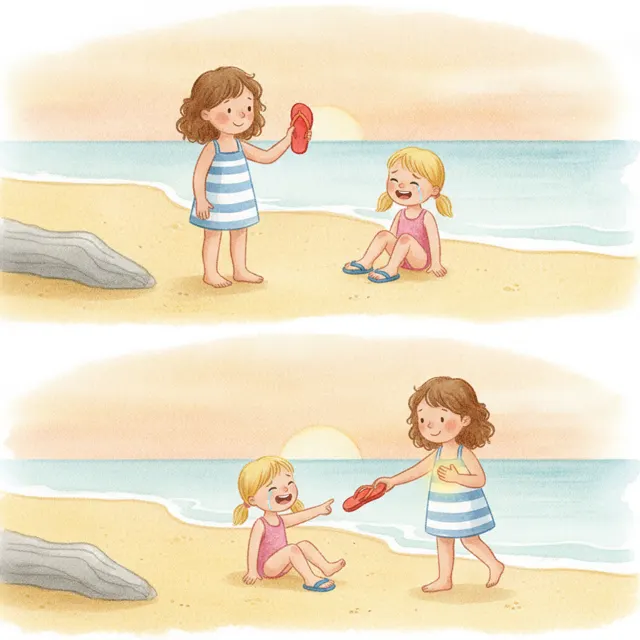
Pippa finds a red flip-flop on the sand and wants to keep it. Then she sees a little girl crying because she lost one shoe. Pippa returns the flip-flop and feels good inside.

Moral: Giving back what is not yours feels good.

Pippa was walking on the beach when she saw something red half buried in the sand. She dug it out. It was a red flip-flop with a little white star on it. "What a pretty shoe!" said Pippa. She slipped it on her foot. It was a little big, but she liked it. "I could wear this home." She walked on with the flip-flop in her hand. It felt nice to find a treasure. But something made her stop. A little girl sat on the sand, crying. "What is wrong?" asked Pippa. "I lost my flip-flop," said the girl. "The wave pulled it off my foot. Now I only have one shoe, and my feet burn on the hot sand." Pippa looked at the red flip-flop in her hand. It had a white star on it. The little girl had one red flip-flop with a white star on her foot. "Is this yours?" asked Pippa. The girl's eyes went wide. "Yes! That is my flip-flop! Where did you find it?" "It was buried in the sand," said Pippa. "Here, you can have it back." Pippa held out the shoe. The girl put it on and jumped up. "Thank you! Thank you!" she said. "Now my feet will not burn!" "You are welcome," said Pippa. Pippa walked on with empty hands. She did not have a treasure anymore. But her heart felt warm and full. Giving the shoe back felt better than keeping it. "Doing the right thing feels good," Pippa said to the sea. And the waves seemed to agree.

The Wave That Went Back

Ages 3-84 minutescaring
The Wave That Went Back story for kids illustration

A big wave crashes onto the sand and leaves a little fish stranded far from the sea. The wave cannot reach it. A boy helps the fish back to the water, and the wave says thank you.

Moral: A kind hand can help when even the sea cannot.

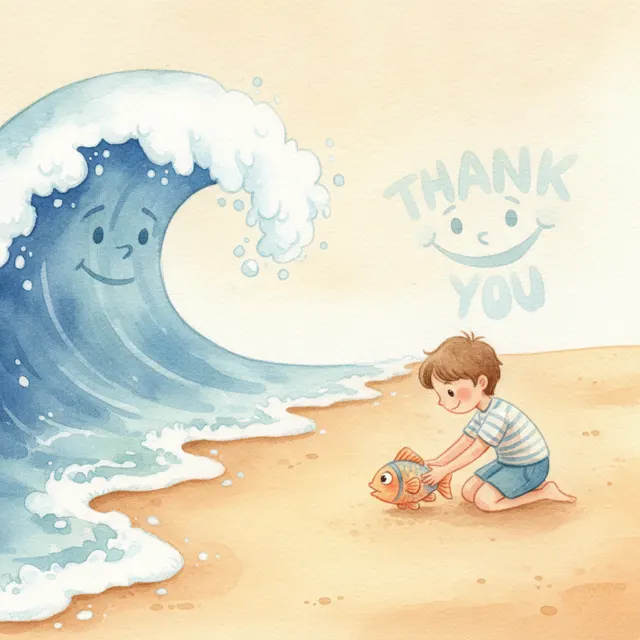
Every day, a big blue wave rolled up the beach and back again. It loved its job. It tickled toes and smoothed the sand and sang a soft whoosh. One morning, the wave rolled up farther than usual. It came in fast and high. When it rolled back, it saw something small flopping on the sand. It was a little silver fish, stranded far from the water. "Oh no," said the wave. "I pushed too hard. Now the little fish cannot reach the sea." The wave tried to roll up again. But it could not reach the fish. It was too far up the sand. The wave pushed and pushed, but each time it fell short. "Please, someone help," called the wave. "The fish cannot breathe on the sand!" A boy named Eli was digging nearby. He heard the wave's soft cry. He saw the little fish flopping on the hot sand. "I can help," said Eli. He cupped his hands and gently scooped up the fish. He ran to the water and set it down in the cool sea. The fish flicked its tail and swam away, happy and free. "Thank you," said the wave, rolling up to wash over Eli's feet. "You saved the little fish." "You tried your best to reach it," said Eli. "But even the biggest wave needs a friend sometimes." "You are right," said the wave. "The sea is strong, but a kind hand is stronger." From that day on, the wave rolled in a little softer. It did not want to strand another fish. And it never forgot the boy who had helped it that day.

Leo's First Beach Day

Ages 3-83 minutesbravery
Leo's First Beach Day story for kids illustration

Leo has never seen the ocean. He is scared of the big waves and the loud sound. His dad holds his hand, and they walk slowly into the water together. Leo finds his brave feet.

Moral: Being brave is one small step at a time.

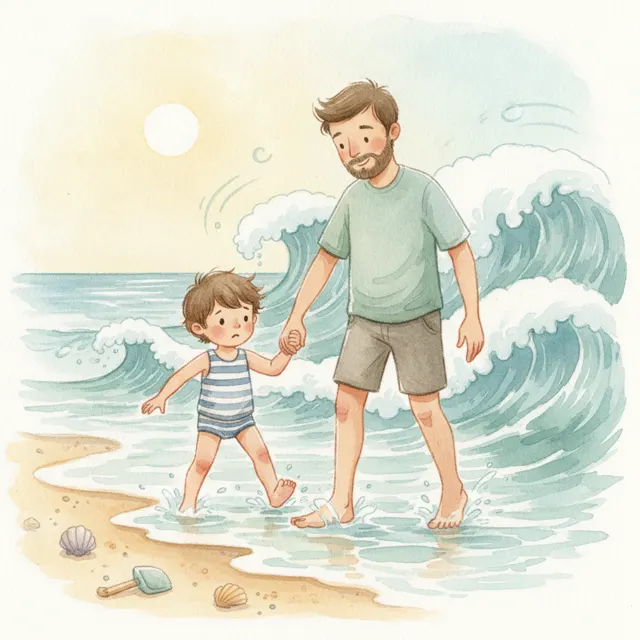
Leo stood at the edge of the beach and stared at the ocean. He had never seen so much water in his life. It went on and on until it touched the sky. "It is so big," said Leo. "And so loud." The waves crashed and roared. White foam rushed up the sand toward his toes. Leo jumped back. "I do not want to go in," he said. "The water will get me." "The water is not trying to get you," said Dad. "It is just saying hello." Leo watched the waves for a long time. They came up and went back. Up and back. The sand got wet and then dry again. "Will you hold my hand?" asked Leo. "Of course," said Dad. "We can go as slow as you want." They walked toward the water. Leo held Dad's hand very tight. A small wave rolled over his toes. It was cold. Leo giggled. "That tickled!" he said. "See? The ocean is friendly," said Dad. They took another step. The water came up to Leo's ankles. He wiggled his toes in the wet sand. Then a bigger wave came, and Leo held on tight. The water rose to his knees, then went back down. "I did not fall!" said Leo. "I am standing in the ocean!" "You are very brave," said Dad. "Look how far you came." Leo looked back at the beach. He had been so scared, and now he was in the water, laughing. Being brave, he learned, was just one small step at a time.

The Seagull Who Shared His Fish

Ages 3-84 minutessharing
The Seagull Who Shared His Fish story for kids illustration

Gus the seagull catches a big fish and plans to eat it alone. A hungry little gull watches him with sad eyes. Gus splits the fish and shares it, and both gulls eat until they are full.

Moral: Sharing your food fills more than your belly.

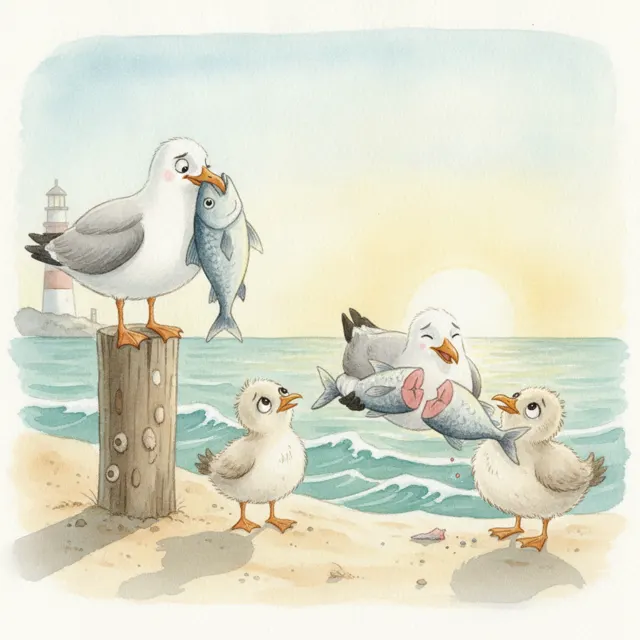
Gus was a big gray seagull. He loved fish more than anything. One morning, he swooped down over the water and caught a big silver fish. It was the best catch he had ever made. "This fish is all mine," said Gus. "I will eat every bite." He landed on a rock and looked at his fish. It was long and shiny and smelled so good. His tummy rumbled. Just then, a small gull landed nearby. Her feathers were thin and her wings drooped. She looked at the big fish with sad, hungry eyes. "What a fine fish," she said in a small voice. "I have not eaten all day." Gus looked at his fish. Then he looked at the little gull. She was so thin and so tired. "Go find your own fish," said Gus. But his voice was not mean. He felt bad saying it. The little gull nodded and turned away. Her head hung low. Gus looked at his big fish again. It was more than he could eat alone. He thought for a long moment. "Wait," called Gus. "Come back. This fish is too big for one gull." The little gull turned around. Gus used his beak to split the fish into two pieces. He pushed the bigger half toward the little gull. "Share it with me," said Gus. The little gull's eyes lit up. "Thank you!" she said. "You are very kind." They ate together on the warm rock. The fish tasted better than any fish Gus had ever eaten. "You know," said Gus, "a fish eaten alone fills the belly. But a fish eaten with a friend fills the heart too." The little gull smiled. "Then our hearts are full," she said. And they watched the waves together, warm and happy.

The Sunhat That Flew Away

Ages 3-83 minutesproblem solving
The Sunhat That Flew Away story for kids illustration

Milo's new yellow sunhat blows off his head and lands high in a palm tree. He cannot reach it. He uses a long stick and a rolled towel to knock it down, one clever idea after another.

Moral: Keep thinking and you will find a way.

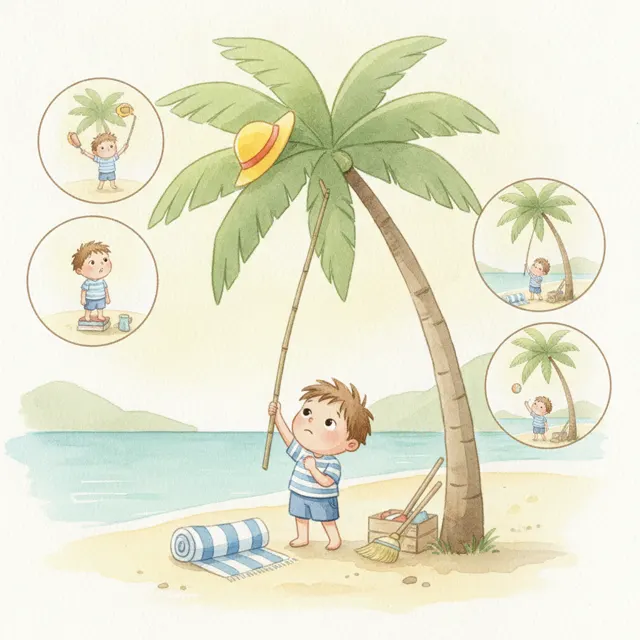
Milo loved his new yellow sunhat. It had a wide brim and a blue band. It kept the sun off his face at the beach. Then a strong wind came. Whoosh! The hat flew off Milo's head and went up, up, up. It landed high in a palm tree. "My hat!" cried Milo. "It is stuck up there!" Milo jumped to reach it. Too high. He shook the tree trunk. The hat did not move. It just sat on a leaf like a big yellow bird. "I will get a stick," said Milo. He found a long stick on the sand. He poked up at the hat. The stick was too short. Milo sat down to think. He did not want to lose his hat. "I need something longer," he said. He tied his beach towel to the stick. Now it was long. He reached up again. The towel flopped, but the hat stayed put. "It is still too high," said Milo. He thought some more. Then he had an idea. He rolled his towel into a soft ball and threw it at the hat. Thump. The hat wobbled but did not fall. He threw again. Thump. The hat slid off the leaf and floated down. Milo caught it with both hands. "I got it!" he shouted. He put the hat back on and tied it under his chin this time. Now the wind could not take it. "Good ideas come one after another," said Milo. "You just have to keep thinking." He walked down the beach with his yellow hat on tight, proud of his clever head.

The Tide's Tiny Treasure

Ages 3-84 minutesgratitude
The Tide's Tiny Treasure story for kids illustration

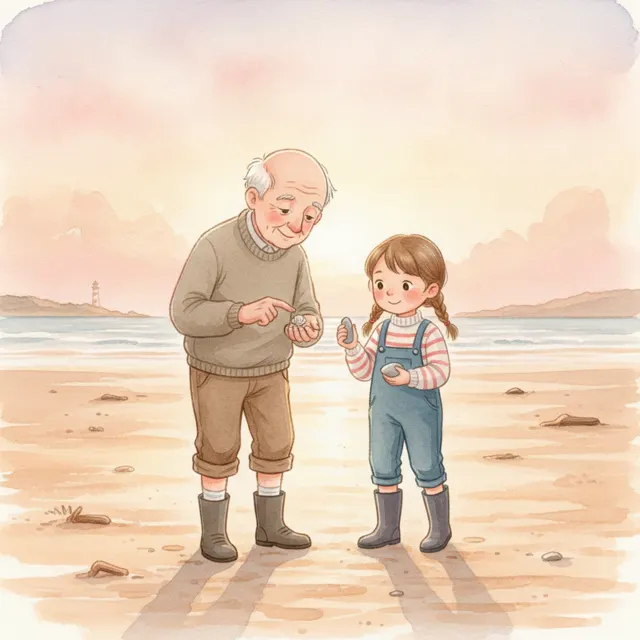
Grandpa and Ivy walk the beach after the tide goes out and find one small thing each day. Ivy learns that the best treasure is not big and bright but the time they share together.

Moral: The best treasure is the time you share.

Every evening, Grandpa and Ivy walked along the beach after the tide went out. They called it their treasure walk. "What will we find today?" asked Ivy. "The tide leaves one tiny treasure for us," said Grandpa. "We just have to look." Ivy looked and looked. She wanted to find something big and bright. A gold coin. A sparkly ring. But all she saw were shells and wet sand. "There is nothing here," said Ivy. "No treasure at all." "Look closer," said Grandpa. He pointed at a small pink shell, no bigger than Ivy's thumb. It curled around in a perfect spiral. "That is just a shell," said Ivy. "Ah, but look at it," said Grandpa. "Pink as a sunset. Smooth as glass. It rode in from far out in the sea, all the way to your hand." Ivy picked up the shell and held it to the light. It really was pretty. She put it in her pocket. They walked on. They found a piece of blue sea glass and a tiny crab claw and a feather from a gull. Each one was small. But each one was special in its own way. "Grandpa, I found three treasures today," said Ivy. "And I found the best one of all," said Grandpa. He tapped Ivy on the nose. "A whole walk with you." Ivy smiled and squeezed his hand. She had wanted gold and sparkles. But this was better. The best treasure was not in her pocket at all. It was walking right beside her.

Frequently Asked Questions

Turn Your Child Into the Hero of Their Own Story

Upload their photo and watch as AI creates a beautiful, personalized storybook with illustrations that look just like them. From $5.99/month.

✨ Make Your Child the Hero

Plans from $5.99/month