Educational Stories for Kids

Stories that make learning irresistible by wrapping facts and skills in adventures children actually want to finish.

โœจ Make Your Child the Hero

The best lessons don't feel like lessons. When children are caught up in a story, they absorb information naturally, without resistance, without boredom. Our educational stories weave real knowledge into engaging narratives: science concepts, math, history, ecology, language, and life skills all taught through characters children love. These stories prove that learning is not separate from fun. Done right, they are the same thing.

Why does reading stories aloud help children learn new words?

Stories give children words they do not hear in daily talk. A book about space, weather, or animals adds new names and ideas. When a parent reads and points at pictures, the child links a word to a picture. This grows a child's word bank fast.

The effect is large. A study from Ohio State University found that children who are read five books a day enter kindergarten having heard about 1.4 million more words than children who are never read to (Ohio State University, 2019). Every story read aloud closes part of that gap.

What kinds of stories teach numbers and science to kids?

Counting stories and nature tales turn lessons into play. A story about apples in a basket teaches adding and taking away. A story about a seed shows how a plant grows. Children learn best when the lesson hides inside a good story.

Sample Stories

Read these stories, then create a personalized version where your child is the hero

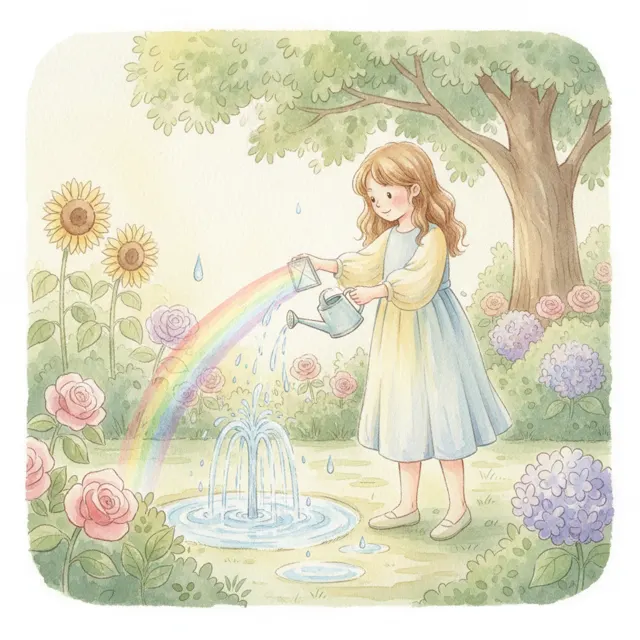
The Rainbow Maker

Ages 5-94 minscience
The Rainbow Maker story for kids illustration

A girl experiments with light and water in her garden and discovers the science behind rainbows.

Moral: Curiosity and experimentation are the tools of science. The best discoveries come from asking "what if I try this?"

Priya wanted to make a rainbow. Not find one, not wait for one. Make one herself. She had seen them after rain, always in the sky, always where the sun hit water in the air. She had a theory. She went to the garden with the hose. She turned her back to the sun, the way her dad had once told her: "The sun has to be behind you to see a rainbow." She turned the hose to its finest spray setting and sent a mist of water into the air in front of her. There. A small rainbow curved through the mist. "It works!" Priya ran inside to get her notebook. She wrote: Rainbows happen when sunlight goes through water droplets. The water bends the light and splits it into colors. The colors are always the same order: red, orange, yellow, green, blue, indigo, violet. She tried to memorize the order. Her dad taught her a name: Roy G Biv. Each letter was the first letter of a color. She spent the whole afternoon making rainbows of different sizes, moving closer and further from the spray. She found that she always had to be in exactly the right position: sun behind her, water in front. "You discovered the geometry of rainbows," her dad said. Priya looked at her notes. "Mostly I just like that I can make them whenever I want now," she said. That seemed like the best kind of learning to her.
The Counting Caterpillar

Ages 3-63 minnumbers
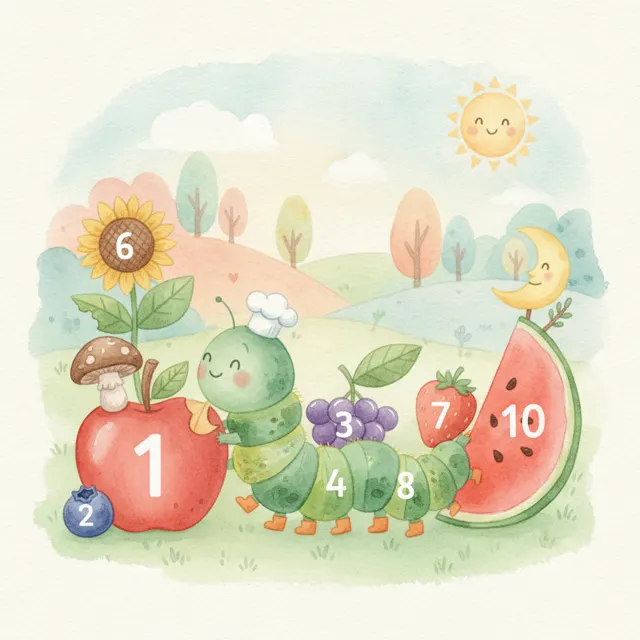
The Counting Caterpillar story for kids illustration

A caterpillar counts everything he eats as he grows, teaching young children numbers and sequences.

Moral: Learning to count is learning to notice and understand the world around us.

Carlos the caterpillar was very hungry. On Monday, he ate one fat red apple. He counted it carefully: one. He felt a little better. On Tuesday, he ate two ripe pears. He counted them: one, two. He felt hungrier than he expected. On Wednesday, he ate three plums, purple and sweet. One, two, three. Getting better. On Thursday, he found four strawberries hiding under a leaf. One, two, three, four. Delicious. On Friday, Carlos went a little overboard. He ate five oranges, six bananas, seven cherries, eight raspberries, nine apricots, and ten grapes. He lay on a leaf feeling extremely full and counted on his many legs: one, two, three, four, five, six, seven, eight, nine, ten. "That is a lot," he said to himself. On Saturday, he ate one green leaf. One was exactly right. On Sunday, Carlos built himself a cozy cocoon. He had eaten thirty-six things in total, though he had lost count around the oranges. He wrapped himself up and went to sleep. Two weeks later, Carlos emerged from his cocoon. He had wings. He counted them: one, two. He was a butterfly now, and the world was enormous, and he was ready to count every flower in it.

Why the Seasons Change

Ages 5-94 minscience
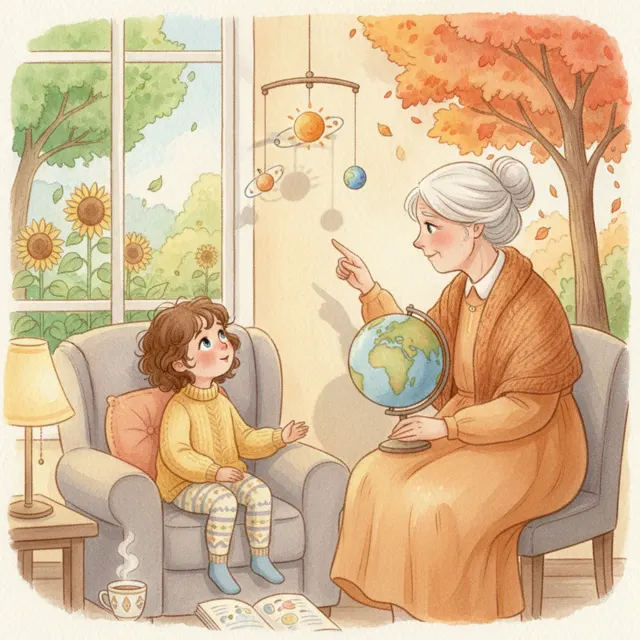
Why the Seasons Change story for kids illustration

A child asks why summer turns to autumn and her grandmother explains the science of seasons through an analogy.

Moral: Understanding how the natural world works makes it even more wonderful, not less.

Lily noticed it first in September. The oak tree outside her bedroom window had started to turn. The edges of the leaves went yellow, then orange, then a deep red she didn't have a word for. "Why?" she asked Grandma. Grandma sat with her by the window. "You know how Earth goes around the sun?" Lily nodded. She'd learned that. "Earth is tilted," Grandma said, leaning sideways to show her. "Not straight up. Tilted. So different parts of Earth get more sunshine at different times of year." "Right now," Grandma continued, "our part of Earth is starting to tilt away from the sun. The days get shorter. Less sunlight reaches us." "So it gets colder," Lily said. "Yes. And trees know this. They sense the shorter days. They start pulling the green stuff, called chlorophyll, out of their leaves and storing it." "And without the green stuff..." "The other colors show through. Yellow, orange, red. They were there all along, hiding under the green." Lily looked at the tree differently now. "They were always colorful?" "Always," Grandma said. "And in spring?" "We tilt back toward the sun. Days get longer. The trees push the chlorophyll back into new leaves. Everything goes green again." Lily watched a red leaf spiral down to the garden. "The tree knows all this?" she asked. "Every year without fail," Grandma said. Lily thought that was perhaps the most impressive thing she'd heard all year.

The Boy Who Built a Bridge

Ages 6-104 minscience
The Boy Who Built a Bridge story for kids illustration

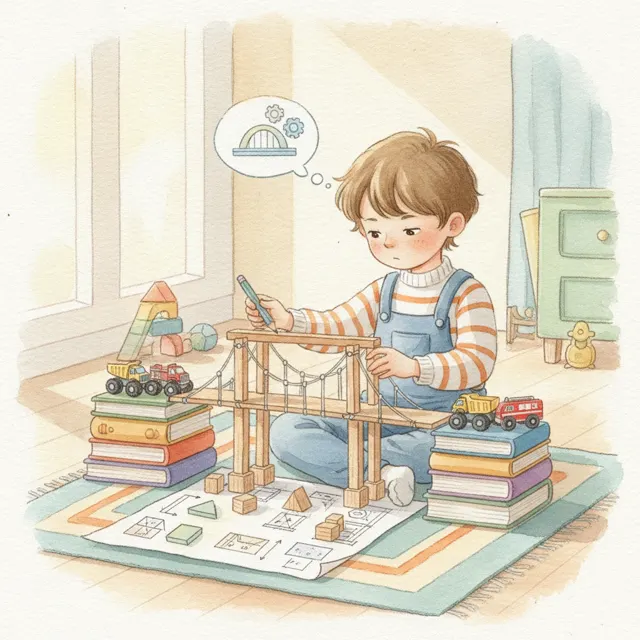
A boy applies basic physics to build a toy bridge strong enough to hold his collection of toy trucks.

Moral: Solving problems often isn't about using more resources. It's about finding a smarter shape or approach.

Arjun had a problem. His toy town was split in two by the living room floor, which he had designated as the River of No Return. His trucks needed to get from one side to the other. They needed a bridge. He built the first bridge from four stiff cardboard pieces laid flat. It collapsed under the weight of the first truck. He rebuilt it. Collapsed again. He sat back and thought. He'd seen bridges before. Big ones. What made them strong? He fetched a library book on bridges. It had pictures. Arching bridges. The arch pushed force outward and down, into the ground instead of down through the middle. Suspension bridges. The weight hung from cables that pulled from the sides. Arjun tried an arch. He bent his cardboard into a curve under the flat surface. He placed a truck. It held. He placed two trucks. It held. He placed his entire collection, twelve trucks, two buses, and a cement mixer. The bridge held every one of them. Arjun sat very still, looking at his bridge. Then he got his notebook and wrote: Arches are strong because they spread the weight out sideways. You don't need more material. You need a better shape. He stared at that last sentence for a while. It seemed important for more than just bridges.

The Girl Who Mapped Her Neighborhood

Ages 6-104 mingeography
The Girl Who Mapped Her Neighborhood story for kids illustration

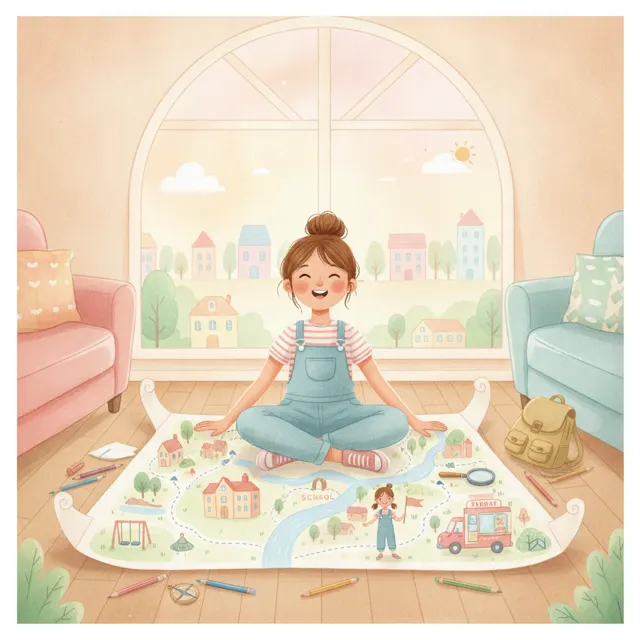
A girl creates a detailed map of her neighborhood and learns about directions, landmarks, and geography.

Moral: Learning to observe and record the world around you is the first step in understanding it.

Sofia wanted to make a map. A real one, of her real neighborhood. She started at her front door. She had a compass, borrowed from her dad. She turned it until North was at the top. She marked her house with a small house symbol and wrote N, S, E, W at the edges of her paper. Then she walked. She walked one block north and reached the park. She drew it and marked it: Park, green, benches, one oak tree. She walked east from the park and found the bakery. Drew it. Marked it: Bakery, blue door, smells incredible. She walked south and found the library. Drew it: Library, grey stone, wide steps. She kept going. The school. The corner shop. The bus stop. The old water tower on the hill, which she marked with a small star because it was her favorite thing. An hour later, she spread her map on the kitchen table. "I drew our neighborhood," she told Mum. Her mum leaned over it for a long time. "This is very good," she said. "You've got the scale roughly right. The park is bigger than the bakery. The distances are nearly accurate." "What's scale?" Sofia asked. Her mum explained. Sofia immediately went back out to measure things more carefully. The second map took three days. It was considerably better. She framed it and hung it on her bedroom wall.

The Volcano in the Classroom

Ages 6-104 minscience
The Volcano in the Classroom story for kids illustration

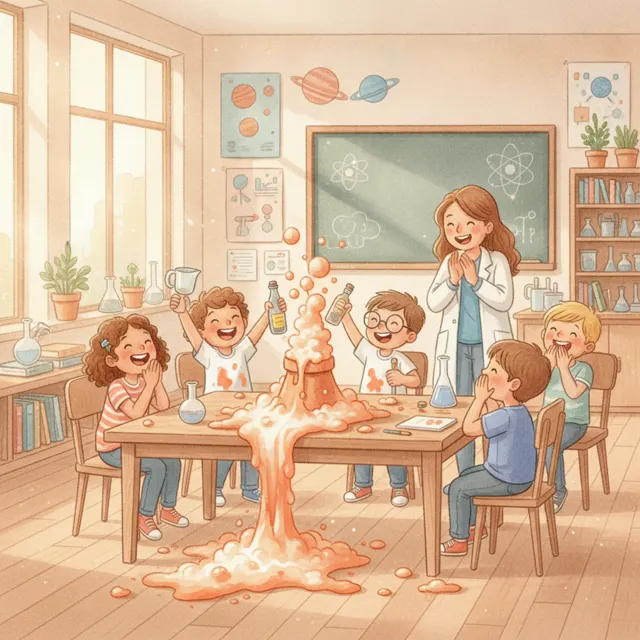
A science project goes entertainingly wrong and teaches a class about chemical reactions.

Moral: The best experiments teach you something even when they go bigger than planned. Curiosity and cleanup go hand in hand.

The science fair project was supposed to be a small demonstration. Ms. Chen had specifically said: small. Sam had not fully understood the meaning of the word. The baking soda volcano stood two feet tall, built from papier-mรขchรฉ over a chicken wire frame, painted brown and grey with red lava streaks. It was magnificent. "That's... large," Ms. Chen said. "It'll be fine," Sam said confidently. The class gathered around. Sam poured the baking soda into the top. Then the vinegar. The reaction was instantaneous, enormous, and completely unstoppable. The foam erupted two feet into the air, cascaded down the side of the volcano, across three desks, onto the floor, and reached the shoes of everyone in the first two rows. For exactly four seconds, nobody said anything. Then the class burst into applause. Ms. Chen took a long breath. "Well," she said, "let's talk about what just happened." She explained: baking soda is a base, vinegar is an acid. When acids and bases meet, they react, producing carbon dioxide gas. The gas creates bubbles. Many bubbles. Rapidly. "The bigger the quantity," she added, looking at Sam, "the bigger the reaction." "I made it scientifically accurate," Sam said. "You made it very accurate," Ms. Chen agreed. "And you're helping clean it up." Sam helped clean up happily. It had been completely worth it.

How the Library Got Its Books

Ages 6-104 minliteracy
How the Library Got Its Books story for kids illustration

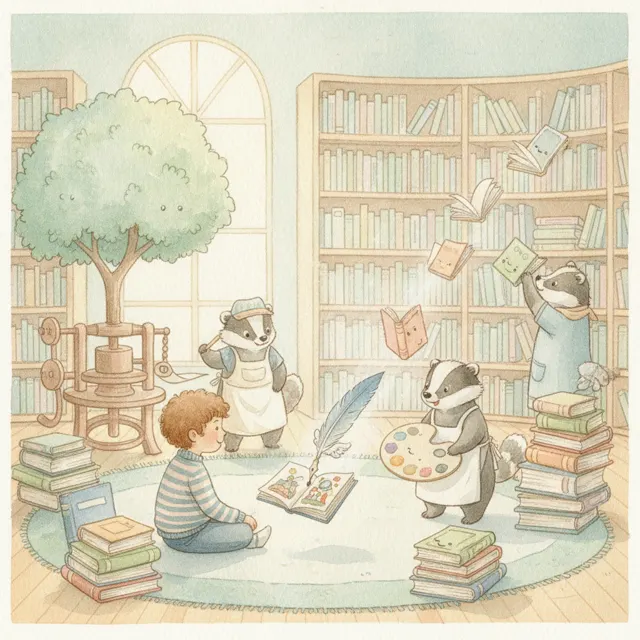
A story about how books are written, illustrated, and published, told through a child visiting their local library.

Moral: Every book represents an enormous journey from imagination to your hands. Reading is participating in that journey.

Theo loved the library. He loved the particular smell of it, old paper and possibility. He loved the way the shelves went on and on. One Tuesday, the librarian Ms. Park was sorting a new delivery. Theo helped carry boxes. "Where do all the books come from?" Theo asked. Ms. Park set down a stack. "Sit down," she said. "I'll tell you." She explained that every book starts as an idea in one person's head. The person writes the story down, takes months, sometimes years. Then they find a publisher, a company that helps make books. The publisher reads it and decides if they want to make it into a real book. If they say yes, an editor works with the writer to make it better. Every word gets considered. Then an illustrator creates the pictures, spending weeks on each page. Then designers arrange everything, the words and pictures and the cover. Then it goes to a printer. Enormous machines print thousands of copies. Workers cut and bind and stack them. Then the books travel to distributors, who send them to bookshops and libraries all over the world. "And then someone like me orders it," Ms. Park said, "and someone like you carries it inside." Theo looked at the stack of new books. Each one had traveled so far to reach this library. Each one had started as one person's idea. He picked up the one on top and opened it carefully. It seemed like the least he could do.

The Water Cycle Adventure

Ages 3-83 minutesscience
The Water Cycle Adventure story for kids illustration

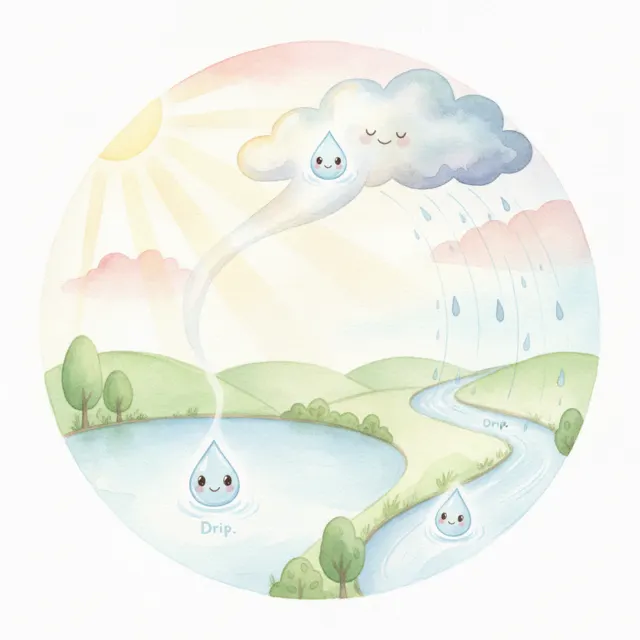
Drip is a drop of water in a lake. On a hot day he rises up into the sky and joins a cloud. He turns back into water and falls as rain. He flows down a stream and a river back to the lake. His trip starts again.

Moral: Water goes up, comes down as rain, and starts its trip all over again.

Drip the water drop lived in a big blue lake. He had many drop friends. One hot day, the sun shone bright and warm. Drip felt lighter and lighter. His body turned into a soft mist. "I am going up!" Drip said. He floated up into the sky. This is called evaporation. Lots of drops went up with him. They joined together and made a big, soft cloud. The cloud floated across the blue sky. Up in the sky it was cold. The drops huddled close. "Brr," Drip said. "I feel heavy now." The drops turned back into water. The cloud grew dark and full. It was heavy with rain. Then it began to rain. Drip fell down, down, down. "Wheee!" he called. He landed on a green hill with a soft splash. The rain soaked into the ground. Drip slid down into a small stream. The stream carried him along. It sang a little song as it moved. "Where are we going?" Drip asked. "To the river, then back to the lake," said a fish. Drip floated to the river. The river flowed to the lake. He was home again. His friends waved hello. "What a trip!" Drip said. "I went up, made a cloud, fell as rain, and came back home." The sun smiled. "You will do it all again tomorrow," it said. "That is the water cycle. Water goes up, comes down, and starts again. Every drop of rain has been on this trip before. It is a round trip that never stops."

The Little Seed That Grew

Ages 3-84 minutesnature
The Little Seed That Grew story for kids illustration

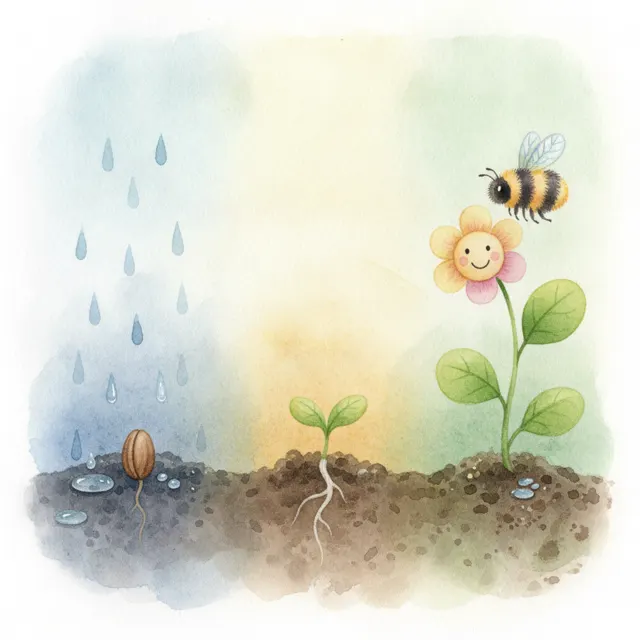
A tiny seed sits in dark soil. Rain falls and the seed drinks it. The sun warms the ground. A root grows down and a stem grows up. The seed becomes a plant with leaves and a flower. A bee visits to share pollen.

Moral: A tiny seed can grow into something big with water, sun, and time.

A tiny seed lay in the dark soil. It felt small and still. "Is this all I am?" the seed said. The soil was warm and soft around it. Rain fell on the soil. The water slid down to the seed. The seed drank it up. "That feels good," it said. It began to swell. Then the sun came out. It warmed the soil. The seed felt a little push inside. A small root grew down. "I am holding on to the ground," the seed said. The root held on tight. Next a tiny stem grew up. It pushed through the soil. It popped out into the light. "I can see the sun!" the seed said. But now it was not just a seed. It was a small plant. The plant grew two little leaves. The leaves caught the sunlight. They helped the plant make food. Day by day, the plant grew taller. Weeks passed. The plant grew a stem and more leaves. Then a bud appeared. One morning the bud opened into a bright flower. It had soft pink petals. The flower swayed in the warm breeze. A bee flew by. "What a pretty flower!" the bee said. "May I take some nectar?" "Yes!" said the flower. "And you can carry my pollen to help other plants." The little seed had become a big, strong plant. Water, sun, and soil had helped it grow. It all started with one small seed. Soon more seeds would fall and the whole thing would start again.

Ten Apples in a Basket

Ages 3-83 minutesnumbers
Ten Apples in a Basket story for kids illustration

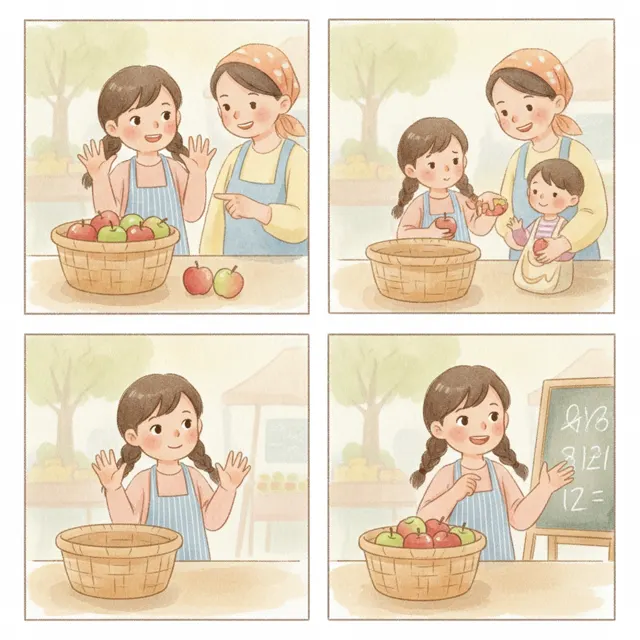
Maya helps her mother at a fruit stand. They count ten apples in a basket. People buy some and Maya takes away. The basket empties, then fills again. Maya learns that numbers help us add and take away every day.

Moral: Numbers help us add, take away, and count the things around us.

Maya helped her mother at the fruit stand. The stand was in a busy market. A big basket held red apples. They were shiny and round. "Let us count them," Mama said. "One, two, three, four, five," Maya counted. "Six, seven, eight, nine, ten. Ten apples!" A man came by. "May I buy three apples?" he asked. Mama gave him three. "How many are left?" Mama asked Maya. Maya counted again. "One, two, three, four, five, six, seven. Seven apples!" she said. She pointed at each one as she said its number. "Ten take away three is seven." A woman came next. She bought two apples. Maya counted. "Five apples now. Seven take away two is five." Then a little girl came with her father. They bought five apples. "How many now?" asked Mama. Maya looked at the empty basket. "None!" she laughed. "Five take away five is zero. We sold them all!" The basket sat empty and clean. Mama clapped her hands. That evening Mama filled the basket again. She put in ten new red apples. "Let us add," she said. "We put in ten new apples. Ten plus zero is ten." Maya grinned. "Counting is easy when you use apples," she said. "You can take away, and you can add. Numbers are everywhere." Mama hugged her. "You are a great counter," she said. "Numbers help us every day at home and at the shop." Maya smiled all the way home. She counted the steps too. One, two, three...

The Compass That Points Home

Ages 3-84 minutesgeography
The Compass That Points Home story for kids illustration

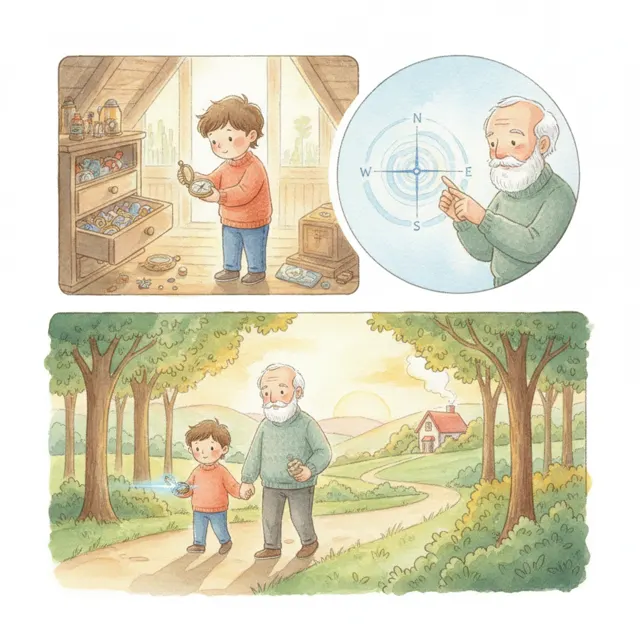
Leo finds a compass in his grandpa's drawer. Grandpa shows him the four directions: north, south, east, and west. They use the compass to walk home from the park. Leo learns the compass always points the way.

Moral: The four directions help you know where you are and how to get home.

Leo found a small round thing in his grandpa's drawer. It had a glass top and a needle that moved. "What is this?" Leo asked. "It is a compass," Grandpa said. "It shows you the way. The needle always points north." "What is north?" Leo asked. Grandpa smiled. "There are four main directions. North, south, east, and west. Let me show you." They went outside into the yard. Grandpa held the compass flat in his hand. The needle spun around and then stopped. "That way is north," he said, pointing. "Behind you is south." He pointed to the right. "That is east." He pointed to the left. "That is west." "So east is on my right and west is on my left?" Leo asked. "Close," Grandpa said. "When you face north, east is on your right and west is on your left." They walked to the park down the street. They played on the swings for a while. Then it was time to go. "Which way is home?" Leo asked. "Our house is south of the park," Grandpa said. "So we walk south." He looked at the compass. "South is that way." They walked south and soon saw their house. "We found home!" Leo said. Leo looked at the compass and smiled. "Now I can always find my way," he said. "North, south, east, and west. The compass helps me know where I am." The next day he took the compass to school to show his friends. They all took turns watching the needle point north.

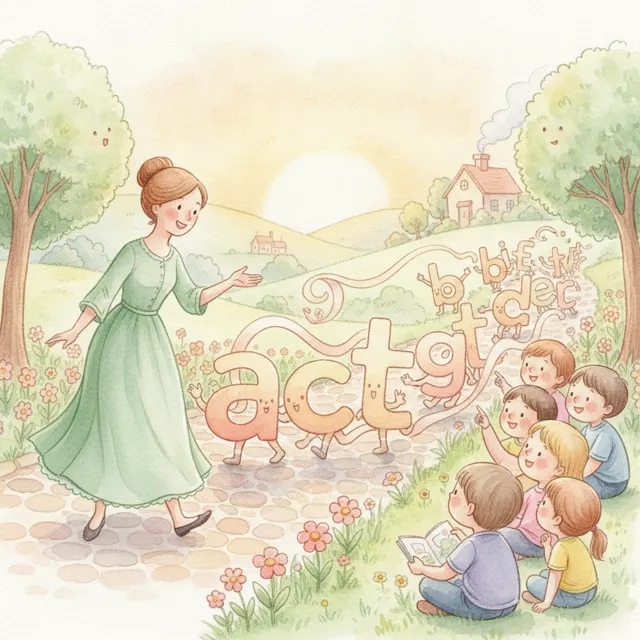
The Letter Sounds Parade

Ages 3-85 minutesreading
The Letter Sounds Parade story for kids illustration

The letters in Miss Green's class are sad because no one knows their sounds. She holds a letter sounds parade. Each letter says its sound. The letters join to make words like cat. The children learn to read.

Moral: Every letter has a sound, and sounds join together to make words.

In Miss Green's class, the letters were sad. They sat in a row on a shelf. "No one knows our sounds," said the letter B. "I can fix that," said Miss Green. "Today we will have a letter sounds parade. Each letter will say its sound." The letter A stepped up first. "A says ah, like in apple," it said. The children said "ah" together. The letter B came next. "B says buh, like in ball." The children said "buh, buh." C was next. "C says kuh, like in cat." Everyone said "kuh." Then D, E, and F had their turns. D said "duh." E said "eh." F said "fff." The parade went on through the whole alphabet. Each letter took a bow. The class clapped after every letter. Soon the letters began to join hands. "Look!" said Miss Green. "C, A, and T are holding hands. What do they make?" The children said the sounds one by one. "Kuh... ah... tuh. Cat!" The children cheered. "We made a word!" they said. The letters were happy now. They danced and made more words. They made "sun" and "dog" and "pig." Miss Green wrote the words on the board. "We are not just letters," B said. "Together we make words. And words make stories." The children learned that sounds are the key to reading. Each letter has a voice. Put the voices together and you can read any word. Reading opens the door to all the stories in the world. The bell rang, but the children did not want the parade to end.

Frequently Asked Questions

Turn Your Child Into the Hero of Their Own Story

Upload their photo and watch as AI creates a beautiful, personalized storybook with illustrations that look just like them. From $5.99/month.

โœจ Make Your Child the Hero

Plans from $5.99/month