Math Stories for Kids

Numbers come to life as your child counts, adds, and shares their way through gentle stories about cookies, stars, and friends.

✨ Make Your Child the Hero

Numbers are everywhere, in the cookies on a plate, the stars in the sky, and the steps up to bed. For a young child, counting and adding can feel like hard work until a story makes it feel like play. These five tales wrap early number skills in little adventures. Your child meets a girl who shares her cookies fairly, a boy who counts his way through a busy day, and friends who learn that math solves big problems. Each story is short and made for counting along. With CreateStory.ai, you can make it personal. Upload a photo and your child becomes the hero of their own math story.

Why Are Math Stories Good for Young Children?

Math stories turn numbers into a tale a child can follow. Instead of a dry worksheet, a child counts cookies, shares a pie, or sorts buttons. The math hides inside a fun story, so learning feels like play and sticks better.

Early math matters more than many parents think. Math skills at the start of school are the strongest predictor of later school success (Society for Research on Educational Effectiveness, 2015). A little counting now builds a big advantage that lasts for years.

How Do I Make Early Math Fun at Home?

Count real things as you go about the day. Count steps, apples, or socks. Ask simple questions like how many are left or how many make five. Keep it light and short, and let your child count along with you.

Stories are a gentle on ramp. When a child helps a character count and share, the ideas stick without drills. End each tale with a small question and let your child answer in their own time. That small habit builds a math mind.

Sample Stories

Read these stories, then create a personalized version where your child is the hero

The Cookie That Had to Be Shared
Ages 3-83 minfairness
The Cookie That Had to Be Shared story for kids illustration

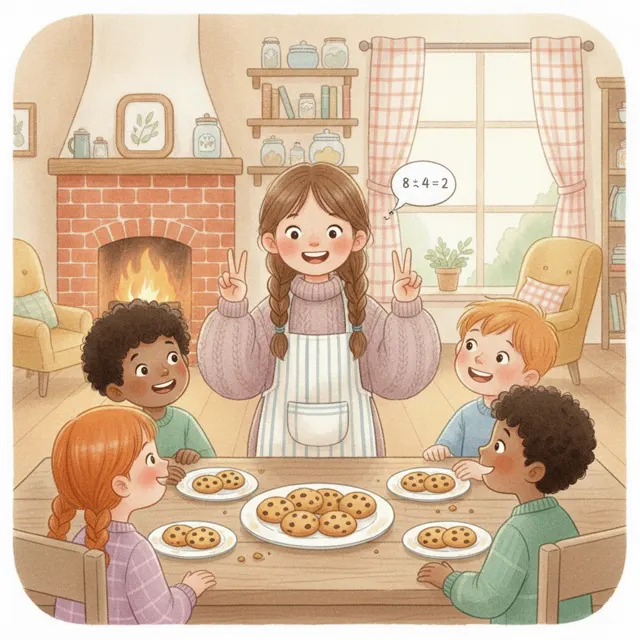
Lina bakes eight cookies for four friends and must figure out how to split them so everyone gets a fair share. With a little counting and a lot of heart, she learns that sharing equally makes every bite taste better.

Moral: Sharing things fairly makes every bite taste better for everyone.

Lina baked a tray of cookies for her friends, and they smelled wonderful. She counted them carefully. One, two, three, four, five, six, seven, eight. Eight cookies. But four friends were coming over, and everyone wanted a cookie. "How do I share eight cookies with four friends?" Lina wondered. She tried to give the first friend four cookies, but then the second friend would only get one, and that did not feel fair at all. She tried giving two friends three cookies each, but then the last two friends would get only one each, and their faces would fall. "This is hard," she said. Her cat Milo watched from the counter, flicking his tail as if he were counting too. "Maybe count them out loud," Mia, Lina's big sister, suggested. "Fair sharing is just little groups that all match." So Lina did. "Two for you, two for you, two for you, and two for you." She placed the cookies in four little piles, and when she was done, every pile had exactly two cookies. "It works!" Lina cheered. "Two and two and two and two makes eight!" When her friends arrived, they each found two warm cookies waiting on their plate. "These are perfect," said one friend, munching happily. "How did you know how to share so well?" Lina smiled. "I counted them out fairly," she said. "Two for each friend." And as she bit into her own two cookies, she thought they tasted better than any cookie she had ever made, because a fair share always tastes sweeter.
Ten Steps to Bed

Ages 3-83 minoptimism
Ten Steps to Bed story for kids illustration

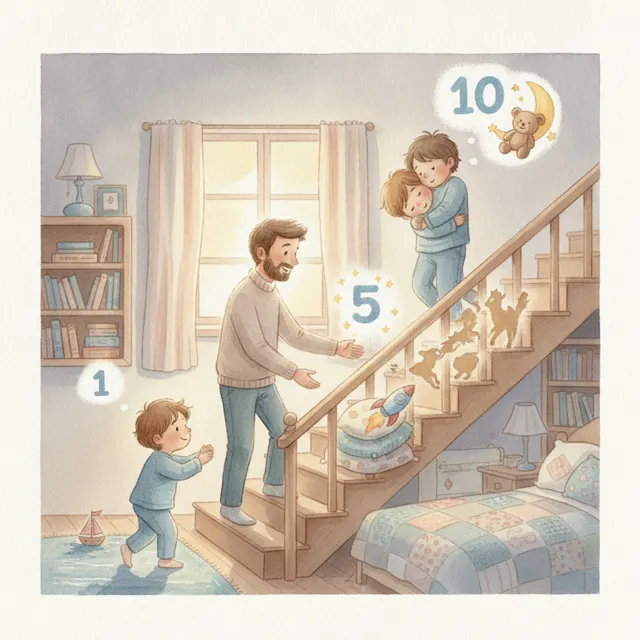
Nico does not want to go to bed, so his dad turns bedtime into a counting game. With every step, a number, and with every number, a little adventure, Nico counts his way all the way to ten and a sleepy goodnight.

Moral: Counting can turn an ordinary moment into a happy game.

Nico did not want to go to bed. "Just ten more minutes," he begged. His dad smiled. "How about ten steps instead? Let us count them together." Nico loved counting, so he nodded. "One," said Dad, as Nico put one foot on the first stair. "One big step." "Two," Nico said, climbing higher. "Two little hops." They counted on. "Three," said Dad. "Three tiny jumps." "Four," said Nico. "Four big yawns." By the fifth step, Nico was smiling. "Five," they said together. "Five sleepy wiggles." Halfway up, Nico forgot all about staying awake. He was too busy counting. Step six, they marched like bears. "Six heavy stomps," Dad said. Step seven, they tiptoed like mice. "Seven quiet steps," Nico whispered. Step eight, they stretched like cats. "Eight long stretches." Step nine, Nico's eyelids began to droop. "Nine slow blinks," Dad whispered. And then they reached the top. "Ten," Nico said, his voice soft and slow. "Ten cozy toes." Dad tucked him in and pulled the blanket up to his chin. He kissed Nico on the forehead, right between the eyes. "You counted all the way to ten," Dad said. "That was the best part," Nico mumbled, already half asleep. "Numbers make everything a game." Dad smiled and turned off the light. "Then we will count again tomorrow," he said. And with ten warm toes under the blanket and a head full of numbers, Nico drifted off to sleep. He dreamed of ten stars, ten clouds, and one big moon, and he was asleep before he could count one more.

The Two Cats Who Learned to Add

Ages 3-84 minsharing
The Two Cats Who Learned to Add story for kids illustration

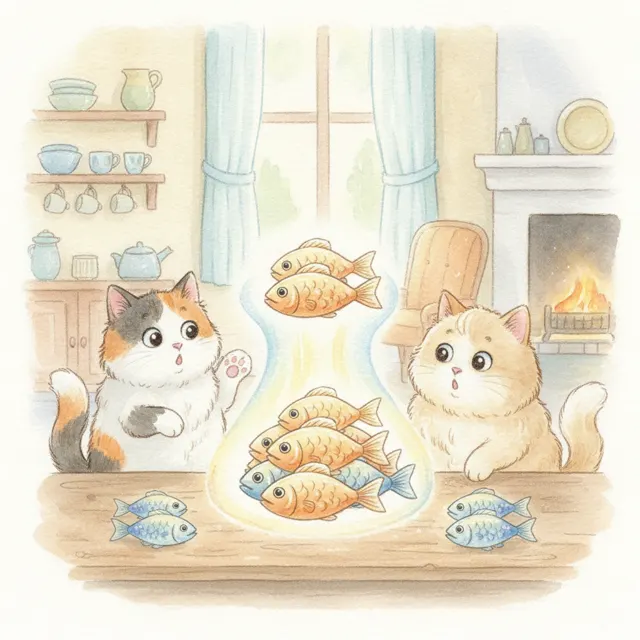
Momo has three fish, and Yoyo has two. When they learn to put their fish together, they discover that three plus two makes five, and that adding things together can make a bigger, better treat for both of them.

Moral: Putting what you have together can make something bigger and better for everyone.

Momo the cat had three little fish in his bowl. Yoyo the cat had two little fish in her bowl. They sat side by side, watching their fish swim in circles. "I wish I had more fish," Momo sighed. "I wish I had more fish too," said Yoyo. A clever old owl heard them and landed on the fence. "Why not put your bowls together?" he asked. Momo and Yoyo looked at each other. "But then whose fish are they?" asked Momo. "Whose bowl is it?" asked Yoyo. "It can be your bowl together," said the owl. "Let us count what you have. Momo, how many fish do you have?" "Three," said Momo. "And Yoyo, how many do you have?" "Two," said Yoyo. "Now let us add them," said the owl. "Three plus two. Count with me. One, two, three, and then four, five." "Five!" the cats said together. "We have five fish!" So Momo and Yoyo pushed their bowls together and watched all five fish swim in one happy little school. The fish looked bigger and brighter together. The next day, Momo found two more fish, and Yoyo found one more. "Two plus one," they counted. "Three new fish." They added them to the bowl too. "Five plus three makes eight!" they cheered. "Adding is fun," said Momo. "Now we have more fish, and we can share them." "And more friends," said Yoyo, nudging Momo. The old owl smiled. "That is what adding does," he said. "It makes small things into bigger, better things."

The Shape That Wanted to Count

Ages 3-84 minself-acceptance
The Shape That Wanted to Count story for kids illustration

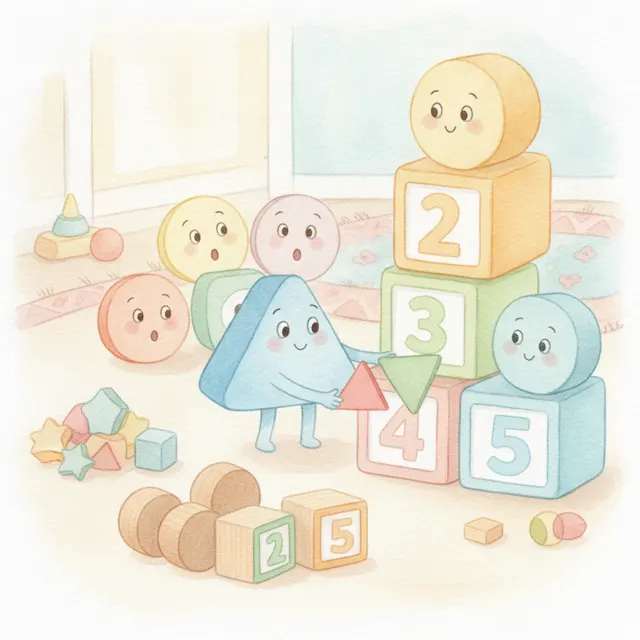
A little triangle wants to play with the counting blocks, but the blocks only count round and square shapes. With patience and a clever idea, the triangle shows that every shape, and every child, belongs in the count.

Moral: Everyone belongs, and you count exactly as you are.

In the counting corner of the classroom lived blocks of every shape and size. There were round circles, strong squares, and one little triangle named Tri. Every morning, the blocks lined up to be counted. "One circle, two circles, three circles," the teacher would say. "One square, two squares, three squares." But when it was Tri's turn, the counting always stopped. "Triangles are tricky to count," the blocks whispered. "You have three points, so no one knows where to start." Tri felt left out. "I want to be counted too," he said quietly. The circles rolled their eyes, and the squares shrugged their corners. Tri tried to stand in the circle line, but he kept poking the circle next to him with his points. He tried to stand in the square line, but he did not fit flat against the wall. "Maybe I do not belong in any line," Tri whispered. But Tri did not give up. "Maybe I can count myself," he said. So Tri pointed to his first point. "One," he said. Then his second point. "Two." Then his third point. "Three. I have three points, and I can count them all by myself." The other blocks went quiet. "You counted yourself," said a circle in surprise. "I did," said Tri, smiling. "And now I can join the counting line too." So the next morning, when the teacher counted the blocks, Tri stood up tall. "One triangle," the teacher said, "with three happy points." And all the blocks cheered. Tri had learned that every shape, and every child, belongs in the count.

The Five Little Stars

Ages 3-85 minpatience
The Five Little Stars story for kids illustration

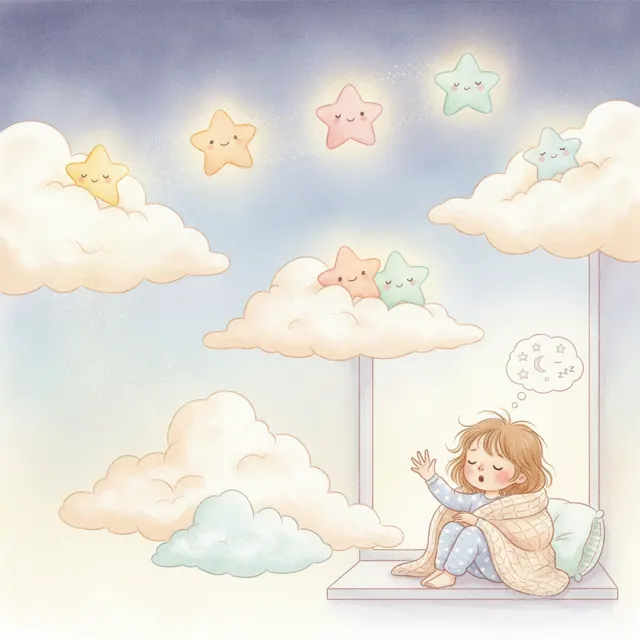
Five little stars shine in the night sky, but one by one they slip behind the clouds to rest. A little girl below counts them as they go, and learns that subtraction is just counting down to a peaceful goodnight.

Moral: Counting down can turn a quiet moment into a peaceful game.

In the night sky, five little stars twinkled in a row. One, two, three, four, five. A little girl named Ava sat by her window and counted them. "Five stars," she whispered. "Five shiny stars." But then a soft cloud drifted by, and one star slipped behind it to rest. "Four stars," Ava counted. "Five take away one is four." A moment later, another star yawned and tucked itself behind a cloud. "Three stars," Ava said. "Four take away one is three." The third star blinked twice, then curled up behind a cloud too. Ava yawned right along with it. "Two stars," Ava counted. "Three take away one is two." Then the second to last star gave a long, slow blink and vanished behind a cloud. "One star," Ava whispered. "Two take away one is one." Finally, the last little star gave Ava a sleepy wink and drifted behind the clouds too. "Zero stars," Ava said softly. "One take away one is zero. Goodnight, stars." Ava pulled her blanket up and smiled. She had counted the stars all the way down to zero, and it felt like a lullaby made of numbers. The stars were resting now, and so could she. "Subtraction is just counting down," she murmured, and she closed her eyes. Her blanket felt warm and her pillow felt soft. Somewhere behind the clouds, five little stars twinkled one last time, and Ava dreamed of numbers dancing in the dark. And out in the sky, the five little stars slept soundly too, waiting to twinkle again tomorrow.

Mina Counts the Garden Bugs

Ages 3-83 minutescounting
Mina Counts the Garden Bugs story for kids illustration

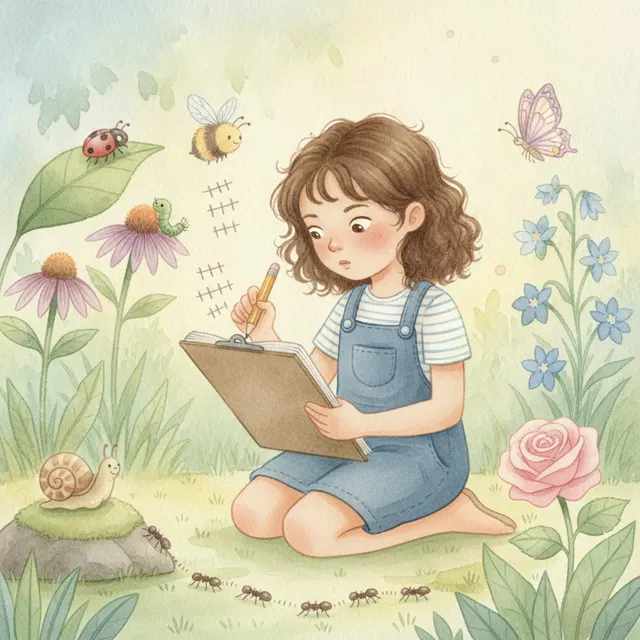
Mina wants to know how many bugs live in her garden. She counts them one by one and draws a mark for each. Counting carefully teaches her that every bug has a number.

Moral: Count one by one and you will always know for sure.

Mina loved her garden. Every day she saw bugs of all kinds. She saw red ladybugs, green beetles, and fuzzy bees. She wanted to know how many bugs there were. 'How many bugs are in my garden?' Mina asked her dad. 'Count them,' Dad said. 'Touch each one as you count. That way you do not miss any.' Mina got a small pad and a pencil. She walked to the flower bed. A ladybug sat on a leaf. 'One,' Mina said. She drew one mark on her pad. Two bees buzzed by the roses. 'Two, three,' Mina said. She drew two more marks. A green beetle crawled on the dirt. 'Four,' Mina said. She drew another mark. Three ants marched in a line. Mina touched each one with her pencil. 'Five, six, seven,' she said. She drew three marks. Mina walked all around the garden. She found more bugs by the tomato plants and under the rocks. She counted every single one and drew a mark for each. Her pad filled up with little lines. At the end, she counted her marks. 'One, two, three, four, five, six, seven, eight, nine, ten!' she said. 'There are ten bugs in my garden.' 'You did it,' Dad said. 'You counted them all.' 'I touched each one,' Mina said. 'That helped me not to skip any.' Dad smiled. 'Counting one by one is how you know for sure.' Mina looked at her garden and smiled too. Every bug had a number now. And she knew them all.

Two Apples and Three More

Ages 3-83 minutesaddition
Two Apples and Three More story for kids illustration

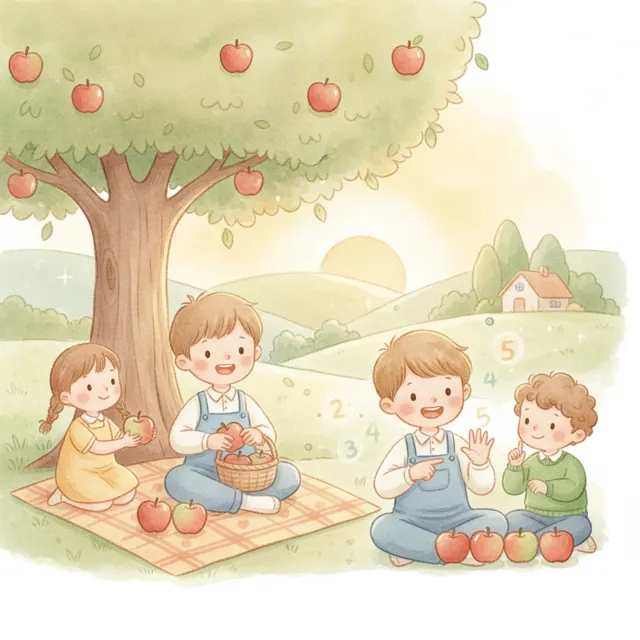
Leo has two apples. His friends give him three more. He puts them together and counts five. Adding small groups teaches him that more can come from putting things together.

Moral: Putting groups together is how we add and get more.

Leo had two red apples in his basket. They were round and shiny. He was about to eat one when his friend Sam came over. 'You have two apples,' Sam said. 'Can I see?' 'Yes,' Leo said. 'One, two. I have two apples.' Sam smiled. 'I brought you three more from my tree,' he said. He put three green apples in the basket. Leo looked at the basket. Now it had red apples and green apples all mixed together. 'How many do I have now?' Leo asked. 'Put them together and count,' Sam said. Leo took out the apples and lined them up in a row. 'One, two,' he said, pointing at the red ones. 'Then three, four, five,' he said, pointing at the green ones. 'Five!' Leo said. 'I have five apples now.' 'You added three to two,' Sam said. 'Two plus three makes five.' Leo was amazed. His basket had grown. 'Adding makes more,' he said. 'I like that.' 'Let us try again,' Sam said. 'If I give you one more, how many will you have?' Leo counted on his fingers. 'Five, then six,' he said. 'Six apples!' He smiled wide. They sat on the grass and shared the apples with their friends. Every time someone added an apple to the basket, Leo counted them again. Two, then three more, then five. Then six, then seven. Adding was like a magic trick. Put groups together, and you always get more. 'Adding is fun,' Leo said. 'I want to add more things tomorrow.'

The Square and the Round Door

Ages 3-83 minutesshapes
The Square and the Round Door story for kids illustration

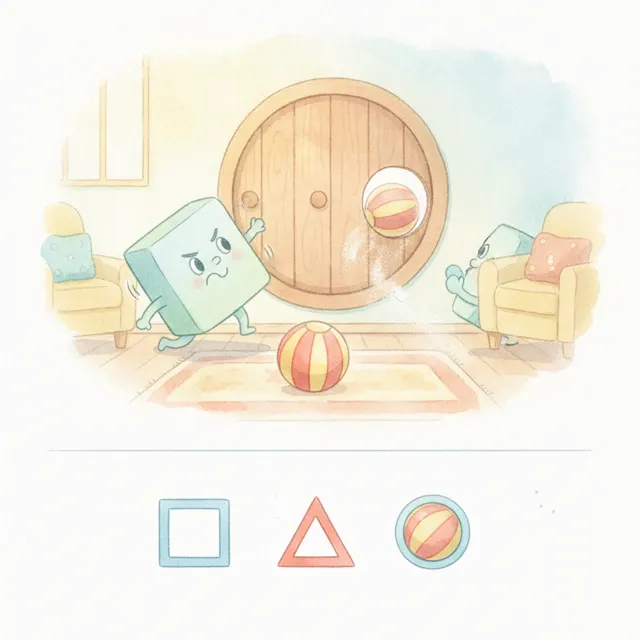
A square block wants to go through a round door but will not fit. It tries turning every way. Finally it rolls a round ball through instead. Matching shapes to holes makes things fit.

Moral: A shape fits best in the hole that matches it.

There was a little square block. It was flat on four sides, with four sharp corners. One day, it wanted to go through a door. But the door was round, like a circle. 'I want to go through,' the square said. It pushed its corner at the round door. It did not fit. The square tried a flat side. Still stuck. It tried another corner. The round door would not let it through. 'Why will I not fit?' the square asked. 'Because I am round,' the door said. 'I have no corners. Your corners are too sharp.' A round ball rolled up. 'Let me try,' the ball said. It rolled right through the round door, smooth as can be. 'See? A round shape fits a round hole.' 'But I want to go through too,' the square said. 'Then find a square door,' the ball said. 'A square shape fits a square hole.' The square looked around. It found a door that was square, with four corners just like its own. It slid right through, and it fit perfectly. 'I fit!' the square said. 'I just needed the right shape.' The square and the ball sat together by the doors. A triangle came by and found a triangle door. A star found a star shaped hole. Every shape found the door that matched it. 'Shapes have to match,' the square said. 'A square goes in a square hole, and a circle goes in a round hole.' 'That is right,' the ball said. 'Matching shapes is how things fit.'

Half of the Big Blue Pie

Ages 3-83 minutesfractions
Half of the Big Blue Pie story for kids illustration

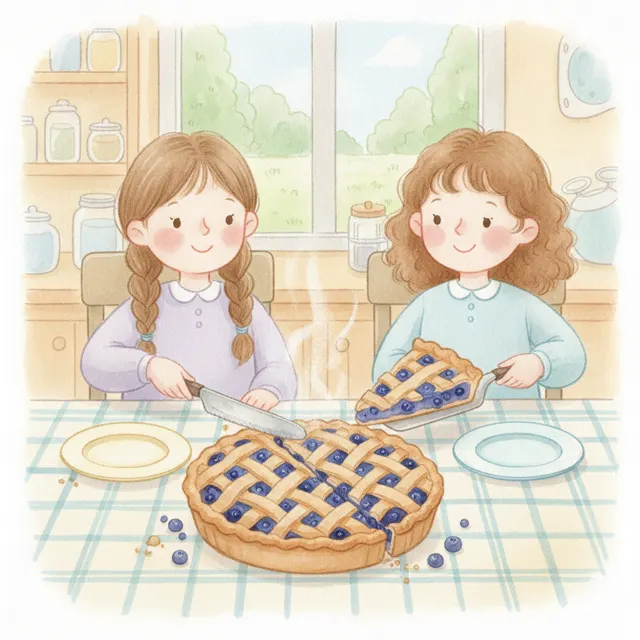
Two sisters have one blueberry pie and must share it fairly. They cut it right down the middle into two equal halves. Sharing a whole into two equal parts makes it fair for both.

Moral: Two equal halves make one fair and whole share.

Grandma baked one big blueberry pie. It sat on the table, warm and sweet. Maya and Rosa both wanted a piece. 'There is only one pie,' Maya said. 'How do we share it?' 'We each get the same,' Rosa said. 'That is fair.' 'But how?' Maya asked. 'One pie for two people.' Grandma smiled. 'Cut the pie into two parts that are exactly the same size,' she said. 'Each part is called one half.' Maya picked up the knife. She cut the pie slowly, right down the middle. The cut went through the very center of the pie. 'Now look at the two pieces,' Grandma said. 'Are they the same size?' Maya and Rosa looked close. One piece was just as big as the other. They matched. 'They are the same!' Rosa said. 'Now we each get one half.' 'One half for you, and one half for me,' Maya said. She slid one piece onto Rosa's plate and one onto her own. 'Two halves make one whole pie,' Grandma said. 'When you put the two halves back together, you get the whole again.' Maya put her half next to Rosa's half. They fit together like a puzzle and made one round pie again. 'It is the whole pie!' Maya said, amazed. 'Yes,' Grandma said. 'Half plus half makes a whole.' They ate their halves together. Both pieces were the same, so no one got more and no one got less. Sharing a pie into halves made it fair for both of them. And it tasted sweet.

Ten Little Cars in a Row

Ages 3-83 minutesordering
Ten Little Cars in a Row story for kids illustration

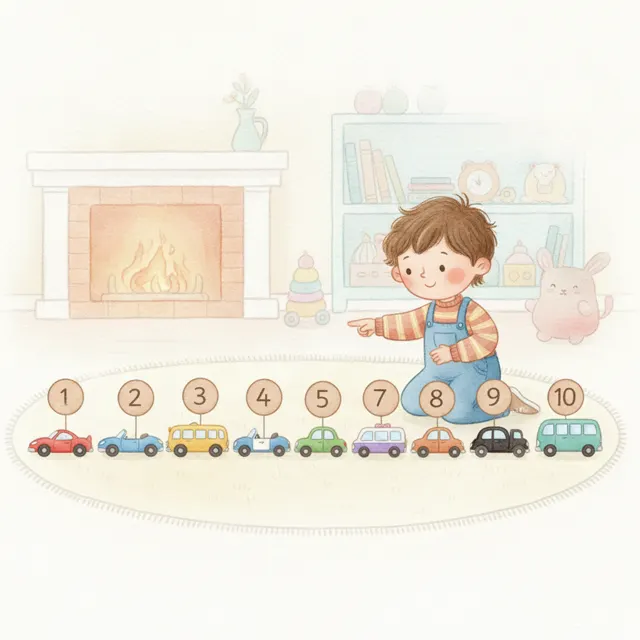
Ten toy cars are scattered on the floor. Sam lines them up from one to ten and gives each a number. Putting things in order from one to ten helps him count them all.

Moral: Putting things in order makes counting them easy.

Sam had ten toy cars. They were red, blue, green, yellow, and every color you can think of. But they were scattered all over the floor, one here and one there. 'I want to count my cars,' Sam said. 'But they are all mixed up.' 'Line them up,' his mom said. 'Put them in a row, and count from one to ten.' Sam gathered the cars. He placed the first one down. 'One,' he said. He placed the second car next to it. 'Two,' he said. He kept going, putting each car right behind the one before it. 'Three, four, five,' Sam counted as he lined them up. The row grew longer and longer. 'Six, seven, eight, nine.' Sam put the last car at the end of the row. 'Ten!' he said. 'I have ten cars, all in a row.' 'Now touch each one and count again,' Mom said. Sam touched each car as he counted. 'One, two, three, four, five, six, seven, eight, nine, ten.' He did not skip a single one. 'Ten cars,' Sam said. 'The row helps me see them all.' 'That is right,' Mom said. 'When things are in order, counting is easy.' Sam looked at his long row of cars. It stretched across the whole room. He knew exactly how many cars he had. He knew which car was first and which was last. 'My cars are in order now,' Sam said. 'I will always line them up before I count.' And from that day on, that is just what he did. Ten cars, in a row, from one to ten.

The Tallest Tower of Blocks

Ages 3-83 minutesmeasurement
The Tallest Tower of Blocks story for kids illustration

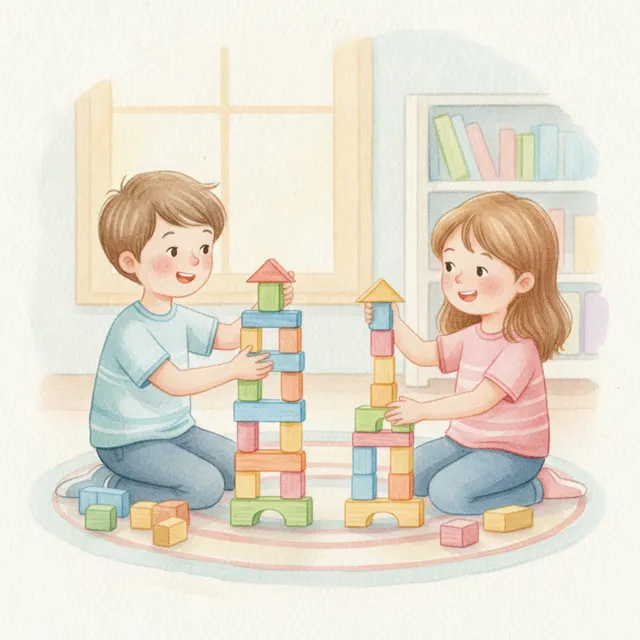
Two friends build towers of blocks and wonder whose is taller. They stack them side by side and compare. Measuring with blocks teaches them which tower is taller and which is shorter.

Moral: Counting and comparing tells you which is taller and which is shorter.

Zoe and Kai loved to build with blocks. One sunny day, they both built a tower. Zoe stacked her blocks up, up, up. Kai stacked his blocks up, up, up too. 'My tower is the tallest,' Zoe said. 'No, mine is,' Kai said. 'Look at it.' They looked at the two towers. But they were far apart, so it was hard to tell. 'Let us put them side by side,' Zoe said. 'Then we can see which one is taller.' They carried their towers to the table and set them right next to each other. Both towers stood straight and tall. 'Look,' Kai said. 'My tower goes up higher than yours.' Zoe looked close. Kai's tower was a little bit taller. Her tower was a little bit shorter. 'You are right,' Zoe said. 'Yours is taller, and mine is shorter.' 'Let us count the blocks,' Kai said. 'Then we will know for sure.' They counted Zoe's blocks. 'One, two, three, four, five,' they said. 'Five blocks.' Then they counted Kai's blocks. 'One, two, three, four, five, six, seven. Seven blocks.' 'Seven is more than five,' Zoe said. 'So your tower is taller.' 'Counting tells us which is taller,' Kai said. 'We did not even have to guess.' Zoe laughed and nodded. 'Now I know the trick,' she said. 'Set them side by side and count the blocks.' They smiled at each other. Then they put their blocks together and built one giant tower, even taller than before. It reached way up toward the ceiling. Counting and comparing made the game more fun.

Pip Sorts the Lost Buttons

Ages 3-83 minutessorting
Pip Sorts the Lost Buttons story for kids illustration

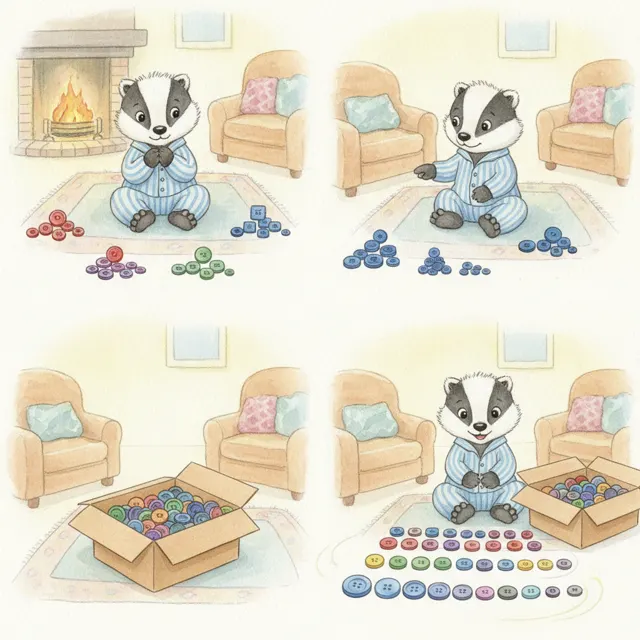
Pip finds a box of mixed up buttons. He sorts them into groups by color and then by size. Sorting things that are alike helps him see the groups and make sense of the mess.

Moral: Sorting things that are alike makes a mess easy to count.

Pip found a little box on the shelf. When he opened it, buttons spilled everywhere. There were red buttons, blue buttons, big buttons, and small buttons. It was a big mess. 'What a jumble,' Pip said. 'How do I make sense of all these buttons?' 'Sort them,' his grandma said. 'Put the ones that are alike together.' Pip looked at the buttons. He picked up a red button and set it in one pile. Then he found another red button and put it with the first. Soon he had a whole pile of red buttons. 'Now the blue ones,' Pip said. He made a pile of blue buttons. Then a pile of yellow buttons. Every button went into a color group. 'Now they are sorted by color,' Pip said. He felt proud. 'Can you sort them another way?' Grandma asked. Pip looked again. Some buttons were big, and some were small. He pushed the big buttons into one group and the small buttons into another group. 'Now they are sorted by size,' Pip said. 'Big buttons here, small buttons there.' 'Which group has more?' Grandma asked. Pip counted the big buttons. 'One, two, three. Three big buttons.' He counted the small buttons. 'One, two, three, four, five. Five small buttons.' 'Five is more than three,' Pip said. 'There are more small buttons.' 'Sorting helps you see that,' Grandma said. 'When things are in groups, counting is easy.' Pip smiled at his tidy piles. The mess was gone. Now every button had a home, and Pip knew just how many he had. Sorting had turned a big jumble into neat little groups.

Frequently Asked Questions

Turn Your Child Into the Hero of Their Own Story

Upload their photo and watch as AI creates a beautiful, personalized storybook with illustrations that look just like them. From $5.99/month.

✨ Make Your Child the Hero

Plans from $5.99/month