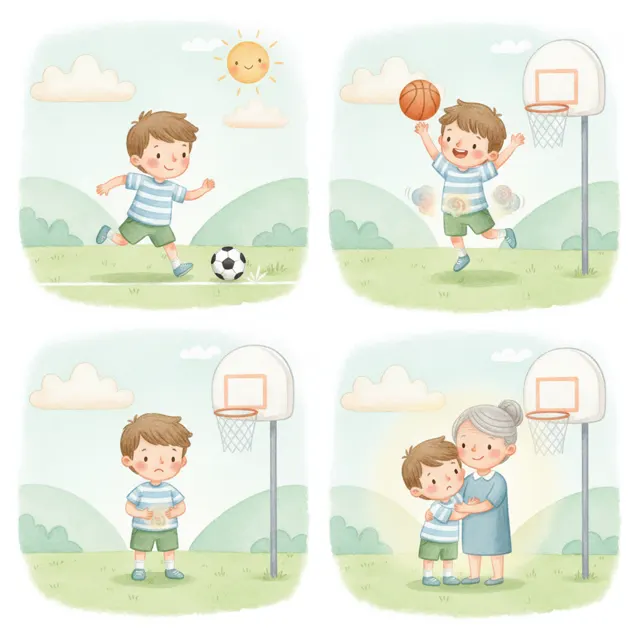
Basketball Stories for Kids

A bouncing ball, a waiting hoop, and a child who becomes the hero of every basketball story on the court.

✨ Make Your Child the Hero

Basketball is full of small moments that feel huge to a kid. The first time the ball goes through the net, the high five after a good pass, the bounce back after a bad miss. Basketball stories bottle those feelings, from the shortest kid on the court who learns height is not everything, to a new teammate who finds a friend at the first practice. With CreateStory.ai, your child takes the court in a story built just for them. Upload a photo and they become the hero, learning that hard work, kindness, and believing in yourself are the real slam dunks.

Why is basketball a favorite sport for young kids?

Basketball gets kids running, jumping, and working as a team. It is fun and easy to learn with a small ball and a low hoop. Basketball is the most popular team sport for kids ages 6 to 17 (Sports & Fitness Industry Association, 2024).

Kids learn to pass, wait for a turn, and cheer for friends. Playing also keeps little bodies strong and healthy. A short game or a few shots at the hoop is a great way for a child to stay active and smile.

What good lessons can children learn from basketball stories?

These short stories show kids how to share, practice, and be honest. Each one teaches one small lesson in a warm way. Reading about a game helps a child see how to act on the court and with friends.

Kids love the bouncing ball and the cheering friends. The stories feel real because children play these games at school and at home. After each story, a parent can ask one simple question about the lesson.

Sample Stories

Read these stories, then create a personalized version where your child is the hero

The Shortest Kid on the Court
Ages 3-84 minperseverance
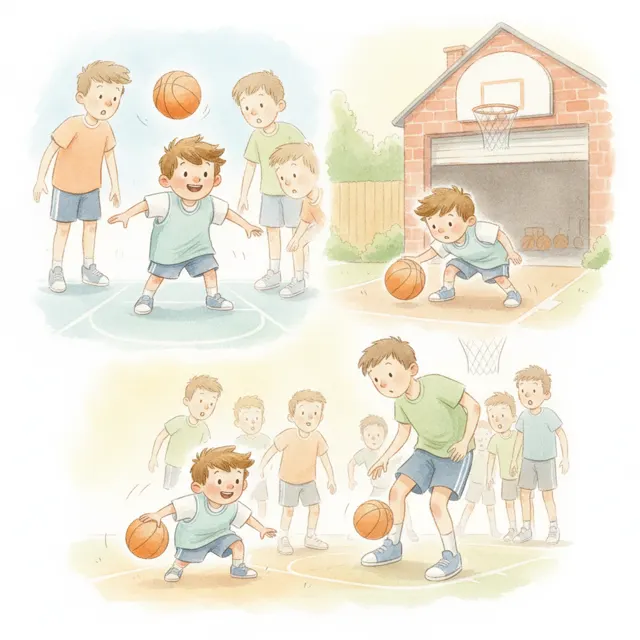
The Shortest Kid on the Court story for kids illustration

Ollie is the shortest kid on the team, and the ball always seems to bounce over his head. But with daily practice and a clever new move, he proves that height has nothing on heart.

Moral: What you practice is worth more than how tall you are.

Ollie was the shortest kid on the basketball team. The ball bounced at his shoulders, the hoop looked like it was in another town, and every rebound seemed to sail right over his head. "You are too small for basketball," said a kid on the other team. Ollie tried to ignore him, but the words stuck. That night, he told his mom. "Maybe I should just quit." His mom smiled and handed him the ball. "Show me what you can do," she said. So Ollie showed her. He dribbled low and fast, the ball never rising above his knees. He zigzagged between the flower pots in the yard. "You dribble better than anyone your size," his mom said. "Why? Because the ball is close to the ground, and you are close to it too." Ollie stared at the ball. She was right. Being short meant he was already low. The ball had less far to fall. So Ollie practiced every day after school. He dribbled around chairs. He passed to the garage door. He invented a move where he spun low and shot from under the big kids' arms. At the next game, the tall kid from the other team guarded him. "Too small," he said again. Ollie just smiled. He spun low, slipped past, and laid the ball up into the hoop. Swish. The tall kid's jaw dropped. Ollie did it again. And again. The crowd roared every time. After the game, the tall kid walked over. "I was wrong," he said. "You are not too small. You are just the right size for that move." Ollie shrugged, grinning. "Turns out low to the ground is a pretty good place to be."
The Pass That Won the Game

Ages 3-84 minteamwork
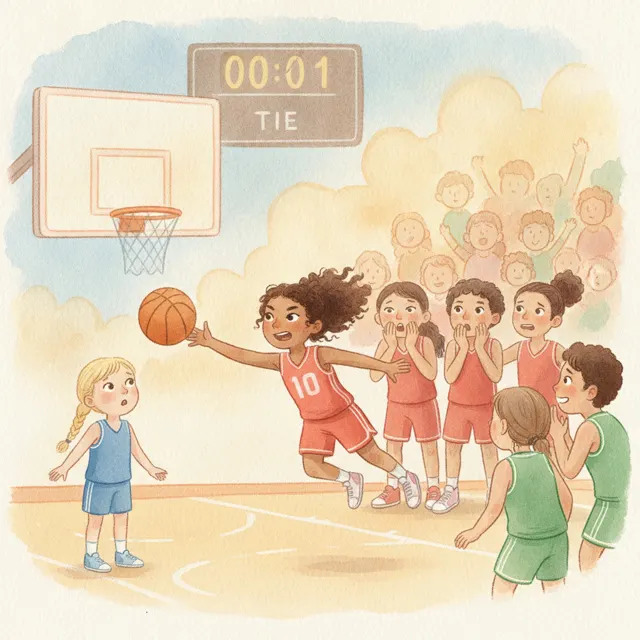
The Pass That Won the Game story for kids illustration

With one second left and the score tied, everyone expects star player Dee to take the shot. Instead, she passes to the quiet teammate no one guards, and the whole team learns what trust means.

Moral: The best play is often the one that lets a teammate shine.

The score was tied. One second left. The whole gym was on its feet. Dee had the ball. She was the team's best shooter, and everyone knew it. The other team crowded around her, three defenders with their arms high. "Shoot, Dee!" the crowd yelled. Dee looked at the basket. Then she looked at her teammate Joon, standing open in the corner. Nobody was guarding Joon. Nobody ever guarded Joon. Dee's coach always said, "Take the shot the defense gives you." The defense was giving her Joon. So Dee passed. The ball flew to Joon, who caught it with wide eyes. He looked almost scared. But he squared his feet, just like they had practiced a hundred times, and shot. The buzzer sounded. The ball arced high, hit the backboard, and dropped through the net. Swish. The gym exploded. Joon's teammates lifted him up. He was laughing and crying at the same time. "You passed it!" Joon said to Dee. "Nobody ever passes to me." "You were open," Dee said with a grin. "And you made it." The coach pulled them both into a hug. "That," he said, "was the best pass I have seen all season." On the bus home, Joon sat next to Dee. "I was so nervous," he admitted. "Me too," Dee said. "But that is what teammates are for. I trust you, and you trust me." Joon nodded, still smiling. "Next game," he said, "I will pass it right back to you." Dee bumped his shoulder. "I am counting on it," she said.

Bouncing Back After a Miss

Ages 3-83 minresilience
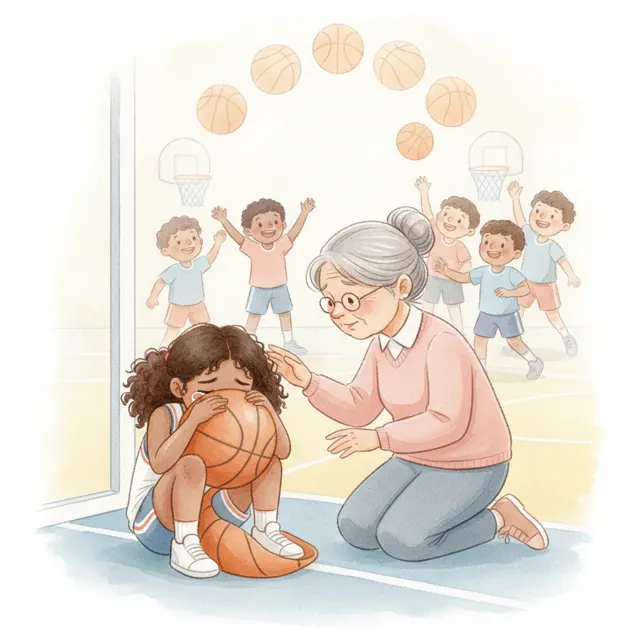
Bouncing Back After a Miss story for kids illustration

Nadia misses the game-winning free throw and wants to hide forever. With her grandmother's gentle words, she learns that everyone misses, and the ones who keep shooting are the ones who score.

Moral: A miss is just the first step of the next shot.

The ball rolled off the rim and into the other team's hands. The buzzer sounded. The game was over, and Nadia had missed the shot that would have won it. She sat on the bench long after everyone left, staring at her shoes. Her grandmother sat down beside her. "I missed," Nadia said, her voice small. "Everyone is going to remember." Her grandmother patted her knee. "Let me tell you something," she said. "The best player in the world misses more shots than anyone else." Nadia looked up. "That does not make sense." "It does," her grandmother said. "Because the best players keep shooting. You cannot score if you are afraid to miss. So they miss, and they shoot again, and they miss, and they shoot again. Until the shots start falling." Nadia wiped her eyes. "But this one mattered." "It mattered because you were brave enough to take it," her grandmother said. "The only real miss is not trying." The next morning, Nadia went to the court alone. She stood at the free-throw line. Bounce, bounce, breathe, shoot. The ball missed. She shot again. Missed. Again. Missed. But she did not stop. She shot until her arms ached. At the next game, the score was tied and Nadia stepped to the line. The gym went quiet. Bounce, bounce, breathe. Swish. Her grandmother caught her eye from the stands and gave a small nod, as if to say, I told you so. Nadia smiled. She had missed before. She would miss again. But now she knew the secret. You just keep shooting.

The New Kid's First Practice

Ages 3-83 minkindness
The New Kid's First Practice story for kids illustration

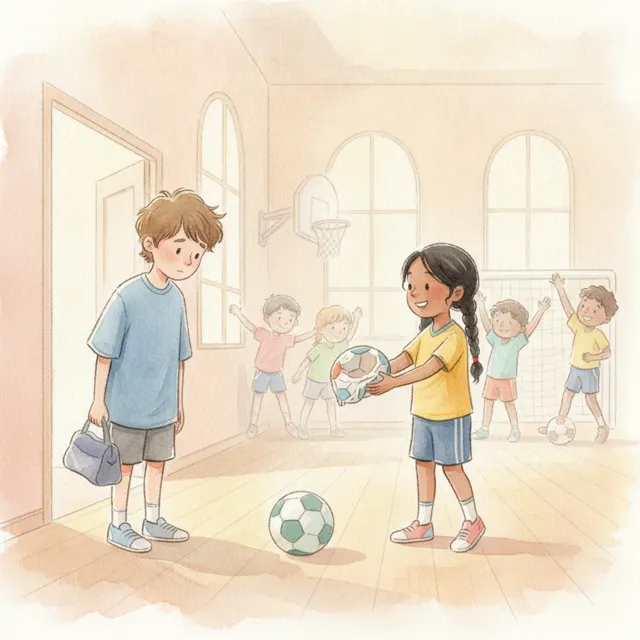
When a shy new kid named Ben walks into the gym looking lost, Maya remembers her own first practice. A shared ball and a kind word turn a stranger into a friend before the warm-up ends.

Moral: A small welcome can make a huge difference to someone new.

Maya still remembered her first basketball practice. The big gym, the squeaky shoes, the feeling of not knowing a single face. It had been the loneliest hour of her life. So when a new kid walked into the gym looking lost, Maya noticed right away. The boy stood by the door, clutching a worn ball, not sure where to go. His name, Maya would learn later, was Ben. "Hey," Maya called, jogging over. "I am Maya. You must be new." Ben nodded, barely meeting her eyes. "I do not know anyone." "You know me now," Maya said. "Come on, we are doing passing drills. I will be your partner." She led him to the court. At first, Ben's passes were wobbly and nervous. But Maya kept encouraging him. "Good one," she said. "Nice hands." Slowly, Ben relaxed. His passes grew stronger. By the end of practice, he was laughing when he fumbled, instead of looking at the floor. "You were really good today," Maya told him as they packed up. Ben looked up, surprised. "You think so?" "I know so," Maya said. "My first practice, nobody talked to me. I told myself that if I ever saw a new kid, I would be the one to say hi." Ben smiled, a real smile this time. "Thanks, Maya. For saying hi." "That is what teammates do," she said. "See you Thursday?" "See you Thursday," Ben said, and this time he did not look lost at all. As he walked out, Ben bounced his ball on the sidewalk, the sound light and sure. Maya waved. The team had gotten a little bigger today, and a little warmer too.

Grandpa's Old Ball

Ages 3-85 minpractice
Grandpa's Old Ball story for kids illustration

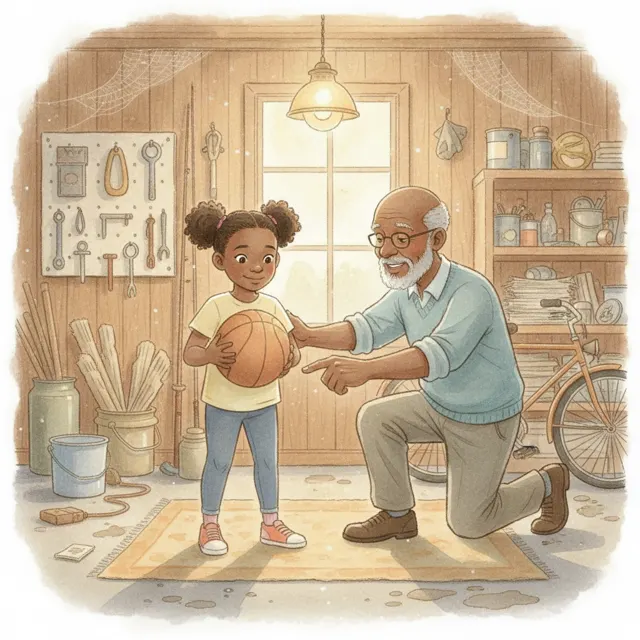
Amara finds her grandfather's old basketball in the garage, worn smooth from years of use. As he teaches her to dribble, she learns that the best skills are built one quiet evening at a time.

Moral: Some things are worth the work, even when nobody is watching.

Amara found the ball in the back of the garage, dusty and worn, its orange faded to peach. She carried it to her grandfather, who was reading on the porch. "Whose ball is this?" she asked. Her grandfather's eyes lit up. "That," he said, "is my old ball. I learned to play with that very ball, more years ago than I like to count." "Can you still play?" Amara asked. He stood up slowly and took the ball, spinning it on one finger. "Some things you never forget. Come on." They went to the court down the street. Her grandfather showed her how to dribble, low and steady. "Not with your palm," he said. "With your fingertips. Feel the ball." Amara tried. The ball wobbled and rolled away. She chased it and tried again. "How did you get so good?" she asked. "Every evening after school," he said, "I came out here and practiced until the streetlights came on. No coach, no team. Just me and this ball." "Did you get bored?" "Sometimes," he said with a smile. "But I wanted to be good more than I wanted to quit. So I stayed." They practiced until the sky turned pink and the first star appeared. Amara's arms ached, but the ball was starting to feel different in her hands. Less like a stranger. "You are a natural," her grandfather said. Amara laughed. "I am not. I fumbled a hundred times." "That is how you know you are learning," he said. "Every great player fumbled a hundred times first." They walked home together, the old ball tucked under Amara's arm. "Can we practice again tomorrow?" she asked. Her grandfather's smile was wide. "Streetlights will be waiting for us."

The Ball That Would Not Bounce

Ages 3-83 minutespatience
The Ball That Would Not Bounce story for kids illustration

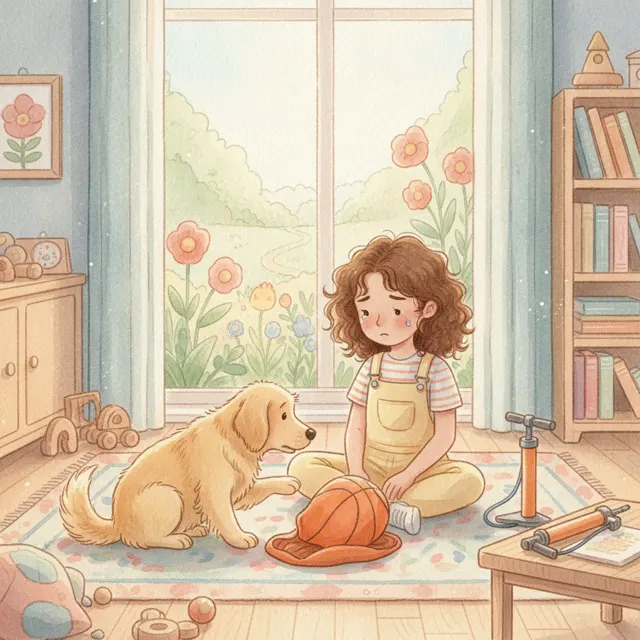
Maya gets a new basketball for her birthday, but it will not bounce. She learns it needs air and must wait for a pump. While she waits, she finds a new way to play and learns that good things come with patience.

Moral: Good things come when you wait and keep playing.

Maya got a new ball for her birthday. It was orange and shiny. She dropped it on the floor. Thud. It did not bounce back up. "Why won't my ball bounce?" Maya asked. She looked sad and crossed her arms. "A ball needs air inside it," said her brother Leo. "Let us find the pump." They looked in the box. They looked on the shelf. They looked under the bed. No pump. "We can wait," said Mom. "We will get a pump at the store tomorrow." Maya did not want to wait. She tapped her foot on the floor. "I want to play right now," she said. "While we wait," said Leo, "we can roll the ball. We can toss it soft from hand to hand. We can still have fun." So they sat on the floor. They rolled the ball back and forth. They tossed it soft and low. Maya began to smile. "This is fun too," she said. The next day they went to the store and got a pump. Leo put air in the ball. Maya dropped it on the floor. Boing! It bounced up high. "It bounces!" Maya yelled. She bounced it ten times. Then twenty times. "See," said Leo. "Good things come when you wait and do what you can." Maya hugged her orange ball. "Waiting was hard," she said. "But now it is so much fun. I am glad we kept playing while we waited." That night, Maya put the ball by her bed. "Tomorrow we will bounce it more," she said. "And I will be ready."

Passing to a New Friend

Ages 3-84 minutessharing
Passing to a New Friend story for kids illustration

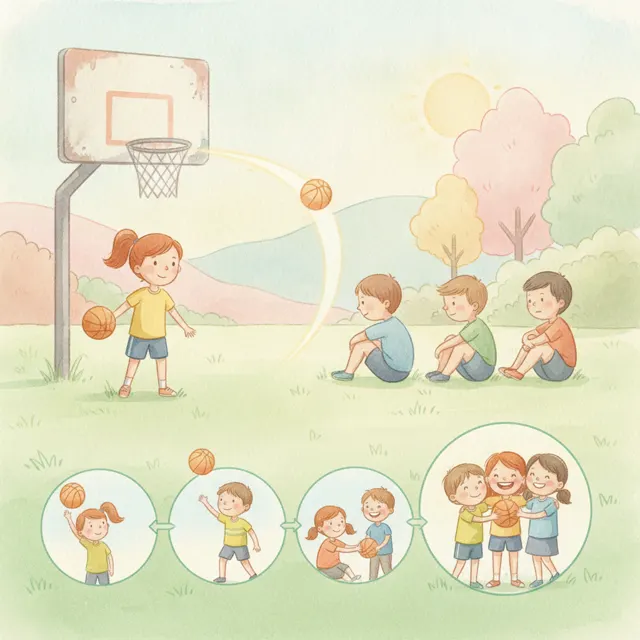
Riley loves to shoot and never passes the ball. Her friends grow sad watching her play alone. When she finally shares the ball, everyone gets a turn and Riley learns that sharing makes the game more fun for all.

Moral: Sharing the ball makes the game fun for everyone.

Riley loved to hold the basketball. At recess she took every shot. She did not pass the ball to anyone. Her friends stood in a row and watched. "Why won't you pass?" asked Sam. "We want to play too." "The ball is fun," said Riley. "I like to shoot it." "You can shoot even more if we all play," said Sam. "Pass the ball to me. I will pass it right back to you." Riley looked at the ball. Then she looked at her friends. They looked sad and quiet. She bounced the ball to Sam. Sam caught it and smiled. "Thank you," said Sam. He bounced it to Ana. Ana bounced it to Ben. Ben passed it back to Riley. Riley took a shot. Swish! The ball went in. "We all had a turn," said Riley. "And I still got to shoot." "When you share the ball," said Sam, "everyone has fun. And you get even more turns to shoot." Riley smiled big. "Let us pass the ball again," she said. They played until the bell rang. Riley passed and shot and passed again. At the end, Sam said, "See? Sharing made the game better for all of us." Riley nodded. "Next time," she said, "I will pass right away. Playing with friends is the best part of the game." From that day on, Riley passed the ball at every recess. Her friends smiled more. And Riley still made lots of baskets. Sharing the ball made the whole team better.

The Last Shot

Ages 3-83 minutespractice
The Last Shot story for kids illustration

Noah cannot make a basket no matter how hard he tries. His dad shows him one small step. Noah practices every day. At the big game, his shot goes in and he learns that practice makes him better.

Moral: Practice and trying again make you better.

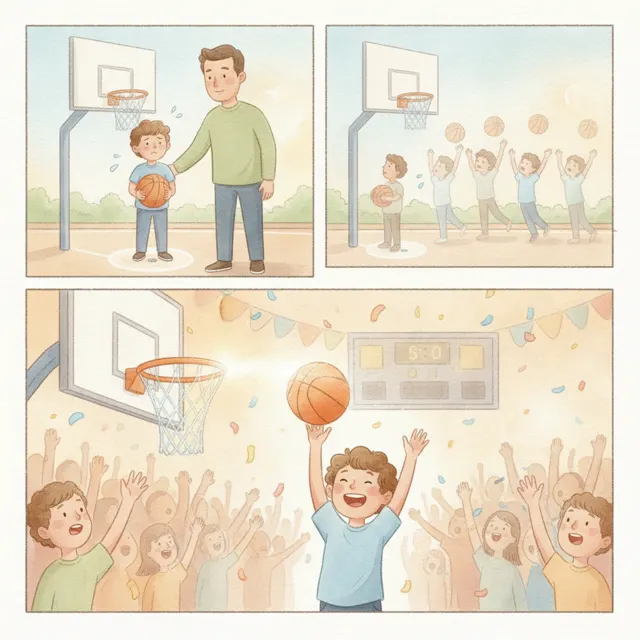
Noah wanted to make a basket. He shot the ball. It hit the rim and bounced away. He shot again. It hit the backboard. He shot one more time. It did not go in. His friend Mia made baskets all the time. Noah wished he could shoot like her. He asked Mia how she did it. "I will never make one," Noah said. He sat down on the grass. Dad sat next to him. "Making a basket takes practice," he said. "Every good player misses at first." "But I miss all the time," said Noah. "Let us try one small thing," said Dad. "Bend your knees. Look at the box on the backboard. Then shoot." Noah stood up. He bent his knees. He looked at the box. He shot. The ball rolled around the rim and fell out. "So close!" said Dad. "Try again." Noah tried again. And again. Every day after school, he shot the ball. Ten times. Twenty times. His arms got tired, but he did not stop. One day, his class had a game. The score was close. Noah got the ball near the hoop. He bent his knees. He looked at the box. He shot. The ball went in! His whole team cheered. "I made it!" Noah yelled. He ran to Dad. "I made it because I practiced," he said. "You made it because you kept trying," said Dad. "Practice is how you get better at anything." Noah nodded. "I will keep practicing," he said. "Even when it is hard."

Two Hands on the Ball

Ages 3-84 minutescourage
Two Hands on the Ball story for kids illustration

Zoe is small and scared of the big basketball. It knocked her down once. Her coach shows her how to catch with two hands. Zoe tries and learns that being brave means trying even when you are scared.

Moral: Being brave means trying when you are scared.

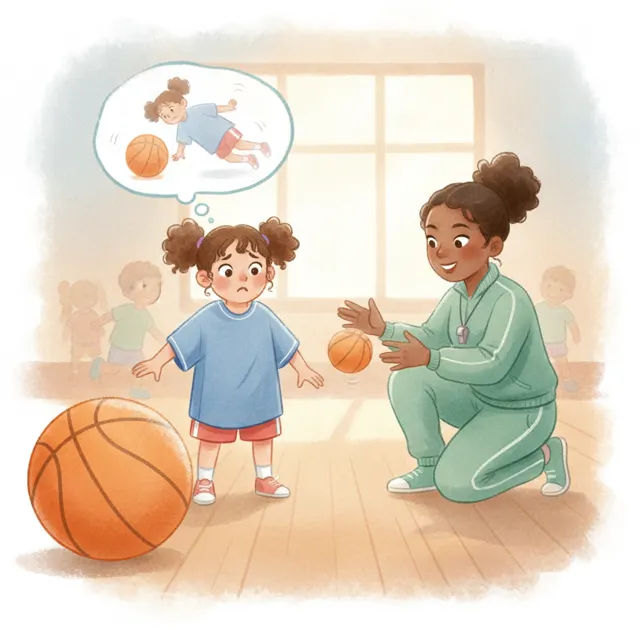
Zoe was small. The ball was big. When she tried to catch it, it knocked her down. She was scared to catch it again. Zoe stood far away from the ball. She did not want to get hurt again. "I can't catch the ball," Zoe said. "It is too big and too fast." Coach Mia knelt down next to her. "You can catch it with two hands," she said. "Hold your arms out like a basket. Let the ball come to you. Do not run from it." Zoe shook her head. "What if it hits my face?" she asked. "I will toss it soft and slow," said Coach Mia. "You are brave. You can try." Zoe took a deep breath. She held out her arms. The ball came to her. She caught it! She laughed out loud. "I did it!" she said. "I caught it with two hands." "Yes you did," said Coach Mia. "Now toss it back to me." They played toss for a long time. Each time, Zoe felt a little braver. The ball did not seem so big now. Her hands felt strong. At the next practice, a friend threw the ball high. Zoe held out her arms. She caught it. Her friend cheered. "Great catch, Zoe!" Zoe smiled. "I was scared at first," she said. "But I tried, and now catching is fun." "Being brave means trying when you are scared," said Coach Mia. Zoe nodded. "Then I am brave," she said. "And next time I will be brave even faster."

Cheering for the Other Team

Ages 3-83 minuteskindness
Cheering for the Other Team story for kids illustration

A boy on the other team falls down and some kids laugh. Leo helps him up instead. Leo cheers for the boy's great shot too and learns that being kind is a win, even in a game.

Moral: Being kind to others is a win too.

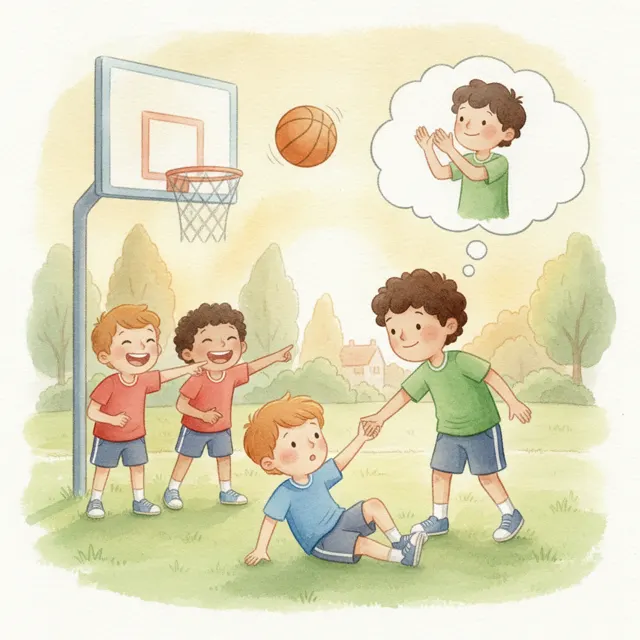
Leo loved to play basketball. His team had a big game on Saturday. A boy on the other team fell down. The boy sat on the floor and rubbed his knee. He looked like he might cry. Leo saw the boy's knee was red. He wanted to help. Some kids laughed. Leo did not laugh at all. He remembered when a friend helped him after he fell. He walked over to the boy. "Are you okay?" Leo asked. "I fell," said the boy. "My knee hurts." Leo held out his hand. "Here," he said. "Let me help you up." The boy took Leo's hand and stood up. "Thank you," he said. "No one else came to help me." "My coach says we should be kind," said Leo. "Even to the other team. It is just a game." The boy smiled. "That is nice," he said. "I will remember that." They went back to the game. The boy on the other team made a basket. Everyone on his team cheered. Leo clapped for him too. "Why did you clap?" asked his friend. "He is on the other team." "He made a great shot," said Leo. "And he was hurt before. I am glad he is playing." After the game, the boy came to Leo. "You are a good player and a good friend," he said. "Thank you for helping me." Leo's team did not win the game. But Leo felt warm and happy inside. "Being kind is a win too," he said.

The Long Line at the Hoop

Ages 3-84 minutesteamwork
The Long Line at the Hoop story for kids illustration

At gym class, all the kids push and yell to shoot first. Aya suggests making a line. When everyone waits and cheers for each other, the game becomes fun. Aya learns that teamwork means everyone gets a turn.

Moral: Waiting your turn and cheering for friends makes the game fun.

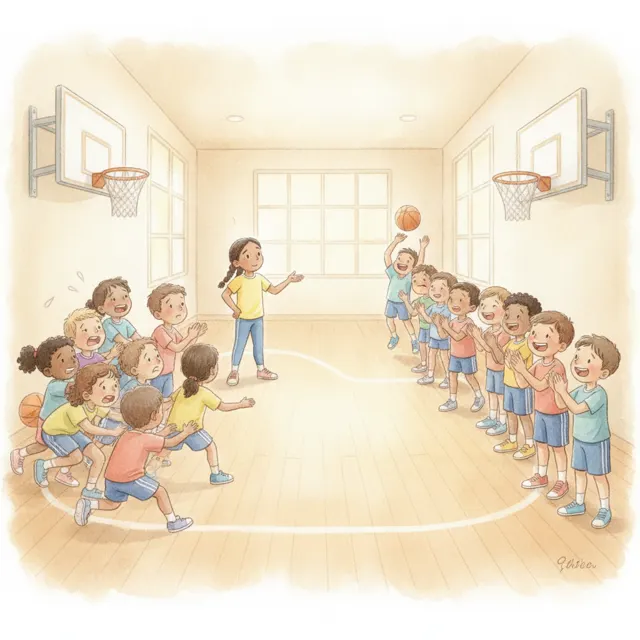
It was free play at gym class. All the kids wanted to shoot at the hoop. They pushed and ran. The line was long and messy. The ball bounced away, and everyone ran after it. Kids yelled, "Me first! Me first!" The teacher, Ms. Green, blew her whistle. "Wait," she said. "We all want a turn. How can we all get one?" The kids stopped and looked at each other. "We can make a line," said Aya. "One at a time. Then everyone gets a turn." "That is a great idea," said Ms. Green. "Teamwork means working together so everyone has fun." So the kids made a line. One by one, they shot the ball. When a shot went in, everyone clapped. When a shot missed, a friend said, "Nice try!" Aya waited for her turn. She passed the ball to the next friend. She cheered for the kids in front of her. She did not push or yell. She just smiled and waited. When it was her turn, she shot. The ball went in! "Great shot, Aya!" the kids yelled. "This is more fun than pushing," said Aya. "When we wait our turn, everyone gets to play." "You figured it out," said Ms. Green. "Waiting and cheering for each other is teamwork." Aya smiled. "I like teamwork," she said. "It makes the game fun for all of us." The bell rang. The kids lined up to go back to class. "Same time tomorrow?" asked Aya. "We can take turns again." Everyone said yes.

Running With the Ball

Ages 3-83 minuteshonesty
Running With the Ball story for kids illustration

Eli touches the line but keeps running and makes a basket. He says he did not touch it. His tummy feels funny until he tells the truth. Eli learns that being honest matters more than any basket.

Moral: Telling the truth matters more than winning.

Eli was playing a game with his team. He caught the ball and started to run. But his foot touched the line. The line meant he had to stop. He kept running and made a basket. His team clapped. Eli felt happy for a second. "Did you touch the line?" asked his coach. Eli looked at the floor. He knew he had touched the line. But he wanted the basket to count. "No," he said in a quiet voice. The game went on. But Eli did not feel good. His tummy felt funny. It felt like a rock inside him. He kept thinking about the line. At the next break, Eli walked over to his coach. "Coach," he said, "I did touch the line. I am sorry I did not tell the truth." The coach smiled. "Thank you for telling me the truth," she said. "That was brave. Being honest is more important than any basket." Eli felt better right away. "What about my basket?" he asked. "We will take that point away," said the coach. "But you just won something much bigger. You told the truth." Eli went back to the game. He ran and passed and played fair. His team cheered for him. At the end, the coach said, "Eli made a mistake, and then he fixed it by telling the truth. That is what good players do." Eli smiled. "Telling the truth was hard," he said. "But it made me feel good inside. I will tell the truth next time too."

Frequently Asked Questions

Turn Your Child Into the Hero of Their Own Story

Upload their photo and watch as AI creates a beautiful, personalized storybook with illustrations that look just like them. From $5.99/month.

✨ Make Your Child the Hero

Plans from $5.99/month