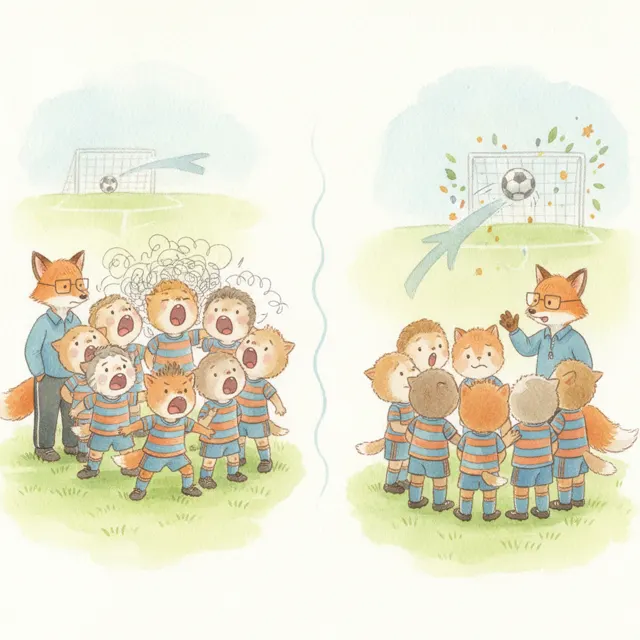
Football Stories for Kids

Little pitch side tales where your child kicks, passes, and learns that a team is stronger than any one player.

✨ Make Your Child the Hero

Football is a game of running feet and quick passes, and it teaches a child more than kicking a ball. It teaches them to share a play, to cheer for a teammate, and to keep going when the score is not on their side. These stories are full of those quiet lessons. A goalkeeper who will not give up. A first big game that feels scary. A pass that wins the day. Each tale is calm enough for bedtime and warm enough to read twice. With CreateStory.ai, you can make it personal. Upload a photo and your child becomes the hero, kicking the ball in their very own story.

How many kids play flag football in America today?

Flag football is a great first sport for little kids. They run, throw, and catch without any tackling, so it feels safe and fun. Many families pick flag football because their children want to play the game and learn how to work with a team.

About 7.8 million Americans played flag football in 2024, more than the 6.1 million who played tackle football (Sports & Fitness Industry Association, 2024). That means lots of kids just like yours are grabbing a ball, putting on a flag belt, and running for the end zone.

Why do young children love flag football stories?

Kids see themselves in these little players. The stories are short and full of talking, so a five-year-old can follow every word. Each one teaches a small lesson, like sharing the ball, waiting for a turn, or telling the truth.

Reading these football tales out loud helps children love books too. They hear kind words, learn new football words, and practice listening. Best of all, they learn that trying hard and being a good friend matter more than winning the game.

Sample Stories

Read these stories, then create a personalized version where your child is the hero

The Goalie Who Wouldn't Give Up
Ages 3-84 minperseverance
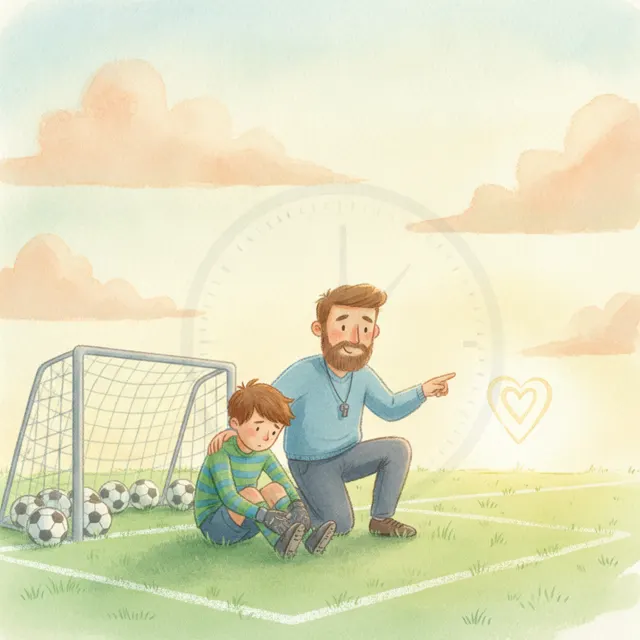
The Goalie Who Wouldn't Give Up story for kids illustration

Sam is the goalkeeper, and the ball keeps rolling past him into the net. He wants to quit after a rough first half, but his coach and his own steady heart teach him that stopping the very last shot is what really counts.

Moral: Getting back up after a mistake is braver than never falling.

Sam was the goalkeeper for the Little Foxes, and he was having a terrible day. The ball kept rolling past him into the net. One goal. Two goals. Three goals. Sam wanted to throw his gloves on the ground and walk off the field. "I am no good at this," Sam said at half time, sitting alone on the bench. His coach came and sat beside him. "Do you know what a goalkeeper's real job is?" the coach asked. "To stop the ball," Sam mumbled. "No," the coach said. "To keep trying after the ball gets past you. Anyone can stop an easy shot. The best goalkeepers are the ones who stand up again after every goal." Sam looked at the field. The other team was already warming up for the second half. His legs felt tired, and his heart felt heavy. "Just try the next shot," the coach said. "Not the last three. Just the next one." So Sam walked back to the goal. The second half began. The other team came running, and a player kicked the ball hard toward the corner of the net. Sam jumped. He stretched his arms as far as they would go, and his glove touched the ball, pushing it just wide of the goal. "Great save, Sam!" his teammates shouted. Sam's heart lifted. He stood up a little taller. When the next shot came, he was ready, and he caught it. And the one after that too. At the end of the game, Sam had let in no more goals. His team cheered and lifted him up. "You never gave up," the coach said, smiling. "And that is the best save of all."
Luca's First Big Game

Ages 3-83 mincourage
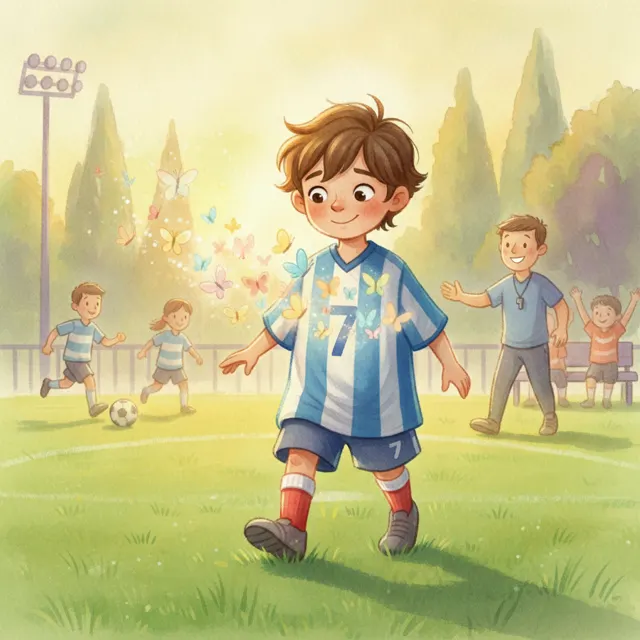
Luca's First Big Game story for kids illustration

Luca has practiced with his team all season but has never played in a real game. When the coach calls his name at last, his tummy is full of butterflies, and he finds a quiet way to step onto the pitch.

Moral: You do not have to be amazing all at once, just brave enough for the next step.

Luca had practiced football all season. He could dribble, he could pass, and he could kick the ball so straight it went exactly where he wanted. But he had never played in a real game. He was always the one on the bench, cheering. One Saturday, the coach called his name. "Luca, you are going in." Luca's tummy filled with butterflies. "What if I mess up in front of everyone?" he whispered. His teammate Nia gave him a smile. "Just pass the ball to me," she said. "That is all you have to do. One pass at a time." Luca took a deep breath and ran onto the pitch. The grass felt different under his boots. The crowd sounded so loud. The ball came rolling toward him, and his heart thumped. He looked up and saw Nia, open and waiting. He passed the ball to her, just like in practice. Nia ran with it and passed to another player, and soon the team was moving together. "Nice pass, Luca!" the coach shouted. Luca felt a little braver. The ball came to him again, and this time he dribbled past one player, then another, and passed it to the striker, who kicked it toward the goal. The whistle blew. Luca's team scored! Luca ran and jumped with his teammates. "I was so scared," he said to Nia, laughing. "But I just did it one pass at a time." "That is how every game works," Nia said. "You do not have to be amazing all at once. You just have to make the next pass." Luca smiled all the way home. His first big game was over, and he could not wait for the next one.

The Pass That Won the Game

Ages 3-84 minteamwork
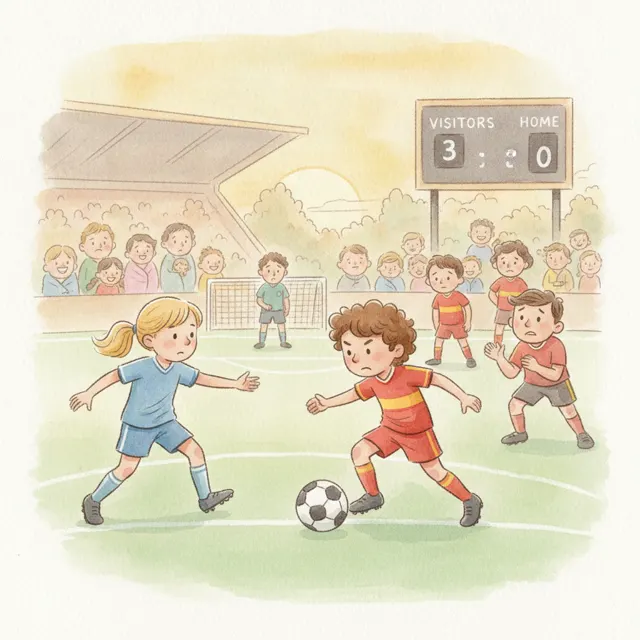
The Pass That Won the Game story for kids illustration

Rico loves scoring goals and never passes the ball, even when a teammate is wide open. When his team starts losing, he learns that giving the ball away can be the best play of all.

Moral: A ball you pass moves faster than one you hold onto alone.

Rico loved scoring goals. Every time he got the ball, he ran straight for the goal and kicked it himself. Sometimes he scored, and everyone cheered. But more and more, the other team took the ball away, and his teammates stood open with their hands up, waiting for a pass that never came. "Pass the ball, Rico!" they called. But Rico did not want to. He wanted to be the star. One game, Rico's team was losing by two goals. Every time Rico ran with the ball, three players from the other team surrounded him, and the ball was taken away. At half time, his friend Aya sat down beside him. "Rico," she said, "why do you never pass?" "Because I want to score," Rico said. "We all want to score," Aya said. "But football is not one player. It is all of us. When you pass to me, and I pass to you, the ball moves faster than any one of us can run." Rico thought about it. He had been so busy being the star that he had forgotten his friends. In the second half, Rico got the ball. Three players came at him. But this time, instead of running into them, he passed to Aya. Aya passed to the striker, and the striker kicked it into the goal. Goal! Rico could not believe it. Passing worked! So he did it again, and again. Each pass moved the ball closer to the goal, and soon his team had tied the score. With the last play, Rico passed the ball to Aya, who scored the winning goal. Rico ran to his team and hugged them all. "We won!" he shouted. "I mean, WE won!" Aya grinned. "That is the best part of football," she said. "Winning together."

Two Teams, One Ball

Ages 3-83 minfairness
Two Teams, One Ball story for kids illustration

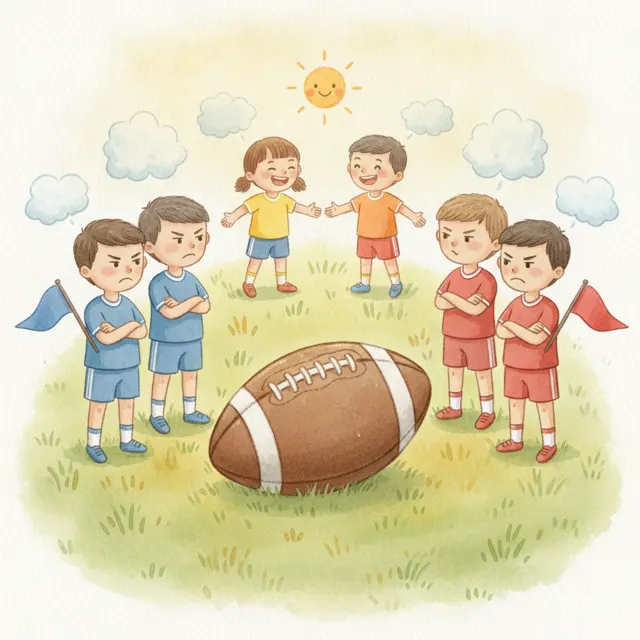
The Blue team and the Red team both want the one football at the park. Their arguing turns a fun game into a grumpy standoff, until two kids suggest the simplest fix of all, playing together.

Moral: A game is more fun when everyone gets a turn to play.

At the park, two teams of kids wanted to play football, but there was only one ball. The Blue team had brought it, and the Red team wanted a turn. "We got here first," said a boy in blue. "But we have been waiting forever," said a girl in red. "It is our ball," the blue boy said. "Then let us play for it," the red girl said back. Soon everyone was shouting, and nobody was playing football at all. The one ball sat in the grass, and the kids stood in two angry lines, glaring at each other. Then a small girl named Pip stepped into the middle. "Why do we have to choose?" she asked. "There are enough of us for two whole teams. Why do we not all play together?" Everyone went quiet. "But we are on different teams," a boy said. "That is what a football game needs," Pip said. "Two teams. One ball. That is the whole game." The kids looked at each other and started to laugh. She was right. A football game needed two teams, and there they were, standing right there. So the Blue team and the Red team became one big game. They split up, mixed and matched, and kicked off. The blue boy passed to a red girl, who scored a goal, and everyone cheered together. By the time the sun went down, nobody remembered who had brought the ball or who had been there first. They only remembered the fun. "One ball is more than enough," Pip said, "when everyone gets a turn to play." And she was right, because the best games are the ones where nobody is left out.

The Boy Who Kicked It Too Hard

Ages 3-85 minpatience
The Boy Who Kicked It Too Hard story for kids illustration

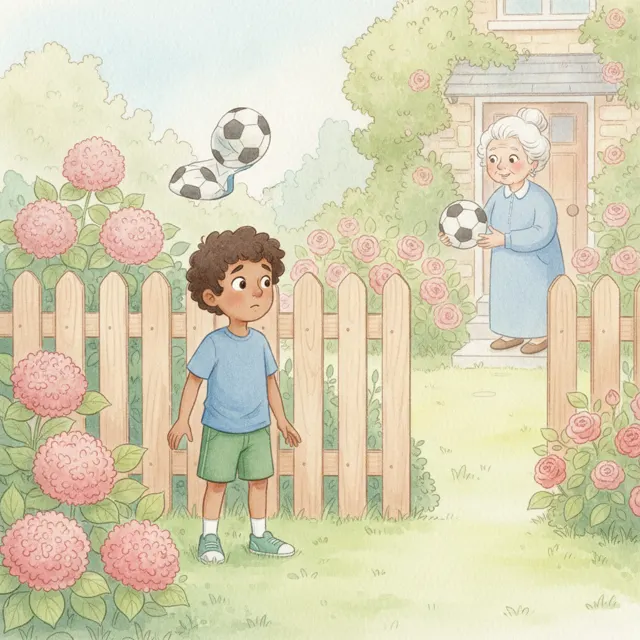
Omar has a powerful kick, but it sends the ball flying over the fence and into a neighbor's garden. He learns that control matters more than power, and that the best players know how to be gentle too.

Moral: A gentle kick in the right place is better than a big one in the wrong place.

Omar had the strongest kick on his football team. When he kicked the ball, it flew like a rocket, and everyone said "wow." But Omar's strong kick had a problem. It always went too far. One afternoon, Omar kicked the ball so hard it flew over the fence and into the neighbor's garden. "Oh no," Omar said. "Not again." He peeked over the fence. The ball was stuck in the middle of Mrs. Patel's flower bed, right on top of her tulips. Mrs. Patel came to the door. She did not look happy. "This is the third time this week," she said. "I am sorry," Omar said, looking down. "My kick is too strong." Mrs. Patel handed him a little rake. "A strong kick is a fine thing," she said, "but a smart player knows when to kick softly. Now, help me fix my tulips." Omar spent the afternoon gently lifting the ball out and patting the soil back around the flowers. He was very careful, and the tulips looked almost as good as new. "Thank you for helping," Mrs. Patel said. "Now, why do you not practice your soft kicks in the park, where there is plenty of room?" Omar took her advice. He practiced soft kicks and gentle passes. At the next game, instead of blasting the ball, he tapped it softly to a teammate right by the goal, and his team scored. "You did not kick it hard at all," his coach said, surprised. "I did not need to," Omar said with a smile. "A gentle kick in the right place is better than a big one in the wrong place." From then on, Omar still had his rocket kick, but he saved it for the open field. And Mrs. Patel's tulips stayed safe.

Maya Shares the Ball

Ages 3-83 minutessharing
Maya Shares the Ball story for kids illustration

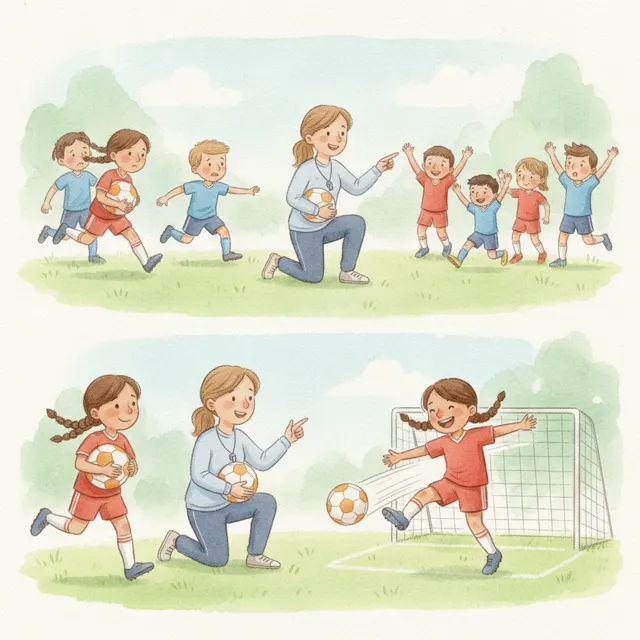
Maya always runs with the ball and never passes to her friends. Her coach asks her to try just one pass. Maya finds out sharing is fun, and in the big game her pass helps the whole team win.

Moral: Sharing the ball helps everyone win.

Maya was the fastest kid on the blue team. She caught the ball and ran. She ran every single time. She never passed to a friend. Not once. "Pass the ball, Maya!" called Leo. But Maya ran alone. She dodged one player. Then a hand pulled her flag. The play was over. "Good try," said her coach. At practice, Coach Sam knelt down next to Maya. "Football is a team game," she said. "When you pass, your friends can run too. Then we all get to play." "But I want to score," Maya said. "I am the fastest one here." "You will score more when the whole team plays," Coach Sam said. "Just try one pass today. One pass is all I ask." Maya took a deep breath. She got the ball and ran. Everyone thought she would keep it. Then she threw the ball to Leo. Leo caught it and ran far. He almost scored. "That felt good," Maya said. She looked surprised and happy. "I did not know passing could be fun." "See?" said Coach Sam. "Sharing the ball made two kids happy at once." At the big game, Maya got the ball. She ran, then stopped. She saw Nina open near the end zone. She passed the ball. Nina ran all the way in. Touchdown! The whole team cheered. "You shared the ball," Leo said. Maya smiled wide. "And we all won together," she said. "That is better than one score by myself." From that day on, Maya passed the ball all the time. Her team scored more than ever, and every kid got a turn to run with the ball.

Leo Catches Every Day

Ages 3-84 minutespractice
Leo Catches Every Day story for kids illustration

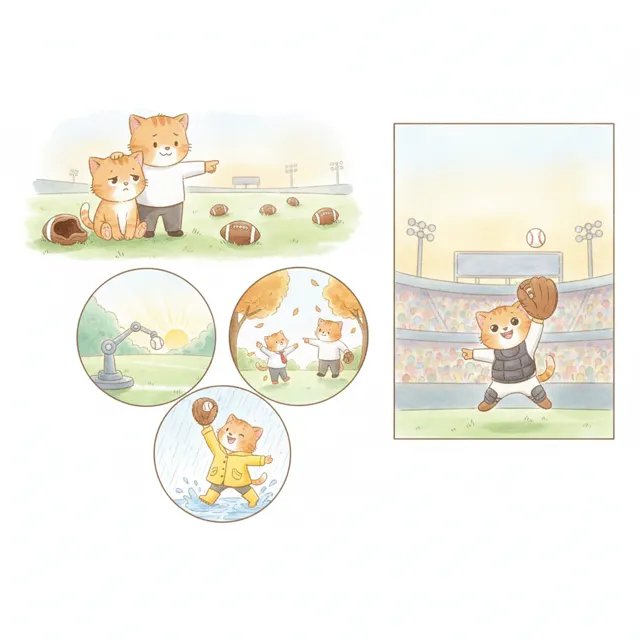
Leo drops every pass and wants to give up. His dad tells him a simple secret: good catchers practice every day. Leo catches before school, after school, and even in the rain. At the game, he makes the big catch.

Moral: Practice every day makes you better.

Leo dropped the ball. Again. It bounced off his hands and rolled into the grass. Again and again, the ball would not stay in his hands. "I can never catch," Leo said. He sat down on the ground and frowned. His dad sat down next to him. "Do you know how good catchers got so good?" he asked. "How?" Leo said. "Maybe they were just born with soft hands." "No," Dad said. "They caught a lot of balls. Every single day. That is the whole secret." Leo thought about it. "Every day?" he asked. "Even when I am tired?" "Yes," Dad said. "Even then. That is when practice matters most." So Leo practiced. Every day after school, Dad threw the ball to him. Ten catches. Then twenty. Then thirty. Leo's hands got soft and strong. Some days it rained. Leo still caught. Some days he was tired. Leo still caught. "Look how far you have come," Dad said one evening. "You did not drop a single ball today." At the next game, the quarterback threw the ball high. Leo looked up. He put both hands out. The ball fell right into them. He held it tight and ran. "Touchdown!" the coach yelled. His dad cheered from the side. "Soft hands!" he called out. Leo held the ball up high. "I practiced every single day," he said. "That is how I caught it." At practice the next week, Leo caught every pass. His coach clapped. "You look like a brand new player," she said.

Nina's First Huddle

Ages 3-83 minutescourage
Nina's First Huddle story for kids illustration

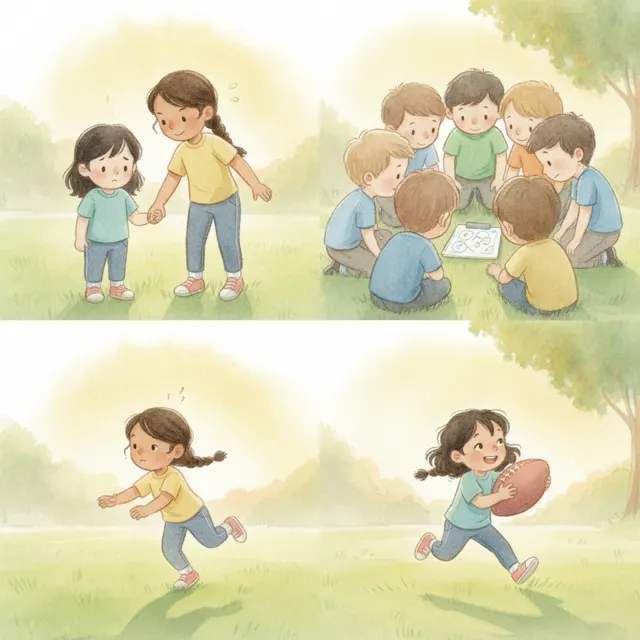
Nina is new and scared of the huddle because she does not know the plays. Her friend Maya holds her hand and helps her learn. Nina bravely joins in and makes her first catch.

Moral: Being brave means doing it even when you are scared.

The field was big and green. Kids ran everywhere, throwing a brown ball back and forth. Nina was new on the team. Her helmet felt too big on her head. She stood far away from the huddle. "Come on, Nina," said the coach. "Join the huddle." But Nina's feet would not move. Maya walked over to her. "Are you scared?" she asked in a soft voice. "I do not know the plays," Nina said. "Everyone will laugh at me." "I did not know them on my first day either," Maya said. "I will stand right next to you. Listen, and say the play after me." Nina looked at the huddle, then back at Maya. "Okay," she said. "I will try." Maya took Nina's hand. They walked to the huddle together. The team said the play. Nina said it too, soft at first. "Louder!" the coach said with a kind smile. "Blue forty-two!" Nina said, loud and clear. The whole team cheered. On the field, Nina did not know what to do. Her heart beat fast. Then she remembered the play. She ran to the right spot and caught a pass. "You did it!" Maya said, jumping up and down. Nina laughed. "I was scared," she said. "But I did it anyway." "That is what brave means," Maya said. "You do the hard thing even when your tummy feels funny." Nina smiled. The huddle did not feel scary anymore. It felt like a place where her friends were waiting for her. She went home that night and told her mom all about her first catch.

Waiting for My Turn

Ages 3-84 minutespatience
Waiting for My Turn story for kids illustration

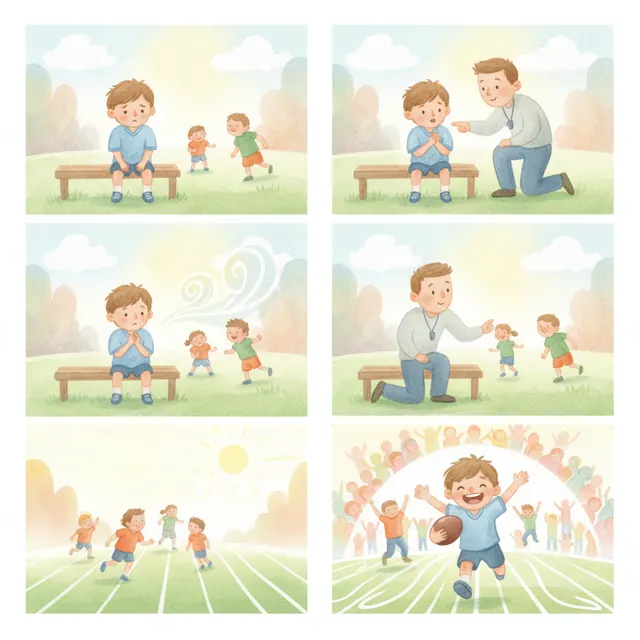
Sam sits on the bench and never gets to play. He feels left out until his coach teaches him to watch, learn, and cheer. When his turn finally comes, Sam is ready and scores a touchdown.

Moral: Good things come when you wait your turn.

Sam sat on the bench. He watched his friends run and throw and catch. He kicked at the grass. "When is it my turn?" he asked. "I never get to play." "Soon," said Coach Ben. "But a team needs good helpers on the side too. We cheer, we watch, and we wait." "That is not fun," Sam said with a frown. "I know it is hard," Coach Ben said. "Waiting is one of the hardest things to do." "Try this," Coach Ben said. "Watch the game. Learn the plays. Cheer for your friends. Your turn will come, and you will be ready." So Sam watched. He saw how Nina ran left when the ball went right. He saw how Leo caught with two hands. He cheered when Maya scored. He learned every single play by heart. At first it was hard to sit still. Sam wiggled and sighed. But every day he got a little better at waiting. One day, Leo hurt his shoe and had to sit out. Coach Ben looked down the bench. "Sam, you are up," Coach Ben said. Sam jumped to his feet. Sam ran onto the field. He knew the play by heart. The ball came to him. He caught it and ran to the end zone. Touchdown! "I was ready because I waited and watched," Sam said. Coach Ben smiled. "Good things come to those who wait," he said. "And you waited like a true teammate." From then on, Sam still waited sometimes. But now he knew that waiting was not doing nothing. It was getting ready.

The Team That Cheered

Ages 3-83 minuteskindness
The Team That Cheered story for kids illustration

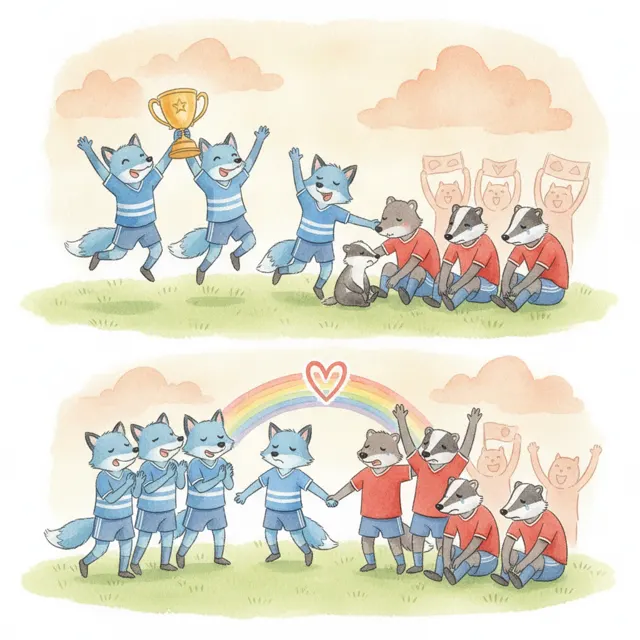
The blue team is winning, but the red team looks so sad. The blue players decide to cheer for the other team too. Both teams end the game happy, and everyone learns that kindness matters.

Moral: Being kind can make someone's day better.

The blue team was winning by a lot. The red team missed pass after pass. A red player sat down and looked at his shoes. "We are beating them by so much," said Leo. "They look so sad." Maya watched the red team. "When I miss, I feel bad too," she said. "My tummy feels heavy." "What can we do?" asked Nina. "We still want to win, but we do not want them to feel bad." "We can cheer for them too," Maya said. "Not just for our own team." Leo thought about it. "That is a nice idea," he said. "Everyone likes to be cheered for." The next time a red player caught a pass, the blue team clapped. "Good catch!" they called out. The red team looked up, surprised. Slowly, they began to smile. A red player ran the ball far. The blue team clapped again. "Great run!" they said. The red team's coach smiled and waved at the blue team. "What good sports!" she said. Soon the red team was cheering for the blue team too. Both sides clapped for each other. At the end, the red team was still behind. But every single player was smiling. "Thank you for cheering," a red player said. "We felt all alone. Then you helped us feel happy." The two teams shook hands. "A good game is a kind game," Maya said. "Let us play again soon," the red player said with a big smile. That day, the blue team learned something big. Winning feels good, but being kind feels even better.

The Flag That Fell Off

Ages 3-84 minuteshonesty
The Flag That Fell Off story for kids illustration

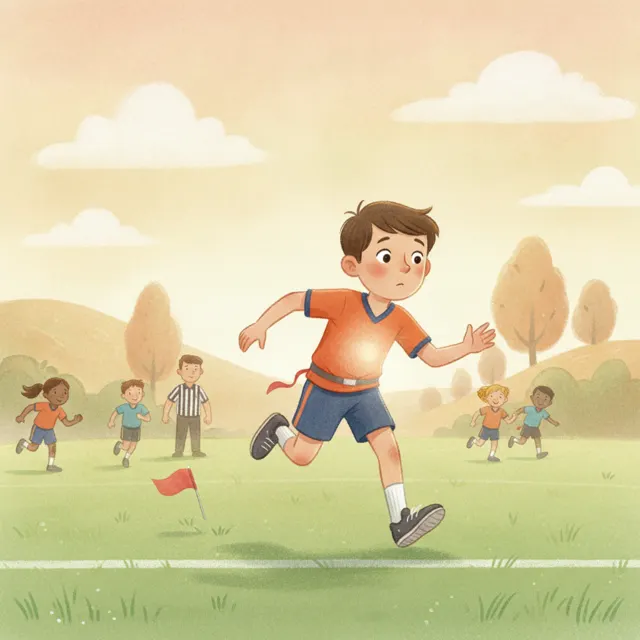
Max is running for a score when his flag falls off by accident. No one sees it, but Max stops and tells the ref the truth. He learns that being honest feels better than winning.

Moral: Telling the truth is better than winning.

Max ran fast with the ball. He ran past one player. Then he ran past another. Suddenly, his flag belt fell off. The flag dropped to the grass. But Max kept running. No one had pulled it. It just fell off by itself. "Max is still running!" yelled a teammate. The ref did not see the flag fall. Max could have scored easily. Max could have kept running. He could have scored. But Max knew what was right. So Max stopped. He walked back and picked up his flag. Then he walked over to the ref. "My flag fell off," Max said. "No one pulled it. It fell by itself. So I did not really score." The ref looked surprised. "Thank you for telling me," she said. "That was very honest of you." Max felt warm inside. Telling the truth made his chest feel light. The play started again. Max got the ball one more time. This time his flag stayed on tight. He ran and scored a real touchdown. The whole team cheered. It was a clean score, and it counted for real. "That was a great run," said Coach Sam. "But you did something even better before," said Nina. "You told the truth." Max smiled. "Winning is good," he said. "But telling the truth feels even better." The team clapped for Max. Not for the touchdown. For being honest. Max's dad watched from the side. "I am proud of you, son," he said. "More proud than if you had scored ten times." That night, Max told his mom the whole story. "The touchdown was nice," he said. "But being honest was the best part."

The Huddle That Listened

Ages 3-83 minutesteamwork
The Huddle That Listened story for kids illustration

The team talks all at once in the huddle, so every play goes wrong. Their coach teaches them to listen to one voice. When they finally listen, the play works and they score.

Moral: A team works best when everyone listens.

The team got into a huddle. Everyone talked at the same time. "Run left!" said Leo. "No, run right!" said Maya. "I want the ball!" said Sam. It was too loud to hear anything at all. Nobody listened to anybody. The ball was snapped. Everyone ran a different way. The play fell apart. Leo went one way. Maya went another. Sam just stood still, confused. "What happened?" asked Coach Sam. "That was a mess." "We all talked at once," Nina said. "Nobody listened to anyone." "A huddle is for listening," Coach Sam said. "One person talks. The rest listen. Then we all do the same thing together." "It is like a team song," she said. "We all sing the same note." "But we all have good ideas," said Leo. "You can share ideas before the huddle," Coach Sam said. "In the huddle, we listen to one voice. That is how a team wins." The kids nodded. They understood now. The next huddle was quiet. The quarterback called the play. Everyone listened with both ears. "Blue forty-two!" he said. The ball was snapped. Everyone knew where to run. Leo ran left. Maya blocked. Sam caught the ball and ran. Touchdown! "We listened," Maya said with a big smile. "That is how a team works," Coach Sam said. "Listen first. Then play as one." From then on, every huddle was quiet and strong. The team won more games, and every kid felt heard. And the best part? Everyone got a turn to be the one voice. Sometimes Leo called the play. Sometimes Nina did.

Frequently Asked Questions

Turn Your Child Into the Hero of Their Own Story

Upload their photo and watch as AI creates a beautiful, personalized storybook with illustrations that look just like them. From $5.99/month.

✨ Make Your Child the Hero

Plans from $5.99/month