Soccer Stories for Kids

One ball, one goal, and a child who becomes the hero of every fast, friendly soccer story they read.

✨ Make Your Child the Hero

Soccer is often the first team a kid ever joins. There is the thrill of the first kick, the joy of a pass that finds a friend, and the lesson that you win and lose together. Soccer stories bring all of it to the page, from a goalie finding her courage to a team that learns passing beats showing off. With CreateStory.ai, your child steps right into the action. Upload a photo and they become the star of their own soccer story, scoring goals, learning teamwork, and discovering that the best players are the ones who lift everyone up.

Why do so many kids love to play soccer?

Soccer is simple and fun. All a child needs is a ball and some open space. Kids can run, kick, and play with friends. The game keeps moving, so no one gets bored standing around.

Soccer is also the most played sport on Earth. FIFA, the group that runs world soccer, counts about 250 million soccer players around the world (FIFA survey). That means your child is joining a very big team.

How does playing soccer help a child grow?

Soccer builds strong bodies. Running and kicking work the legs, the lungs, and the heart. Kids learn to move fast and stop fast, which makes them quick on their feet. They also learn to work with a team and to share the ball.

The game also grows the heart in another way. Kids learn to win with grace and to lose with a smile. They cheer for their friends and shake hands with the other team. Those lessons stay with them long after the game ends.

Sample Stories

Read these stories, then create a personalized version where your child is the hero

The Goalie Who Was Afraid of the Ball
Ages 3-84 mincourage
The Goalie Who Was Afraid of the Ball story for kids illustration

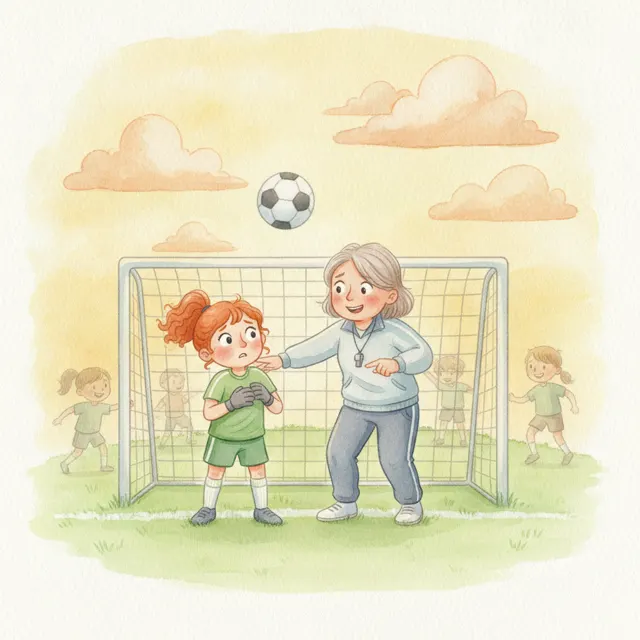
Pip loves being goalie, but every time the ball flies at her, she flinches. With her coach's patient help, she learns that catching starts with not looking away.

Moral: Bravery grows a little every time you try.

Pip wore the goalie gloves like a badge of honor. She loved the goal, the net, and the way the grass smelled after rain. But every time the ball came flying at her, she squeezed her eyes shut and flinched. "You are afraid of the ball," said her friend Max after practice. "I can tell." "I am not afraid," Pip said. "I just do not like it near my face." "That is being afraid," Max said, not unkindly. Pip kicked a clump of grass. It was true. She hated the sound of a hard kick and the blur of the ball coming fast. Coach Rosa noticed. "Pip," she said, "a goalie who closes her eyes can still catch the ball. But a goalie who keeps them open can catch it on purpose." "How do I stop flinching?" Pip asked. "Start small," Coach Rosa said. "Today, your only job is to keep your eyes open. You do not have to catch anything." So that is what Pip did. When the ball came, she watched it. It looked big and fast, but she watched it roll right past her. Then again. And again. "You did not flinch once," Max said. "I kept my eyes open," Pip said, surprised at herself. The next practice, Coach Rosa rolled the ball slowly. Pip caught it. Then a little faster. She caught it again. By the end of the week, she was catching kicks from across the field, her eyes wide and watching the whole way. At the last game, a shot rocketed toward the top corner. Pip did not blink. She jumped, and the ball landed in her gloves like it had been thrown by a friend. The whole team cheered. Max ran over. "You did it!" Pip smiled. "I kept my eyes open."
Passing Is Better Than Scoring

Ages 3-84 minteamwork
Passing Is Better Than Scoring story for kids illustration

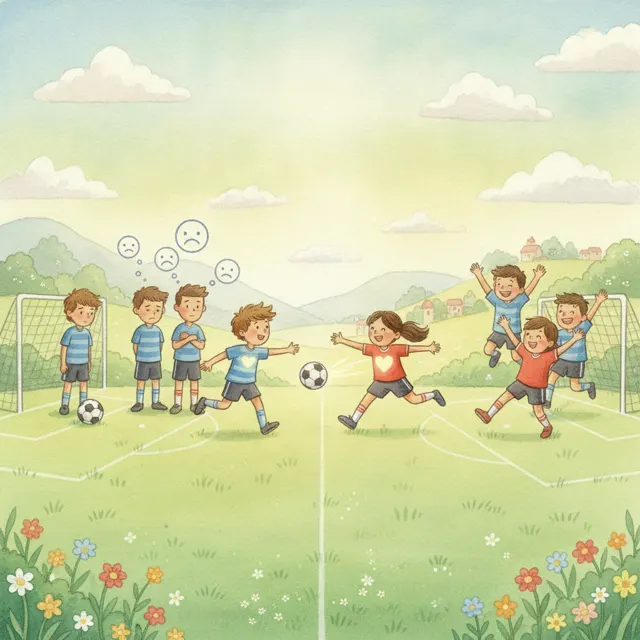
Leo scores every goal and never passes, and his team is tired of watching. When he finally shares the ball, he discovers that a great assist feels even better than a goal.

Moral: A team is stronger when everyone gets to shine.

Leo was the fastest kid on the field, and he knew it. When the ball came to him, he did not pass. He dribbled, and he shot, and he scored. Every single time. "Pass it!" his teammates yelled. But Leo just smiled and scored again. After the game, the team sat on the bench looking glum. They had won, but nobody felt good. "Why are you all so quiet?" Leo asked. "We won." "You won," said Ana. "The rest of us just watched." Leo blinked. He had not thought about it that way. The next game, Leo got the ball near midfield. He heard Ana call his name. He saw her open near the goal. For once, he passed. Ana kicked it in. Goal. The whole team swarmed her, cheering like she had won the cup. "Nice pass, Leo!" she shouted. Something warm spread through Leo's chest. It felt different from scoring. It felt bigger. So Leo passed again. And again. He passed to Max, who had never scored before, and when Max's kick found the net, the whole field erupted. "Did you see that?!" Max yelled, running over to hug Leo. "That was because of you!" Leo grinned. "No, it was because of you. I just gave you the ball." "That is the point," Ana said, throwing an arm around them both. "That is the whole point." That day, Leo scored only once. But when the final whistle blew, he felt like the biggest winner on the field. Because he had finally learned what his team already knew. Winning together beats winning alone.

The Last-Second Goal

Ages 3-83 minperseverance
The Last-Second Goal story for kids illustration

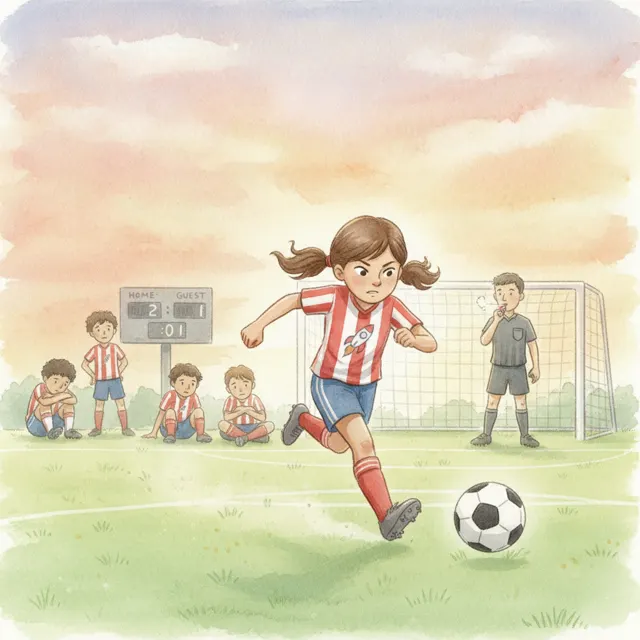
The Rockets are losing by one goal with seconds left, and everyone has stopped trying. Everyone except Zara, who keeps running and finds out what happens when you play until the very last whistle.

Moral: Never give up, because you never know what the next second brings.

The clock showed ten seconds left. The Rockets were losing, two goals to one. The whole team had slowed down, their heads hanging. "It is over," groaned Sam. "We lost." "Not yet," said Zara. She was still running. "Zara, there are ten seconds left," said Sam. "Ten." "That is ten whole seconds," Zara called back, already chasing the ball. The other team passed lazily toward their own goal. Zara saw her chance. She darted forward, stuck out her foot, and stole the ball. The crowd gasped. Zara dribbled. Past one defender. Past another. She was tired, and her legs ached, but she kept going. She could hear Coach yelling from the sideline. She could not make out the words, but she knew what they meant. Keep going. She looked up. The goal loomed in front of her. The keeper was ready. Zara took a breath and kicked as hard as she could. The ball sailed through the air. It seemed to hang there for a very long time. Then it kissed the inside of the post and dropped into the net. Goal. The whistle blew at the exact same second. The Rockets had tied the game, two to two. Zara's team lifted her onto their shoulders. "You did not give up!" Sam shouted. "I cannot believe you did not give up!" Zara laughed, out of breath. "Ten seconds is a long time," she said. "Long enough to try." Coach ruffled her hair. "You just learned the most important thing in soccer," she said. "The game is never over until the whistle says so."

Sharing the Captain's Armband

Ages 3-84 minkindness
Sharing the Captain's Armband story for kids illustration

Maya has worn the captain's armband all season, until a new rule says captains must take turns. Passing the band to a shy teammate teaches her that leadership is about lifting others up, not leading them.

Moral: Being kind to a friend matters more than being in charge.

Maya had been team captain all season long. She loved the armband, the little stretch of blue fabric that meant everyone looked to her first. Then Coach called a meeting. "From now on," he said, "we take turns being captain. Everyone gets a chance to lead." Maya's heart sank. "But I am the captain," she said. "I have always been the captain." "And now it is someone else's turn," Coach said gently. "This week, it is Tomi." Tomi was the quietest kid on the team. She rarely spoke during games. Maya could not imagine her leading anything. At practice, Tomi put on the armband. She looked nervous. "Um, everyone," she said softly, "let us start with passing drills." Nobody moved. They were all waiting for Maya. Maya took a breath. Then she jogged to the front. "You heard the captain," she said loudly. "Passing drills!" The team snapped into action. Tomi's face lit up, just a little. During the drills, Maya noticed something. Tomi was good. She saw passes nobody else saw. She helped the younger kids position their feet. She was a natural leader, once someone listened. At the next game, Tomi gave the pre-game speech. "We play as one team," she said, her voice growing stronger. "Everyone touches the ball. Everyone matters." The team cheered. And Maya cheered loudest of all. After the game, Maya pulled Tomi aside. "You were a better captain than me," she said honestly. Tomi shook her head. "I was only good because you backed me up." Maya smiled. "That is what teammates do," she said. "And that is what makes a real captain."

The Ball That Went Over the Fence

Ages 3-85 minhonesty
The Ball That Went Over the Fence story for kids illustration

When Aiden's wild kick sends the ball over a fence and into Mrs. Ito's garden, he wants to run. Instead, he knocks on her door and learns that honesty turns a mistake into a new friendship.

Moral: Telling the truth can be scary, but it always makes things better.

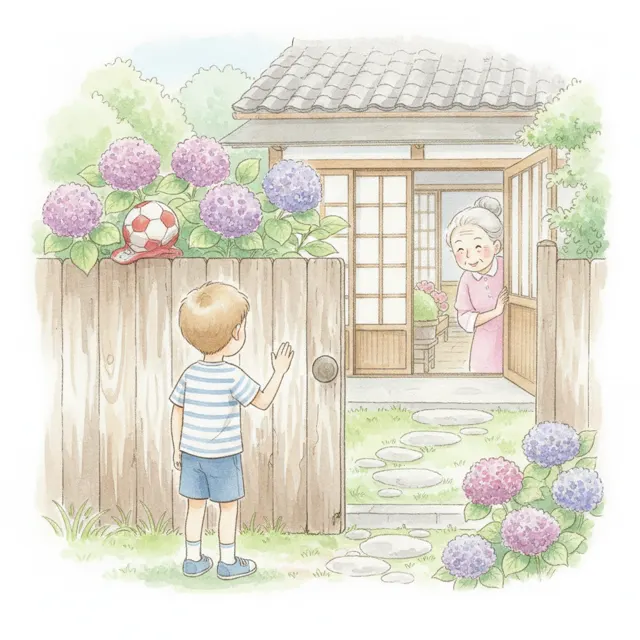
Aiden loved to kick the ball as hard as he could. One afternoon in the park, he wound up and swung his leg with everything he had. The ball sailed high, higher than it ever had before. It cleared the hedge, cleared the fence, and landed with a soft thump in Mrs. Ito's garden. Aiden froze. The other kids froze too. "Run!" someone whispered. Aiden wanted to run. His legs wanted to run. But his feet would not move. "Mrs. Ito has the biggest tomatoes in town," said Sam. "If we broke one, she will be so mad." "We did not break anything," Aiden said. "But my ball is in her garden." He walked to the gate. His heart pounded. He knocked on the door. Mrs. Ito answered, wiping her hands on her apron. "Hello, Aiden. I believe your ball is in my garden." "I am really sorry," Aiden said quickly. "I kicked it too hard and it went over your fence. I did not mean to." Mrs. Ito looked at him for a long moment. Then she smiled. "Thank you for telling me the truth," she said. "Most children run away. Come, let us find your ball together." They walked into the garden. The ball sat in the middle of the path, not a single tomato touched. "Nothing is broken," Aiden said with relief. "No," said Mrs. Ito. "But something is built. Honesty is like a garden. It grows a little every time you water it." She handed him the ball and a small paper bag. "For your team," she said. Inside were three tomatoes, red and round as the ball. Aiden grinned. "Thank you, Mrs. Ito!" "Thank you for the knock," she said. That day, Aiden learned that owning up to a mistake can turn a scary moment into something sweet.

The Team That Shared One Ball

Ages 3-83 minutesteamwork
The Team That Shared One Ball story for kids illustration

Six friends show up to soccer practice, but there is only one ball. They push and grab, and no one has fun. Their coach tells them to pass the ball instead. When they share, everyone gets a turn and the team plays better.

Moral: A team works best when everyone shares and takes a turn.

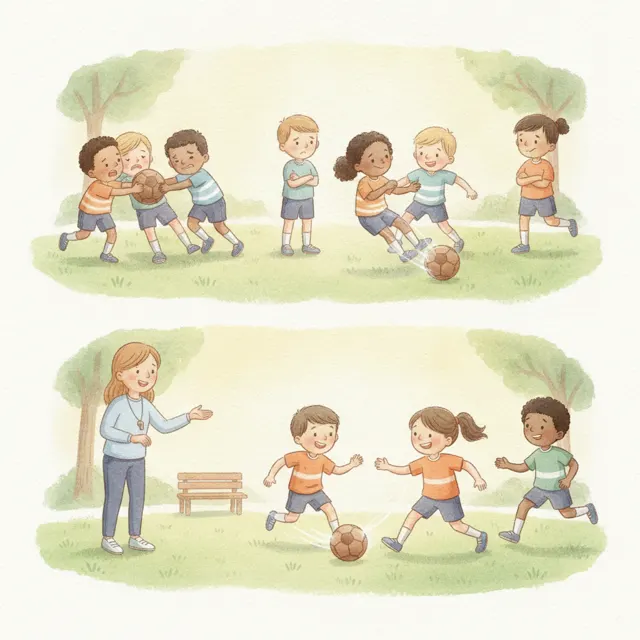
Six friends ran to the soccer field. Coach Ana held up one ball. "Where are the other balls?" asked Sam. "This is our only ball today," Coach Ana said. "Make it work." The whistle blew. All six kids ran at the ball at once. They pushed and grabbed. "It is mine!" yelled Leo. "No, mine!" yelled Mia. The ball popped out and rolled away. No one scored. No one had fun. Coach Ana blew the whistle again. "Stop," she said. "A team shares one ball. Pass it. Do not grab it." "But I want to score," Leo said. "You will score more if you pass," Coach Ana said. "Try it." They tried again. Mia got the ball first. She passed it to Leo instead of kicking it far. "Nice pass!" said Leo. He passed to Sam. Sam passed to Nina. The ball moved from friend to friend. Everyone touched it. "Now kick it in!" Coach Ana called. Nina passed to Leo. Leo kicked the ball into the goal. It went in! "Goal!" they all shouted. "See?" Coach Ana said. "You all helped make that goal." They played all day with one ball. The ball flew from one friend to the next. No one grabbed. No one yelled. At the end, Leo smiled. "One ball is enough," he said. "Yes," said Mia. "When we share it." Coach Ana nodded. "A team that shares plays its best game." The six friends went home happy. One ball was all they needed. That night, Sam told his mom about the game. "We did not fight over the ball," he said. "We passed it to each other." "That is a good team," his mom said. "The best teams share."

Leo's Left Foot Learns to Kick

Ages 3-83 minutespractice
Leo's Left Foot Learns to Kick story for kids illustration

Leo can kick a soccer ball far with his right foot, but his left foot only wiggles. Every day he practices tapping the ball against a wall with his left foot. After many tries, his left foot scores a big goal.

Moral: You get better at hard things when you practice a little every day.

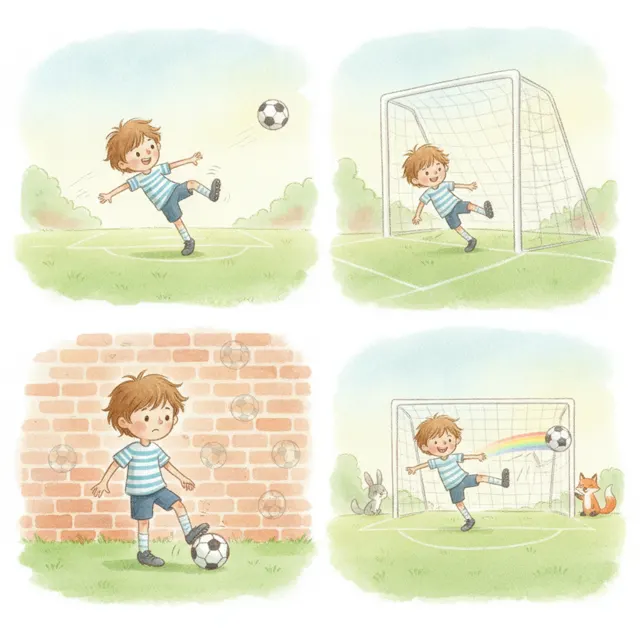
Leo could kick the ball far with his right foot. His left foot just wiggled. "Kick with your left foot," his coach said. "I cannot," Leo said. "My left foot does not listen." "It will listen if you practice," his coach said. "A little every day." So Leo practiced. Every day after school, he stood by the brick wall. He tapped the ball with his left foot. The ball wobbled to the side. "Come back!" Leo called to the ball. He tried again. Tap. The ball rolled a little straighter. Day after day, Leo stood by the wall. Tap, tap, tap. His left foot got a little stronger. His left foot got a little smarter. One day he kicked the ball with his left foot, and it rolled straight to the wall. Then it rolled straight back to him. "You did it!" said his friend Mia. "Not yet," Leo said. "I want to score with my left foot." So he practiced some more. Tap, tap, kick. Tap, tap, kick. The sun went down and Leo was still there. On game day, the ball came to Leo. He was close to the goal. The ball sat by his left side. He could turn and use his right foot, but there was no time. Leo kicked with his left foot. The ball flew past the goalie and into the net. "Goal!" the team shouted. Mia ran to Leo. "Your left foot listened!" "It did," Leo said, smiling. "It just needed a lot of practice." Leo looked down at his shoes. "Good job, left foot," he said. "Good job."

The Goal That Did Not Count

Ages 3-83 minuteshonesty
The Goal That Did Not Count story for kids illustration

Leo's shot hits the goal post and bounces out, but the referee is not looking. Leo could say the ball went in and take the win. He tells the truth instead, and his whole team is proud of him.

Moral: Telling the truth is worth more than winning the wrong way.

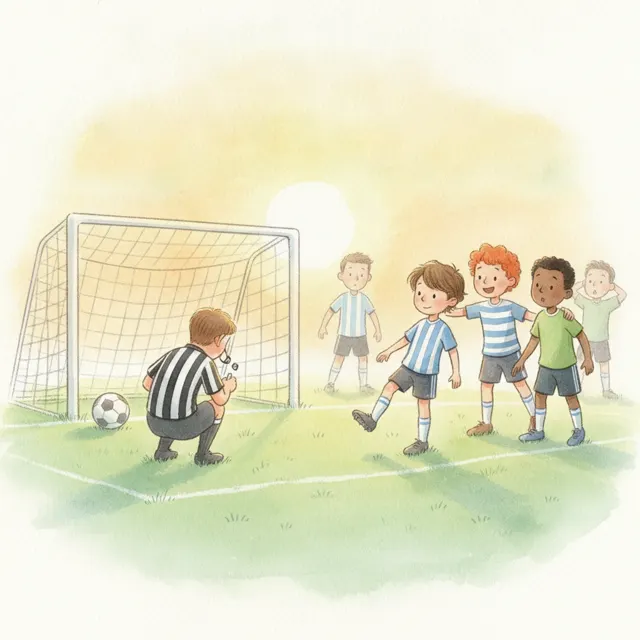
It was the last minute of the game. The score was tied. Leo had the ball right by the goal. He kicked it as hard as he could. The ball hit the post and bounced back out. "Did it go in?" yelled Sam. Nobody knew. The referee was tying his shoe and did not see the play. The referee looked up. "Did that ball cross the line?" he asked Leo. Leo's heart beat fast. If he said yes, his team would win. The other kids would cheer. But the ball had not gone in. It hit the post. Leo saw it with his own eyes. Leo took a deep breath. "No," he said. "It hit the post. It did not go in." The other team's coach smiled. "Good honesty, young man," he said. The game went on. The other team scored. Leo's team lost by one goal. After the game, Leo sat on the grass. He felt sad. Then his coach sat down next to him. "You told the truth," the coach said. "That is harder than any kick." "But we lost," Leo said. "We did not lose our honesty," the coach said. "And that is worth more than a goal." Leo's teammates came over. Sam patted his back. "You did the right thing," Sam said. "A goal that is not true is not a goal at all," said Mia. Leo smiled a little. He still wished his team had won. But deep down, he knew he did the right thing. And that felt good.

A New Kid on the Team

Ages 3-83 minuteskindness
A New Kid on the Team story for kids illustration

A new boy named Omar joins the soccer team and stands all alone. He does not know the games or the other kids. One teammate waves him over, shows him how to play, and makes him feel like he belongs.

Moral: A small act of kindness can help a new friend feel at home.

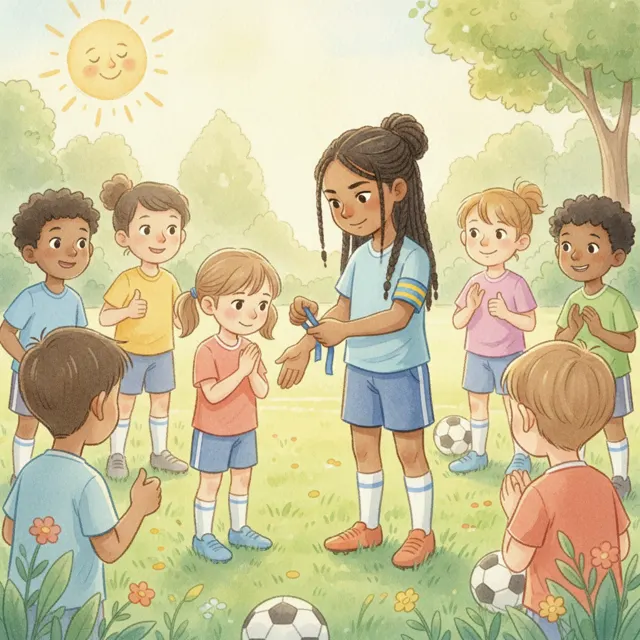
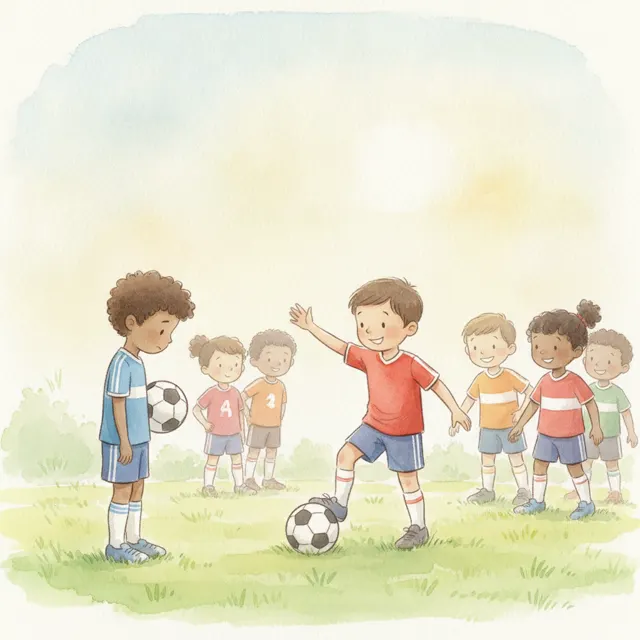
A new boy stood at the edge of the soccer field. His name was Omar. He held his arms close to his body and watched the other kids play. "Who is that?" asked Mia. "He is new," said Coach Ana. "His family just moved here." Omar did not know the games. He did not know the other kids. So he just stood there and watched. The team played a passing game. The ball flew from kid to kid. Omar watched from the side. Mia saw Omar standing alone. She ran over to him. "Hi," she said. "Do you want to play?" "I do not know how," Omar said in a small voice. "That is okay," Mia said. "I did not know how at first either. I will show you." Mia waved him over. "Come stand here," she said. "When the ball comes to you, stop it with your foot. Like this." Mia stopped the ball with the inside of her foot. "Now you try." Omar stopped the ball. It wobbled, but he stopped it. "Good!" said Mia. "Now pass it to Sam." Omar kicked the ball. It rolled to Sam. "Great pass, Omar!" Sam called. Omar's face lit up. He ran into the game. He passed and stopped and laughed with the rest of them. After practice, Omar walked home with a smile. "Thank you for showing me," he said to Mia. "You are on our team now," Mia said. "Teams help each other." Omar nodded. He was not alone anymore. He had a team.

The Rainy Day Game

Ages 3-83 minutesresilience
The Rainy Day Game story for kids illustration

It rains hard on game day, so the soccer game is called off. The team is sad until their coach sets up a silly game in the gym with a soft ball. They laugh and play even harder than before.

Moral: You can still have fun when your plans change.

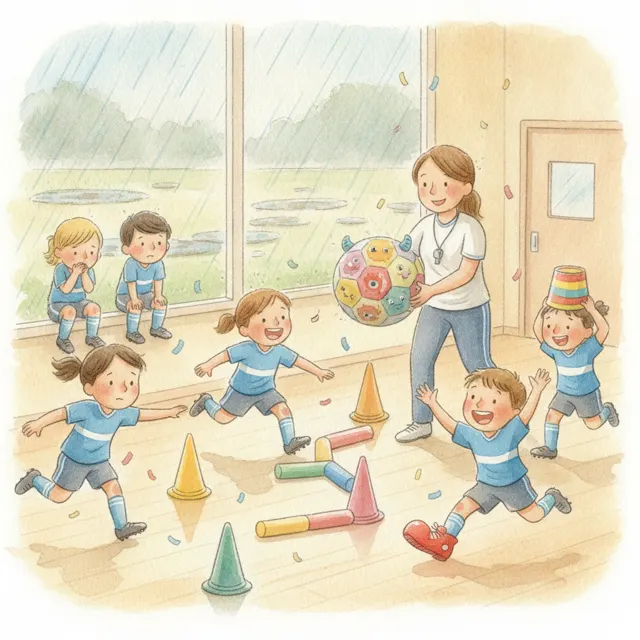
The team woke up on game day to a gray sky. Rain poured down and made puddles on the field. "Is the game cancelled?" asked Leo. Coach Ana looked at the muddy grass. "We cannot play on this field," she said. "It is too wet and slippery." The team's faces fell. They had practiced all week. They wanted to play. "This is the worst day," said Sam. "Maybe not," Coach Ana said with a wink. "Everyone follow me to the gym." They all walked into the big gym. Coach Ana pulled out a soft foam ball. "New game," she said. "Silly soccer. You must hop on one foot while you pass the ball." The kids laughed. "That is so silly!" said Mia. They played silly soccer. Leo hopped and passed. Nina passed while spinning in a circle. Sam scored a goal with his nose. Everyone fell over laughing. They played tag with the ball. They made up a dance after each goal. The gym echoed with giggles. "I did not know rain could be this fun," said Omar. At the end, the team sat on the gym floor. They were tired and happy. "I am glad it rained," said Sam. "This was more fun than the real game." "Plans change," Coach Ana said. "But fun does not have to. A team finds a way to play." The next week the sun came out, and they played on the real field. But no one forgot the rainy day game. It was one of their best days ever.

Cheering from the Sideline

Ages 3-83 minutessupport
Cheering from the Sideline story for kids illustration

Ben hurts his ankle and has to sit out of the game. He feels left out and useless. Then he starts cheering loudly for his team, and his cheers help them score. Ben learns he matters even off the field.

Moral: You can help your team in many ways, even when you are not playing.

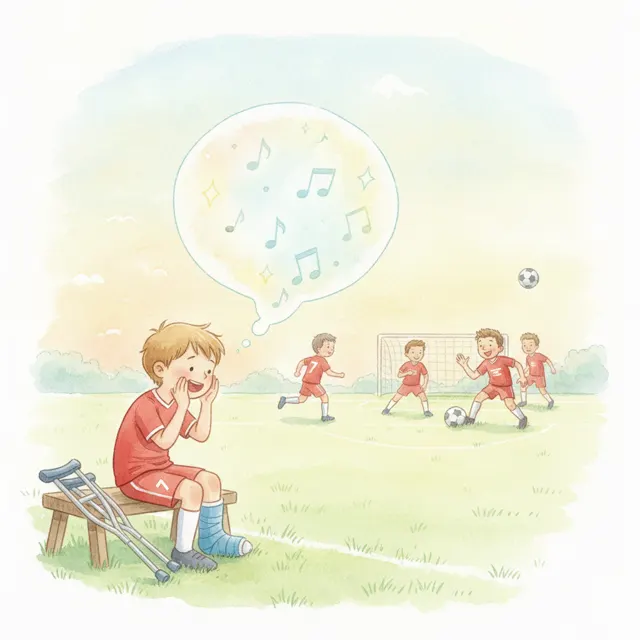
Ben loved to run. He loved to kick. He loved to be in the middle of the game. But one day Ben fell and hurt his ankle. The doctor said he had to rest. "No running for two weeks," the doctor said. Ben sat on the sideline at the next game. He watched his team play. He felt left out and useless. "I wish I could play," Ben said to Coach Ana. "You cannot kick today," Coach Ana said. "But you can still help your team." "How?" Ben asked. "I am just sitting here." "Watch and see," Coach Ana said. Ben watched. The game was close. His team looked tired. Nobody was cheering. Ben took a deep breath. "Come on, team!" he yelled. "You can do it!". His teammates looked over and smiled. They ran a little faster. Ben cheered louder. "Great pass, Mia! Go, Sam, go!" The team scored. Then they scored again. "Your cheers are helping!" Sam shouted from the field. Ben cheered until his voice was tired. His team won the game. After the game, the whole team ran to Ben. "We won because you cheered!" said Mia. Ben smiled. He was not useless at all. He was part of the team, even from the sideline. "I will cheer every game," Ben said. "Playing is fun. But cheering is fun too." That night, Ben's voice was scratchy. "I cheered so loud," he told his dad. "The team said my cheers helped them win." "A good cheer is like a good pass," his dad said. "It lifts the whole team." Ben smiled. He could not wait to cheer again.

The Ball That Rolled Too Far

Ages 3-83 minuteshelping
The Ball That Rolled Too Far story for kids illustration

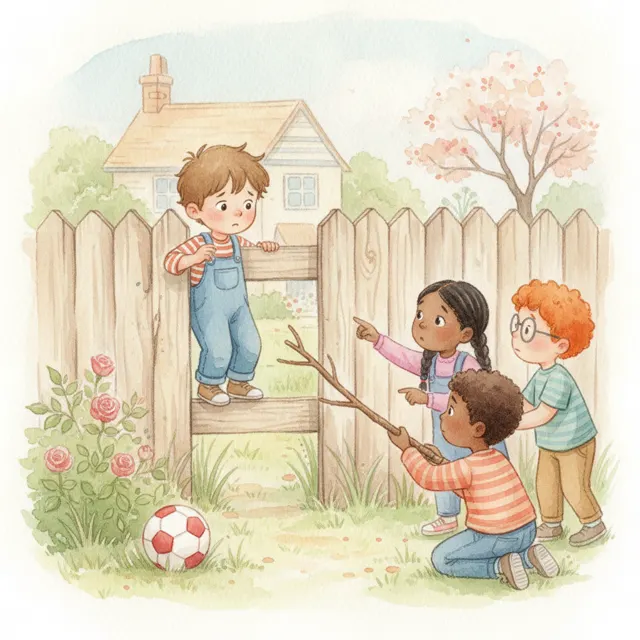
Little Max kicks his soccer ball over a tall fence, and it lands in a yard he cannot reach. He is too small to climb over. He asks his friends for help, and together they make a plan to get the ball back.

Moral: It is okay to ask for help when something is too big to do alone.

Max was the smallest kid on the team. But he loved to kick the ball as hard as he could. One day Max kicked the ball with all his might. It flew up, up, up, and over the tall fence next to the park. "Oh no!" Max said. "My ball!" The ball landed in a yard on the other side of the fence. Max ran to the fence. It was way too tall to climb. Max sat down. "I can never get it back," he said. "I am too small." His friend Mia came over. "What happened?" she asked. "My ball went over the fence," Max said. "I cannot reach it." "Let us ask the team for help," Mia said. "We can make a plan." Max did not want to ask. "I can do it by myself," he said. "Sometimes we need help," Mia said. "That is okay." Max sighed. "Okay." They called the team over. Sam had an idea. "I can lift Max on my shoulders," he said. "Then Max can reach over." Sam lifted Max. Max was still too short. The ball was too far down. Nina ran home and got a long stick. "Try this," she said. Max reached over the fence with the stick. He nudged the ball. It rolled closer and closer. Then he scooped it up. "I got it!" Max yelled. His friends cheered. Max held the ball tight. "Thank you," Max said. "I could not do it alone." "That is what a team is for," Mia said. "Next time, just ask." Max smiled. He was small, but with his friends, he was strong.

Frequently Asked Questions

Turn Your Child Into the Hero of Their Own Story

Upload their photo and watch as AI creates a beautiful, personalized storybook with illustrations that look just like them. From $5.99/month.

✨ Make Your Child the Hero

Plans from $5.99/month