Tennis Stories for Kids

Fun tennis tales where your little one learns to serve, rally, and shake hands like a champion after every match.

✨ Make Your Child the Hero

Tennis is a wonderful first sport for kids, full of running, swinging, and the happy sound of a ball on a racket. But it also teaches something quieter: how to keep trying, how to lose with grace, and how to cheer for a teammate. These stories follow young players who miss a hundred balls, share a court with a friend, and learn that the score is not the best part of the game. Each tale is short, warm, and just right for winding down. With CreateStory.ai, you can make it personal. Upload a photo and your child becomes the hero, stepping onto the court in a story all their own.

Why is tennis a fun sport for young kids?

Tennis is a game of hitting a ball over a net. Kids love the sound of the ball on the strings and the joy of a long rally. They can play with one friend or with a whole team.

More and more people are picking up a racket every year. In 2025, 27.3 million people in the United States played tennis, a new record (USTA). Kids who start young join a big and growing sport.

What does tennis teach children besides hitting the ball?

Tennis builds focus. A child must watch the ball, plan the shot, and move their feet at the same time. It also teaches fairness, because players call their own lines and shake hands after the match.

The game also builds a strong heart and quick feet. Every rally is a little workout. Kids run, stop, and turn over and over. They learn to keep going even when the point is long and tiring.

Sample Stories

Read these stories, then create a personalized version where your child is the hero

The Ball That Would Not Go Over
Ages 3-84 minperseverance
The Ball That Would Not Go Over story for kids illustration

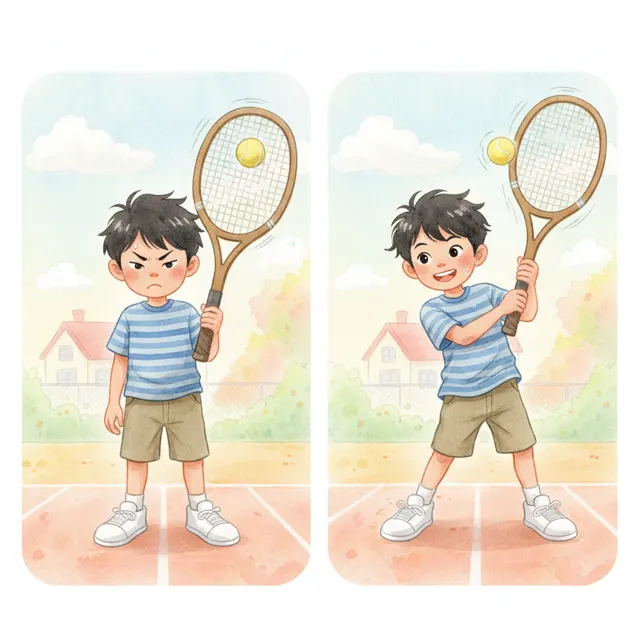
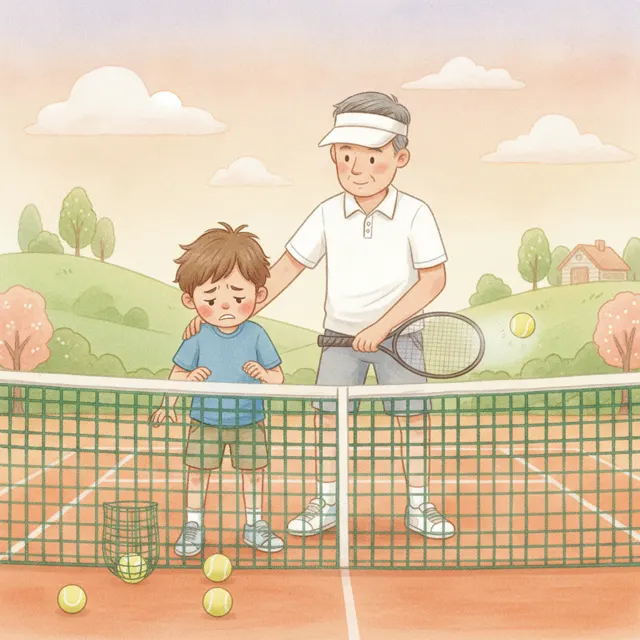
Jonas keeps hitting the tennis ball into the net, no matter how hard he swings. His coach teaches him that slow and steady wins, and one soft tap at a time, the ball finally sails over.

Moral: Sometimes slow and steady beats fast and frustrated.

Jonas gripped his racket and swung as hard as he could. The ball sailed up, up, and then plop. It dropped into the net. "Again," he said, and hit another. Plop. Another. Plop. "Why will it not go over?" Jonas groaned. "I am swinging as hard as I can." His coach, Ms. Ada, walked over and smiled. "You are trying to hit it too hard," she said. "The ball does not need all your strength. It needs a soft, steady tap." "A tap?" Jonas said. "But I want to hit it far." "Watch," Ms. Ada said. She dropped a ball and gave it the gentlest little tap. The ball floated over the net and landed softly on the other side. "See?" she said. "Slow and steady." Jonas tried again. This time, instead of swinging hard, he tapped the ball. It wobbled up and over the net. "It went over!" Jonas shouted. He tapped another, and another. Each one floated over the net, soft as a feather. Before long, Jonas and Ms. Ada were rallying back and forth, and the ball did not touch the net once. "I was trying to be strong," Jonas said, "but I needed to be steady." "That is the secret to so many things," Ms. Ada said. "Slow and steady wins." Jonas laughed and tapped the ball over the net one more time. It felt easy now, and he could have played all day. And every time he wanted to hit it too hard, he remembered to tap it soft and steady instead.
One Court, Two Friends

Ages 3-83 minsharing
One Court, Two Friends story for kids illustration

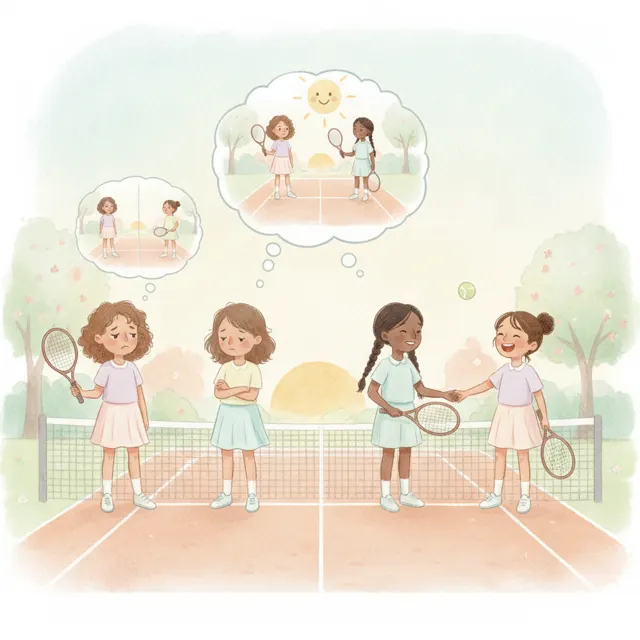
Mia and her best friend Tara both want the only open court. Instead of fighting, they learn to share it and end up playing the best game of doubles together.

Moral: Sharing what you have can turn a problem into a good time.

It was a sunny Saturday, and the tennis court was empty except for one open spot. Mia ran toward it, and so did her best friend Tara. They both reached the gate at the same time. "I was here first!" Mia said. "No, I was!" Tara said. They both grabbed the gate handle and frowned at each other. Neither one wanted to let go. "There is only one court," Mia said. "And I want to play." "So do I," Tara said. Then she stopped and thought for a second. "Wait. Why do we have to play alone? We could share the court." "Share it?" Mia said. "How?" "We could play doubles together," Tara said. "Two against two. You and me on one side." Mia's frown turned into a smile. "Against who?" Just then, two kids from the next street walked over with rackets. "Do you need partners?" one asked. "Yes!" Mia and Tara said at the same time. The four of them played the best game of the whole summer. Mia and Tara cheered for each other, ran for every ball, and laughed when they missed. They won by one point, and then they all played again. "I am glad we did not fight over the court," Mia said. "Me too," Tara said. "Sharing it turned into the best afternoon ever." And from then on, the court did not belong to just one of them. It belonged to both of them, together, and they played on it nearly every sunny Saturday after that.

The First Real Match

Ages 3-84 mincourage
The First Real Match story for kids illustration

Arun plays his very first real match and is nervous about losing in front of everyone. His dad reminds him that the score does not matter, and Arun learns to enjoy the game no matter what.

Moral: It is okay to lose, as long as you try your best and have fun.

Arun had practiced tennis all year, and now it was time for his first real match. He stood on one side of the court, and a boy named Daniel stood on the other. Arun's hands were sweaty, and his heart was beating fast. "What if I lose in front of everyone?" Arun whispered to his dad on the sideline. "Then you lose," his dad said with a warm smile. "And the sun will still rise tomorrow. The score is not the best part of today, Arun. Playing is." "But I want to win," Arun said. "Everyone does," his dad said. "But the best players are the ones who enjoy the game, win or lose. Just go have fun, and I will be proud of you no matter what." Arun took a deep breath and walked onto the court. The match began. Arun missed his first serve. Then his second. But he remembered his dad's words and kept smiling. He hit a few good shots, and Daniel hit some back. The points went back and forth. In the end, Daniel won. Arun felt a small twinge, but then he walked to the net and shook Daniel's hand. "Good game," Arun said. "Good game," Daniel said. "You almost had me on that last one." Arun's dad ran over and hugged him. "I am so proud of you," he said. "I lost," Arun said. "But I had fun." "Then you won the part that matters," his dad said. Arun smiled. He could not wait for his next match.

Losing with a Smile

Ages 3-83 minsportsmanship
Losing with a Smile story for kids illustration

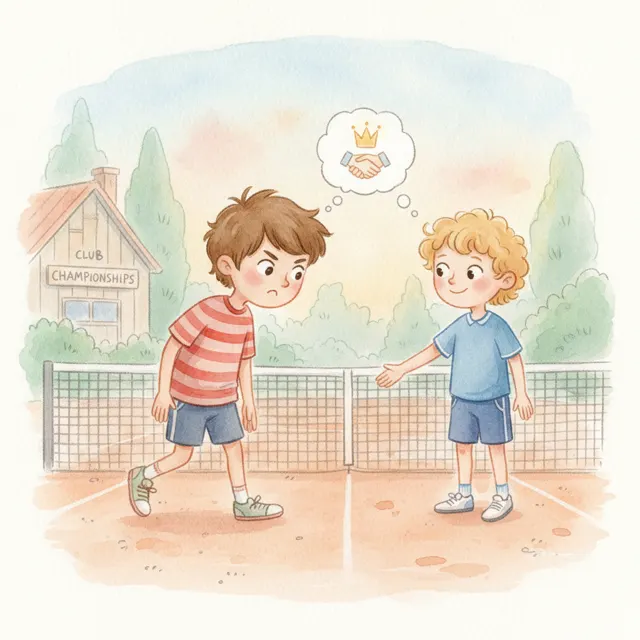
Kai loses the club match and wants to stomp away, but he sees his opponent waiting to shake hands. He learns that saying good game is the mark of a true champion.

Moral: Being a good sport matters more than winning.

The club match had come down to the very last point, and Kai had lost it. He wanted to throw his racket on the ground and stomp off the court. His face felt hot, and his eyes stung. Across the net, his opponent, a girl named Ruby, was walking toward the middle. She was smiling and holding out her hand. "Good game, Kai," Ruby said. Kai looked at her hand and did not want to take it. He wanted to say it was not fair. But then he remembered what his coach always told him: a true champion shakes hands, win or lose. Kai took a deep breath and reached out. He shook Ruby's hand. "Good game," Kai said. And even though the word felt hard to say, he said it. Ruby smiled even wider. "You played so well," she said. "That last rally was the best of the whole day." Kai blinked. "You think so?" "I know so," Ruby said. "You almost got me." Kai felt his anger melt away. Ruby was not bragging. She was being kind. And suddenly, losing did not feel so bad anymore. That afternoon, Kai's coach came over. "I saw you shake hands," he said. "That is the mark of a true champion, Kai. Winning is easy. Losing with grace is hard." Kai smiled. He had lost the match, but he had learned something bigger. Being a good sport was a win he could keep forever, and he knew he would shake hands with a smile every single time from now on.

The Doubles Team That Would Not Give Up

Ages 3-85 minteamwork
The Doubles Team That Would Not Give Up story for kids illustration

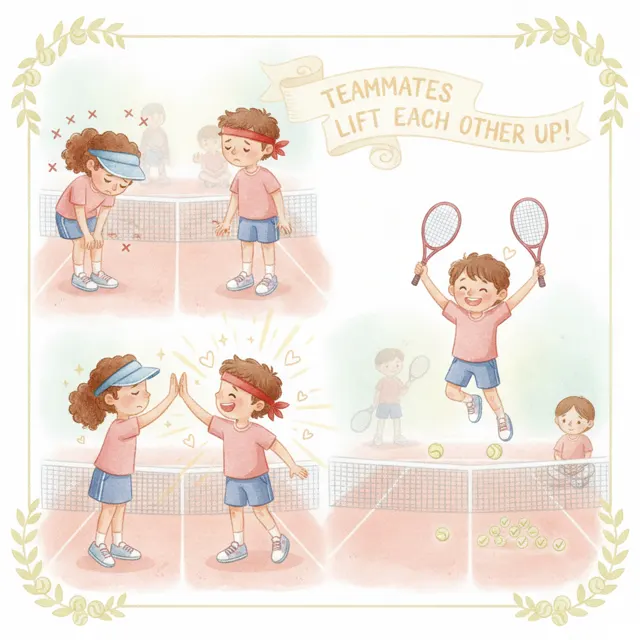
Rosa and Ben are losing every point in their doubles game, but they keep cheering each other on. Working together, they turn the game around and learn that teammates lift each other up.

Moral: Cheering each other on makes any team stronger.

Rosa and Ben were playing doubles together for the first time, and it was not going well. They had lost five points in a row, and the other team was winning easily. "This is hopeless," Ben said, hanging his head. "We are losing everything." "Hey," Rosa said, tapping his shoulder. "We are a team. Let us cheer each other on instead of giving up." "How is cheering going to help us win?" Ben asked. "You will see," Rosa said. "Try it with me." So when Ben missed a ball, instead of sighing, Rosa called out, "Nice try, Ben! You will get the next one!" And when Rosa hit a good shot, Ben clapped and shouted, "Great shot, Rosa!" Something funny started to happen. The more they cheered, the better they played. Ben ran faster. Rosa hit harder. They won a point. Then another. Then another. "We are coming back!" Ben shouted. The other team looked surprised. Point by point, Rosa and Ben closed the gap, and in the end, they won the game by two points. "We did it!" they both shouted, and they high fived in the middle of the court. "Cheering really did help," Ben said. "I felt braver every time you said nice try." "That is what teammates are for," Rosa said. "We lift each other up." From that day on, Rosa and Ben were the best doubles team at the whole club, because they knew the real secret: a team that cheers together wins together, point after point, game after game.

The Racket That Felt Too Big

Ages 3-83 minutespractice
The Racket That Felt Too Big story for kids illustration

A boy named Kai gets a hand-me-down tennis racket that is too big for him. The ball keeps missing the sweet spot, and he wants a new one. After weeks of practice, the big racket finally feels just right.

Moral: Keep trying and one day the hard thing will feel just right.

Kai got a tennis racket from his big brother. It was long and heavy. "This racket is too big," Kai said. "It feels like a log." "Keep using it," his dad said. "Your brother learned with the same racket." Kai tried to hit the ball. The big racket was slow. The ball missed the strings and bounced off the side. "See?" Kai said. "It is too big." "You are still growing," his dad said. "Keep practicing." So Kai practiced. Every day he hit balls against the wall with the big racket. At first the ball went everywhere except where he wanted. Week one, the racket felt heavy. Week two, it felt a little lighter. Week three, Kai's arm got stronger. One day, Kai hit the ball right in the middle of the strings. It made a happy popping sound. "I hit the sweet spot!" Kai yelled. His dad smiled. "The racket is starting to fit you." Kai kept practicing. He could swing the big racket faster now. He could reach balls that were far away. The long handle gave him more reach. At his next lesson, Kai played his best tennis ever. He hit shot after shot over the net. "Nice racket," his coach said. "It looks like it fits you well." Kai looked at the racket. It did not feel like a log anymore. It felt like a part of his arm. "I wanted a new racket," Kai told his dad. "But this one is perfect now." "You grew into it," his dad said. "Just like your brother did." Kai held the racket up. "One day I will pass it to someone little too," he said.

Sam's Serve Goes Over the Net

Ages 3-83 minutespersistence
Sam's Serve Goes Over the Net story for kids illustration

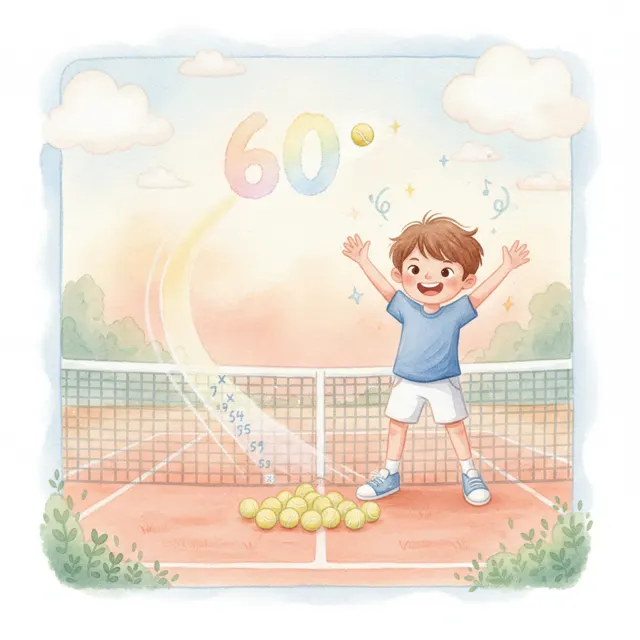
Sam cannot get his tennis serve over the net. The ball hits the net again and again. He counts his tries and does not give up. On his sixtieth try, the ball sails over, and Sam cheers.

Moral: Keep trying and the hard shot will finally come.

Sam tossed the ball up. He swung his racket. The ball hit the top of the net and fell back down. "Again," his coach said. Sam tossed and swung. The ball hit the net again. "Again," the coach said. Sam tried ten times. Twenty times. The ball kept hitting the net. "I cannot do it," Sam said. "The net is too high." "The net is not too high," the coach said. "Your toss is too low. Toss the ball a little higher and swing up." Sam took a deep breath. He tossed the ball higher. He swung up. The ball went over the net this time, but it flew too far and landed out. "So close!" the coach said. "That one was over. Now we fix the aim." Sam kept trying. He counted each try in his head. Twenty nine. Thirty. Forty. Each serve got a little better. On his fiftieth try, the ball went over the net and landed inside the box. "Was that in?" Sam asked. "That was in!" the coach said. "You did it!" Sam jumped up. "Yes!" he cheered. "My serve went over!" He did it again. And again. Soon his serve went over the net almost every time. "How many tries did it take?" Sam asked. "I lost count," the coach said. "But you never gave up. That is what matters." Sam smiled. "The net is not too high anymore," he said. "It never was," the coach said. "You just needed more practice." Sam picked up the ball and served one more time. Over the net. Right in the box. He smiled. The net did not look so high anymore.

The Ball Kid Who Waved

Ages 3-83 minuteskindness
The Ball Kid Who Waved story for kids illustration

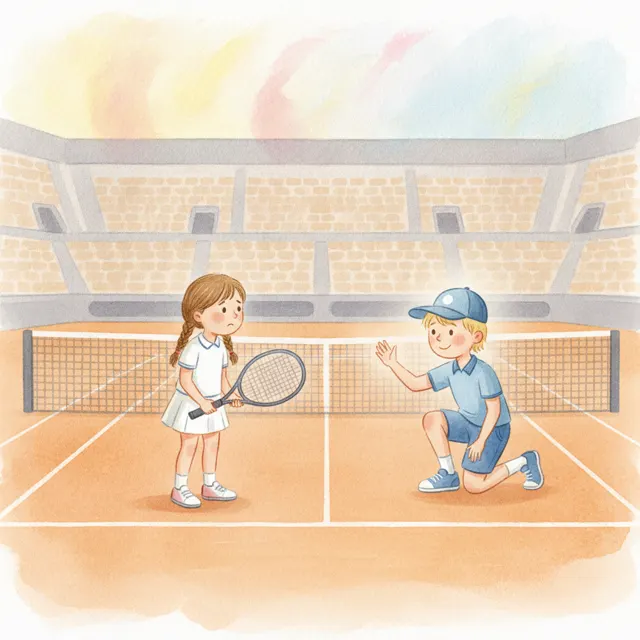
A girl named Ava is nervous before her first big tennis match. She looks around and feels small. A ball kid gives her a small wave and a smile. It calms her down, and she plays her best match ever.

Moral: A small wave or smile can make someone feel brave.

Ava walked onto the tennis court. Her first big match was about to start. Her hands were shaking. Her heart was beating like a drum. She looked up at the stands. So many people. She felt very small. Ava bounced the ball. She could not stop shaking. She looked around for a friendly face. Then she saw him. A ball kid stood at the back of the court. He was about her age. He gave her a small wave and a big smile. Ava blinked. She waved back. It was a tiny wave, but it made her feel a little warmer inside. The ball kid gave her a thumbs up. Ava smiled. Someone out there was cheering for her, even if it was just one small wave. Ava took a deep breath. She tossed the ball and served. It went over the net. The match began. Ava hit the ball back and forth. She forgot about the big crowd. She just played. When she hit a good shot, she looked over. The ball kid was smiling and nodding. Ava played her best tennis. She won the match. After the match, Ava walked over to the ball kid. "Thank you for waving at me," she said. "I was so nervous." "I could tell," the ball kid said. "A little wave can help." "It helped a lot," Ava said. "You made me feel brave." The ball kid smiled. "That is what friends are for. Even new ones." Ava waved goodbye. One small wave had started it all.

Two Rackets and One Basket of Balls

Ages 3-83 minutessharing
Two Rackets and One Basket of Balls story for kids illustration

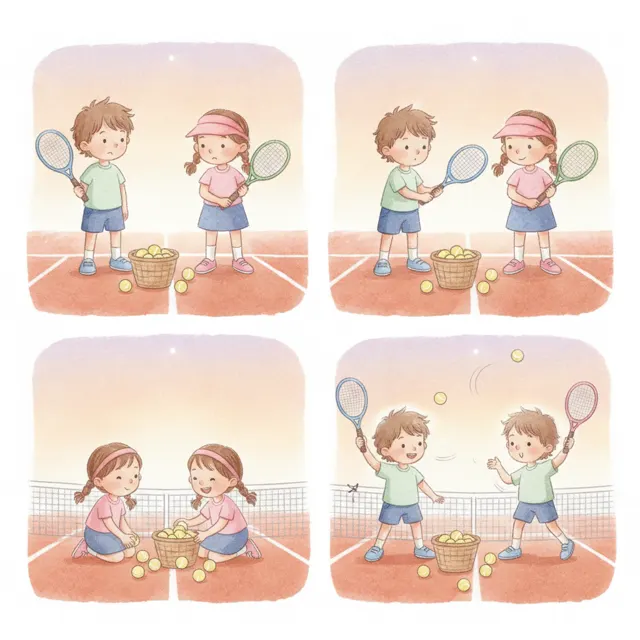
Two kids show up to tennis practice with only one basket of balls. They each want to hit first. Instead of fighting, they take turns, pick up balls together, and both get better at the game.

Moral: Sharing what you have makes playtime better for everyone.

Leo and Maya ran to the tennis court. There was one basket of balls and two rackets. "I want to hit first," said Leo. "No, me first," said Maya. They both grabbed for the balls. The basket tipped over. Balls rolled everywhere. "Now look what we did," Maya said. They stood there, frowning at the mess. "We could pick them up together," Leo said. "Then we could take turns," Maya said. So they picked up the balls together. It went fast with two people. "You hit first," Leo said. "I will toss the balls to you." Maya hit the balls over the net. Leo tossed one, then another, then another. Then they switched. "My turn," Maya said. "I will toss for you." Leo hit the balls. He got better with each swing. Maya got better too. "This is fun," Leo said. "I like taking turns." "Me too," Maya said. "When we share, we both get to play more." They played all afternoon. They picked up balls together, took turns hitting, and cheered for each other's good shots. At the end, the basket was full again. Both kids were smiling. "One basket is plenty," Maya said. "When we share it," Leo said. They walked home together, planning to meet again the next day. Two rackets and one basket of balls were all they needed. That night, Leo told his mom about the day. "We shared the basket," he said. "And we both got better." "Sharing makes everything go further," his mom said. "Even tennis balls." Leo laughed and went to bed, already excited for tomorrow.

The Match That Ended in a Tie

Ages 3-83 minutesfairness
The Match That Ended in a Tie story for kids illustration

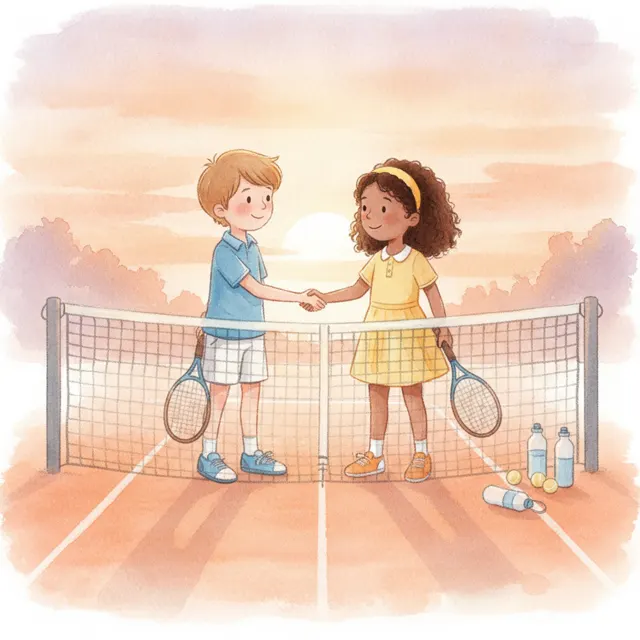
Two friends play a long, close tennis match. When the sun goes down, the score is tied. They could play one more point to decide, but instead they shake hands and call it even. Both are happy.

Moral: It is okay when a game ends even, as long as everyone played fair.

Eli and Noah were best friends. They were also the two best tennis players on the block. "Let us play a match," Eli said. "You are going down," Noah said with a grin. They played all afternoon. Eli won a game. Noah won a game. Back and forth they went. The score got close. Six games to six. They were tied. The sun began to sink behind the trees. The sky turned orange and pink. "One more point," Eli said. "The winner takes it all." Noah looked at the sky. "It is almost dark," he said. "We can barely see the ball." "But we are tied," Eli said. "Someone has to win." "Does someone have to?" Noah asked. "We both played our best. What if we just call it even?" Eli thought about it. He really wanted to win. But Noah was right. It was too dark to play fair. "Okay," Eli said. "Let us call it a tie." They met at the net and shook hands. "Good match," Noah said. "Good match," Eli said. "I wanted to win, but a tie is fair." "We can play again tomorrow," Noah said. "When the sun is up." They walked home together in the fading light. Neither of them felt sad. "A tie is not a loss," Eli said. "It means we are both pretty good." Noah laughed. "Tomorrow I will beat you for real." "We will see," Eli said. And they both smiled the whole way home. The next morning, the sun was bright. Eli and Noah met at the court again, ready to play. A tie was fine, but today they both wanted to win.

Waving to the Other Player

Ages 3-83 minutessportsmanship
Waving to the Other Player story for kids illustration

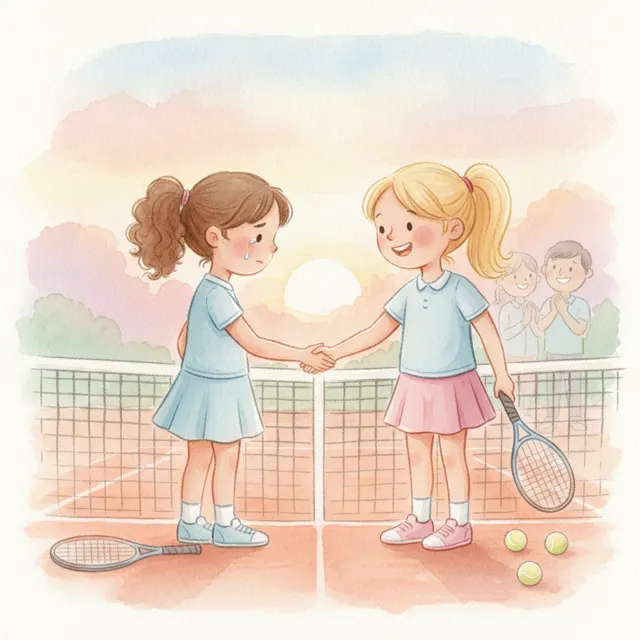
A girl named Zoe loses a tennis match and feels sad. Instead of sulking, she walks to the net, shakes the winner's hand, and says good game. The winner smiles, and the two become practice friends.

Moral: Being kind after a loss is part of the game, and it can win you a friend.

Zoe lost the match. She had played hard, but the other girl, Ava, was just better that day. Zoe sat on the bench. Her lip wobbled. She wanted to cry. She wanted to throw her racket. She wanted to run home and hide. Her coach sat down next to her. "How do you want to end this match?" the coach asked. "It is already over," Zoe said. "I lost." "The match is over," the coach said. "But how you act now is still part of the game." Zoe looked at Ava. Ava was waiting at the net. She was holding out her hand. Zoe took a deep breath. She walked to the net. She shook Ava's hand. "Good game," Zoe said. "You played really well." Ava's face lit up. "So did you," she said. "That last rally was amazing." Zoe smiled a little. It felt good to be kind, even when she felt sad. "Do you want to practice together sometime?" Ava asked. Zoe blinked. "Really?" "Really," Ava said. "Playing with you makes me better." The next week, Zoe and Ava practiced together. They hit balls back and forth. They cheered for each other. Zoe lost again, but this time she did not mind. "I am glad I waved and shook your hand," Zoe said. "Me too," Ava said. "Now we are friends." Zoe learned that being a good sport is part of the game. And it can even win you a friend. That night, Zoe told her dad about Ava. "I lost, but I made a friend," she said. "Then you did not really lose," her dad said. "You won something better than a match."

Practice on the Empty Court

Ages 3-83 minutesdedication
Practice on the Empty Court story for kids illustration

After tennis practice, a boy named Milo stays behind while his friends go home. He hits balls against the wall all alone, day after day. At the next match, his extra practice shows in every shot.

Moral: Practice even when no one is watching, and it will show when it counts.

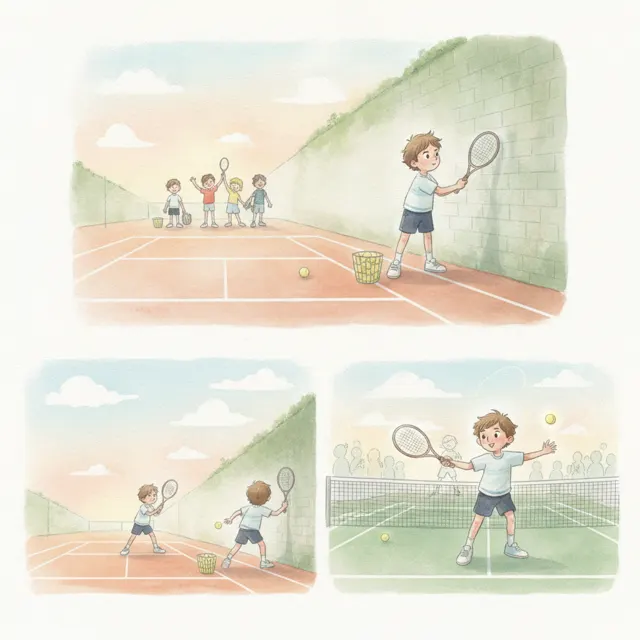
Practice was over. All the kids packed their bags and ran home. "Come on, Milo," his friend called. "Let us go." "You go ahead," Milo said. "I am going to stay a little longer." Milo was the only one left on the court. It was quiet and empty. He pulled out a bucket of balls and started to hit them against the wall. Thump. Thump. Thump. The ball came back to him, and he hit it again. "What are you doing?" asked the groundskeeper. "Practicing," Milo said. "The wall is a great partner. It never gets tired." The groundskeeper laughed. "The wall never misses either." Milo hit the ball again and again. He practiced his forehand. Then his backhand. He practiced until the sun went down. The next day, after practice, Milo stayed again. And the next day. And the next. Some days his arm was tired. Some days he wanted to go home with his friends. But Milo kept hitting the ball against the wall. "Why do you stay so late?" his friend asked. "I want to be better," Milo said. "Even when no one is watching." Then came the big match. Milo played the best he had ever played. His forehand was fast. His backhand was strong. Every ball went where he wanted it to go. "How did you get so good?" his opponent asked. Milo smiled. "I had a secret partner," he said. "A wall that never gets tired." His coach clapped. "You practiced when no one was watching. That is why you won today."

Frequently Asked Questions

Turn Your Child Into the Hero of Their Own Story

Upload their photo and watch as AI creates a beautiful, personalized storybook with illustrations that look just like them. From $5.99/month.

✨ Make Your Child the Hero

Plans from $5.99/month