Confidence Stories for Kids

Five gentle stories that help shy kids find their voice, try new things, and learn that being themselves is always enough.

โœจ Make Your Child the Hero

Confidence does not come from being perfect. It grows slowly, every time a child tries something hard, speaks up in a small voice, or gets back up after a wobble. That is exactly what these confidence stories for kids are for. Each one follows a shy fox, a wobbly bike rider, a quiet turtle, and other little heroes as they find the courage to be themselves. The stories are gentle, funny, and just the right length for bedtime or a quiet afternoon. With CreateStory.ai, your child steps into the story and becomes the brave hero, because seeing their own face makes believing in themselves feel real.

Why does feeling confident matter for young kids?

Confidence helps a child try new things and keep going after a miss. A child who feels brave raises a hand, joins a game, and asks for help. That brave feeling grows with each small win, one step at a time.

Low body confidence makes some kids pull back. Dove found that 8 in 10 girls skip activities they love because they do not like how they look (Dove Self-Esteem Project). Kind words and small wins help kids stay in the game.

What is a simple way to build a child's confidence?

Praise the try, not just the win. Say things like, "You worked hard on that." Let kids pick small jobs they can finish, like pouring their own drink. Each finished job makes them feel strong and sure. They learn to trust their own hands.

Sample Stories

Read these stories, then create a personalized version where your child is the hero

The Quiet Fox Who Sang at the Fair
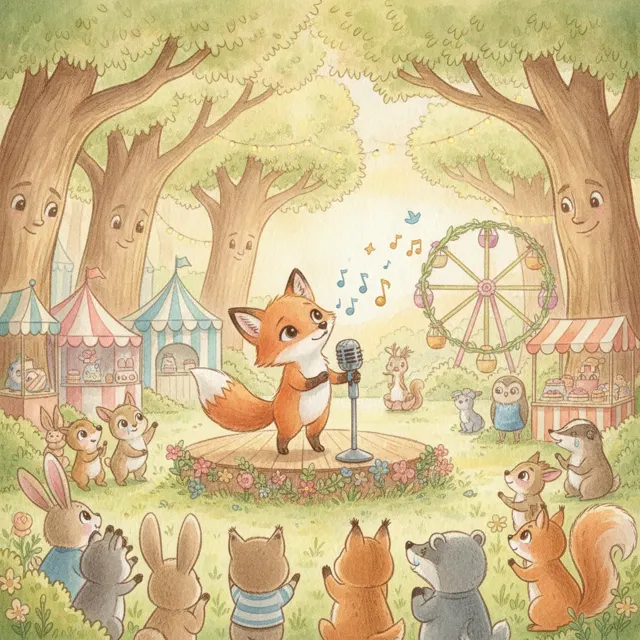
Ages 3-84 minconfidence
The Quiet Fox Who Sang at the Fair story for kids illustration

Fiona the fox has a lovely voice but only the trees have heard it. When a talent fair comes to the forest, she must decide whether to keep hiding or share her song with everyone she knows.

Moral: Sharing what you can do, even when you feel nervous, makes you braver every time.

Fiona the fox had the prettiest voice in the whole forest, but only the trees had ever heard it. She sang softly to herself while she gathered berries, and the moment another animal came near, she stopped and looked at her paws. One morning a bright poster appeared on the old oak tree. It said TALENT FAIR ON SATURDAY. Bring a song, a dance, or a trick to share. "I could sing," Fiona whispered to her friend Rabbit. "Then sign up!" said Rabbit. "Your voice is lovely." "But what if I forget the words?" Fiona's tail curled tight around her feet. "What if everyone laughs?" "What if you do wonderfully?" Rabbit smiled and gave her a gentle nudge. All week Fiona practiced by the stream, where the water never told anyone her secrets. On Saturday morning her paws shook as she climbed onto the little wooden stage. The whole forest sat in a quiet ring around her. She opened her mouth and the first note came out small and wobbly, like a baby bird. She almost ran away. Then she remembered Rabbit's smile, took a deep breath, and tried again. The second note came out strong. By the third note she forgot to be scared at all. When she finished, the forest clapped so loud the leaves rattled. Fiona bowed and felt something warm and brave growing right in the middle of her chest. After that, Fiona sang everywhere she went, and the best part was that now the whole forest could hear how pretty her voice really was. Sometimes she still felt a little flutter before she sang, but she sang anyway, because she had learned that brave is not the same as not scared. Brave means doing it anyway.
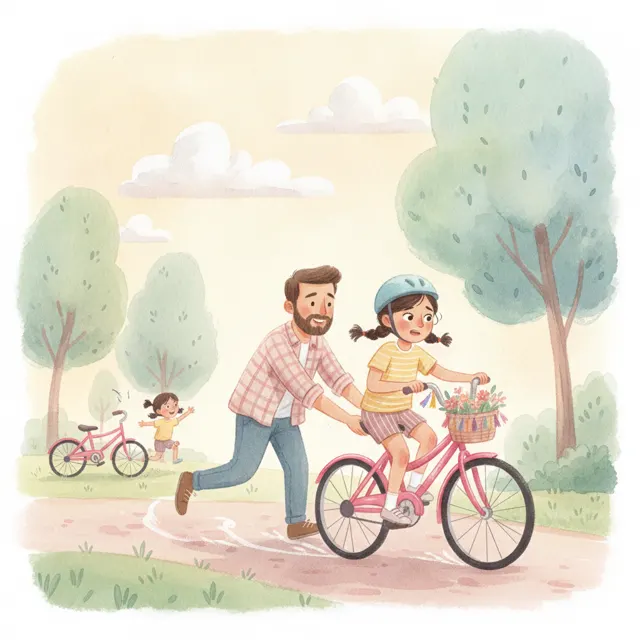
Maya Rides Without Training Wheels

Ages 3-83 minconfidence
Maya Rides Without Training Wheels story for kids illustration

Maya loves her pink bike but is scared to take off her training wheels. With her dad running beside her and a few wobbly tries, she discovers that falling is just part of learning to ride.

Moral: Falling is part of learning, and every try makes you a little bit stronger.

Maya's bike was pink and shiny, with a bell that rang like a little song. She loved riding it around the park with her two training wheels holding her steady. But all the big kids rode on just two wheels, and Maya secretly wanted to try. "Dad, I want to take them off," she said one Saturday, pointing at the training wheels. "Are you sure, peanut?" Dad asked. "It might feel wobbly at first." "I'm sure," Maya said, even though her tummy felt full of butterflies. Dad got out his wrench and took the training wheels off. The bike looked taller now, and a little bit scary. Maya climbed on and gripped the handles tight. "Ready?" Dad held the back of her seat. "Pedal, and I'll stay right here." Maya pedaled. The bike tipped. "Whoa!" She put her foot down and caught herself. "I can't do it!" "You almost did," Dad said. "You caught yourself, that's the hard part. Let's try again." She tried again. And again. Each time she went a little farther before she wobbled. On the fifth try, Dad let go without telling her, and Maya kept going, past the big tree and all the way to the slide before she noticed. "I did it!" she shouted. "I really did it!" Dad cheered so loud that two dogs started barking. Maya rode the rest of the afternoon with the wind in her hair, and every little wobble just reminded her that she was the one in charge now.

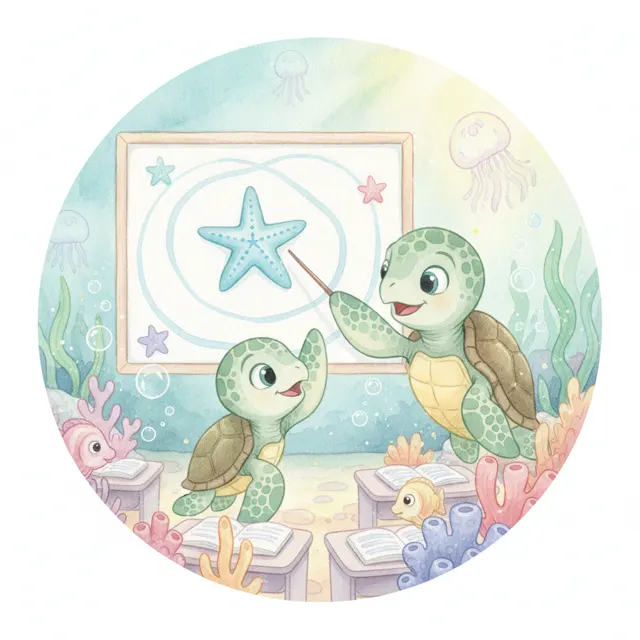
The Little Turtle Who Raised His Hand

Ages 3-84 minconfidence
The Little Turtle Who Raised His Hand story for kids illustration

Timmy the turtle always knows the answer but never says it out loud. When his teacher asks about the blue sea star, Timmy finally lifts his flipper and finds his quiet voice.

Moral: Speaking up gets easier every time you try, and your ideas deserve to be heard.

Timmy the turtle loved school. He loved the counting shells, the alphabet rocks, and especially story time at the end of each school day. But Timmy had a secret. Every time his teacher Miss Coral asked a question, Timmy knew the answer, but he kept his flipper down and his head tucked low. "Why don't you ever answer, Timmy?" his friend Sally the seahorse asked. "You always whisper the right answer to me." "I'm scared I'll say it wrong," Timmy admitted, blushing. "Miss Coral is nice," Sally said. "She won't mind if you make a mistake." The next day Miss Coral held up a picture. "Who can tell me what this is?" She pointed to a blue sea star. Timmy knew. He knew it was a sea star, and that it had five arms, and that it could grow a new arm if one broke off. His heart thumped. Slowly, slowly, he lifted one flipper into the air. "Yes, Timmy?" Miss Coral's eyes went wide and happy. "It's a sea star," Timmy said, and his voice came out louder than he expected. "And it can grow a new arm if it loses one." "Wonderful, Timmy!" Miss Coral clapped. "That's exactly right." After that Timmy raised his flipper every single day. His voice got steadier each time, and one afternoon he even stood up in front of the class to tell a story all by himself. When he sat back down, Sally gave him a high five with her tail, and Timmy felt like the biggest turtle in the whole ocean.

Omar and the Backwards Cartwheel

Ages 3-83 minconfidence
Omar and the Backwards Cartwheel story for kids illustration

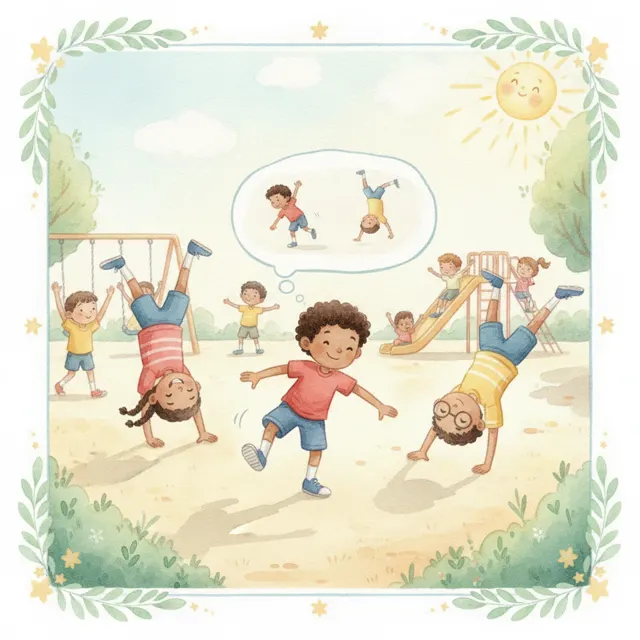
Omar can do a perfect cartwheel, but everyone else at recess can do it backwards. Instead of giving up, he practices a little each day and learns that slow, steady tries beat giving up.

Moral: Everyone learns at their own speed, and practice turns hard things into easy ones.

Omar could do a cartwheel, and it was a very good one. His legs went up straight, his hands landed just right, and he always finished with a big smile. But at recess, his friends had started doing backwards cartwheels, and Omar could not figure out how they did it. "I'll never get it," Omar said, flopping onto the grass. "Maya learned it in one day." "You learned to read in one year," said his friend Leo. "Everyone learns at their own speed." "Backwards is different," Omar grumbled. "Show me what you can do," Leo said. So Omar did his best backwards cartwheel. His legs went up crooked and he landed on his bottom with a soft thud. Both boys laughed until their sides hurt. "Okay, that was terrible," Omar giggled. "But watch. Tomorrow it'll be a little less terrible." Every day at recess Omar practiced. He fell a lot at first, then less. He learned to push off with his feet a little harder. Two weeks later he did a backwards cartwheel, then two in a row, then three. "See?" Leo grinned. "Slow and steady." "Yeah," Omar said, brushing the grass off his hands. "And a whole lot of falling down first." That Friday Omar did four backwards cartwheels in a row while Maya watched and clapped, and he finished with the biggest smile of all. He still practiced every recess after that, not because he needed to be better than anyone, but because it felt good to try something hard and watch it slowly, surely, become easy.

Pippa the Penguin Who Danced Anyway

Ages 3-85 minconfidence
Pippa the Penguin Who Danced Anyway story for kids illustration

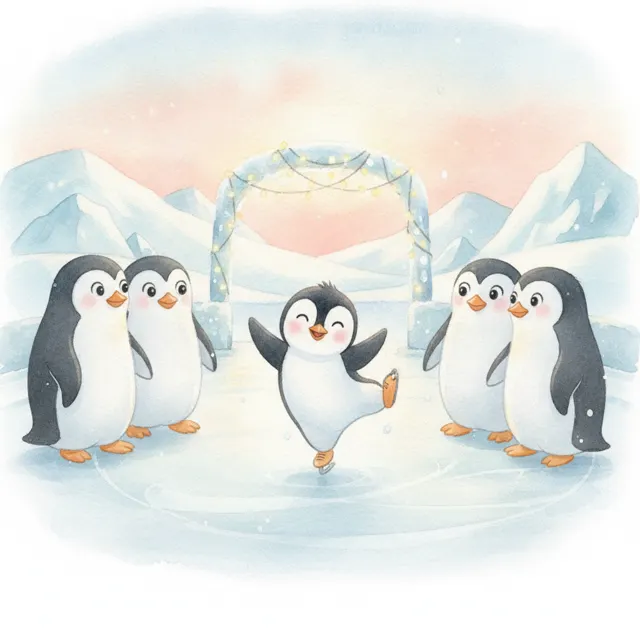
Pippa the penguin loves to dance, but she does not waddle like the other penguins and she worries they will stare. When the ice rink opens, Pippa decides her own moves are worth showing.

Moral: Being yourself is always good enough, and the best thing you can share is what makes you you.

Pippa the penguin loved music. Whenever the ice band played, her flippers started tapping before she could stop them. But Pippa danced differently from the other penguins. She spun when they slid, and she hopped when they swayed, and she was always a little bit afraid that everyone was staring. "Why don't you dance with us?" asked Polly, who danced in perfect circles with the others. "I don't do it right," Pippa said. "My moves are all mixed up." "Who said there's a right way?" Polly tilted her head. That weekend the penguins opened a big new ice rink, and there was a dance party under the lights. Pippa watched from the edge, her flippers tapping against her will. "Come on," Polly called, sliding over. "Dance however you like. I'll dance with you." Pippa took a deep breath and stepped onto the ice. She spun when the others slid. She hopped when they swayed. And something funny happened. Nobody stared in a mean way. A few penguins even copied her spin. Soon the whole rink was a mix of circles and spins and hops, and everyone was laughing. Pippa danced until her flippers ached, and she realized that the dance was always good enough, as long as it was hers. After that Pippa danced at every single party, right in the middle of the ice, because she finally understood that being yourself is the best move there is. And every time the music started, Pippa was the first one onto the ice.

Zara and the Big Slide

Ages 3-83 minutesconfidence
Zara and the Big Slide story for kids illustration

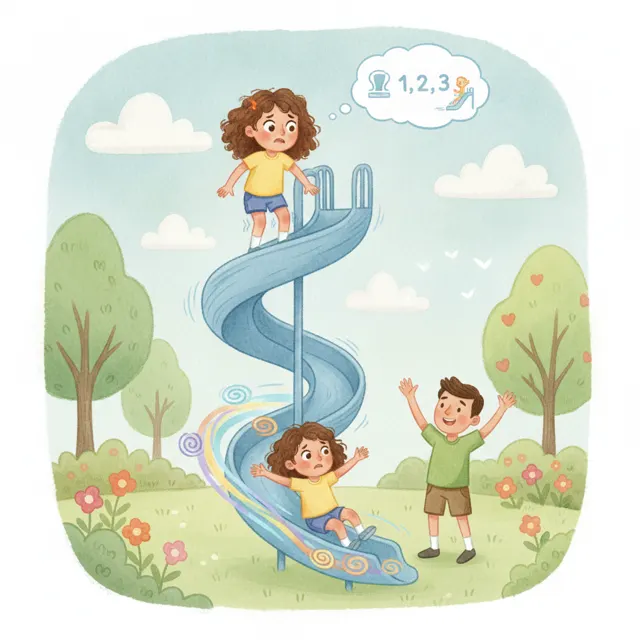
Zara stands at the top of the big slide at the park. It looks very high, and her legs feel shaky. Her dad cheers her on. She takes a deep breath, counts to three, and slides down. She feels scared and brave at the same time.

Moral: You can be scared and brave at the same time, and still try.

Zara stood at the top of the big slide. It looked very high. The ground looked very far away. "I am scared," Zara said. Her legs felt shaky. "You can do it," her dad called from the bottom. "Take your time." Zara looked down the long slide. Kids were sliding down one after another. They laughed and yelled. Zara wanted to be like them. But her feet would not move. "What if I fall?" Zara asked. "You are sitting down the whole way," her dad said. "You will slide to the bottom, and I will be right here to catch you." Zara sat down at the top. She held the sides. Her heart went thump, thump, thump. "You can be scared and brave at the same time," her dad said. "Being brave means you try even when you are scared." Zara took a deep breath. She counted to three. One, two, three. Then she let go. Whoosh! She slid down fast. The wind pushed her hair back. She laughed out loud. The ride was over too soon. She landed at the bottom, right where her dad was waiting. "You did it!" he said, and gave her a big hug. "That was so fun!" Zara said. "I want to go again!" She ran back up the steps. This time, her legs did not shake. She slid down again, laughing the whole way. "I was scared, but I did it anyway," Zara said. "That made it even better." "That is what brave looks like," her dad said. Zara smiled. She knew she could be scared and brave at the same time. And she could do big things.

The Boy Who Read Aloud

Ages 3-83 minutesconfidence
The Boy Who Read Aloud story for kids illustration

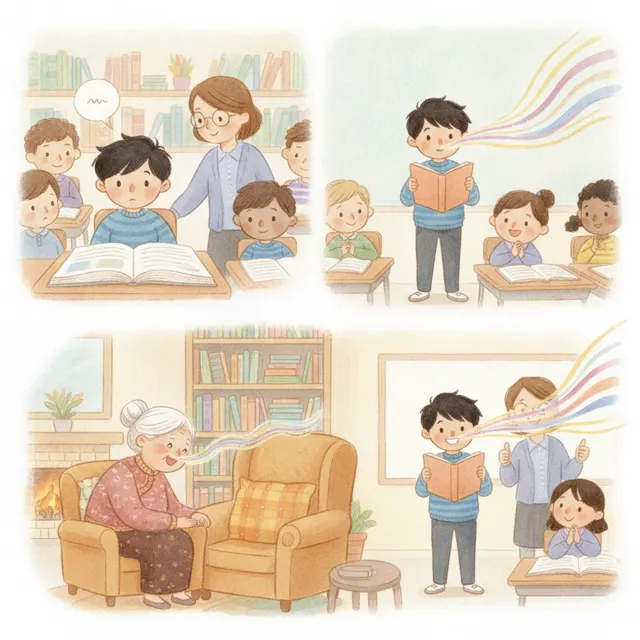
Kai can read, but his voice goes quiet when the teacher calls on him. He is afraid of making a mistake. His grandma tells him his voice matters. He practices at home, then reads a page to his class in a strong, clear voice.

Moral: Your voice matters, so let the whole class hear it.

Kai could read. At home, he read to his grandma every night. But in class, when the teacher called on him, his voice went small and quiet. "Kai, will you read the next page?" his teacher asked. Kai's heart sank. He stood up slowly. His mouth felt dry. He read in a tiny whisper. The words came out all wrong. At home, Kai told his grandma what happened. "I am afraid I will make a mistake," he said. "Everyone makes mistakes," Grandma said. "Even teachers. The trick is to keep going. Your voice matters, Kai. Let the class hear it." "But what if they laugh?" Kai asked. "If you read with a strong voice, they will listen," Grandma said. "And if you trip on a word, just say it again. That is all." That night, Kai practiced. He read a whole page to Grandma in a big, clear voice. He read it three times. "Louder," Grandma said. "You can do it." The next day, the teacher asked, "Kai, will you read?" Kai took a deep breath. He remembered Grandma's words. He stood up tall. He opened the book. And he read in a strong, clear voice. Every word came out just right. When he finished, the teacher smiled. "What a wonderful reader you are, Kai," she said. Kai sat down. His heart felt proud. He had read in front of everyone, and it was fine. Nobody laughed. In fact, some kids clapped. At home, Kai told Grandma the good news. "I read in a big voice!" he said. "I knew you could," Grandma said. "Your voice matters. Never hide it." From that day on, Kai read out loud in class. And his voice grew stronger every single time.

Nia Jumps Into the Pool

Ages 3-83 minutesconfidence
Nia Jumps Into the Pool story for kids illustration

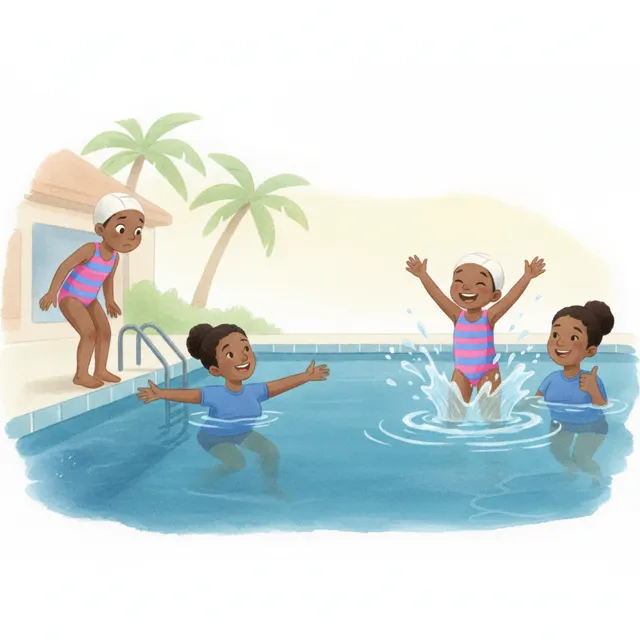
Nia stands at the edge of the pool in her swimsuit. The water is deep, and she is afraid to jump. Her swim teacher holds out her arms. Nia takes a deep breath, bends her knees, and jumps. She comes up laughing and proud.

Moral: Take a deep breath and jump. You are braver than you know.

Nia stood at the edge of the pool. She wore her red swimsuit and her floaties. The water was deep and blue. "Jump in, Nia!" her swim teacher called. She held out her arms. "I will catch you." Nia looked at the water. It looked deep. "I am scared," she said. "What if I sink?" "Your floaties will hold you up," the teacher said. "And I am right here. You just have to take a deep breath and jump." Nia's toes curled over the edge. Her heart went fast. Other kids were jumping in and splashing. They made it look easy. But Nia's feet would not move. "You can do it," the teacher said. "Bend your knees. Big breath. One, two, three." Nia bent her knees. She took a big breath. She closed her eyes. One, two, three. She jumped. Splash! The water came up around her. It was cold for one second. Then her floaties lifted her up, up, up. She popped back to the top. Nia opened her eyes. She was floating! The teacher was right there, smiling. "You did it, Nia!" she said. Nia laughed. "I did it!" she said. "I jumped!" She kicked her legs and swam to the side. Then she climbed out and did it again. Splash! And again. Splash! Each jump felt braver than the last. "I was so scared," Nia said. "But jumping felt amazing." "That is the best part," the teacher said. "The scary thing turns into the fun thing when you try." Nia smiled big. She had been afraid of the water. Now she could not wait to jump in again. She had been braver than she knew.

Show and Tell Star

Ages 3-83 minutesconfidence
Show and Tell Star story for kids illustration

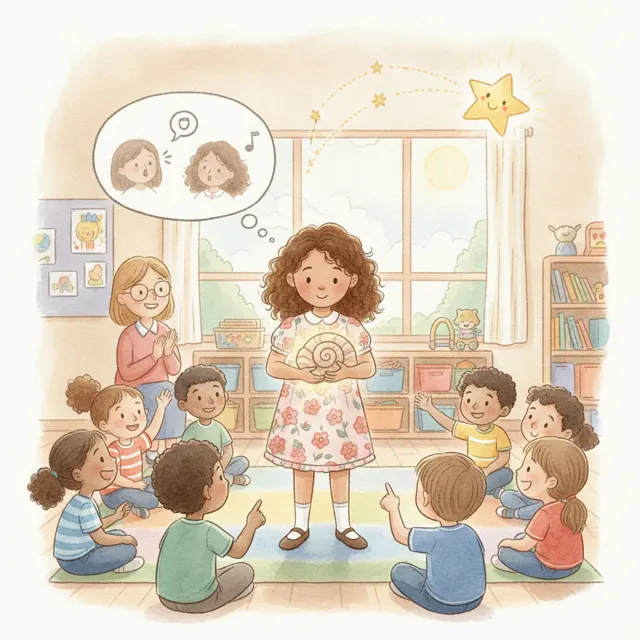
It is show and tell day, and Amara brought her favorite seashell. She is shy and afraid to talk in front of the class. She practices what to say, takes a deep breath, and shares her shell. The class loves it, and Amara feels proud.

Moral: Sharing what you love helps you shine.

It was show and tell day. Amara brought her favorite thing. It was a big seashell from the beach. It was pink and swirly, and you could hear the ocean inside it. Amara sat at her desk. Her tummy felt funny. "What if I forget what to say?" she whispered to her friend. "You know your shell better than anyone," her friend said. "Just tell us about it." The teacher called her name. "Amara, it is your turn." Amara walked to the front. She held the shell tight. All the kids were looking at her. Her mouth felt dry. She took a deep breath. "This is my shell," she said in a small voice. "I found it at the beach." "Louder, please," the teacher said softly. Amara took another breath. "This is my shell," she said again, louder this time. "I found it at the beach with my dad. If you put it to your ear, you can hear the ocean." "Can I hear it?" a boy asked. "Sure," Amara said. She walked over and held the shell to his ear. The boy's eyes went wide. "I can hear it!" he said. "It sounds like waves!" Soon all the kids wanted a turn. Amara let each one listen. They smiled and laughed. "That is the coolest shell ever," a girl said. Amara felt warm and proud. She had been scared to talk. But once she started, it got easier. And everyone loved her shell. "Great job, Amara," the teacher said. "You shared something special." Amara sat down with a big smile. Sharing what she loved had made her shine. She could not wait for the next show and tell day.

Leo Joins the Game

Ages 3-83 minutesconfidence
Leo Joins the Game story for kids illustration

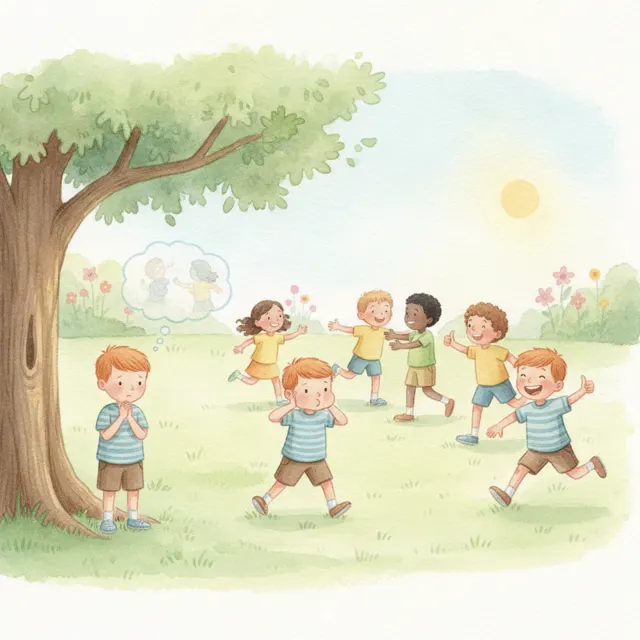
At the park, Leo sees kids playing tag. He wants to join, but he is shy and stands alone. He worries they will say no. He takes a deep breath, walks over, and asks to play. The kids say yes, and Leo has a blast.

Moral: Ask to join in. Friends love a new player.

At the park, Leo saw some kids playing tag. They ran and laughed under the big tree. Leo wanted to play too. But he stood alone by the bench. "Why do you not go play?" his mom asked. "What if they say no?" Leo said. "What if they do not want me?" "You will not know until you ask," his mom said. "And if they say no, you can play something else. But I bet they will say yes." Leo watched the kids. They were having so much fun. His feet wanted to run with them. But his heart felt shy. "Take a deep breath," his mom said. "Then walk over and ask." Leo took a deep breath. He walked over to the kids. His legs felt wobbly. "Can I play too?" he asked. His voice came out a little quiet. The biggest kid turned around. He smiled. "Sure!" he said. "You can be on my team. We need one more player." Leo's heart jumped for joy. "Really?" he said. "Really," the kid said. "Come on, let us run!" Leo ran with them. They chased each other around the tree. Leo was fast. He tagged two kids right away. "You are good at this!" the big kid said. "What is your name?" "Leo," he said, out of breath and smiling. "I am Jay," the kid said. "Want to play again tomorrow?" "Yes!" Leo said. He could not believe it. All he had to do was ask. When it was time to go, Leo ran to his mom. "They said yes!" he said. "And I made a new friend named Jay." "I knew they would," his mom said. "All you had to do was ask." Leo waved goodbye to his new friends. Asking had been scary. But it was the best thing he did all day.

The Girl Who Made a Friend

Ages 3-83 minutesconfidence
The Girl Who Made a Friend story for kids illustration

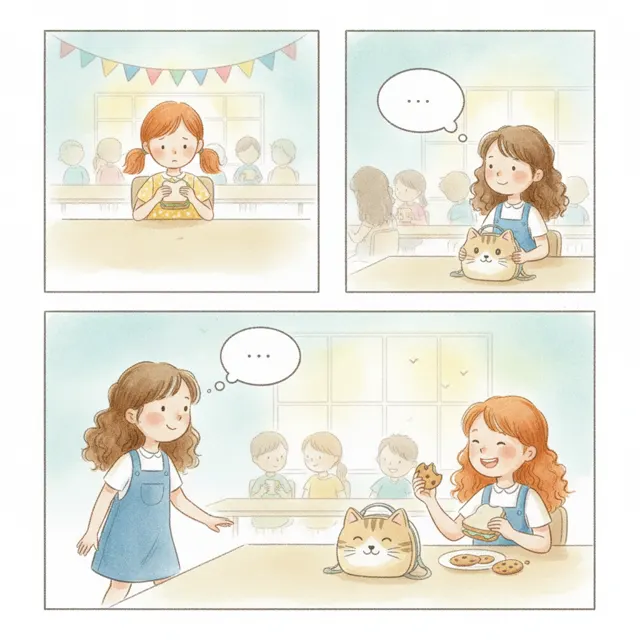
On the first day at a new school, Ivy does not know anyone. At lunch, she sits alone. She sees a girl with a cat lunchbox and wants to say hello. Ivy gathers her courage, walks over, and asks to sit. A friendship begins.

Moral: A hello can turn a stranger into a best friend.

It was Ivy's first day at a new school. She did not know anyone. All the kids were talking and laughing. Ivy felt very alone. At lunch, she sat by herself at the end of a long table. She opened her lunchbox and looked at her sandwich. Then she saw a girl sitting a few seats away. The girl had a lunchbox with a cat on it. Ivy loved cats. She wanted to say hello. But her mouth would not open. "What if she does not like me?" Ivy thought. She looked down at her sandwich. But then she remembered her mom's words. "To make a friend, you have to say hello first." Ivy took a deep breath. She stood up. She walked over to the girl. "Hi," she said. "I like your lunchbox. I love cats." The girl looked up and smiled. "Me too!" she said. "My cat is named Mittens. Do you have a cat?" "I have a cat named Shadow," Ivy said. "She is black and very soft." "That is a cool name," the girl said. "My name is Zoe. Want to sit with me?" "Yes," Ivy said. She sat down next to Zoe. They talked about cats and sandwiches and their favorite shows. "What is your favorite cat?" Zoe asked. "All of them," Ivy said, and they both laughed. By the end of lunch, Ivy and Zoe had traded half their cookies. They walked to class together. Ivy was not alone anymore. After school, Ivy told her mom, "I made a friend today! Her name is Zoe, and she loves cats too." "How did you do it?" her mom asked. "I just said hello," Ivy said. "And the rest was easy." Her mom hugged her. "A hello can start a whole friendship," she said. Ivy smiled. She already could not wait for lunch tomorrow.

Sam's First Sleepover

Ages 3-83 minutesconfidence
Sam's First Sleepover story for kids illustration

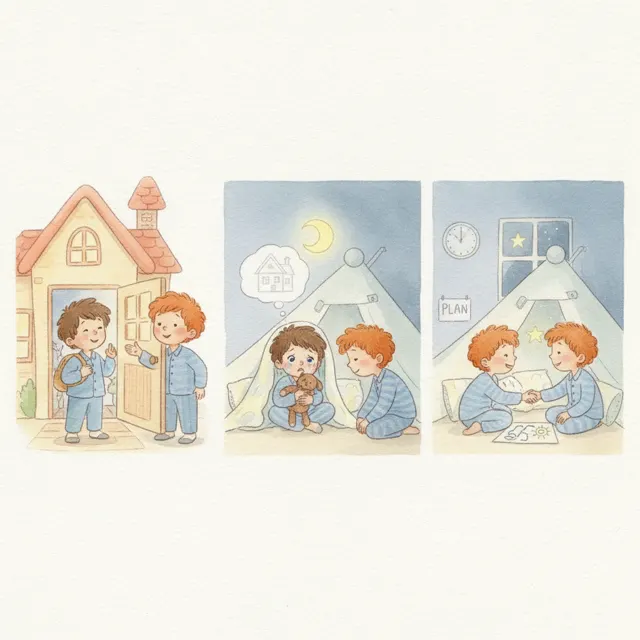
Sam is invited to his first sleepover at his friend's house. He is excited, but when the lights go out, he feels scared and misses home. He tells his friend how he feels, and together they make a plan. Sam stays the whole night.

Moral: You can be scared and still stay the whole night.

Sam was going to his first sleepover. His friend Ben had invited him. Sam packed his bag with his pajamas, his toothbrush, and his favorite bear, Brownie. "I am so excited," Sam said in the car. But when they got to Ben's house, Sam felt a little funny. The house was new to him. It smelled different. It sounded different too. They played games and ate pizza. Sam forgot to feel funny. Then it was bedtime. The lights went out. Sam lay on the sleeping bag. The room was dark and quiet. He missed his own bed. He missed his mom's goodnight kiss. A tear slid down his cheek. "Sam, are you awake?" Ben whispered. "Yes," Sam said. "I feel a little scared." "Me too," Ben said. "I have never had a sleepover before either." Sam sat up. "Really?" he asked. "What can we do?" "We can leave a little light on," Ben said. He clicked on a small lamp. The room glowed soft and warm. "And we can hold our bears," Sam said. He hugged Brownie tight. "And we can tell stories until we fall asleep," Ben said. So they did. They told stories about pirates and rockets. Sam's eyes got heavy. The strange room did not feel so strange anymore. When Sam woke up, the sun was shining. He had stayed the whole night. He felt proud and brave. "I did it!" Sam said. "I stayed all night!" Ben's mom made them pancakes. "You were both very brave," she said. In the car, Sam told his mom everything. "I was scared at first," he said. "But I talked to Ben, and we made a plan. Then it was fun." "Talking about your feelings is brave," his mom said. "I am proud of you." Sam smiled all the way home.

Ivy Climbs the Tree

Ages 3-83 minutesconfidence
Ivy Climbs the Tree story for kids illustration

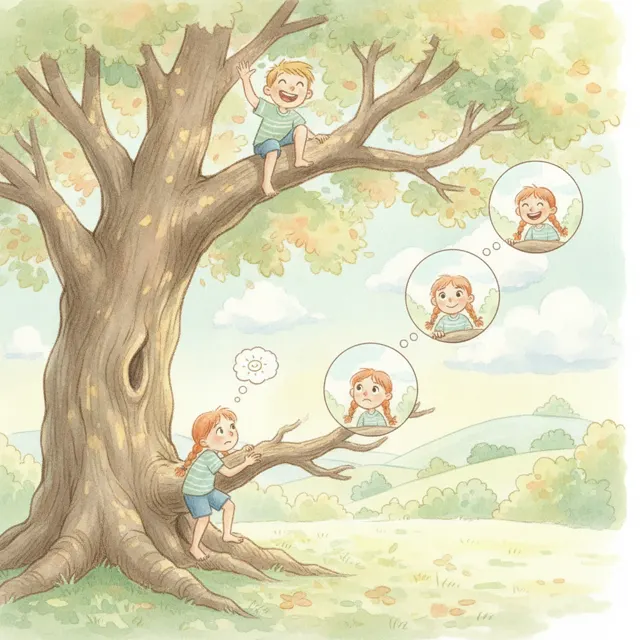
Ivy wants to climb the big tree in her yard, but the branches look high. Her brother is already at the top. She starts slow, one branch at a time, and talks herself through the scary parts. Soon she reaches the top too.

Moral: Climb one branch at a time, and you will reach the top.

Ivy watched her brother climb the big tree in their yard. He went up, up, up, until he sat on a high branch. "Come up, Ivy!" he called. "You can see the whole street from here." Ivy looked at the tree. It was very tall. The branches were far apart. "I am scared," she said. "Start slow," her brother said. "One branch at a time. You do not have to go fast." Ivy put her hands on the lowest branch. She pulled herself up. There. One branch done. "Good," her brother said. "Now the next one." Ivy reached for the next branch. It was a little higher. Her heart beat fast. But she grabbed it and pulled up. Two branches done. "I can do this," Ivy said to herself. "One branch at a time." She climbed to the next branch. Then the next. Each one felt a little easier. She did not look down. She looked at the branch right above her. "You are almost here," her brother said. "One more." Ivy took a deep breath. She reached up and pulled herself onto the high branch. She sat next to her brother. The whole street spread out below her. "Wow," Ivy said. "I can see everything!" "I knew you could do it," her brother said. "You just had to go one branch at a time." Ivy smiled. She had been scared at the bottom. But she had not given up. She had climbed one branch at a time, and now she was at the top. "The scary part was only at the start," Ivy said. "Once I started, it got easier." "That is how climbing works," her brother said. "And that is how a lot of hard things work too." Ivy looked out over the street. She felt tall and strong and proud.

The New Kid at School

Ages 3-83 minutesconfidence
The New Kid at School story for kids illustration

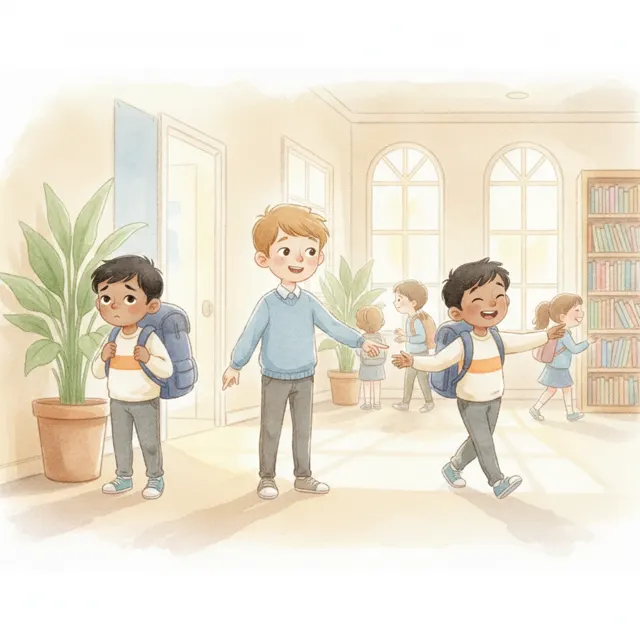
It is Ravi's first day at a new school. He is nervous and does not know where to go. He wants to hide, but he remembers to smile and say his name. A kind boy shows him around, and Ravi's day turns around.

Moral: A smile and your name can open new doors.

It was Ravi's first day at a new school. He stood at the big front door. His hands were sweaty. He did not know where to go. "What if nobody talks to me?" Ravi thought. "What if I get lost?" He wanted to hide behind the door. But he remembered what his mom said. "Smile, say your name, and ask for help. A smile can open new doors." Ravi took a deep breath. He walked inside. The hallway was full of kids. They all seemed to know where to go. Ravi saw a boy with a red backpack. "Hi," Ravi said with a small smile. "I am Ravi. It is my first day. Do you know where room 3 is?" The boy turned around. "Hi, Ravi," he said. "I am Milo. I am in room 3 too! Come with me." Ravi's heart felt lighter. He walked with Milo down the hall. "This is the library," Milo said. "And that is the gym. And here is room 3." They walked into the classroom together. The teacher smiled. "You must be Ravi," she said. "Milo, will you show him where to put his bag?" "Sure," Milo said. He showed Ravi a cubby with his name on it. At lunch, Milo waved him over. "Sit with me," he said. Ravi sat down. He met Milo's friends too. They all asked him questions and laughed at his jokes. By the end of the day, Ravi knew where everything was. He had a new friend. He was not lost anymore. "How was your first day?" his mom asked at pick up. "It was great," Ravi said. "I smiled and said my name, and I made a friend named Milo." "I told you," his mom said. "A smile opens doors." Ravi smiled. She was right. He could not wait for day two.

The Boy Who Wore Glasses

Ages 3-84 minutesconfidence
The Boy Who Wore Glasses story for kids illustration

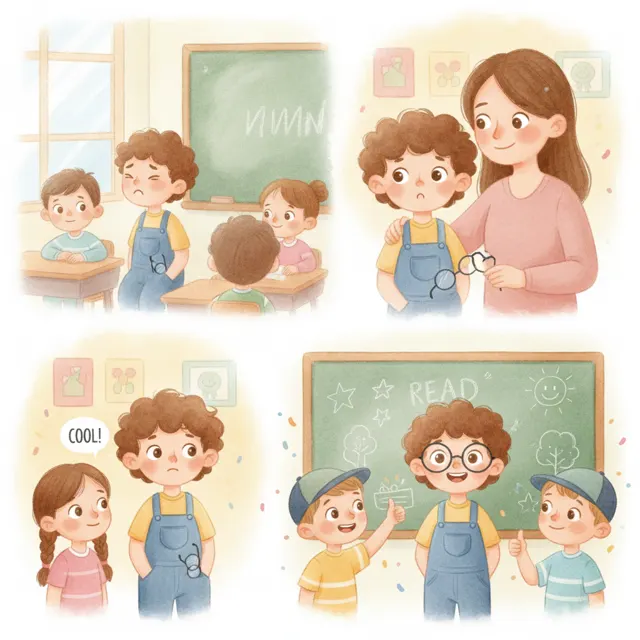
Devan needs glasses, but he is afraid the other kids will laugh. He hides them in his pocket and squints at the board. His teacher gently helps him. When he finally wears them, he sees clearly, and his friends think they are cool.

Moral: Wear what helps you see, and hold your head up high.

Devan could not see the board at school. The letters looked blurry and fuzzy. So his mom took him to the eye doctor. "You need glasses," the doctor said. "They will help you see clearly." Devan picked out a pair with blue frames. At home, he liked them. But at school, he was scared to wear them. "What if the kids laugh at me?" Devan asked his mom. "If they are good friends, they will like your glasses," his mom said. "And you need them to see. Wear them with your head held high." The next day, Devan hid his glasses in his pocket. At school, he squinted at the board. The letters were still blurry. He could not read what the teacher wrote. "Devan," his teacher said softly, "do you have your glasses?" Devan nodded slowly. He pulled them out of his pocket and put them on. Everything snapped into focus. The board was clear. His teacher's face was clear. Even the clock across the room was clear. "Wow," Devan whispered. "I can see everything!" At lunch, his friend Leo looked at him. "Cool glasses," Leo said. "The blue is nice." "Really?" Devan said. "Really," Leo said. "Can I try them on?" Devan handed them over. Leo put them on and made a funny face. They both laughed. "You look smart," Leo said. "Like a scientist." Devan smiled. "They help me see," he said. "The board was all blurry before." "Then you should wear them every day," Leo said. "I wish I had cool blue glasses." Devan wore his glasses all day. No one laughed. In fact, a few kids said they liked them. Devan held his head high. At home, he told his mom the news. "Everyone liked my glasses," he said. "And I can see the board now." "I am proud of you," his mom said. "You wore them with a brave heart." Devan smiled. He was glad he had not hidden them forever.

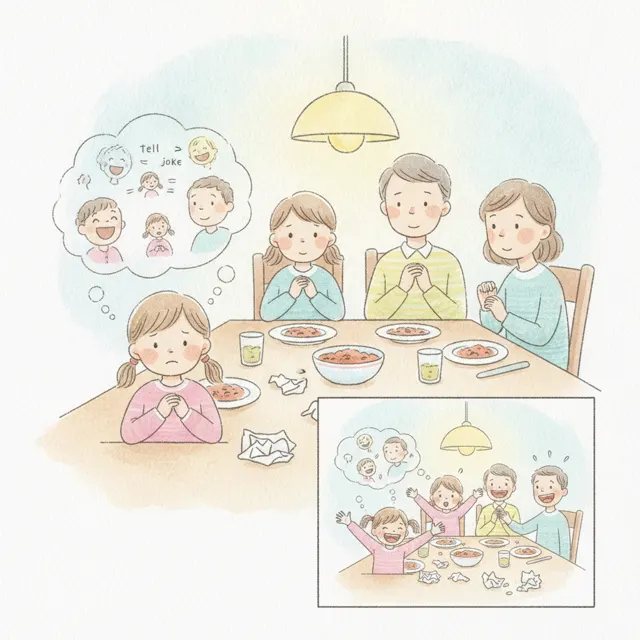
The Joke at Dinner

Ages 3-83 minutesconfidence
The Joke at Dinner story for kids illustration

At a family dinner, Mia has a joke to share, but she is afraid no one will laugh. She practices it in her head. When the table goes quiet, she takes a breath and tells it. Everyone laughs, and Mia feels brave and happy.

Moral: Your joke is funny, and sharing it makes everyone laugh.

At family dinner, the table was full of people. Aunts, uncles, and cousins all talked at once. Mia sat small in her chair. She had a joke. She had heard it at school, and it was very funny. She wanted to tell it. But her voice felt stuck. "What if nobody laughs?" Mia thought. "What if I mess up the words?" She practiced the joke in her head. Why did the banana go to the doctor? Because it was not peeling well. She smiled to herself. It was a good joke. The table got quiet for a moment. Everyone was eating. Mia's heart went thump. "Now is my chance," she thought. She took a deep breath. "Can I tell a joke?" Mia asked. Her voice was a little shaky. The table looked at her. "Of course," her dad said. "Tell us." Mia sat up tall. "Why did the banana go to the doctor?" she asked. "Because it was not peeling well!" The whole table burst out laughing. Uncle Sam laughed so hard he spilled his drink. Her cousins clapped. Her grandma wiped her eyes. "That is a great joke, Mia!" her aunt said. "Tell us another one." Mia's face went warm and happy. She told another joke. Then another. Everyone laughed and cheered. "You are the funniest one at this table," her grandpa said. Mia beamed. She had been so scared. But once she told the first joke, the rest came easy. After dinner, her mom hugged her. "You were so brave to share," she said. "You made the whole table laugh." Mia smiled. "I was scared," she said. "But telling the first joke was the hardest part. Then it got easy." "That is how it works," her mom said. "The first step is always the scariest." Mia was already thinking up new jokes for the next dinner.

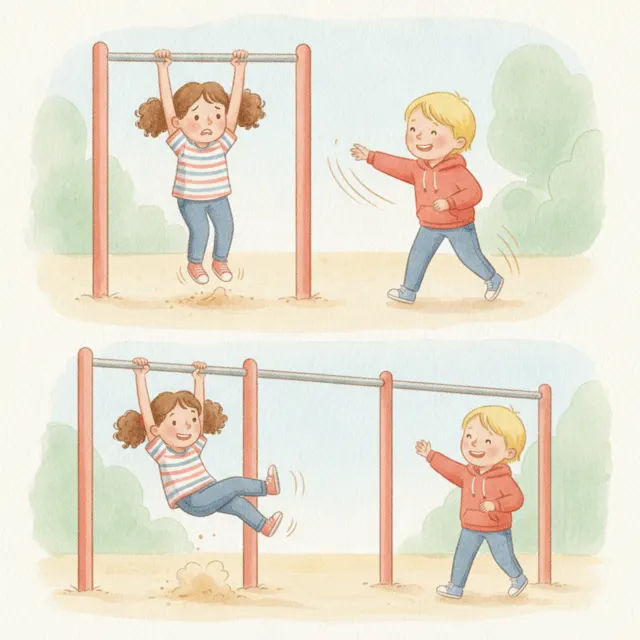
The Monkey Bars

Ages 3-83 minutesconfidence
The Monkey Bars story for kids illustration

On the playground, Zoe wants to cross the monkey bars, but her arms feel weak and she is scared to fall. Her friend shows her how to swing one bar at a time. Zoe tries, falls once, gets up, and tries again until she crosses.

Moral: Fall once, get up, and swing one bar at a time.

On the playground, Zoe looked at the monkey bars. They hung high above the soft ground. All the kids were swinging across, one bar at a time. Zoe wanted to cross too. But her arms felt weak, and she was scared to fall. "I cannot do it," Zoe said. "Yes, you can," her friend Lena said. "Just swing one bar at a time. I will show you." Lena jumped up and grabbed the first bar. She swung her hand to the next bar, then the next. In a few seconds, she was on the other side. "See?" Lena said. "You just focus on the next bar. Do not look at the end." Zoe took a deep breath. She jumped and grabbed the first bar. Her hands were sweaty. Her arms shook a little. "Now swing to the next bar," Lena said. Zoe reached out and grabbed the second bar. Then the third. She was doing it! Then her hand slipped, and she fell onto the soft ground with a thump. "Are you okay?" Lena asked. Zoe sat up. She was not hurt. "I fell," she said. "Maybe I should stop." "No way," Lena said. "Falling is part of learning. Try again." Zoe got up. She brushed off her hands. She jumped and grabbed the first bar again. This time, she did not rush. One bar. Then the next. Then the next. "You are almost there!" Lena cheered. Zoe grabbed the last bar and swung her feet to the platform. She had crossed the whole thing! "I did it!" Zoe yelled. "I crossed the monkey bars!" "I knew you could," Lena said. "You fell once, but you got back up. That is what brave kids do." Zoe smiled. Her arms were tired, but her heart was full. She had fallen, and she had tried again. And now she could cross the monkey bars all by herself.

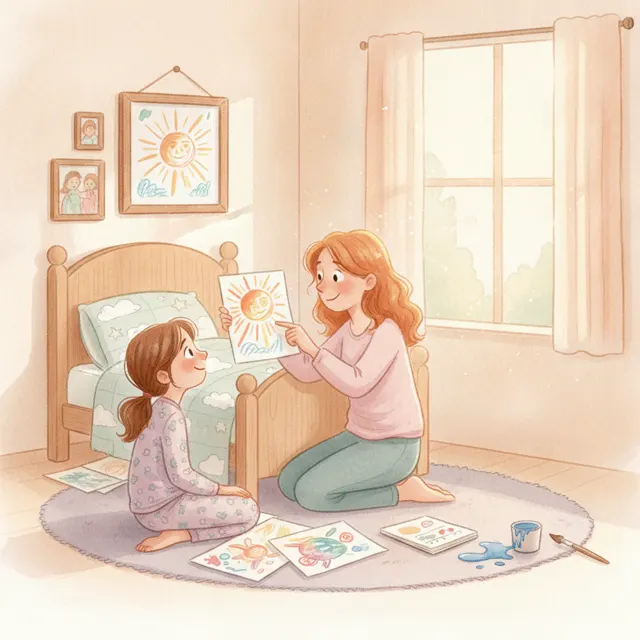
The Drawing on the Wall

Ages 3-83 minutesconfidence
The Drawing on the Wall story for kids illustration

Lia loves to draw, but she hides her pictures under her bed. She thinks they are not good enough. Her mom finds them and praises one. Together they hang it on the wall. Lia sees her art in a new way and draws with pride.

Moral: Your art is worth showing, so hang it up with pride.

Lia loved to draw. She drew cats, trees, and houses with big windows. But she hid all her pictures under her bed. "Why do you hide them?" her mom asked. "They are not good enough," Lia said. "My lines are wiggly, and my colors go outside the lines." "Let me see them," her mom said. Lia pulled out a stack of drawings from under the bed. There were so many. Her mom looked at each one and smiled. "Lia, these are wonderful," her mom said. "Look at this cat. It has so much life in its eyes." Lia looked at the cat drawing. The lines were wiggly, but the cat did look happy. "You made all of these by yourself," her mom said. "That is something to be proud of." "But other kids draw better," Lia said. "Art is not a race," her mom said. "Your drawings are yours. They show how you see the world. That makes them special." Lia picked up the cat drawing. She looked at it for a long time. It was not perfect. But it was hers. "Can we hang it on the wall?" Lia asked. "I would love that," her mom said. They put the drawing in a frame and hung it right in the living room, where everyone could see it. Lia stepped back and looked at it. "It looks good up there," Lia said. "It looks like real art." "It is real art," her mom said. "You made it." From that day on, Lia did not hide her drawings. She hung up a new one every week. Her friends came over and said how much they liked them. Lia drew with a proud heart. Her lines were still wiggly. But that did not matter anymore. Her art was worth showing, and so was she.

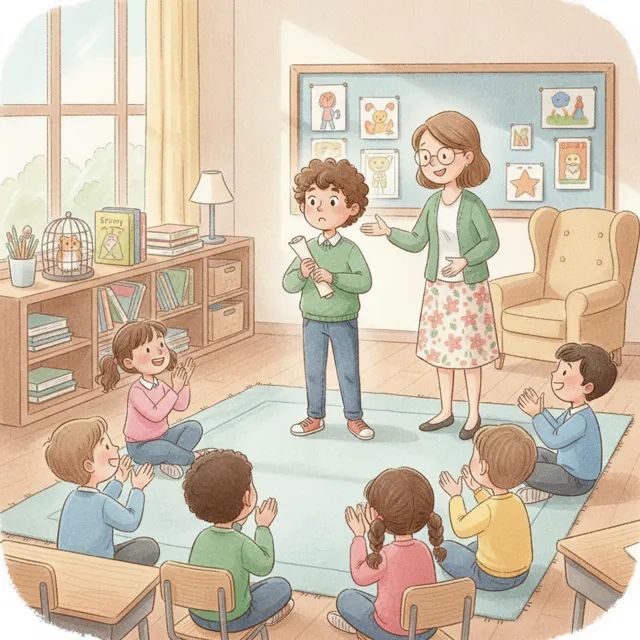
The Poem for the Whole Class

Ages 3-83 minutesconfidence
The Poem for the Whole Class story for kids illustration

Tariq wrote a poem for school, and his teacher asks him to read it to the class. He is nervous about speaking in front of everyone. He practices, takes a deep breath, and reads his poem. The class claps, and Tariq feels tall.

Moral: Your words are worth hearing, so say them out loud.

Tariq wrote a poem for school. It was about the moon and the stars and a sleepy little cat. His teacher read it and smiled. "Tariq, this is lovely," she said. "Will you read it to the class?" Tariq's heart dropped. Read it to the whole class? His hands got sweaty. "I am scared to talk in front of everyone," he said. "Your words are worth hearing," his teacher said. "And I will be right here. Just take it slow." That night, Tariq practiced. He read his poem to his cat. He read it to his mirror. He read it to his dad. Each time, his voice got a little stronger. "The moon is high, the stars are bright," he read. "A little cat says goodnight." The next day, it was time. Tariq walked to the front of the class. All eyes were on him. He held his paper, and it shook a little. He took a deep breath. He remembered the mirror and his cat. He began to read. "The moon is high, the stars are bright. A little cat says goodnight." His voice came out clear. He read the next lines, then the next. The class was very quiet. They were listening. When he finished the last line, he looked up. The class clapped and clapped. His teacher beamed. "That was beautiful, Tariq," she said. Tariq walked back to his seat. His heart was full. He had read his poem in front of everyone, and it had gone well. No one laughed. They had clapped. At home, he told his dad the news. "I read my poem to the whole class," he said. "And they clapped!" "I am so proud of you," his dad said. "Your words are worth hearing." Tariq smiled. He was already writing a new poem. This time, he could not wait to share it.

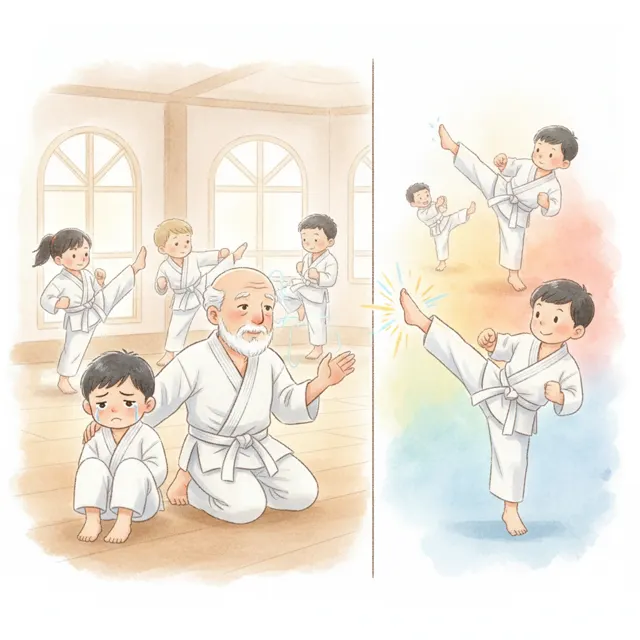
The First Kick in Karate

Ages 3-83 minutesconfidence
The First Kick in Karate story for kids illustration

Jin joins a karate class, but on the first day he feels clumsy and everyone else seems better. He wants to quit. His teacher tells him every master was once a beginner. Jin keeps practicing one kick, and soon he gets it right.

Moral: Everyone starts as a beginner. Your first kick is the first step.

Jin joined a karate class. On the first day, he wore his new white belt and stood in line with the other kids. The teacher showed them a kick. "Kick high, like this," she said. Her leg went up straight and strong. Jin tried the kick. His leg wobbled. He almost fell over. The other kids seemed to do it so easily. "I am no good at this," Jin said after class. "Everyone is better than me. I want to quit." His teacher heard him. She knelt down. "Jin, do you know how I learned that kick?" she asked. "How?" Jin asked. "I practiced it a thousand times," she said. "And I fell down a lot at first. Every master was once a beginner who kept trying." Jin looked at his white belt. "So I do not have to be good right away?" he asked. "No one is good right away," his teacher said. "You just have to keep trying. Come back tomorrow, and we will practice your kick." The next day, Jin came back. He practiced his kick over and over. Kick. Wobble. Try again. Kick. Steady. Try again. Each day, his kick got a little better. His leg did not wobble as much. He did not fall over. Then one day in class, the teacher said, "Jin, show us your kick." Jin took a breath. He kicked high and strong. His leg went up straight. He did not wobble at all. The teacher smiled. "That is a fine kick, Jin," she said. Jin felt proud. He had wanted to quit. But he had kept trying, one kick at a time. And now he was getting better every day. "I am glad I did not quit," Jin said. "That is the secret," his teacher said. "Beginners who keep trying become masters." Jin smiled at his white belt. It was just the beginning, and that was okay.

Frequently Asked Questions

Turn Your Child Into the Hero of Their Own Story

Upload their photo and watch as AI creates a beautiful, personalized storybook with illustrations that look just like them. From $5.99/month.

โœจ Make Your Child the Hero

Plans from $5.99/month