Gratitude Stories for Kids

Five tender stories that teach a child to notice the kind hands, warm meals, and quiet helpers who fill every ordinary day.

✨ Make Your Child the Hero

Somewhere between the rush of school drop-offs and bedtime, children learn how to see the world. Gratitude stories help them pause and notice the hands that pack their lunch, the neighbor who waves, the sun that still rises each morning. When a child practices thankfulness through a story, it stops being a lesson and becomes a habit of the heart. These five gentle tales invite your little one to look closely at the small kindnesses all around them. With CreateStory.ai, the story gets even closer to home. Upload a photo and your child becomes the hero, thanking the very people and moments that make their own life warm.

Why does teaching gratitude matter for young children?

Grateful children tend to feel happier and act more kindly. In a study by Froh, Sefick, and Emmons (2008, Journal of School Psychology), early adolescents who counted the good things in their lives each day reported more gratitude, optimism, and life satisfaction than those who focused only on daily hassles.

How can parents help a child feel more thankful?

You do not need a big lesson plan. Small daily habits work best. Ask your child to name one good thing each day, or to thank one person who helped them. Keep it short and fun.

These tiny moments teach a child to notice what is already good. Over time, noticing grows into a steady habit of gratitude.

Sample Stories

Read these stories, then create a personalized version where your child is the hero

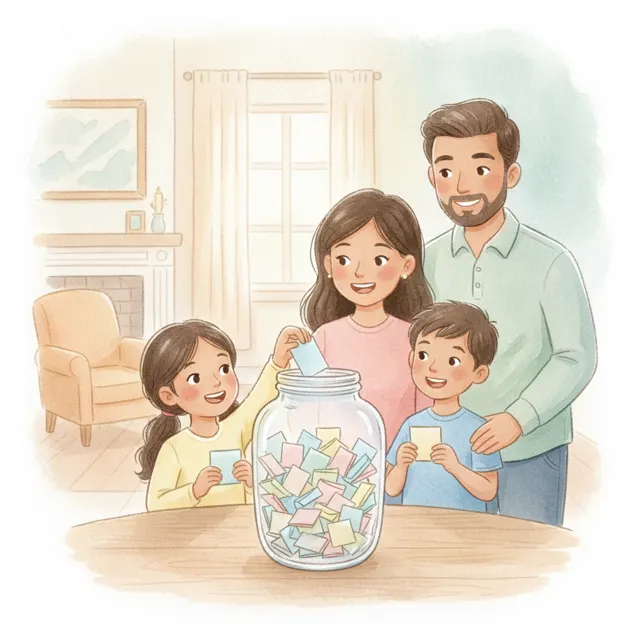
The Thank You Jar

Ages 3-83 mingratitude
The Thank You Jar story for kids illustration

Maya's family starts a jar for little thank-yous. Every day they drop in a paper slip naming one good thing. Soon the jar is full, and Maya learns that counting your blessings makes them feel bigger.

Moral: Counting the good things each day makes them feel bigger and more real.

Maya watched her mother wash the pickle jar in the sink. "What is that for?" she asked. "It is our thank-you jar," said Mama. She dried the jar and set it on the kitchen counter. "Every day, we each write one thing we are thankful for on a slip of paper and drop it inside." Maya wrinkled her nose. "Only one thing?" "At least one," Mama laughed. "You may write more." That evening, Papa came home with warm bread. He wrote on his slip, "I am thankful for the bakery down the street." Maya wrote, "I am thankful for the bread." She folded the paper and dropped it in. It made a soft plink against the glass. The next day it rained. Maya wrote, "I am thankful for my yellow boots." Plink. On Sunday, Grandma came for dinner and made dumplings. Maya wrote two slips. Plink. Plink. Weeks passed. The slips piled higher and higher, until the jar was nearly full. One evening Maya sat with the jar on her lap. She pulled out the slips and read them one by one. There was the day the cat came home. There was the day she learned to skip rope. There was the day Papa read three bedtime stories. "Look how much we have," she whispered. Mama hugged her close. "That is the secret of the jar, my love. When we notice the good things, they grow." Maya smiled and wrote one more slip for the very top of the pile. It said, "I am thankful for our thank-you jar."
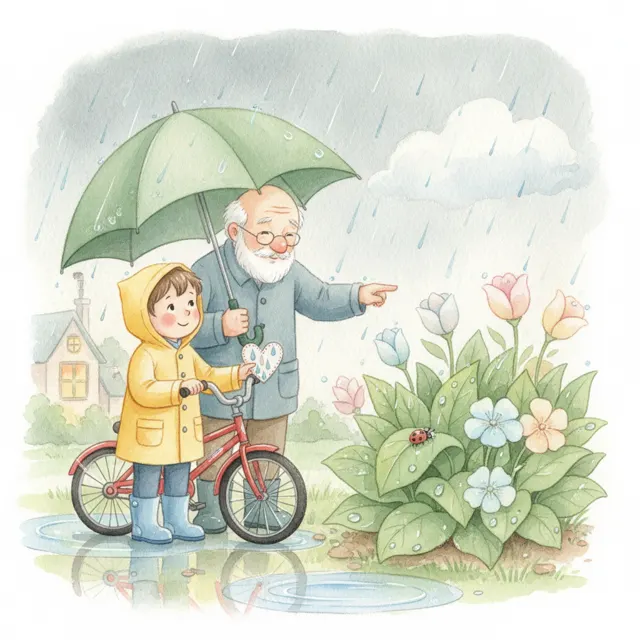
Milo Thanks the Rain

Ages 3-84 mingratitude
Milo Thanks the Rain story for kids illustration

Milo wants to ride his bike, but a gray rain keeps falling. Instead of grumbling, his grandfather shows him every good thing the rain brings, from puddles to sleepy plants. Milo finds a whole new reason to say thank you.

Moral: The rain that spoils your plans is the same rain that waters your world.

Milo stood at the window with his chin on the sill. The rain was tapping on the glass like tiny fingers. He had planned to ride his bike all afternoon. "This rain is no good," he said. Grandpa looked up from his book. "No good? Come see." He took Milo's hand and led him to the door. They stood under the porch roof and watched the rain fall. "Listen," said Grandpa. Milo listened. The rain made a soft shushing sound on the leaves. A robin shook its feathers under the maple tree. The gutters gurgled happily. "Now watch the garden," Grandpa said. The tomato plants stood up straight and drank. The soil turned dark and rich. A fat worm wiggled across the wet path. "Where do you think puddles come from?" Grandpa asked. Milo laughed. "From the rain!" "And what do puddles give you?" Grandpa grinned. "Splashing!" Milo shouted. "And paper boats!" They walked to the edge of the yard. Milo saw the whole street shining like a mirror. A neighbor's dog shook water from its fur and sneezed, which made Milo laugh again. "So you see," said Grandpa, "the rain is busy working. It feeds the plants, fills the streams, and makes puddles for little boys to jump in." Milo looked at the gray sky with new eyes. "Thank you, rain," he said softly. "That is a good habit," Grandpa said. "Thank the thing that waters your world." When the rain finally stopped, Milo put on his boots. He jumped in every puddle and called out a thank you with each splash.

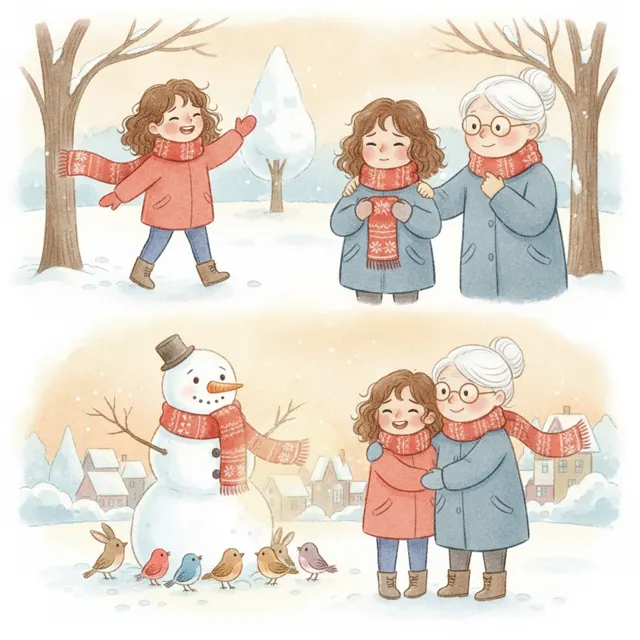
Grandma's Warm Scarf

Ages 3-85 mingratitude
Grandma's Warm Scarf story for kids illustration

Every winter, Nia wears the scarf her grandmother knitted. This year it is too short, and Nia is sad to leave it behind. Instead of throwing it away, the two of them pass the warmth on in a surprising way.

Moral: The things we outgrow can grow into something kind for someone else.

Nia pulled her red scarf from the drawer. It was soft and fuzzy, with little white pom-poms on the ends. Grandma had knitted it for her when she was small. "Let me wrap you up," said Grandma. She looped the scarf around Nia's neck, once, twice. But this year the ends did not reach her knees the way they used to. Nia looked down. "It is too short," she said. "Then you have grown," Grandma smiled. "That is a good thing." Still, Nia felt a little ache. The scarf had been with her for so long. She did not want to stuff it in a box. That afternoon, the two of them sat by the window with yarn and needles. Grandma showed Nia how to knit a simple row. Nia's stitches were bumpy and loose, but Grandma said they were perfect. "What will we make?" Nia asked. "A surprise," said Grandma. "Something small that carries a lot of thanks." All week they knitted. Nia's fingers learned the rhythm. In, around, and through. By Friday, they had finished a little scarf, just big enough for one very small neck. Grandma took Nia to the porch, where a bird feeder hung in the cold. "In winter, the birds have a hard time finding warmth," she said. "We can share ours." They wrapped the little scarf around the bird feeder, and Grandma tucked a few seeds on top. Nia watched from the window. Soon a chickadee landed, puffed its feathers, and sang. "Do you think it likes it?" Nia whispered. "I think it is very thankful," said Grandma. "And so am I. My scarf is not in a box. It grew into something kind." Nia touched her own red scarf. "I am thankful too," she said. "For you, and for warm hands, and for chickadees."

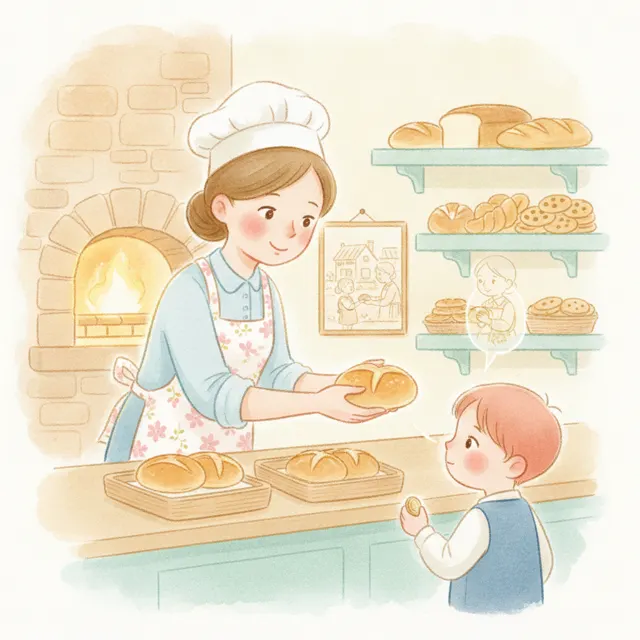
The Bread Lady

Ages 3-83 mingratitude
The Bread Lady story for kids illustration

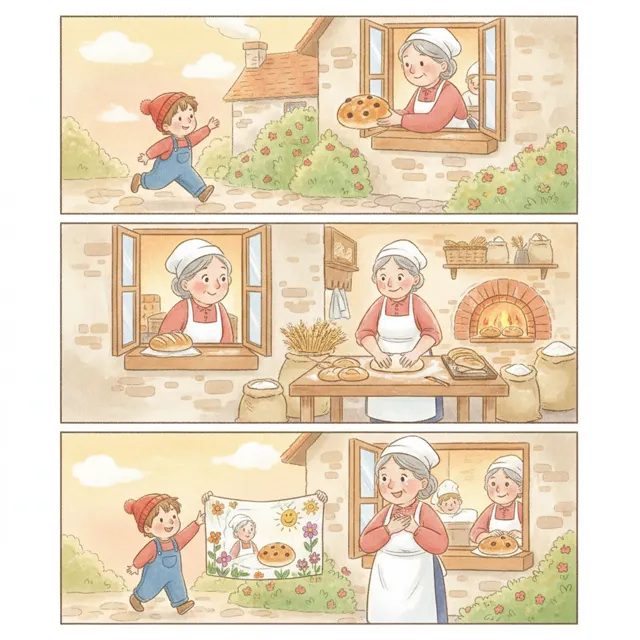
Every Saturday, Theo visits the bakery, and the bread lady always saves him the last raisin bun. One week he stops to notice all the work behind that warm bun, and he decides to say thank you in a way she will never forget.

Moral: A thank you with a little thought behind it can warm someone's whole day.

Every Saturday morning, Theo and his mother walked to the bakery on the corner. The bell above the door went ding, and the bread lady looked up with a smile. "The last raisin bun," she would say, holding it out in a paper bag. "I saved it for you." Theo always said thank you. But one Saturday, as he watched the bread lady knead a big mound of dough, he began to wonder. Her arms moved in strong, steady circles, and a little cloud of flour floated up around her. "How early do you wake up?" Theo asked. "Before the sun," she said, not stopping her work. "The bread has to rise." Theo's eyes went wide. "The bread sleeps and then gets up?" The bread lady laughed. "Something like that. It rests, and then it grows." Theo watched her shape the dough into loaves, slide them into the hot oven, and pull out rows of golden bread. His own bun had taken a long, quiet trip to reach him. Warm hands, a hot oven, and many early mornings. "That is a lot of work," Theo said softly. "It is my favorite work," said the bread lady. "I bake because I like feeding my neighbors." On the walk home, Theo thought hard. The next Saturday, he came back with a folded paper in his pocket. He handed it to the bread lady. Inside, he had drawn a picture of her with the sun still sleeping in the sky, and below it he had written, "Thank you for waking up early." The bread lady's eyes grew shiny. She taped the picture beside the cash register. "Now I have two reasons to bake," she said, and she gave Theo the last raisin bun, warm as always.

A Card for Mr. Felix

Ages 3-84 mingratitude
A Card for Mr. Felix story for kids illustration

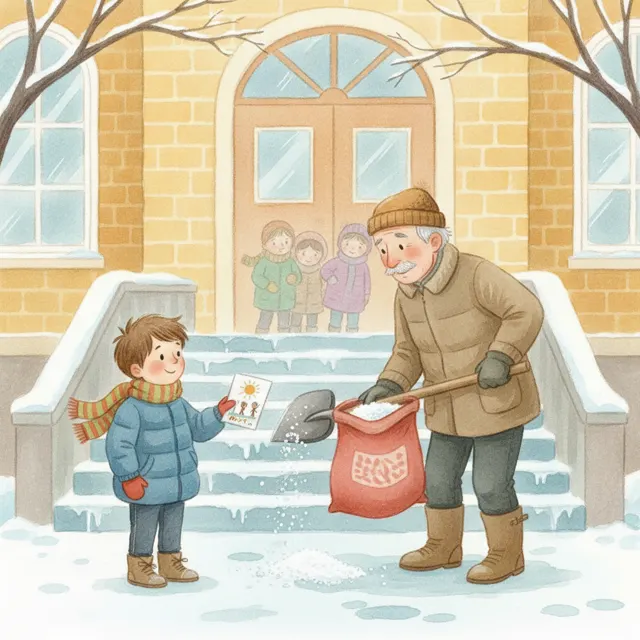
Luca hardly notices the quiet man who sweeps the school steps each morning, until the day the steps are covered in ice. When Mr. Felix spreads salt and keeps everyone safe, Luca finds a way to say the thank you he had never said.

Moral: Saying thank you to the quiet helpers can be the nicest surprise of their day.

Every morning, Luca ran past the man with the broom. The man swept the school steps, and Luca never once said hello. He did not know the man's name. He did not know that the man was called Mr. Felix, or that he arrived before the buses, every single day, rain or shine. Then winter came, and one morning the steps were covered in a slick sheet of ice. The children slipped and wobbled. The crossing guard blew her whistle. But Mr. Felix was already there, shaking salt from a bucket. Back and forth he went, until the ice crackled and melted under the salt. The children walked up the steps safely, one after another, like a line of little ducks. That afternoon, Luca's teacher asked the class to draw someone who helps them. Luca thought about his drawing for a long time. Then he drew a man with a broom and a bucket of salt, standing in front of the school steps. "Who is that?" asked his teacher. "The man who keeps us from falling," said Luca. "I do not even know his name." "His name is Mr. Felix," said the teacher. "I think he would love this picture." The next morning, Luca carried the drawing to school. He stood at the bottom of the steps and held it out. "For me?" asked Mr. Felix, surprised. "Thank you for the salt," said Luca. "And for sweeping. And for being here before everyone." Mr. Felix smiled a wide smile. "You are the first person to say that in twelve years," he said. "I will keep this by my broom." From that day on, Luca always said hello. And every morning, the man with the broom lifted a hand and waved.

The Thankful Walk

Ages 3-83 mingratitude
The Thankful Walk story for kids illustration

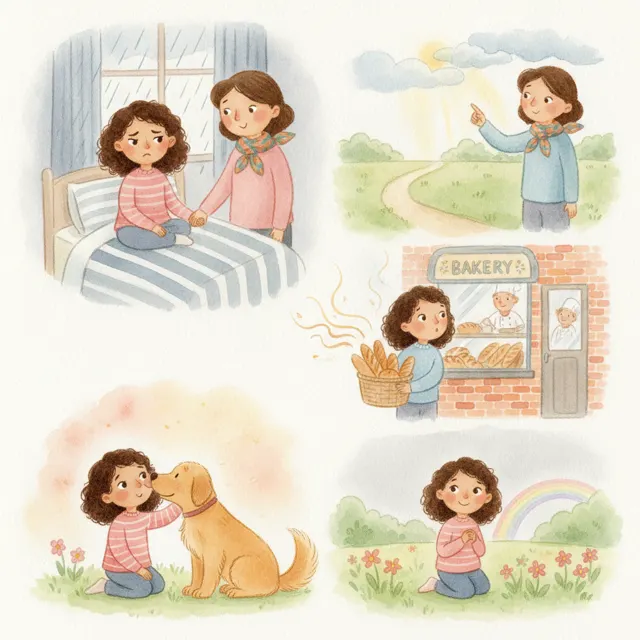
Zara wakes up grumpy on a gray day. Her mother takes her on a walk and asks her to find three good things. Zara spots the sun, smells warm bread, and meets a friendly dog. Naming good things turns her mood around.

Moral: Naming the good things you see can turn a gray day around.

Zara woke up feeling grumpy. The sky was gray and the day felt dull. She frowned at her breakfast and pushed her toast around the plate. "Why the long face?" asked Mama. "Nothing is fun today," said Zara. "Let us go for a walk," said Mama. "We will play a little game. Look for three good things. When you find one, you tell me. Deal?" Zara sighed. "Deal." They put on their coats and stepped outside. The wind was cold but soft. Zara looked around as they walked. "I found one," she said. "The sun is trying to come out. See that patch of light on the road?" "Good one," said Mama. They walked past the bakery on the corner. A warm smell drifted out the open door. "Found another!" said Zara. "The bread smell. It smells like a hug." Mama laughed. "I like that one a lot." At the corner, a brown dog trotted up and wagged its tail. Zara patted its soft head. "Number three," she said. "A friendly dog who likes me." "You found three good things," said Mama. "How do you feel now?" Zara thought about it. Her frown was gone. "Better. I did not even see the gray sky anymore." "That is what thankfulness does," said Mama. "It helps you see the good that is already there." Zara smiled all the way home. "Can we play the game again tomorrow? I want to find even more good things." That night, Zara fell asleep counting good things in her head. The sun, the bread smell, the friendly dog. There were more than three now, and she was still finding them.

Thank You, Mr. Bus Driver

Ages 3-83 mingratitude
Thank You, Mr. Bus Driver story for kids illustration

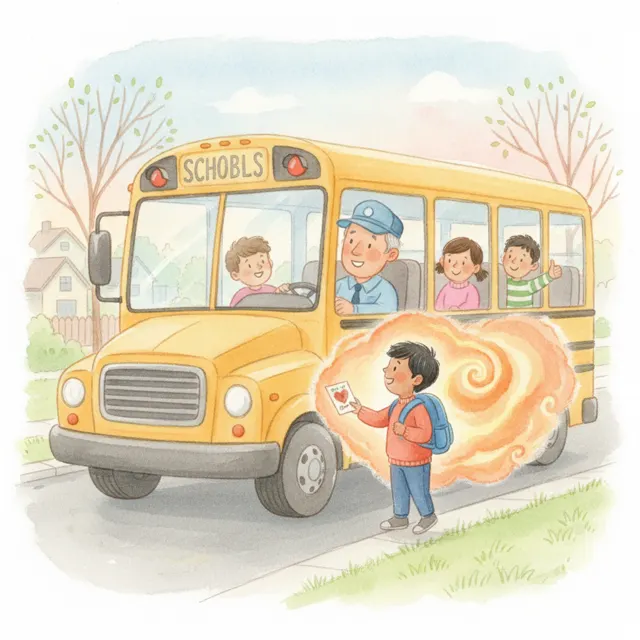
Every morning Ravi rides the yellow bus. One day he notices all the small kind things the driver does. He decides to say thank you, and his two little words make the whole bus feel warmer.

Moral: Saying thank you makes the helper's day brighter too.

Every morning Ravi climbed onto the big yellow bus. Mr. Ben, the driver, said hello to every child by name. He waited while the little ones found their seats. He slowed down on every bump so nobody bounced too high. Ravi never thought about it. The bus was just the bus. One rainy morning, Ravi watched Mr. Ben help a small girl with her wet umbrella. Then Mr. Ben wiped the seat so she would not sit in a puddle. "Did you see that?" Ravi whispered to his friend Sam. "Mr. Ben does nice things all the time. And nobody ever says anything." "He is just the bus driver," said Sam. "That is his job." Ravi thought about that all the way to school. When the bus stopped, the children rushed to get off. Ravi stayed behind for a moment. "Mr. Ben," he said. "Thank you for helping us every day. You make the bus ride nice." Mr. Ben looked up in the mirror and smiled so wide his eyes crinkled. "Well now," he said. "Thank you, Ravi. That made my whole day." Ravi hopped off the bus. The rain felt softer now. Two little words had made Mr. Ben glow like a lamp. The next morning, more children said thank you as they got off. The whole bus felt warmer, and it had all started with one boy and two kind words. Ravi sat by the window the next morning and watched Mr. Ben smile at each child. Two little words, he thought. Who knew they could be this big?

Maya's Thank You Song

Ages 3-84 mingratitude
Maya's Thank You Song story for kids illustration

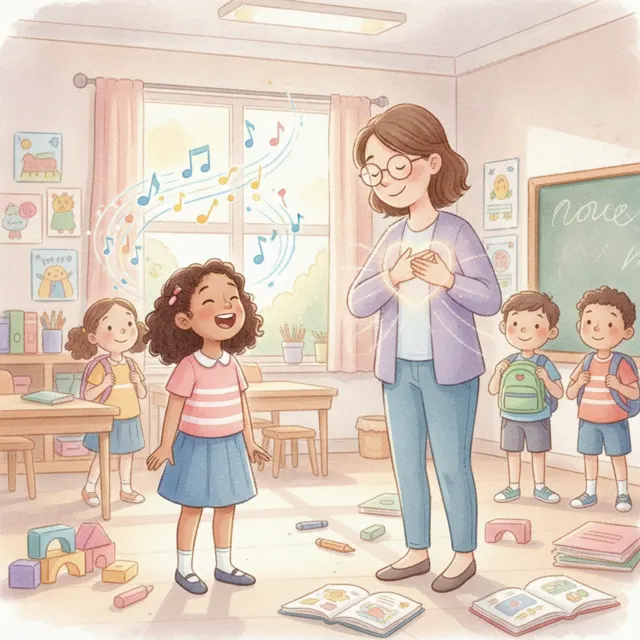
Maya wants to thank her teacher but cannot find the right words. So she makes up a little song and sings it at the end of the school day. Her teacher keeps the song in her heart all week.

Moral: A thank you made just for someone shows you really care.

Maya loved her teacher, Miss Lee. Miss Lee helped her tie her shoes. She read stories with funny voices. She always knew when Maya needed a little help. "I want to thank Miss Lee," Maya told her mother one night. "But I do not know how. A plain thank you feels too small." "Make it big in your own way," said Mama. "What do you love to do?" "I love to sing," said Maya. "Then sing your thank you," said Mama. Maya sat on her bed and hummed. Then the words came. She made up a little song about a teacher who helps you tie your shoes, and reads with funny voices, and knows just when you need a hand. The next day, at the end of class, Maya raised her hand. "Miss Lee, I made you a song," she said. The room went quiet. Maya stood up and sang her song. Her voice was small but clear. When she finished, Miss Lee put her hand on her heart. "That is the best thank you I have ever heard," she said. "I will keep it in my heart all week." The other children clapped. Maya's face felt warm and happy. On the way out, Miss Lee hugged her. "You found your own way to say thank you," she said. "That makes it extra special." Maya skipped all the way to the car. A thank you made just for someone, she learned, says more than any plain word ever could. That night Maya sang her song for her mother. Miss Lee kept it in her heart, she said. So now it lived in two hearts, not just one.

Thanks for My Lunch

Ages 3-84 mingratitude
Thanks for My Lunch story for kids illustration

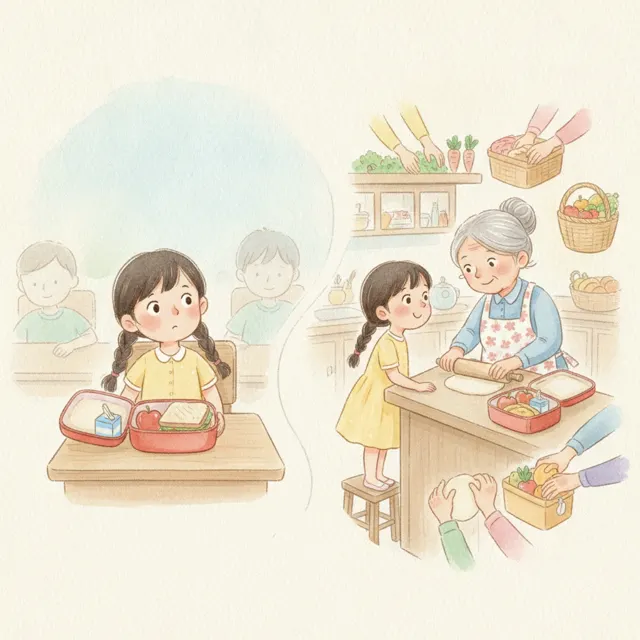
Every day Priya opens her lunchbox without a thought. Then she visits her grandmother's house and watches her cook. She learns how many loving hands make one small lunch, and she stops taking it for granted.

Moral: Every lunch holds the work of hands that love you.

Every day Priya opened her lunchbox and ate fast. A sandwich, an apple, a little box of raisins. She never thought about where it came from. It was just lunch. One Saturday, Priya stayed at her grandmother's house. Grandma Nani was cooking for a family picnic. Priya watched her chop carrots so small and neat. "Why do you cut them so little?" asked Priya. "So the little ones can eat them easily," said Nani. "Cooking is a way of caring with your hands." Priya helped spread butter on bread. She watched Nani pack each lunchbox with a napkin and a kind note. "Who are all these for?" asked Priya. "For the children in the building who walk to school," said Nani. "A good lunch helps them think and play." Priya looked at the neat rows of food. So much work. So much care. And every day someone did this for her too. That Monday, Priya opened her lunchbox and stopped. She looked at the sandwich, the apple, the raisins. "Thank you, Mama, for my lunch," she said. Mama looked up, surprised. "You are welcome, Priya. What a sweet thing to say." Priya took a slow bite. The sandwich tasted better than it ever had before. Because now she knew. Every lunch held the work of hands that loved her. From that day on, Priya never ate fast again. She opened her lunchbox slowly and looked inside. She saw the sandwich, the apple, the raisins, and all the care that went into them. A sandwich was never just a sandwich after that.

The Grumpy Morning

Ages 3-84 mingratitude
The Grumpy Morning story for kids illustration

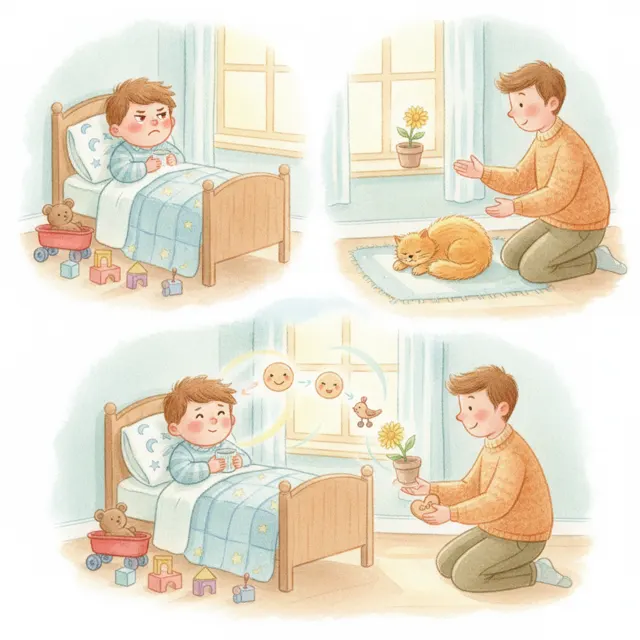
Ben wakes up mad for no reason. Everything feels wrong until his father asks him to find one good thing. That one good thing leads to another, and Ben learns a small trick for hard mornings.

Moral: Looking for one good thing can soften a grumpy morning.

Ben woke up mad. He did not know why. His pillow felt lumpy. His toast was too brown. His socks would not go on right. "I do not want to do anything!" he said. His father sat on the edge of the bed. "Some mornings are just grumpy mornings," he said. "Let me show you a trick. Find one good thing. Just one. Any good thing." Ben crossed his arms. "There is nothing good." "Look out the window," said Dad. Ben looked. Rain dripped down the glass. But on the branch outside, a small bird shook its wet feathers and chirped. "A bird," said Ben. "It is singing even though it is wet. That is kind of good." "Now another one," said Dad. Ben looked around his room. His teddy bear sat by the pillow, soft and old and always there. "Teddy," said Ben. "He never goes anywhere. I like that." "Now your stomach," said Dad. "Are you hungry?" Ben's stomach rumbled. "A little," he said. "Then we have a good breakfast to look forward to," said Dad. "Toast with honey. And we can eat it together." Ben smiled a small smile. The grumpy feeling was already shrinking. "Three good things," he said. "The bird, Teddy, and honey toast." "You found them all yourself," said Dad. Ben hopped out of bed. The morning was not so bad after all. Now he had a trick for every grumpy day that came his way. At breakfast, Ben ate his honey toast slowly. Thank you for the trick, Dad, he said. I think I will use it every single morning.

A Thank You for the Mail Carrier

Ages 3-84 mingratitude
A Thank You for the Mail Carrier story for kids illustration

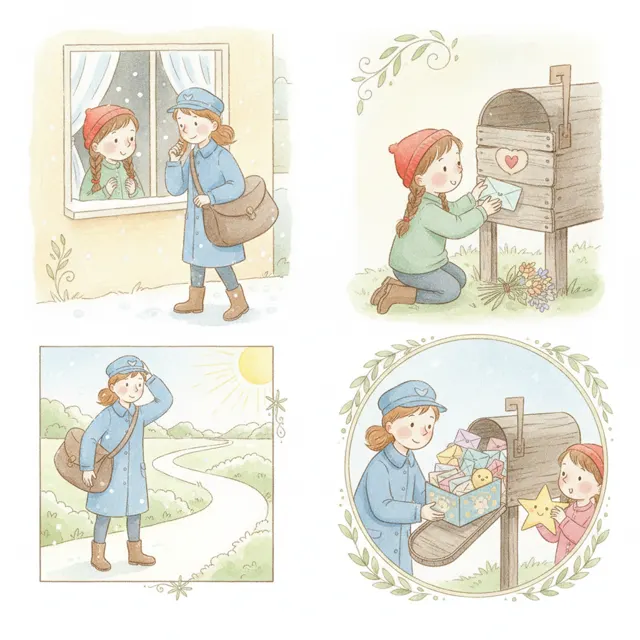
Every day Nina watches the mail carrier walk her long route in sun and snow. She decides to leave a thank you by the mailbox. What she gets back teaches her how far one small kindness can go.

Moral: A small thank you can warm a long working day.

Every day Nina watched the mail carrier walk up the long street. Her name was Rosa. She carried a heavy bag in the hot sun. She carried it in the cold rain too. And every day she gave a wave and a smile. "Rosa works so hard," Nina said to her mother. "Nobody ever thanks her." "People forget the quiet helpers," said Mama. "That is a good thing to notice." Nina wanted to do something. She drew a picture of Rosa with her mailbag. Under it she wrote, "Thank you for bringing our mail." She taped it to the mailbox with a little bag of cookies. The next morning, Nina peeked out the window. Rosa stopped at the mailbox. She read the note and smiled a huge smile. She waved at the window, even though she could not see Nina. That afternoon, there was a note in the mailbox. It was from Rosa. It said, "Dear Nina, your note made me smile all day. I put your picture on my locker at home. Thank you." Nina read it three times. "She kept my picture!" she said. "Your small thank you traveled a long way," said Mama. Nina thought about Rosa walking her route, smiling because of one drawing and one note. It was such a small thing. But it had filled up a whole day for someone who worked hard for everyone else. The next time Nina saw Rosa, she ran to the window and waved. Rosa waved back, grinning from ear to ear. The next time Rosa walked by, Nina ran outside to say thank you out loud. Rosa tipped her hat and smiled. Two friends, one mailbox.

Thank You, Little Brother

Ages 3-83 mingratitude
Thank You, Little Brother story for kids illustration

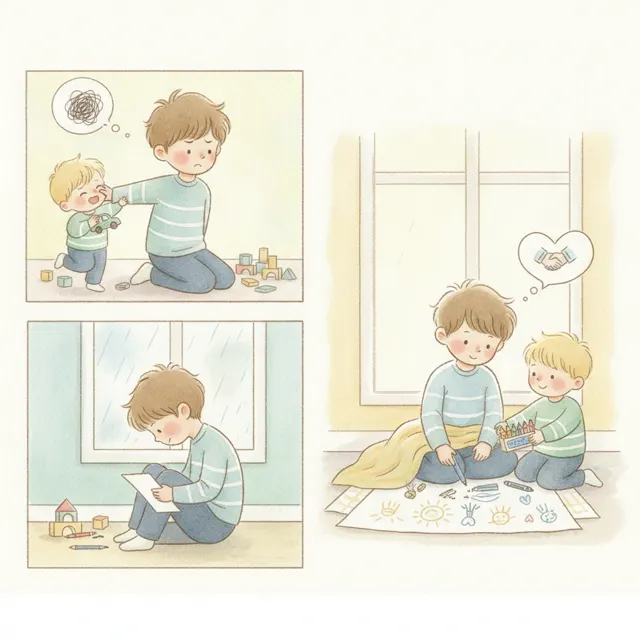
Kai thinks his little brother is always in the way. Then one lonely day his brother shares his crayons and his company, and Kai learns to be thankful for the small friend who is always there.

Moral: Even a little brother brings big gifts, if you look.

Kai thought his little brother Tomas was always in the way. Tomas knocked over his block towers. He tore pages from his books. He followed Kai everywhere. "Why did we have to get a little brother?" Kai grumbled. One afternoon, Kai's best friend moved away. Kai sat on the floor, too sad to play. His crayons sat in a box, but he did not feel like drawing. Tomas walked over. He held out his own tiny box of crayons. "You color with me?" he asked. "Not now, Tomas," said Kai. But Tomas sat down beside him anyway. He opened his box and pushed a blue crayon toward Kai. Then he started scribbling quietly on a paper. Kai watched him. Tomas was not being loud. He was not knocking anything over. He was just sitting close, sharing his crayons, keeping Kai company. Kai picked up the blue crayon. They colored side by side for a long time. Tomas hummed a little song. It made the quiet room feel less empty. "You know what, Tomas?" said Kai. "Thank you for sitting with me." Tomas smiled and leaned his head on Kai's arm. That night Kai looked at his little brother, asleep with his crayon still in his hand. Maybe Tomas was always in the way. But he was also always there. And on a sad day, that had been exactly what Kai needed. "I am glad you are my brother," Kai whispered. That night, Tomas did not wake up. But in the morning, Kai let him help build the tallest block tower yet. And when it toppled, they both laughed together.

The Quiet Thank You

Ages 3-84 mingratitude
The Quiet Thank You story for kids illustration

When Amara's friend helps her without being asked, she wants to say thank you in a way that matters. She learns that the best thank you is not always words. Sometimes it is a kind thing you do back.

Moral: The best thank you is a kind thing you do back.

Amara fell on the playground and skinned her knee. Before she could even cry, her friend June was there. "Come on," said June. "Let us get you to the nurse." June helped her up and walked her all the way inside. She waited while the nurse put on a bandage. She did not leave even when the other children ran off to play. "Thank you, June," said Amara. But the words felt too small for how kind June had been. That week, June caught a cold and stayed home from school. Amara remembered the feeling of someone staying right beside her. She made June a get well card. Then she asked her mother to help her make a small pot of soup. "We can drop it off," said Amara. "June brought me to the nurse and never left my side. Now it is my turn to stay beside her." They left the soup and the card on June's doorstep. That night, June called. "You brought me soup!" June said. "Nobody ever does things like that for me." "I wanted to thank you," said Amara. "For staying with me when I fell." June was quiet for a second. "That was the nicest thank you I ever got," she said. Amara smiled. She had learned something new. Words are good. But a thank you you do with your hands can say even more. The next time June needed help, Amara was already on her way. That, she knew now, was how good friends said thank you. Not always with words. Sometimes with showing up.

Thank You, Firefighters

Ages 3-84 mingratitude
Thank You, Firefighters story for kids illustration

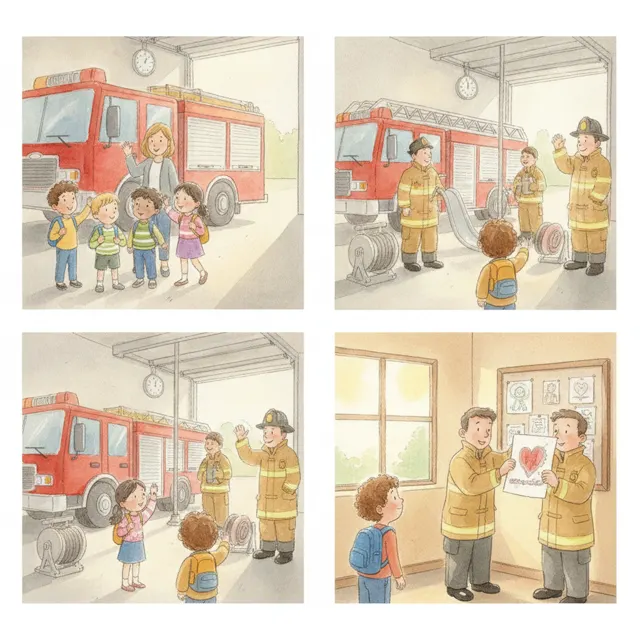
Leo's class visits the fire station. He learns how many hard things firefighters do to keep everyone safe. He makes a thank you poster, and the firefighters hang it where everyone can see it.

Moral: Saying thanks to helpers shows them their work matters.

Leo's class went to visit the fire station. Firefighter Maya showed them the big red truck. She let them touch the hose and try on a helmet that was way too big. "Do you really run into burning houses?" asked Leo. "We do," said Firefighter Maya. "We train every day so we can help people when they are scared and in danger." Leo looked at the heavy coats and the tall ladders. "That is a lot of hard work," he said. "It is," said Maya. "But nobody is born brave. We practice being brave, and we do it together as a team." On the bus ride home, Leo could not stop thinking about it. Firefighters trained every day. They ran toward danger when everyone else ran away. And most of the time, nobody said thank you. Back in class, Leo had an idea. He asked his teacher for a big piece of paper. He drew a huge red fire truck and a big yellow sun. At the top he wrote, "Thank you for keeping us safe." The whole class signed it. The teacher mailed it to the fire station. Two weeks later, a letter came back. It said, "Dear Class, your poster is on our wall where every firefighter sees it when they come to work. It reminds us why we do this job. Thank you." Leo read the letter out loud. The class cheered. "See?" said Leo. "Saying thank you helps the helpers remember their work matters." On the walk out of school, Leo saw a fire truck roll by. He waved, and a firefighter in the window waved back. It felt like a thank you going both ways.

The Garden's Gift

Ages 3-84 mingratitude
The Garden's Gift story for kids illustration

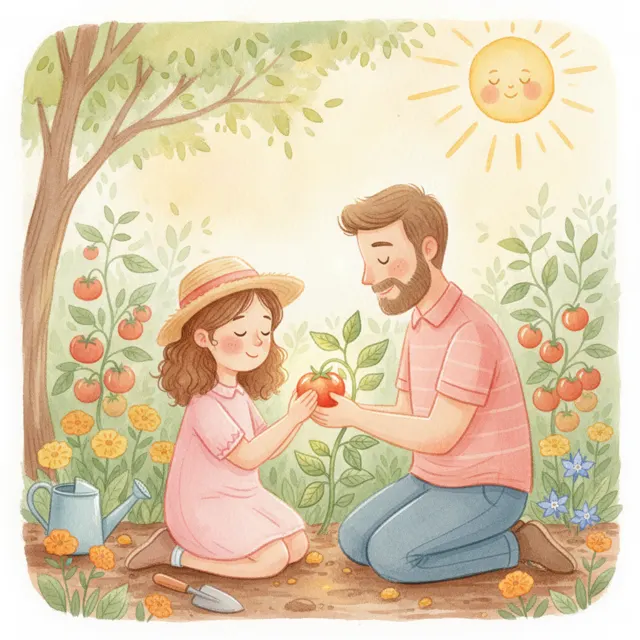
Ana helps her father grow tomatoes all summer. When the first red tomato is ready, she wants to gobble it up. Her father teaches her to stop and thank the garden first, and the tomato tastes even sweeter.

Moral: The earth gives us food, and we can give thanks back.

All summer, Ana helped her father in the garden. They planted tiny tomato seeds in the warm dirt. Ana watered them every day. She pulled the weeds and watched the little green plants grow tall. "When will we get a tomato?" she asked almost every morning. "Good things take time," said Papa. "The garden is working even when we cannot see it." Then one day, a tomato turned red. It hung on the vine like a shiny red ball. "It is ready!" Ana shouted. "Can I eat it now?" "Almost," said Papa. "First, we thank the garden." Ana tilted her head. "Thank a garden? It is just plants." "The garden gave us this tomato," said Papa. "The sun warmed it. The rain watered it. The soil fed it. We helped, but we did not make it alone." Ana looked at the red tomato. She thought about the sun and the rain and the dark dirt working together all summer long. "Thank you, garden," she said softly. "Thank you, sun and rain and soil. And thank you, Papa, for helping me grow it." Papa smiled and picked the tomato. He cut it into slices and put one on a plate for Ana. Ana took a bite. It was warm from the sun and sweet like summer. "Does it taste better now?" asked Papa. Ana nodded, her mouth full. "Because now I know all the hands and sunbeams that helped it grow." That evening, Ana helped Papa pick more tomatoes. They filled a whole basket. We will share these, said Papa. The garden gives enough for everyone to say thank you.

Thank You, Old Swing

Ages 3-84 mingratitude
Thank You, Old Swing story for kids illustration

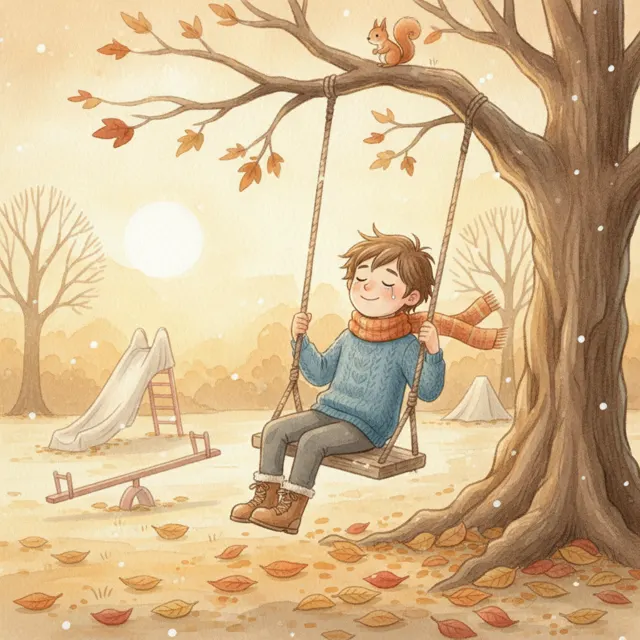
Eli is too big for the old swing in the park. But before the park closes for the winter, he takes one last ride and says thank you to the swing that made his childhood happy.

Moral: A favorite place can be a friend worth thanking.

There was an old swing in the corner of the park. Its seat was worn smooth. Its chains squeaked when the wind blew. Eli had ridden that swing since he was a tiny boy. Now Eli was bigger. The other kids ran to the new swings, the tall shiny ones. Eli could ride those too. But the old swing was his favorite. One day, a sign went up. The park would close for the winter. Workers would fix things up. Nobody knew if the old swing would still be there in the spring. Eli walked to the old swing and sat down. He was almost too tall for it now. His feet dragged on the ground. "One last ride?" his mother asked. Eli nodded. He pushed off and swung. Up and back. Up and back. The chains squeaked their old familiar song. "Thank you, swing," he said quietly. "For all the rides. For catching me when I was little. For the wind in my hair on hot days." His mother smiled. "You are saying goodbye to a friend." "The swing was always there," said Eli. "When I was happy, I swung high. When I was sad, it held me while I thought. That is a friend." The swing creaked back and forth, like it was answering him. When Eli finally stopped, he patted the smooth seat. "I will not forget you," he said. That winter, Eli learned that being thankful is not only for people. It is for the places and things that made you who you are. In the spring, the old swing was still there, with a fresh coat of paint. Eli was too big to ride it now, but he still sat beside it and said hello.

The Thank You Chain

Ages 3-84 mingratitude
The Thank You Chain story for kids illustration

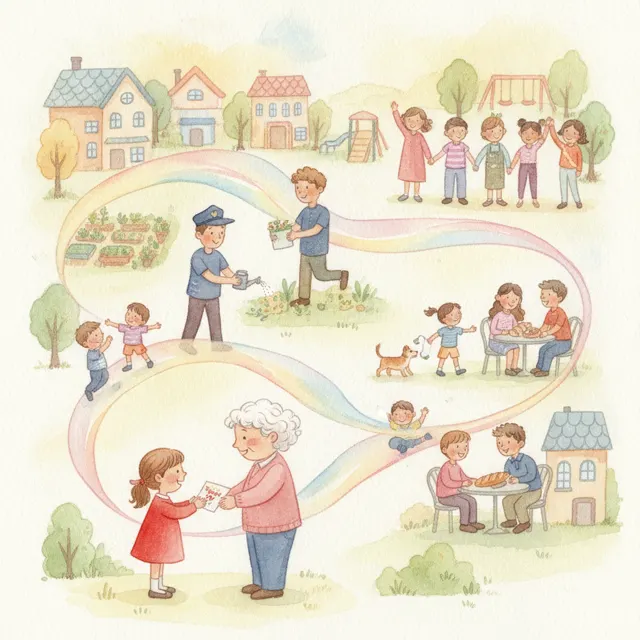
One thank you from a small girl starts a chain that travels across a whole neighborhood. Sofia learns that a single kind word, passed from one person to the next, can grow bigger than she ever imagined.

Moral: One kind thank you can start a chain of kindness.

Sofia held the door open for an old man at the bakery. "After you," she said. "Thank you, young lady," said the man. He looked tired, but he smiled. That small thank you made Sofia feel bright. And it gave her an idea. At the bus stop, she thanked the driver for the smooth ride. The driver smiled and drove extra carefully for the next person. The next person thanked the crossing guard. The crossing guard felt so good that she helped a mother carry her stroller across the street. The mother thanked her neighbor later that day. The neighbor felt so good that he baked bread and left a loaf for the family next door. That family wrote a thank you note to their mail carrier. The mail carrier read it and smiled all the way down the block. At the end of the week, Sofia's mother told her a story. "The strangest thing is happening on our street," she said. "Everyone is being extra kind. The baker says it started with a little girl who said thank you." Sofia grinned. "That was me," she said. "I said thank you, and the man said thank you back, and it just kept going." "One thank you became a whole chain," said Mama. Sofia thought about it. A thank you was free. It cost nothing. But passed from one person to the next, it could warm a whole neighborhood. "Let us add another link tomorrow," she said. Mama tucked Sofia in. A whole neighborhood, she said, all because one girl said thank you. Sofia fell asleep smiling, already planning the next link.

Five Good Things

Ages 3-84 mingratitude
Five Good Things story for kids illustration

Every night before bed, Noah names five good things from his day. Some days it is hard. But the habit teaches him to hunt for the good, and soon his heart feels fuller than he expected.

Moral: Counting five good things before bed fills a heart up.

Noah's mother started a new game at bedtime. "Name five good things from your day," she said. "Five things, before we turn out the light." "Five is a lot," said Noah. "Then we will hunt for them," said Mama. On the first night, Noah thought hard. "One, I had pancakes for breakfast. Two, my teacher said my drawing was nice. Three, I played tag at recess." He stopped. "That is only three." "What about after school?" asked Mama. "Four, we read a story together. Five... five is my pillow is soft." Mama smiled. "You found five. Was it hard?" "A little," said Noah. "But once I started looking, they kept coming." Some nights were easy. Some nights Noah had to dig. But every night, before the light went out, he named five good things. Big ones and tiny ones. A new friend. A warm bath. A dog he saw on the walk home. A joke his dad told. After a month, Noah noticed something. He was finding good things during the day now, not just at night. He would see a bird and think, "That is one for tonight." His heart felt fuller, like a jar slowly filling up. One night he said, "Mama, I found five good things without even trying. They were just there all day." "That is the gift of the game," said Mama. "You learned to see what was already around you." Noah pulled the blanket up. Tonight's five are already full, he said. I found them all before bed. Tomorrow I will look for five more.

Thank You for My Blanket

Ages 3-84 mingratitude
Thank You for My Blanket story for kids illustration

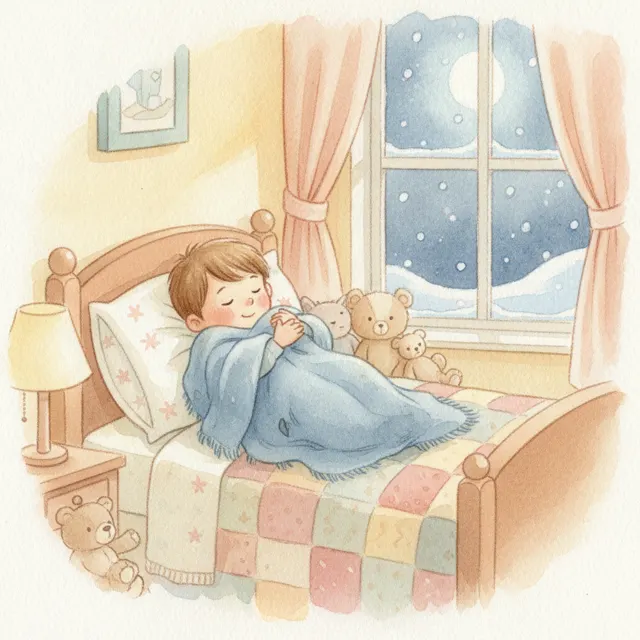
Sami's blanket is old and faded, and he is almost too big for it. When a cold night comes, he remembers all the warm nights it gave him and says a quiet thank you to a simple thing.

Moral: Even a warm blanket is a gift worth noticing.

Sami's blanket was old. The edges were frayed. The color had faded from bright blue to soft gray. Sami was almost too big for it now, and his toes stuck out at the bottom. "Maybe it is time for a new blanket," said his father. Sami looked at the old blanket. It was just a blanket. But it had been his since he was a baby. That night, the wind blew cold outside. Sami climbed into bed and pulled the old blanket up to his chin. Even with his toes sticking out, it felt warm. It felt like every cozy night he could remember. "Thank you, blanket," he whispered. "For all the warm nights. For keeping the scary dark away when I was little. For every sick day you stayed on top of me while I slept." The blanket could not answer. But somehow, tucked under it, Sami felt a little warmer. He thought about how many nights the blanket had kept him safe. Rainy nights. Snowy nights. Nights when he was scared of shadows. Nights when he was too happy to sleep. "I do not want a new blanket," Sami told his father the next morning. "Not yet. This one still has good nights in it." His father smiled. "A blanket is a small thing," he said. "But being thankful for small things is how you learn to be thankful for big ones." Sami folded the old blanket and put it at the foot of his bed. It was faded and frayed. But to Sami, it was a friend. That night, Sami fell asleep with the blanket tucked around him. Old and faded and warm. Some gifts, he knew, only got softer with time.

The Baker's Thank You

Ages 3-84 mingratitude
The Baker's Thank You story for kids illustration

A baker gives Tom a free roll when his coin is short. Tom wants to thank her, and he learns a secret about why the baker is so kind. Gratitude, he finds, has a story behind it.

Moral: Thankfulness grows when you learn how kindness began.

Tom stood in the bakery, counting his coins. He was one coin short for the soft roll he wanted. "That is okay," said the baker, a kind woman named Mrs. Dima. She wrapped the roll and handed it to him. "You can bring the coin tomorrow." "But why would you trust me?" asked Tom. Mrs. Dima smiled. "Someone once trusted me, a long time ago. When I first opened this bakery, I had almost no money. A man came in and bought bread every day, and he always left a little extra. When I asked him why, he said, 'Pass it on.' So now I do." Tom took the roll and went home. But he could not stop thinking about Mrs. Dima's story. The next day, Tom came back with his coin. And he did not come alone. He brought a small drawing he had made. It showed Mrs. Dima at her bakery, handing bread to a happy boy. At the top he had written, "Thank you for passing it on." Mrs. Dima's eyes got shiny. "Oh, Tom. This is going right on my wall." "I wanted to thank you," said Tom. "Not just for the roll. For being the kind of person who passes things on." Mrs. Dima hung the drawing by the cash box. "Now every customer will see it," she said. Tom walked home feeling tall. He had learned that a thank you is not just two words. It is seeing the person behind the kindness, and the story behind the gift. Every time Tom passed the bakery, he saw his drawing in the window. And every time, he felt thankful all over again.

Frequently Asked Questions

Turn Your Child Into the Hero of Their Own Story

Upload their photo and watch as AI creates a beautiful, personalized storybook with illustrations that look just like them. From $5.99/month.

✨ Make Your Child the Hero

Plans from $5.99/month