Empathy Stories for Kids

Little moments of noticing how someone else feels, wrapped into gentle bedtime stories where your child learns kindness by living it.

✨ Make Your Child the Hero

Empathy is one of the hardest things to teach and one of the most important. You cannot explain it in a single talk, but you can grow it one small story at a time. These gentle tales show children noticing how a friend, a sibling, an animal, or a new kid might be feeling, and choosing kindness because of it. Each one is short enough for bedtime and soft enough for the youngest listeners. And here is the part kids love most: at CreateStory.ai, you upload your child's photo and they step right into the story as the hero, learning what kindness feels like from the inside.

Why do empathy stories matter for young children?

Empathy is feeling what someone else feels. Stories let kids practice it from a safe, cozy spot. A 2025 review of 21 studies with 2,293 children found storybook reading improved empathy skills, especially helping behavior (Early Education and Development).

How can I help my child notice other people's feelings?

Name feelings as they happen. Ask, 'How do you think she feels?' after a story. Then talk about kind ways to help. Little talks build big hearts.

Sample Stories

Read these stories, then create a personalized version where your child is the hero

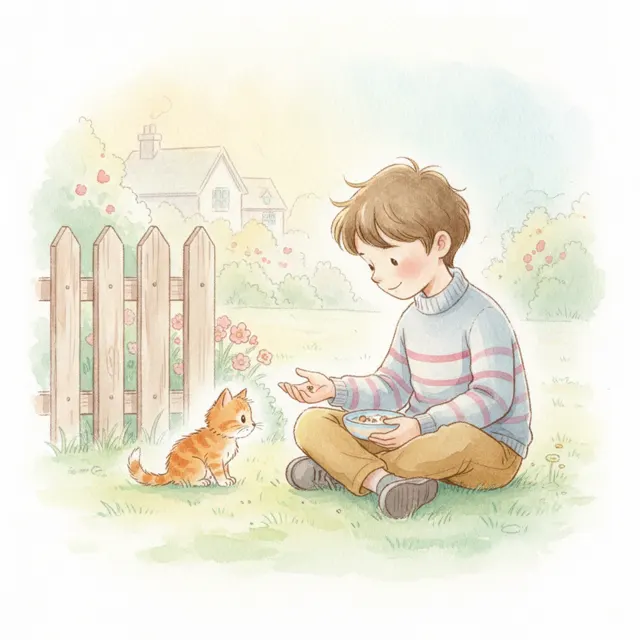
Milo and the Lost Kitten
Ages 3-84 minempathy
Milo and the Lost Kitten story for kids illustration

Milo finds a tiny kitten alone by the fence and realizes it must miss its mother. Instead of walking past, he sits quietly, offers food, and helps it feel safe until they can find where it belongs.

Moral: Paying attention to someone who is scared and staying close can make them feel safe.

Milo was kicking a ball in the yard when he heard a tiny sound. Meow. He stopped and listened. There it was again, small and sad, coming from behind the fence. He tiptoed over and peeked. A little gray kitten sat shivering near the bushes. Its fur was dusty and its eyes were wide. It looked like it had been alone for a long time. "Are you lost?" Milo whispered. The kitten backed up a step, looking scared. Milo remembered how he felt on his first day of school, all alone with no one he knew. He sat down slowly on the grass, not too close. "It is okay," he said softly. "I will just sit here with you." For a while neither of them moved. Milo did not reach out or chase it. He just stayed still and let the kitten see he was not going to hurt it. Then Milo remembered the crackers in his pocket. He broke one into tiny pieces and put them a little nearer. The kitten sniffed, crept forward, and nibbled. "You were hungry," Milo said. "That is why you were crying." He stayed until the kitten stopped shaking. Then he called his mom, and together they asked the neighbors. It turned out the kitten belonged to Mrs. Rao two doors down, and she had been searching all morning. Mrs. Rao scooped up the kitten and hugged it. "You found her, and you were so patient," she said. "She was scared, and you helped her feel safe." That night Milo thought about the kitten purring on Mrs. Rao's lap. It felt good to notice when someone needed help, even someone as small as a lost kitten.
Lily's Turn to Swing

Ages 3-83 minempathy
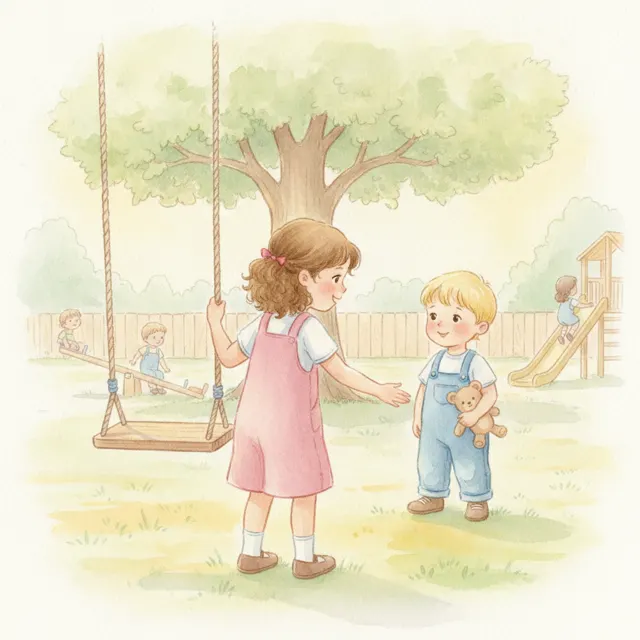
Lily's Turn to Swing story for kids illustration

Lily wants the swing but so does her little brother Ben. When she sees him waiting and watching, she steps back, lets him go first, and finds out sharing feels better than being first.

Moral: Letting someone else go first can feel even better than being first yourself.

Lily ran to the swing as fast as she could. It was the last one free, and she had waited all recess for it. The other swings were full, and the kids on them were going higher and higher. But just as she grabbed the chain, she heard a small voice behind her. "Can I have a turn?" It was her little brother Ben. He stood with his hands behind his back, watching her with big, hopeful eyes. He had been standing there for a while, too shy to ask anyone else. "I got here first," Lily said. Then she looked at him again. He had not swung all day. He had been too shy to ask anyone, and now he stood there waiting while the other kids raced past him. She remembered how her own legs had felt when she was three, too small to climb on without help. She remembered wanting to swing and not being able to reach. She took a breath and let go of the chain. "You go first," she said. "I will push you." Ben's whole face lit up. He climbed on and held tight to the chains. "Ready?" Lily asked. "Ready!" She pushed gently, then a little higher, and Ben laughed and laughed. He kicked his legs and called out, "Higher, Lily, higher!" When he was done, he hopped off and said, "Now your turn, Lily. I will push you too." As she swung higher, Lily smiled. Being first was fun, but watching her brother's happy face felt even better. One small choice had made his whole day, and hers too.

The New Boy Who Didn't Talk

Ages 3-84 minempathy
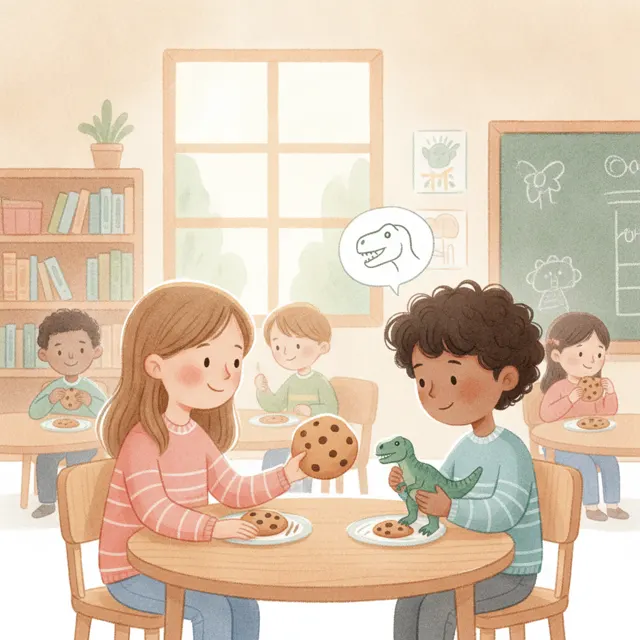
The New Boy Who Didn't Talk story for kids illustration

A new boy joins Ava's class and does not say a word. Instead of leaving him out, Ava sits beside him at lunch, offers a cookie, and discovers he speaks a little slowly and loves dinosaurs.

Moral: Sitting beside someone who is alone and asking one small question can turn a stranger into a friend.

A new boy started in Ava's class on Monday. His name was Kenji, and he did not say a word. Not during the morning song, not during counting, not even when the teacher asked him his favorite color. Some kids whispered that he was strange. Others just walked past him as if he were not there. Ava watched it all from her desk and felt a little sad for him. At lunch, Ava noticed Kenji sitting alone at the end of the table, looking down at his sandwich. The other kids were busy talking and laughing, and no one sat next to him. Ava remembered her first day at a new school the year before. She had felt like everyone was watching and no one was. She picked up her tray and walked over. "Hi," she said. "Can I sit here?" Kenji looked up, surprised, and nodded. "Do you like my cookie?" she asked, holding it out. "It is chocolate." Kenji took a small piece and smiled. Then Ava noticed a little dinosaur sticker on his lunchbox. "I like dinosaurs too," she said. "T-rex is my favorite." "Mine is Triceratops," Kenji said quietly. "It has three horns." Ava grinned. "You do talk!" Kenji laughed, and just like that, the two of them were friends. The next day at lunch, Kenji saved a seat for Ava, and they talked about dinosaurs the whole time. Sometimes all it takes is sitting next to someone and asking one small question, and that is what being a good friend means.

Sam's Sad Drawing

Ages 3-85 minempathy
Sam's Sad Drawing story for kids illustration

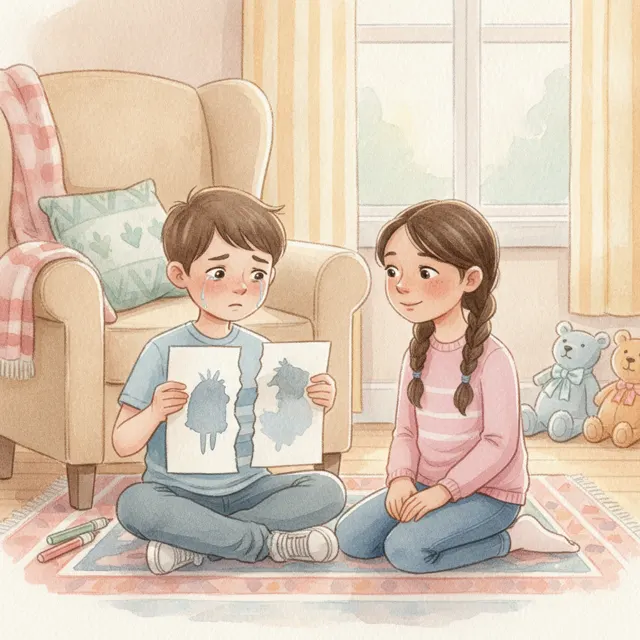
Sam rips his drawing in half because it did not come out right. His friend Priya does not fix it or say it is no big deal. She simply listens, stays close, and helps him feel less alone.

Moral: When a friend is upset, listening and staying close helps more than fixing the problem.

It was free drawing time in Sam's class. He had been working on a picture of his dog all morning, but the ears came out wrong and the tail looked like a banana. He frowned, then tore the paper right in half. His friend Priya looked over from her seat. "Sam, what happened?" "It is all wrong," Sam said, his voice shaking. "I wanted it to be good." Priya wanted to say the drawing looked fine, but she could see that was not what Sam needed right then. Instead, she pulled her chair closer and sat down beside him. "That is really frustrating," she said quietly. Sam nodded and wiped his eyes. "I practiced so hard. It never comes out the way I want." "Tell me about your dog," Priya said. "What is his name?" "Biscuit," Sam said, a tiny smile starting. "He has one floppy ear." Priya listened while Sam told her about Biscuit chasing squirrels and sleeping on his pillow. She did not rush him or tell him to cheer up. She just listened. Then she slid a fresh piece of paper over. "Want to draw Biscuit again together? I will do the ears if you want," she offered. Sam picked up his crayon. "Okay. But the ears are hard." "We will figure it out," Priya said. Soon they were both drawing, side by side, and Sam's picture was full of smiles. He had not needed someone to fix anything. He had just needed a friend to sit close and stay.

Tia and Mrs. Chen's Garden

Ages 3-83 minempathy
Tia and Mrs. Chen's Garden story for kids illustration

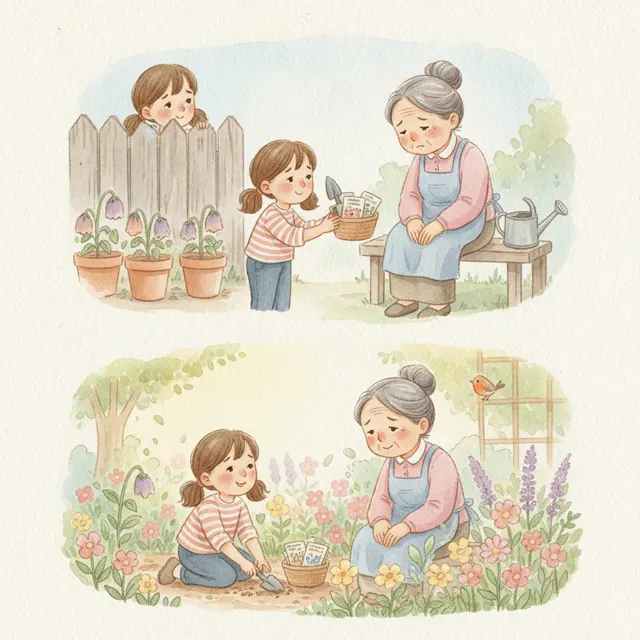
Tia notices her neighbor Mrs. Chen no longer waters her flowers and looks sad. When she finds out Mrs. Chen misses her daughter, Tia offers to garden with her and brings back her smile.

Moral: Simply showing up and being there for someone is a powerful kind of kindness.

Every day on the way home, Tia walked past Mrs. Chen's house. The flowers in the front garden were always bright and full. But lately, they had started to droop, and Mrs. Chen sat on her porch looking sad. "Hi, Mrs. Chen," Tia said one afternoon. "Your flowers look thirsty." Mrs. Chen sighed. "I know. I have not felt like watering them." Tia thought for a moment. "Can I help? I could water them today." Mrs. Chen's eyes looked tired, but she nodded. Tia filled the watering can and walked up and down the garden, giving every flower a drink. She watered the red ones and the yellow ones and the little purple ones by the gate. When she finished, she sat on the step beside Mrs. Chen. "Why are you sad?" Tia asked softly. Mrs. Chen was quiet for a while. Then she said, "My daughter moved far away. I miss her very much. We used to garden together every Sunday." Tia did not know what to say, so she just sat close and listened. Then she had an idea. "Maybe I can be your garden friend now," she said. "We can water the flowers together every day." A small smile came over Mrs. Chen's face. "I would like that very much." From then on, Tia stopped by every afternoon. The flowers perked up, and so did Mrs. Chen. Tia learned that sometimes the kindest thing is not a big fix. It is just showing up and being there.

The Girl Who Felt the Rain

Ages 3-82 minutesempathy
The Girl Who Felt the Rain story for kids illustration

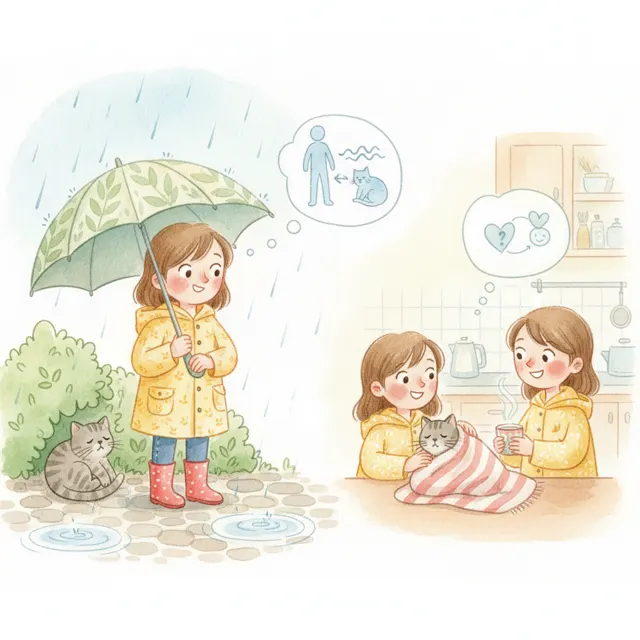
On a rainy walk, Ana notices a cat shivering under a bush. She thinks about how the cold feels and brings the cat home. Her mom helps, and Ana learns that noticing how others feel is the first step to helping.

Moral: Notice how others feel and you can help.

Ana walked home in the rain. She had a warm coat and boots. She splashed in the puddles and hummed. Then she saw a cat under a bush. The cat was wet and shaking. Its fur was stuck to its body. Ana stopped. "You must be so cold," she said. "I would be cold too." She thought about how the rain felt on her skin. Cold. Wet. Not fun. The cat had no coat and no home. Ana took off her hat and held it out. "Come here, kitty," she said softly. The cat did not move. Ana ran home. "Mom!" she called. "There is a wet cat under the bush. It is shaking. I felt how cold it must be." Mom grabbed a towel and a box. They went back. Mom wrapped the cat in the towel. It purred. "You noticed how the cat felt," Mom said. "That is called empathy. You felt what it felt." "Can we keep it warm?" Ana asked. "Yes," Mom said. "Until we find its home." At home Ana gave the cat warm milk. The cat drank and purred. It curled up on Ana's lap. "You are warm now," Ana said. "I am glad I stopped to notice." Mom smiled. "The world is better when we notice each other." The next day they found the cat's owner. The old man was so happy. "Thank you for feeling my cat's cold," he said. Ana learned that stopping to notice how someone else feels is the first step to helping them.

Leo and the Slow Snail

Ages 3-82 minutesempathy
Leo and the Slow Snail story for kids illustration

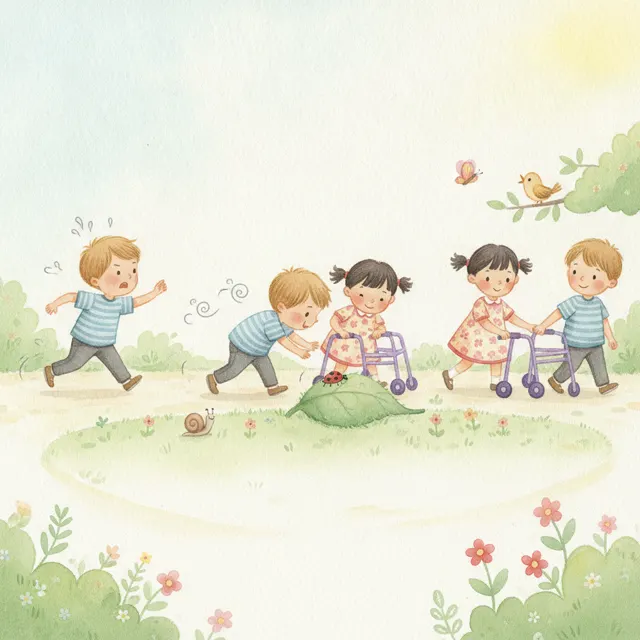
Leo walks fast, but his friend Poppy uses a walker and goes slow. At first Leo is annoyed. Then he slows down and walks with Poppy, noticing fun things he used to miss. He learns to match her pace.

Moral: Going at someone else's pace shows you care.

Leo walked fast. He liked to be first in line and first to the door. His legs were quick. His friend Poppy used a walker. She went slow. One step at a time. Leo often ran ahead. "Come on, Poppy!" Leo called. "You are too slow." Poppy said nothing. She kept walking. One day their teacher asked them to walk to the garden together. "Stay with your partner," she said. Leo sighed. "Fine. I will wait." He walked next to Poppy. Slow. Step by step. At first Leo tapped his foot. Then he looked around. He saw a ladybug on a leaf. He saw a worm on the path. He heard a bird singing. "Whoa," Leo said. "I never saw the ladybug before. I always run past." "I see them every day," Poppy said. "Walking slow lets you look." They stopped to watch the ladybug. It opened its wings and flew away. "That was cool," Leo said. "What else do you see when you walk slow?" "Lots," Poppy said. "Clouds that look like dogs. Flowers opening. Snails." They got to the garden last. But Leo did not mind. He had seen more than ever. "I am sorry I called you slow," Leo said. "Your pace is nice. I was missing things." "Thank you," Poppy said. "You can walk with me any time." From then on, Leo walked with Poppy sometimes. Fast on his own, slow with her. He learned that matching a friend's pace is a kind thing to do.

The Loud Lunch and the Quiet Kid

Ages 3-82 minutesempathy
The Loud Lunch and the Quiet Kid story for kids illustration

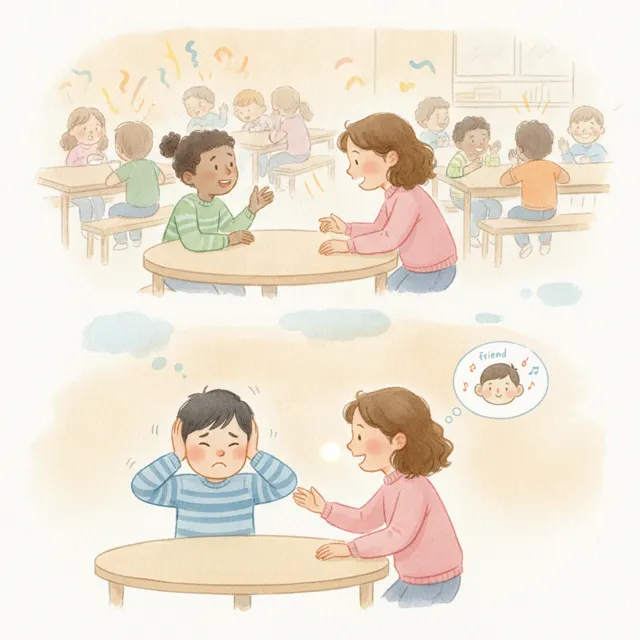
The lunch room is loud. A quiet boy named Wen sits alone with his hands over his ears. Nia notices he looks upset, sits with him, and speaks softly. Wen opens up, and Nia learns loud places can hurt some friends' ears.

Moral: A quiet friend may just need a patient friend.

The lunch room was loud. Kids yelled. Trays clanged. Chairs scraped. Nia loved the noise. It was fun and busy. But one boy sat in the corner with his hands over his ears. His name was Wen. He looked like he might cry. Nia watched him. "Why does Wen look so sad?" she thought. "Maybe the noise hurts him." She walked over and sat down. She did not yell. She spoke softly. "Hi, Wen. Is the lunch room too loud for you?" Wen nodded. "My ears hurt," he said in a tiny voice. "It is too much." "That makes sense," Nia said. "Loud sounds can feel like too much. I can sit with you. I will talk quiet." They ate together. Nia spoke in a soft voice. Wen smiled a little. "Some kids like it loud," Wen said. "I like it quiet." "That is okay," Nia said. "People are different. Do you want to sit by the window? It is quieter there." "Yes, please," Wen said. They moved to the window. It was still busy, but not as loud. Wen took his hands off his ears. "Thank you for noticing," Wen said. "Most kids think I am weird." "You are not weird," Nia said. "You just like quiet. Now I know." The next day Nia saved a spot by the window for Wen. They ate lunch there every day. Wen talked more. He told funny jokes in his soft voice. Nia learned that when a friend seems quiet or sad, the kind thing is to ask what they need.

Maya's Missing Marble

Ages 3-82 minutesempathy
Maya's Missing Marble story for kids illustration

Maya loses her favorite blue marble and cries. Her brother Zain wants to fix it fast, but instead he sits with her and lets her talk about why it matters. He learns that listening to sad feelings helps more than a quick fix.

Moral: Feelings matter more than things.

Maya had a blue marble. It was her favorite. She kept it in her pocket. One day she reached for it. It was gone. Maya searched her room, the couch, and the yard. No marble. She sat on the steps and cried. "It was my favorite!" she said. Her brother Zain came outside. "What is wrong?" he asked. "I lost my blue marble," Maya said. "It is gone forever." Zain wanted to say, "It is just a marble." But he saw how sad Maya looked. So he sat down next to her. "That must feel bad," Zain said. "Tell me about the marble." "It was blue like the sky," Maya said. "Grandma gave it to me. I rolled it every night." "That sounds special," Zain said. "I would be sad too if I lost something from Grandma." Maya sniffed. "You get it. Everyone says it is just a marble. But it is not just a marble." "I know," Zain said. "Want to look for it together?" "Yes," Maya said. They looked under the couch and in the yard. Zain checked the car. There, under the seat, was a small blue marble. "I found it!" Zain said. Maya's face lit up. "You found it! Thank you, Zain." "Thanks for telling me about it," Zain said. "Now I know why it matters." Maya put the marble back in her pocket. "You listened first," she said. "That helped more than finding it." Zain learned that when someone is sad, sitting with them and listening matters more than a quick fix.

The Dog Who Missed His Owner

Ages 3-82 minutesempathy
The Dog Who Missed His Owner story for kids illustration

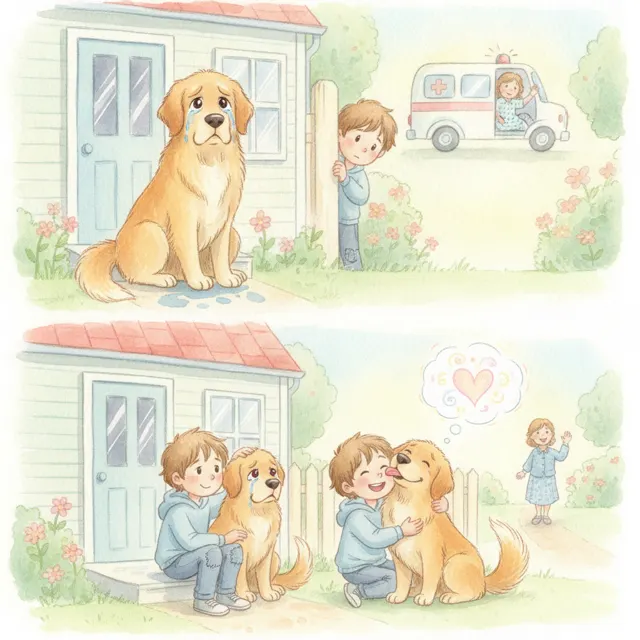
A neighbor's dog, Rex, cries when his owner goes to the hospital. Tom notices Rex is lonely, visits each day, and sits with him. Rex's tail wags again, and Tom learns that keeping someone company helps them feel less alone.

Moral: We can comfort others who are sad or scared.

The dog next door was named Rex. He barked and wagged when his owner, Mr. Cole, came home. One week Mr. Cole went to the hospital. Rex stayed in the yard alone. He stopped wagging his tail. He whined by the gate. Tom heard the whining. He looked over the fence. Rex lay by the door with sad eyes. "Poor Rex," Tom said. "You miss Mr. Cole." Tom's mom took him next door. They fed Rex and gave him water. But Rex still looked sad. "Can I sit with him?" Tom asked. "I think he is lonely." "Sure," Mom said. Tom sat on the step. Rex lay down next to him and put his head on Tom's lap. Tom petted his ears. "I miss Mr. Cole too," Tom said softly. "But he will come back. Until then, I will keep you company." Rex sighed. His tail thumped once on the ground. Every day after school, Tom went to sit with Rex. They played fetch. They walked around the yard. Rex's tail began to wag again. One day a car pulled up. Rex ran to the gate, barking with joy. Mr. Cole was home! "Tom," Mr. Cole said, "thank you for keeping Rex company. He told me all about it." He laughed. "I knew he was lonely," Tom said. "So I stayed with him." "You have a kind heart," Mr. Cole said. "Not everyone notices a sad dog." Tom learned that when someone is sad or alone, sitting with them is a big help.

Eli's Sticky Note

Ages 3-82 minutesempathy
Eli's Sticky Note story for kids illustration

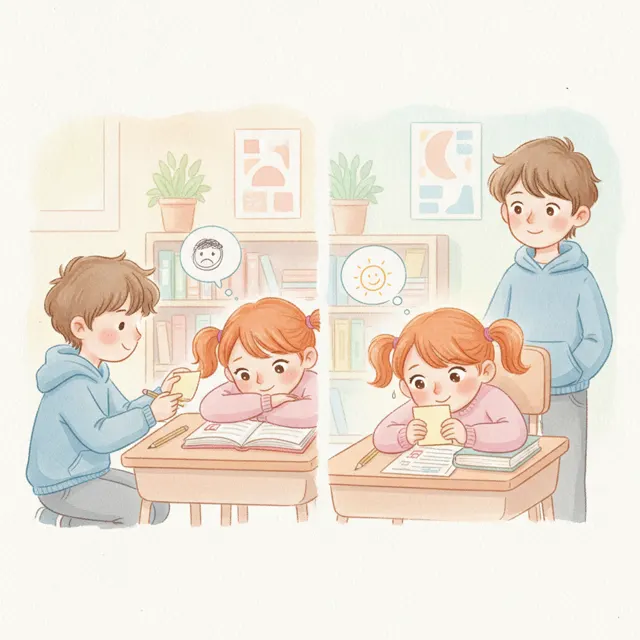
Eli notices his classmate Ruby looks sad after failing a test. He writes her a kind note and sticks it on her desk. Ruby smiles and opens up. Eli learns that small kind words can lift someone up.

Moral: A kind word can fix a sad day.

Ruby got her test back. She had not done well. She put her head on her desk and did not talk. Eli watched her from across the room. Ruby was usually full of jokes. Today she was quiet. "She looks so sad," Eli thought. "I wonder how she feels. I would feel bad too." Eli wanted to help. He did not know what to say. So he wrote on a small yellow note. He wrote, "You are smart and kind. One test does not change that. Want to play at recess?" He folded the note and walked over. He put it on Ruby's desk and went back to his seat. Ruby looked up. She opened the note and read it. A small smile came to her face. She looked at Eli and nodded. At recess, Ruby found Eli by the swings. "Thanks for the note," she said. "It made me feel better." "I meant it," Eli said. "One test is just one test. You are still great." "Want to swing?" Ruby asked. "Sure," Eli said. They swung side by side. Ruby was smiling again. She even told a joke. "Why did the kid bring a ladder to school?" she asked. "Because he wanted to go to high school!" Eli laughed. "See? You are funny and smart." "Thanks for noticing I was sad," Ruby said. "Most people did not." Eli learned that a few kind words on a small note can turn a sad day around. It all started with one small yellow square of paper.

The Plant That Needed a Friend

Ages 3-82 minutesempathy
The Plant That Needed a Friend story for kids illustration

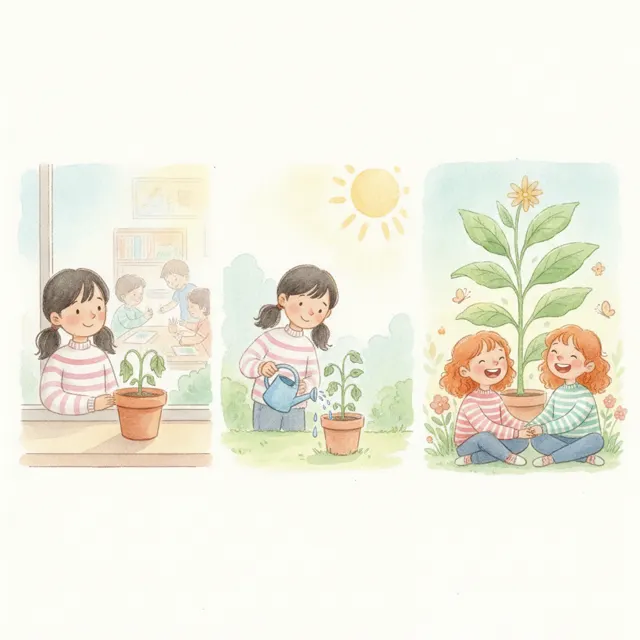
Dara's class gets a droopy plant. She notices it needs water and sun, then cares for it each day and watches it grow. Caring for the plant helps Dara understand how to care for her friends too.

Moral: Caring for something teaches you to care for people.

Mrs. Reed put a small plant on the window sill. Its leaves drooped. It looked tired and sad. "Does anyone want to be the plant helper?" Mrs. Reed asked. Dara raised her hand. "I do," she said. "The plant looks like it needs help." "Good eye, Dara," Mrs. Reed said. "What do you think it needs?" Dara looked at the plant. "It needs water," she said. "And sun. Its leaves are droopy." She touched the dirt. It was dry. "It is thirsty," she said. Every day Dara watered the plant a little. She turned it so all the leaves got sun. She talked to it. "You are growing," she said. "Good job, little plant." After a week, the leaves stood up. New green shoots grew at the top. The plant looked happy. "How did you know what it needed?" asked her friend Ben. "I watched it," Dara said. "When it drooped, I knew it was thirsty. I thought about how I feel when I am thirsty." Ben nodded. "You take care of it." "Like a friend," Dara said. "You watch how a friend feels too. If a friend is sad, you help. If a friend is tired, you are kind." "You are good at that," Ben said. "You always ask if I am okay." Dara smiled. "The plant taught me. Caring means paying attention." The plant grew tall and green on the window sill. And Dara grew too. She learned that paying attention to what someone needs is what caring means.

Frequently Asked Questions

Turn Your Child Into the Hero of Their Own Story

Upload their photo and watch as AI creates a beautiful, personalized storybook with illustrations that look just like them. From $5.99/month.

✨ Make Your Child the Hero

Plans from $5.99/month