Perseverance Stories for Kids

Warm tales of trying again where your little one learns that practice, patience, and a little grit turn hard things into wins.

✨ Make Your Child the Hero

Every parent knows the moment when a child wants to give up, whether it is a wobbly bike, a tricky puzzle, or a song that will not come out right. These stories are about what happens next: the deep breath, the second try, the third, and the fourth. They show kids that falling down, messing up, and trying again are all part of getting good at something. Each tale is warm and patient, with characters who keep going and feel proud when they finally get there. With CreateStory.ai, you can make it personal. Upload a photo and your child becomes the hero who learns that trying again always pays off.

Why do perseverance stories matter for young children?

Perseverance stories show kids that failing is part of learning. When a character falls and gets back up, children see that effort matters more than being perfect the first time. This is the heart of a growth mindset.

The lesson sticks. In one Stanford study, 90 percent of children praised for effort chose harder puzzles next, while most children praised for being smart picked easier ones (Mueller and Dweck, 1998). Praise the trying, and kids keep trying.

How can parents teach perseverance through bedtime stories?

Read a story, then talk about it. Ask your child what the hero did when things went wrong. Point out that the character did not give up, even when the task felt hard. That small chat is where the lesson sinks in.

Try it in real life too. The next time your child struggles with a zipper or a puzzle, remind them of the story. A small connection like this turns a tale into a habit of trying again, until they say it themselves.

Sample Stories

Read these stories, then create a personalized version where your child is the hero

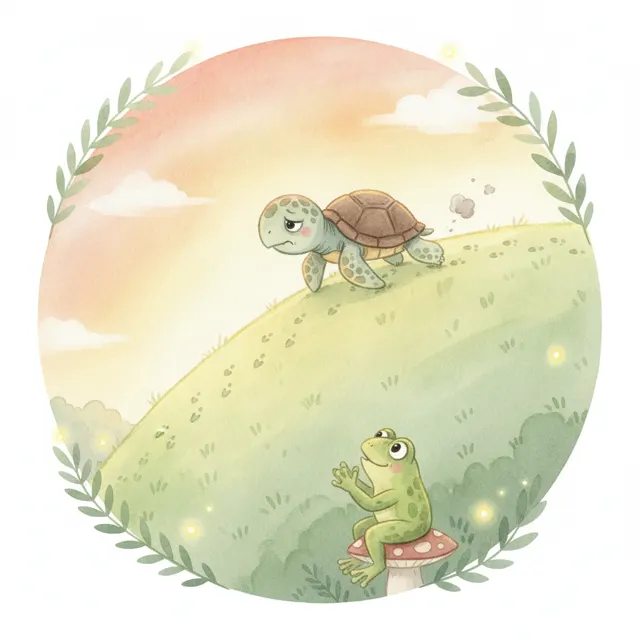
The Little Turtle Who Kept Climbing
Ages 3-84 minperseverance
The Little Turtle Who Kept Climbing story for kids illustration

Tilly the turtle wants to reach the top of the big hill, but she keeps slipping back down. With steady little steps and a friend cheering her on, she learns that never giving up gets you to the top.

Moral: Slow and steady, and never giving up, gets you to the top.

At the bottom of a very big hill lived a little turtle named Tilly. Every day, Tilly looked up at the hill and dreamed of seeing the view from the top. "I am going to climb that hill today," she told herself. She started climbing. Step by slow step, she moved up the grass. But the hill was steep, and halfway up, Tilly slipped and slid all the way back down to the bottom. "Oh no," she said. "That was a long way to fall." A rabbit hopped by. "That hill is too big for a little turtle," he said. "Maybe you should give up." But Tilly shook her head. "I will try again," she said. So Tilly climbed again. This time, she went a little higher before she slipped. Then she climbed a third time, and a fourth. Each time, she fell back down. Each time, she got back up and started again. A friendly ladybug landed on her shell. "You keep trying," the ladybug said. "That is brave." "I want to see the top," Tilly said, panting. "I will get there." And then, on her fifth try, Tilly found a small flat rock halfway up the hill. She rested there and caught her breath. Then she climbed again, a little at a time, and finally, at last, she reached the very top. The view was beautiful. Green fields and a winding river stretched out below. Tilly smiled so wide it hurt. "I almost gave up," Tilly said. "But I kept going." "And now you are at the top," the ladybug said, landing beside her. "Slow and steady won the climb."
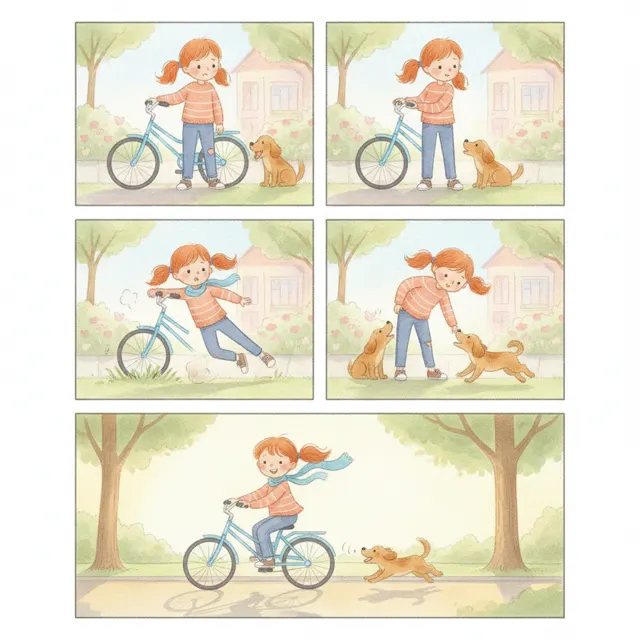
Nora Learns to Ride Her Bike

Ages 3-85 minperseverance
Nora Learns to Ride Her Bike story for kids illustration

Nora takes her training wheels off and wobbles into a few falls. Instead of giving up, she gets back on each time, and soon she is pedaling all the way down the street with the wind in her hair.

Moral: Every fall teaches you something, and every try gets you closer.

Today was the day. Nora's dad was taking the training wheels off her bike, and Nora was going to learn to ride like a big kid. "Ready?" her dad asked, holding the back of the seat. Nora nodded. She pushed the pedals, and the bike wobbled. Her dad held on tight, running beside her. It felt wobbly but fun. Then, without warning, her dad let go. Nora pedaled by herself for a few seconds, and then the bike tipped over. She fell onto the soft grass. "Are you okay?" her dad asked. Nora's knee hurt a little, and her eyes filled with tears. "I fell," she said. "Everyone falls when they learn," her dad said. "The brave part is getting back on." Nora sniffed and stood up. She dusted off her hands and climbed back on the bike. Her dad held the seat again, and she pedaled. This time she went a little farther before she wobbled and put her feet down. "I almost had it!" Nora said. She tried again, and again. Each time, she went a little farther. Each time, she fell a little less. Then, on her seventh try, something amazing happened. Nora pedaled all by herself, straight and steady, all the way down the street. "Look at me!" she shouted. "I am doing it!" Her dad cheered from the sidewalk. Nora turned around at the end of the street and rode all the way back, the wind in her hair, her heart flying. "I fell a lot," Nora said, out of breath and grinning. "But I kept getting back on." "That is how you learn to ride," her dad said. "And how you learn everything else too."

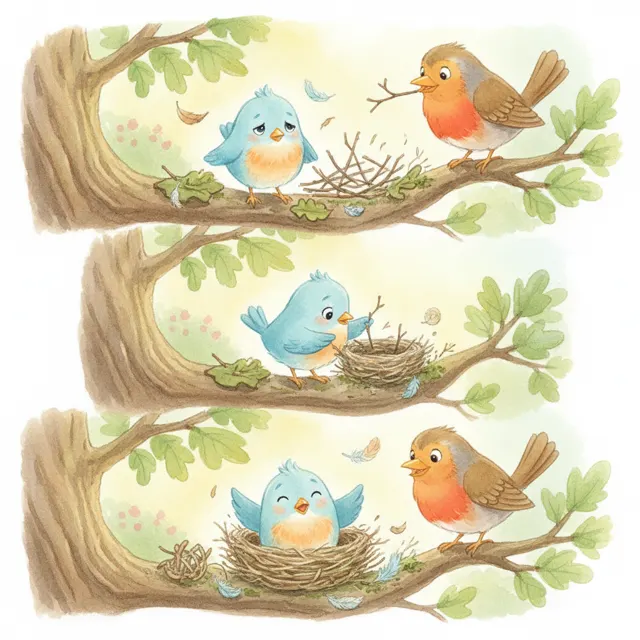
The Bird Who Could Not Build a Nest

Ages 3-83 minperseverance
The Bird Who Could Not Build a Nest story for kids illustration

Pip the little bird tries to build a nest, but every one falls apart. With help from a wise old robin and a lot of practice, Pip builds a nest that holds together, twig by twig.

Moral: Asking for help and trying again is how you get better.

Pip was a little bird who wanted to build a nest, just like the big birds. But every nest he built fell apart. He gathered twigs and stacked them up, but the wind blew them away. He tried mud, but the mud crumbled. He tried grass, but the grass was too floppy. "I will never build a nest," Pip sighed, sitting on a branch. A wise old robin landed beside him. "What is wrong, little one?" she asked. "Every nest I build falls apart," Pip said. "I am no good at this." "When I was young, my nests fell apart too," the robin said. "Let me show you a trick. You have to weave the twigs, not just stack them." The robin showed Pip how to bend the twigs and tuck the grass around them. Pip watched closely and tried again. This time, the nest held a little better. Pip practiced all week. He gathered stronger twigs and wove them carefully. He lined the nest with soft feathers. Some days it still fell apart, but Pip did not give up. He kept weaving and kept trying. Then, one sunny morning, Pip stepped back to look at his nest. It was round and sturdy and cozy, and it held together perfectly. "I did it!" Pip chirped. "My very own nest!" The wise old robin came to see. "It is beautiful," she said. "You kept trying, and now look what you built." Pip puffed out his chest. "I almost gave up," he said. "But I am glad I did not." And Pip slept in his nest that night, warm and proud, listening to the wind in the leaves.

The Seed That Took the Longest to Grow

Ages 3-84 minpatience
The Seed That Took the Longest to Grow story for kids illustration

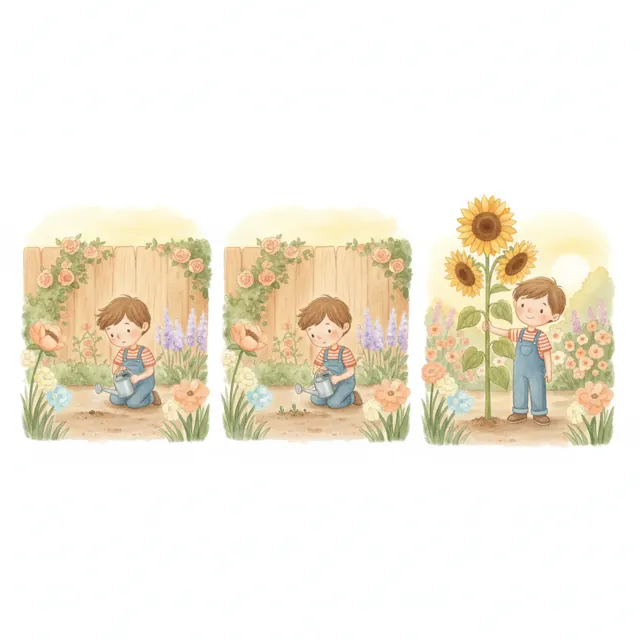
Eli plants a sunflower seed and checks it every single day, but nothing grows. As he keeps watering and waiting, he learns that the best things grow slowly, and patience is part of the reward.

Moral: Good things grow slowly, and patience is part of the reward.

Eli planted a sunflower seed in a little pot by the window. He pushed the seed into the soil, gave it water, and waited. The next morning, he ran to the pot. "Did it grow?" he asked. "Not yet," his mother said. "Seeds take time." Eli waited one more day. Nothing. Then a whole week. Still nothing but dark soil. Eli poked the dirt with his finger and frowned. "Why is it not growing?" he asked. "I water it every day." "It is growing," his mother said. "Just not where you can see it yet. Under the soil, the seed is waking up and putting down roots." Eli did not understand roots he could not see. But he kept watering the little pot and talking to it softly. "Grow, little seed," he would whisper. "I am waiting for you." His friend planted a bean, and it sprouted quickly. Eli felt a little sad. His sunflower was still just dirt. "Every seed grows at its own pace," his mother said. "Good things are worth waiting for." Then, one morning, Eli looked at the pot and gasped. A tiny green stem was pushing up through the soil, with two small leaves on top. "It grew!" he shouted. "My sunflower grew!" He watered it and watched it every day, and the little stem grew taller and taller, until a bright yellow flower opened toward the sun. "It was the slowest," Eli said, beaming, "but it was worth the wait." And he knew he would plant another seed next spring.

The Boy Who Kept Practicing the Piano

Ages 3-85 minpractice
The Boy Who Kept Practicing the Piano story for kids illustration

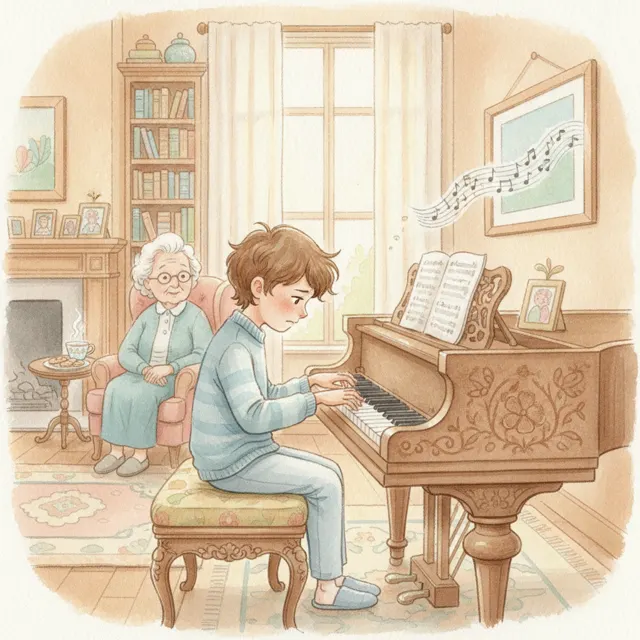
Theo wants to play his grandma's favorite song, but his fingers keep stumbling over the keys. By practicing a little every day, he learns that hard things become easy when you do not give up.

Moral: Practice a little every day, and hard things become easy.

Theo wanted to play his grandma's favorite song on the piano. It was called "Twinkle, Twinkle, Little Star," and it looked so easy when his teacher played it. But when Theo tried, his fingers stumbled. They hit the wrong keys and made funny, bumpy sounds. "This is too hard," Theo said. "My fingers will not listen." His teacher smiled. "Your fingers are still learning. Practice a little every day, and soon they will remember." So Theo practiced. Every day after school, he sat at the piano and played the song slowly. Some days he made the same mistake over and over. He felt like giving up. "Grandma is coming to visit next month," his mother reminded him. "You can play for her." Theo thought about Grandma, and he kept practicing. He played the song once in the morning and once before bed. Slowly, his fingers stopped stumbling. The notes began to sound smooth and pretty. One day, Theo played the whole song without a single mistake. He stopped and stared at his hands. "I did it!" he said. When Grandma came to visit, Theo led her to the piano. He took a deep breath and played "Twinkle, Twinkle, Little Star" from beginning to end. Grandma clapped and pulled him into a hug. "That was beautiful," she said. "You practiced so hard." "I wanted to give up," Theo admitted. "But I practiced a little every day." "And that," Grandma said, "is how hard things become easy." Theo smiled. He already knew which song he wanted to learn next.

The Kite That Would Not Fly

Ages 3-83 minutesperseverance
The Kite That Would Not Fly story for kids illustration

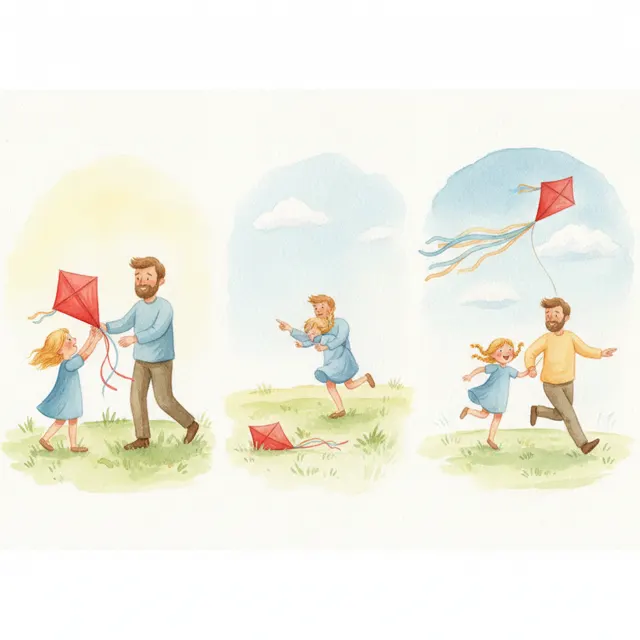
Nina gets a red kite for her birthday. She runs and runs, but the kite keeps flopping on the grass. With her dad's help, she adds a long tail and runs into the wind. Her kite finally flies high.

Moral: Keep trying, and a small fix can make a big thing work.

Nina got a red kite for her birthday. She ran to the park with her dad. "Watch this!" she said. She held the string and ran fast. The kite flopped on the grass. It did not fly. "I will try again," Nina said. She ran faster. The kite bounced behind her. It still did not fly. "Why will it not fly?" Nina asked. Her lip shook. "Let us look at the kite," Dad said. He held it up. "The tail is too short. A kite needs a long tail to stay steady in the wind." Nina and Dad made a longer tail out of ribbons. They tied it on tight. The ribbons were red and yellow. "Now try," Dad said. Nina ran again. The kite lifted a little, then fell back down. Nina sighed. "It is still not working," she said. "You are close," Dad said. "Try running into the wind, not away from it." Nina turned around and ran the other way, into the wind. The wind caught the kite. It rose up, up, up into the blue sky. The red kite danced in the air. "It is flying!" Nina shouted. "I did it!" "You kept trying," Dad said. "That is why it flies now." Nina held the string and watched her kite. It was the highest kite in the whole park, bobbing and swaying. She felt proud and warm inside. "Next time I will not give up so fast," Nina said. "Trying again really works, and it was fun too."

Milo Learns to Tie His Shoes

Ages 3-84 minutespractice
Milo Learns to Tie His Shoes story for kids illustration

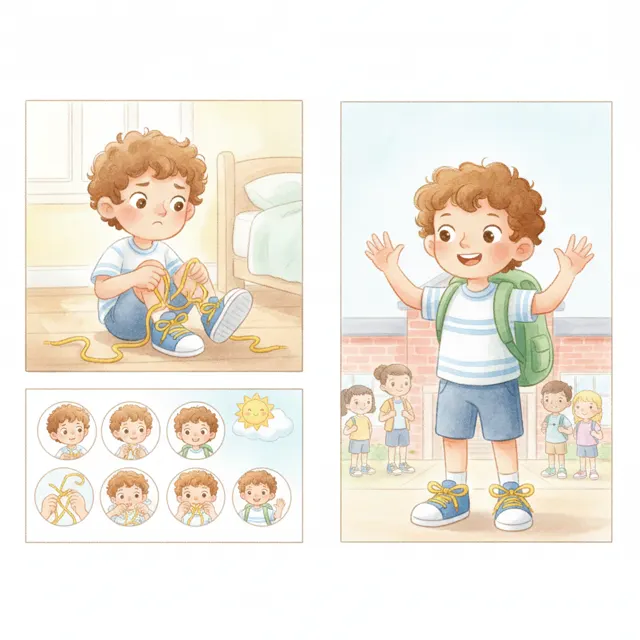
Milo wants to tie his own shoes before school starts. The laces tangle and the loops fall apart. He practices a little every day. By the first day of school, his hands know just what to do.

Moral: Practice every day turns a hard skill into an easy one.

Milo's shoes had laces, and Milo could not tie them. The loops fell apart. The laces got tangled. His mom always did it for him. "I want to tie my own shoes," Milo said one morning. "Then let us practice," Mom said. "Watch my hands." Mom made a loop with one lace. She wrapped the other lace around it and pulled it through. A neat bow sat on her shoe. "That looks easy," Milo said. He tried. The laces flopped. "Mine looks like a mess," he said. "That is okay," Mom said. "The first try is always the messiest. Try again." Milo tried again that afternoon. The bow was too loose. It fell apart in two steps. "I will never get it," Milo said. "You will," Mom said. "But not all at once. A little practice each day." So Milo practiced every day. On Monday, he made one loop. On Tuesday, he wrapped the lace. On Wednesday, he pulled it through. His bow was still crooked, but it stayed. "Almost!" Milo said. He kept trying. Each day his fingers moved a little faster. The laces stopped tangling so much. Then the morning came. It was the first day of school. Milo sat on his bed. He crossed the laces. He made a loop. He wrapped and pulled. A perfect bow sat on his shoe. "I did it all by myself!" Milo shouted. Mom clapped. "You practiced and practiced. Now your hands know how." Milo ran to the door. He tied his other shoe too. "I am ready for school," he said. "And I can tie my shoes for the whole class if they need help."

The Baker's Tenth Loaf

Ages 3-84 minutespractice
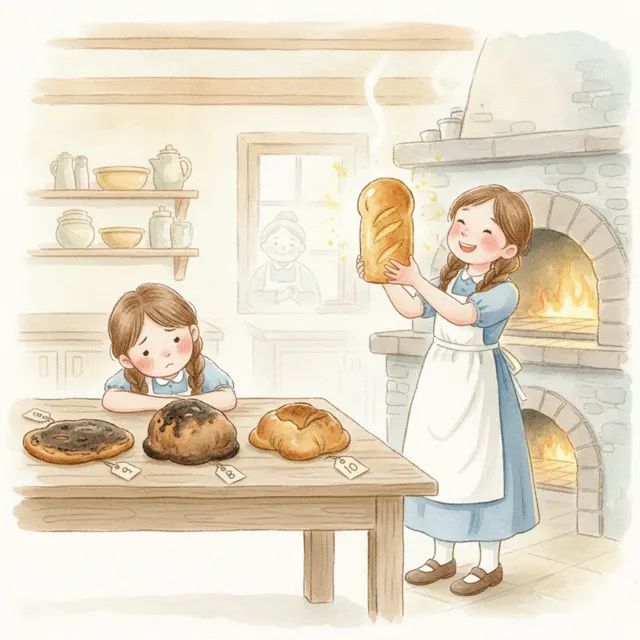
The Baker's Tenth Loaf story for kids illustration

Rosa the baker tries to bake bread like her grandma. Her first nine loaves come out flat, burnt, or lumpy. She does not give up. On the tenth try, the loaf comes out golden and tall.

Moral: Mistakes are not failing; they are steps toward getting it right.

Rosa loved the smell of fresh bread. Her grandma was the best baker in town. Rosa wanted to bake a loaf just like hers. "Teach me," Rosa said. Grandma gave her a bowl of flour, some water, and a little yeast. "Mix it, let it rise, and bake it," she said. Rosa mixed and baked. Her first loaf came out flat like a pancake. "Oh no," she said. "I did not let it rise long enough." "Then try again," Grandma said. Rosa's second loaf came out burnt. Her third loaf was lumpy. Her fourth loaf was too dry. Each time, Rosa looked at her bread and sighed. "Maybe I am not a baker," Rosa said. "I have tried nine times." "Nine times is not the end," Grandma said. "What did each loaf teach you?" Rosa thought. "The first taught me to wait. The second taught me to watch the oven. The third taught me to mix slowly." "Then you are learning," Grandma said. "Try once more. Make the tenth loaf." So Rosa tried again. She let the dough rise until it was puffy and soft. She set the oven low. She mixed with care. The loaf went in. When the timer rang, Rosa opened the oven. A golden loaf sat there, tall and warm. The smell filled the whole kitchen. "It is perfect!" Rosa said. Grandma smiled. "You did not give up. That is the secret ingredient." Rosa cut a warm slice and shared it with Grandma. "The tenth loaf is the best one," she said. "Because I worked for it."

Lily Keeps on Skating

Ages 3-83 minutesperseverance
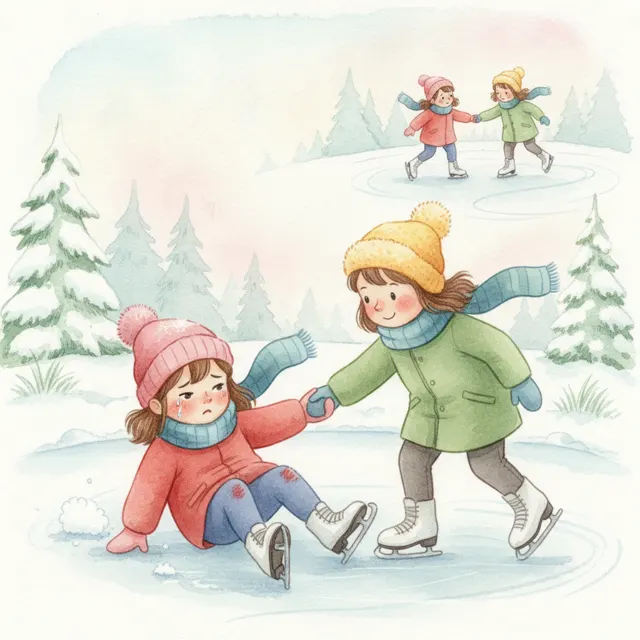
Lily Keeps on Skating story for kids illustration

Lily gets shiny new skates but falls down again and again on the ice. Her knees hurt and she wants to quit. With a friend holding her hand, she stands up one more time and glides.

Moral: Fall down, stand up, and try one more time.

Lily got shiny new ice skates for her birthday. She could not wait to glide like the big kids at the rink. At the rink, Lily stepped on the ice. Her feet slid out from under her. Thump! She fell on her bottom. "That hurt," Lily said. She stood up and tried again. Thump! She fell again. Lily sat on the ice. Her knees hurt. Her hands were cold. "Skating is too hard," she said with a sigh. "I want to go home." Her friend Ada skated over. "Do not quit yet," Ada said. "Everyone falls at first. Watch." Ada showed Lily how to bend her knees and push with one foot. "Hold my hand," Ada said. Lily took Ada's hand. They pushed off together. Lily wobbled. She almost fell. But she squeezed Ada's hand and stayed up. "I am moving!" Lily said. They went around the rink once. Then twice. Lily's legs shook, but she kept going. "Let go for a second," Ada said. "Try by yourself." Lily let go. She pushed off slowly. One foot, then the other. She glided all the way to the wall. "I did it!" Lily shouted. "I skated by myself!" Ada clapped. "See? You just had to fall a few times first." Lily smiled. "Falling is part of learning," she said. "Now watch me go again," she said with a big smile. She pushed off from the wall and glided across the ice. Her shiny skates sparkled. She was not the fastest skater in the rink, but she was a real skater now.

The Tall Tower of Blocks

Ages 3-84 minutespatience
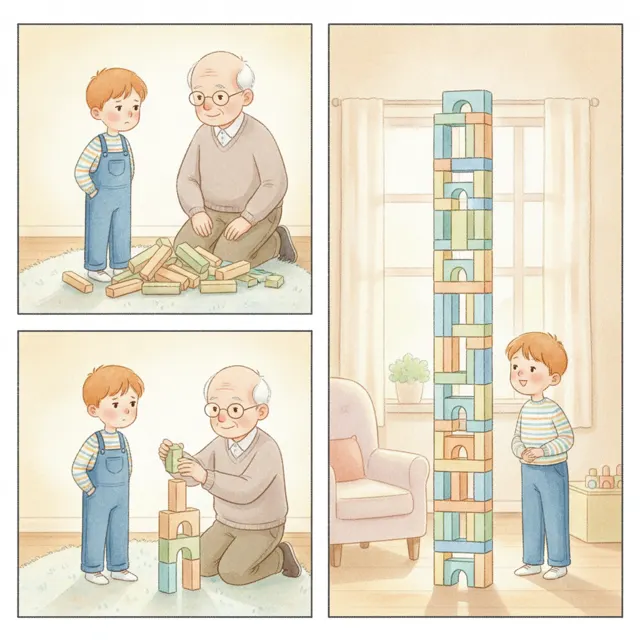
The Tall Tower of Blocks story for kids illustration

Jon wants to build the tallest block tower ever. It falls down twice because he rushes. His grandpa shows him how to stack slowly and carefully. The tower grows tall and strong.

Moral: Slow and careful hands build the tallest towers.

Jon had a big box of blocks. He wanted to build the tallest tower ever. "I will make it touch the sky," he said. Jon stacked blocks as fast as he could. One, two, three, four. The tower grew fast. Then it wobbled. Crash! The blocks fell all over the floor. "Too fast," Jon said. He tried again. He stacked faster this time. Five blocks, six, seven. The tower leaned to one side. Crash! Down it came again. "I give up," Jon said. "These blocks hate me." His grandpa sat down next to him. "The blocks do not hate you," Grandpa said. "They just need slow, careful hands." "I want it done fast," Jon said. "Fast towers fall down," Grandpa said. "Tall towers take time. Let us build it together, one block at a time." Jon picked up one block. He set it down flat. He picked up another and set it right on top, in the middle. He did not rush. "Now another," Grandpa said. "Make sure it is steady before you add the next one." Jon stacked slowly. Block by block, the tower grew. It did not lean. It did not wobble. It stood straight and tall, taller than Jon's knees, then taller than the table. "Look how high it is!" Jon said. He put on the very last block. The tower stood tall and still. It did not fall. "I did it," Jon said softly. "Slow and steady won." Grandpa nodded. "The tower is strong because you took your time." Jon sat back and looked at his tall tower. "Next time I will not rush," he said. "Good things are worth going slow."

Sam's Messy First Drawing

Ages 3-83 minuteseffort
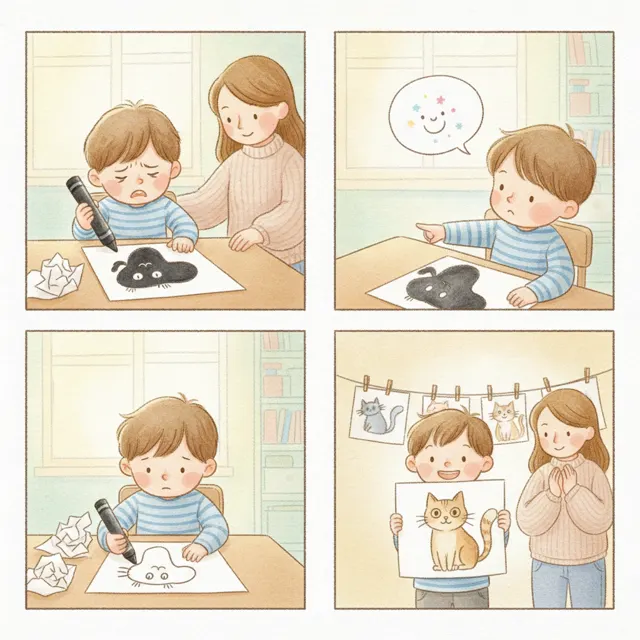
Sam's Messy First Drawing story for kids illustration

Sam draws a cat that looks like a blob. He wants to tear it up. His teacher tells him every artist starts with a messy first try. Sam keeps drawing, and each cat looks better.

Moral: A messy first try is the start of something better.

Sam loved to draw. One day he drew a cat. He drew the head, the body, and the tail. Then he looked at it. The cat looked like a lumpy blob. "This is terrible," Sam said. He wanted to rip the paper. His teacher, Mrs. Bell, came over. "Let me see," she said. Sam hid the paper. "It is ugly," Sam said. "My cat looks like a rock." "Sam," Mrs. Bell said, "every good artist starts with a messy first try. Even the best painters made blob cats when they began." "They did?" Sam asked. "They did," Mrs. Bell said. "The magic is in the second try, and the third. Do not tear it up. Try again." Sam picked up his pencil. He drew another cat. This one had ears that did not match and a wavy tail. But it looked a little more like a cat. "Better," Sam said. "But still messy." "Try once more," Mrs. Bell said. Sam drew a third cat. He took his time. He made two round eyes, whiskers, and a curling tail. When he looked, the cat was smiling back at him. "That one is good!" Sam said. "Look at the difference," Mrs. Bell said. "The messy first try taught you how to make the third one better." Sam taped all three cats to the wall. The blob cat, the wavy cat, and the smiling cat. "I am going to keep my messy first try on the wall," Sam said. "It shows how far I came."

The Hill That Fought Back

Ages 3-84 minutesdetermination
The Hill That Fought Back story for kids illustration

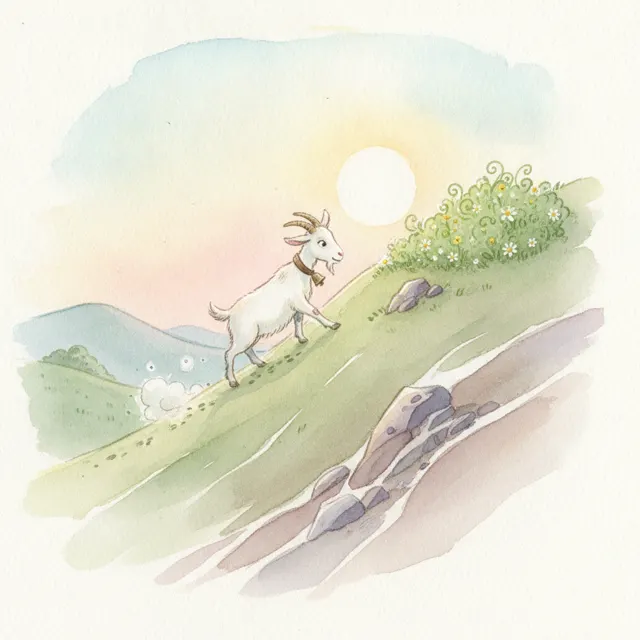
Every day, little goat Juno tries to climb the steep hill to the sweet grass at the top. She slips and slides back down. She keeps going one small step at a time until she reaches the top.

Moral: Keep going one small step at a time, and you will reach the top.

Juno was a little goat who lived at the bottom of a steep hill. At the top of the hill grew the sweetest green grass. Juno wanted to eat that grass more than anything. Juno started to climb. The hill was steep and rocky. Her hooves slipped. She slid all the way back down. "That hill is mean," Juno said. The next day, she tried again. She climbed a little higher. Then her foot hit a loose rock. Down she slid, right back to the bottom. "It is too hard," Juno said. "I will never get to the top." A big old goat named Bruno watched her. "Do not look at the whole hill," Bruno said. "Just take one small step. Then another. The top comes one step at a time." Juno looked up. The hill looked so tall. Then she looked down at her own feet. "One step," she said. She took one small step. She did not look up again. She only looked at the rock right in front of her. Step. Step. Step. Her legs got tired, but she kept going. Halfway up, she wanted to stop. "My legs hurt," she said. "One more step," Bruno called from below. "Just one." Juno took one more step. Then another. The sweet smell of grass reached her nose. She looked up. The top was right there. She climbed the last bit and stood at the top. The sweet grass was everywhere. Juno took a big, happy bite. "I did it!" she called down to Bruno. "One step at a time!" "Now you know the secret," Bruno said. "Big hills are just lots of small steps." Juno chewed her sweet grass. It tasted better because she worked so hard to reach it.

Benny Learns to Whistle

Ages 3-83 minutespersistence
Benny Learns to Whistle story for kids illustration

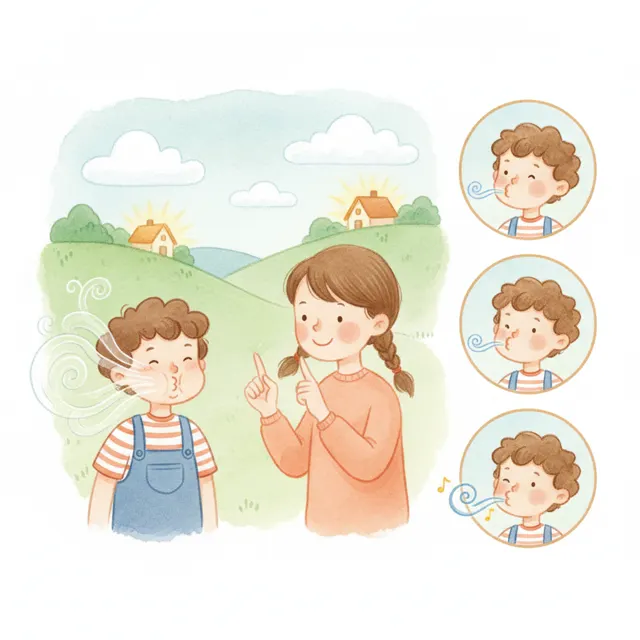
Benny tries to whistle one big try, but only air comes out. His sister tells him to practice a little every day. Day by day, a tiny sound grows into a real whistle.

Moral: A little practice each day can do what one big try cannot.

Benny wanted to whistle like his big sister, Maya. Maya could whistle any song. Benny blew and blew, but only air came out. Not one note. "I want to whistle now!" Benny said. He blew as hard as he could. Pfff. Nothing. "Whistling is not a one big try thing," Maya said. "It is a little practice every day thing." "That takes too long," Benny said. "Try just shaping your mouth today," Maya said. "Just that." So Benny shaped his mouth into a small O. He did it all day. At dinner, at the bath, before bed. Just the shape, no sound. The next day, Maya said, "Now add a little air. Softly." Benny shaped his mouth and blew softly. A tiny puff of air came out. "I heard something!" he said. It was very small, like wind through a crack. "It is starting," Maya said. "Practice a little more." Benny practiced every day. On day three, a small squeak came out. On day five, the squeak lasted a whole second. On day seven, Benny made a real, clear whistle. "Listen!" Benny said. He whistled a long, bright note. Then he whistled two notes. Maya clapped. "You did it! All those little practices added up." Benny whistled all the way to the kitchen and all the way back. "I can whistle!" he sang. "And I learned that little bits of practice beat one big try." That night, Benny whistled himself to sleep. Just a little. It was the best sound he had ever made.

Priya's Perfect Cartwheel

Ages 3-84 minutespractice
Priya's Perfect Cartwheel story for kids illustration

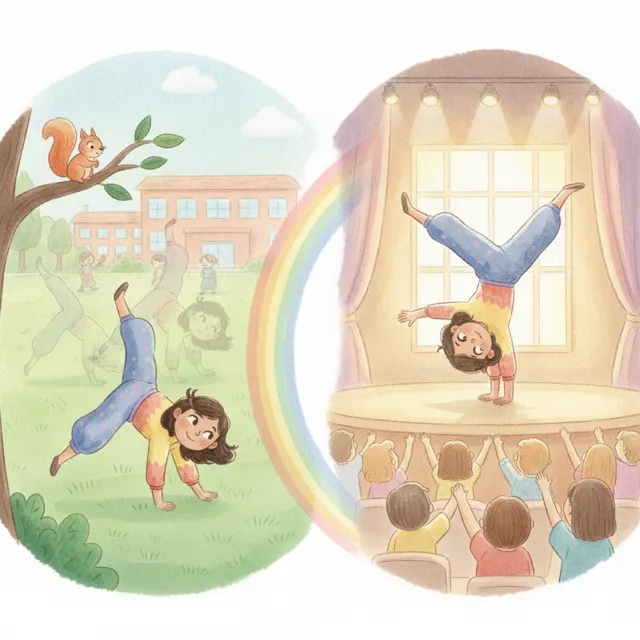
Priya wants to do a cartwheel at the school show. Her legs go wobbly and she flops over sideways again and again. She practices every day, and by show time her cartwheel is straight and strong.

Moral: Every great trick starts with many wobbly tries.

Priya wanted to do a cartwheel at the school show. Her friend Meena could do one perfectly. Priya's legs went all wobbly, and she flopped over sideways. "Your legs are not straight," Meena said. "Try it against the wall first." Priya tried. Flop. She landed in a heap on the mat. She tried again. Flop. Her cartwheel looked like a bent pretzel. "I will never do it," Priya said. "My cartwheel is broken." "It is not broken," Meena said kindly. "It is just new. Every great trick starts with many wobbly tries." Priya tried every single day after school. On Monday, her legs went a little higher. On Tuesday, she almost stayed straight. On Wednesday, she got both feet over, but she fell at the end. "I got my feet over!" Priya shouted. "That is the first time!" "See?" Meena said. "You are so close now." On Thursday, Priya tried in the yard. She put her hands down, kicked her legs up, and swung them over. Her feet landed one after the other. She stood up tall. "I did a cartwheel!" Priya yelled. "A real one!" She did another one. And then another one. Each one was straighter than the last. At the school show, Priya stepped onto the mat. She took a deep breath. Hands down, legs up, and over. She landed with her arms in the air. Everyone clapped and cheered for her. Priya bowed. "I fell a hundred times to do that one cartwheel," she said. "And it was worth it."

The Garden That Needed Time

Ages 3-83 minutespatience
The Garden That Needed Time story for kids illustration

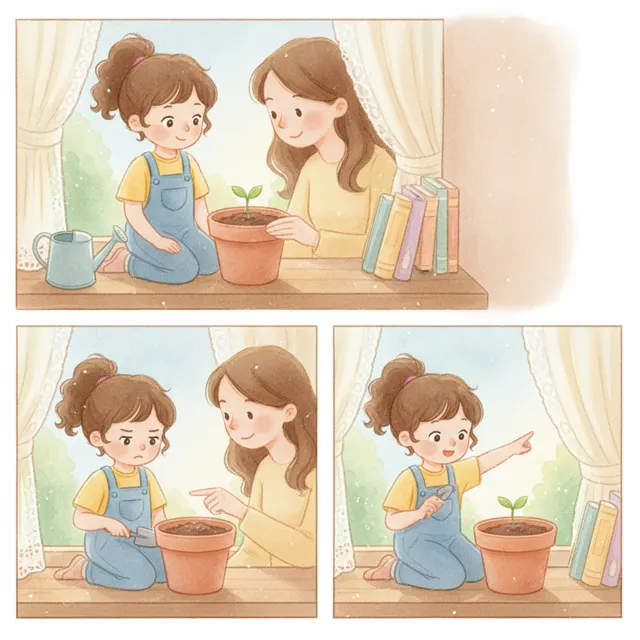
Tara plants a sunflower seed and waits for it to grow. Day after day, the pot stays just dirt. She wants to dig it up, but her mom tells her to be patient. One morning, a green sprout appears.

Moral: Good things grow when you keep caring and wait.

Tara planted a little sunflower seed in a pot. She watered it with care and put it in the warm sun. The next day, she ran to look at the pot. There was nothing there. "Where is my flower?" Tara asked. "It did not grow." "Give it time," her mom said with a smile. "Seeds do not hurry." Tara checked the pot every single day. Day after day, the pot stayed just dirt. Tara felt sad. "Maybe my seed is broken," she said. "It is not broken," Mom said. "It is working under the dirt, where you cannot see. Roots are growing first." Tara wanted to dig it up and look. "But I want to see it now," she said. "If you dig it up, it will stop growing," Mom said. "Keep watering it and wait. Good things take time." So Tara kept watering her pot. She talked to it softly. "Grow, little seed," she said. "I am waiting for you." Then one morning, Tara looked and saw a tiny green sprout poking out of the dirt. "It came!" she shouted. "My seed is growing!" The sprout grew taller each day. It opened two little leaves, then four. Soon a strong green stem stood in the pot, reaching for the sun. "See?" Mom said. "It was growing the whole time. You just had to wait and keep caring for it." Tara smiled at her little plant. "You were worth the wait," she said. "The best things grow when you are patient."

Ravi Ties the Knot

Ages 3-84 minutespractice
Ravi Ties the Knot story for kids illustration

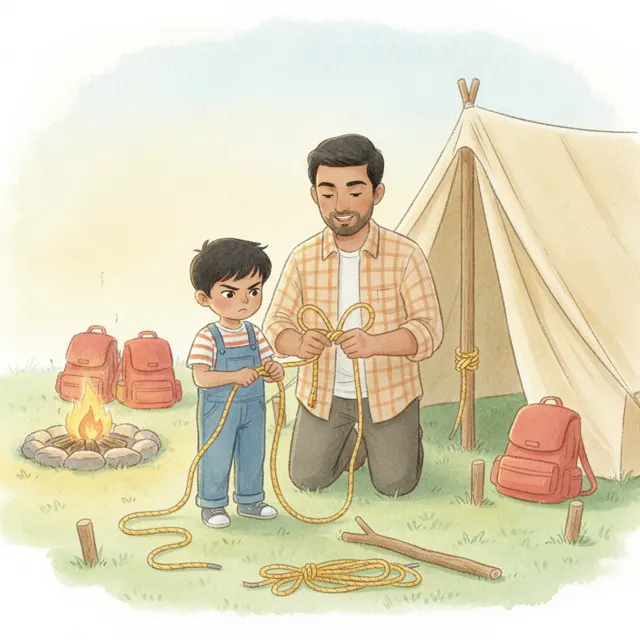
Ravi wants to tie the tent ropes by himself before a camping trip. The rope keeps slipping out of his hands. His dad shows him the same knot, and Ravi practices it again and again until it stays.

Moral: A tricky task gets easier each time you try it.

Ravi was going camping with his dad in the woods. He wanted to tie the rope to the tent all by himself. But tying knots was tricky and hard. The rope slipped out of his hands every single time. "I cannot tie a knot," Ravi said. "The rope just slides." Dad showed him. "Make a loop, pull the end through, and pull tight," he said. His knot was neat and strong. Ravi tried once. His loop fell apart. He tried again. The rope came loose the second he let go. "This is too hard," Ravi said, feeling cross. "It was hard for me too, the first time," Dad said. "Knots take a lot of practice. Try the same knot three more times." Ravi tried three more times. Each knot was a little neater. By the third one, the rope stayed tied when he pulled. "Look!" Ravi said. "It is staying!" "That is it," Dad said. "Now do it ten more times so your hands remember." Ravi tied the knot ten more times, one after another. His fingers got faster. His knots got tighter. Soon he could tie the knot without even looking at his hands. On the camping trip, Ravi tied every rope. He tied the tent ropes, the food bag ropes, and even the little swing rope. "You are the knot expert now," Dad said with a grin. Ravi grinned. "I am," he said proudly. "A tricky task gets easier every time you try it. I just had to keep practicing."

The Boat That Kept Sinking

Ages 3-84 minutesperseverance
The Boat That Kept Sinking story for kids illustration

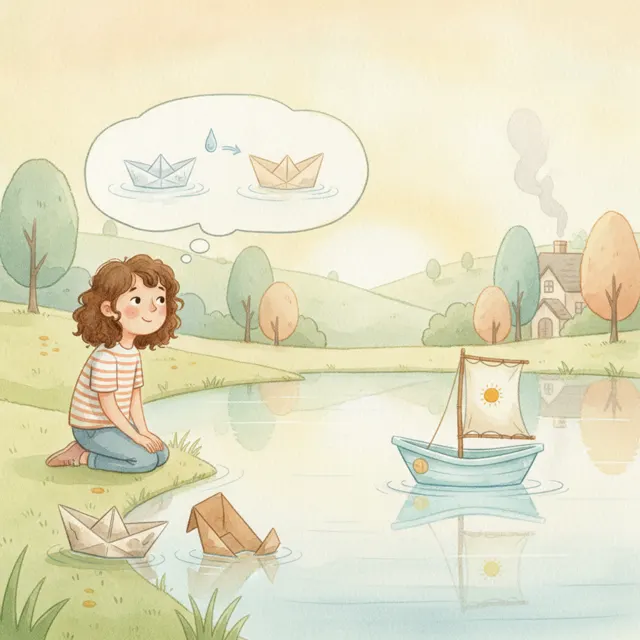
Maya builds a boat for the pond, but paper and cardboard both sink. Each sinking teaches her something new. She builds a plastic boat with a low, light sail, and it floats across the water.

Moral: Do not stop when it sinks; find a better way to build.

Maya wanted to make a boat that floats in the pond. She folded paper into a boat shape and set it in the water. The paper got wet and sank. Glub. Down it went. "Paper is too soft," Maya said. "I will use cardboard." She built a cardboard boat. It floated for a little while. Then it soaked up water and sank too. "Cardboard is too weak," Maya said. "I will use a plastic lid." The plastic lid floated! Maya put a little stick for a mast and a leaf for a sail. But when she blew on it, the boat tipped over. Splash! The leaf sail fell in the water. "Nothing works," Maya said. "Maybe I should give up." "Good builders do not stop when it sinks," her grandpa said. "They find a better way. What did each boat teach you?" Maya thought. "Paper taught me it needs to be strong. Cardboard taught me it must not soak up water. The lid taught me the sail must be light and low." "Then you know exactly what to build next," Grandpa said. Maya took the plastic lid and taped a small, light leaf flat on top for the sail. She set it gently in the pond. It floated. It did not tip. The wind pushed it across the water. "It is sailing!" Maya shouted. "My boat works!" Grandpa smiled. "You did not give up. You made a better plan each time." Maya watched her little boat glide. "Sinking was not the end," she said. "It was just a clue for how to build better."

Ella's Hard Spelling Test

Ages 3-83 minuteseffort
Ella's Hard Spelling Test story for kids illustration

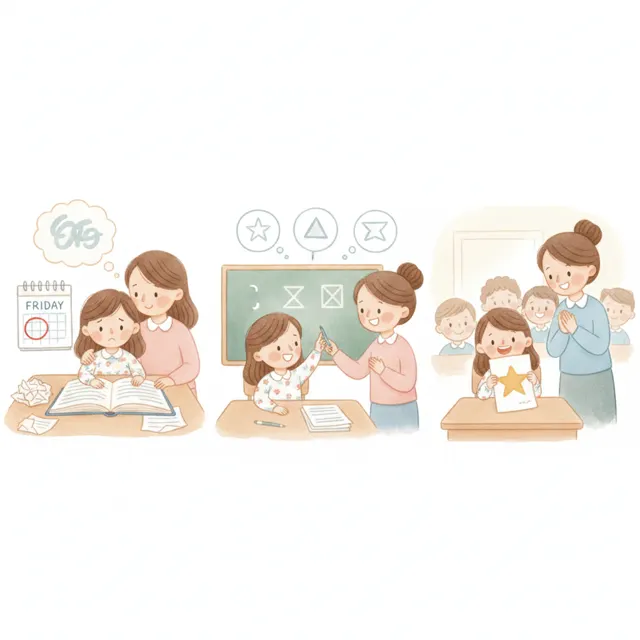
Ella has a big spelling test on Friday with hard words. She feels scared at first, but her mom teaches her to learn three words a day. By test day, Ella knows every word and earns a gold star.

Moral: Studying a little every day helps you pass a hard test.

Ella had a big spelling test coming up on Friday. The words were hard, like elephant, dinosaur, and beautiful. Ella looked at the long list and felt scared inside. "I cannot learn all these words," she said. "There are too many." "You do not have to learn them all at once," her mom said gently. "Learn three words a day. By Friday, you will know them all." So Ella sat down and learned three words on Monday. She wrote each word three times and said them out loud, slowly. On Tuesday, she learned three more words. On Wednesday, she learned three more after that. "This is working," Ella said. "I already know six words." On Thursday night, she practiced all the words one more time with her mom. She spelled elephant, dinosaur, and beautiful without even looking at the list. On Friday, Ella sat at her desk. Her teacher said, "Spell the word beautiful." Ella took a deep breath. "B-e-a-u-t-i-f-u-l," she said. "Correct!" her teacher said. Ella spelled every single word right on the test. She got a big shiny gold star on her paper. "How did you do it?" her friend asked in wonder. "I studied a little bit every day," Ella said. "Not all at once. A little bit of work each day beats one big last minute panic." Ella took her test home and showed it to her mom with a smile. "You were right," she said. "Small steps add up to big wins." She taped the star above her desk to remind her.

The Boy Who Jumped Rope

Ages 3-85 minutesdetermination
The Boy Who Jumped Rope story for kids illustration

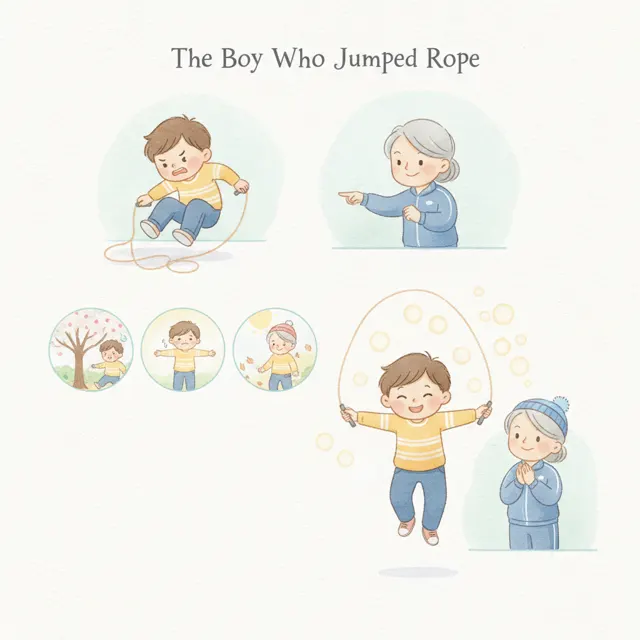
Dev wants to jump rope ten times in a row, but he cannot even jump once. His coach tells him to focus on one jump at a time. Dev practices all season until he reaches ten.

Moral: You can reach a big goal one jump at a time.

Dev could not jump rope. His friends made it look so easy. The rope swung over their heads and under their feet, fast as a spinning blur. Dev tried, and the rope smacked his legs. "Ouch," Dev said. He got up and tried again. The rope got tangled around his ankles. He hopped and tumbled right over. "I want to jump ten times in a row," Dev said. "But I cannot even jump once." "You are thinking about ten jumps," his coach said. "Think about one. Just jump once over the rope." Dev swung the rope slowly. He jumped. The rope went under his feet. "I did one!" he said. "Now do one more," the coach said. Dev jumped again. One more time. Then one more. Soon he could do two jumps in a row, then three. "Now you are getting it," the coach said. Dev practiced every day. He jumped two, then five, then seven times in a row. His legs got stronger. His timing got better. On the last day of the season, Dev stood with his rope. "One jump at a time," he whispered. He started to jump. One, two, three, four, five, six, seven, eight, nine, ten! "Ten jumps!" Dev shouted. "I did it!" All his friends cheered and clapped. "You practiced all season long," his coach said. "That is how big goals are reached." Dev grinned wide. "Ten jumps felt impossible at first," he said. "But really it was just ten little ones, one after another."

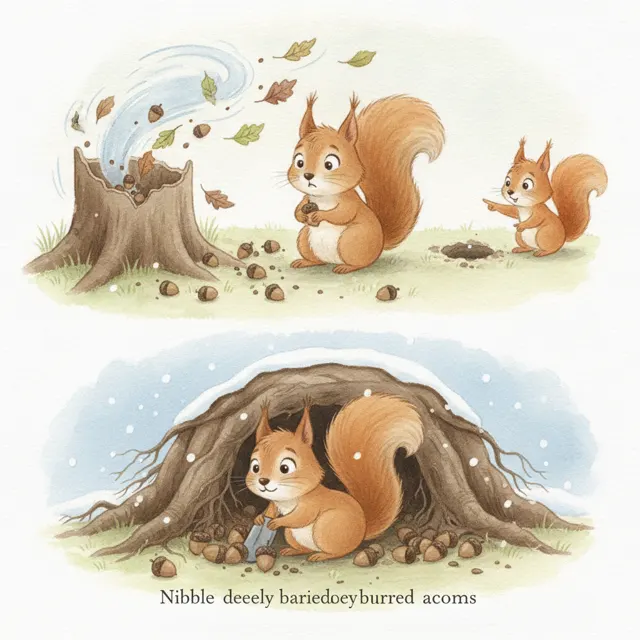
The Squirrel Who Planted Again

Ages 3-83 minutesperseverance
The Squirrel Who Planted Again story for kids illustration

Nibble the squirrel hides acorns for winter, but a strong wind scatters them all. Her friend Pip tells her to gather them again and hide them deeper. Nibble plants again and stays fed all winter.

Moral: When the wind blows your work away, plant it again.

Nibble the squirrel gathered acorns all autumn. She dug a small hole under the oak tree and hid them away for winter. The next day, a strong wind blew through the woods. It scattered all her acorns across the ground. "My acorns!" Nibble said. "All my work is gone." She looked at the acorns rolling away in the wind. Her tail drooped. "I will have nothing to eat this winter," she said. Her friend Pip the bird landed next to her. "Do not sit in the mess," Pip said. "Gather them again. You can do it." "But I already did all that work," Nibble said. "You did it once, so you know you can do it again," Pip said. "This time, hide them deeper, where the wind cannot reach." Nibble thought about it. Pip was right. She had done it once, so she could do it again. She hopped to work. She picked up each acorn and dug a deeper hole, under a thick root. She packed the dirt down tight. The wind could not blow these away. That winter, the snow came down deep and cold. Nibble stayed warm in her tree. When she was hungry, she dug under the root and found her acorns, safe and dry. "The wind took my first try," Nibble said, munching an acorn. "But I planted again, and it was worth it." "See?" Pip said. "When the wind blows your work away, you just plant it again." Nibble smiled. "And this time, I planted it deeper."

Frequently Asked Questions

Turn Your Child Into the Hero of Their Own Story

Upload their photo and watch as AI creates a beautiful, personalized storybook with illustrations that look just like them. From $5.99/month.

✨ Make Your Child the Hero

Plans from $5.99/month