Responsibility Stories for Kids

Five warm stories about kids caring for a plant, a pet, and a promise, and learning how good following through feels.

✨ Make Your Child the Hero

Responsibility sounds heavy for a small child, but it really just means taking care of the things and promises that are yours. These responsibility stories for kids make that idea feel good instead of hard. A boy waters his bean plant, a girl searches for a lost hamster, a class shares its chores, and other little heroes learn that following through feels proud. The stories are gentle, realistic, and full of small wins a child can copy at home. With CreateStory.ai, your child becomes the hero who keeps their promise, because seeing their own face in a story about responsibility makes the lesson feel like it belongs to them.

Why do chores and jobs help children grow?

Regular small jobs teach kids to follow through and feel capable. They build the habit of being counted on. A study of nearly 10,000 parents found children who did chores in kindergarten showed stronger self-control and helping behavior by third grade (Journal of Developmental and Behavioral Pediatrics).

How can I help my child be more responsible at home?

Give one clear job and a regular time for it. Use a simple chart, and praise the effort, not just the result. Let them feel proud when they follow through.

Sample Stories

Read these stories, then create a personalized version where your child is the hero

The Boy Who Watered the Bean Plant
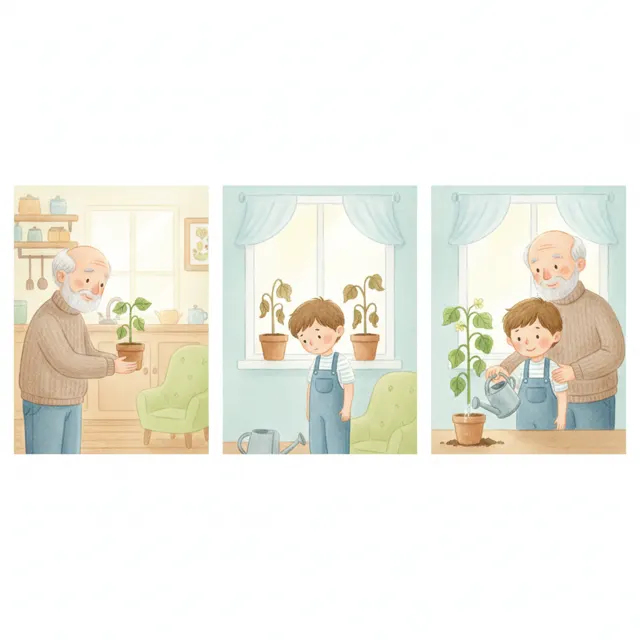
Ages 3-84 minresponsibility
The Boy Who Watered the Bean Plant story for kids illustration

Grandpa gives Sam a little bean plant and one job: water it every day. When Sam forgets for a week, the plant droops. He brings it back to life and learns that caring for something takes showing up.

Moral: Taking care of something means showing up for it every day, and it grows for you.

When Sam turned five, his grandpa gave him a present that was not a toy. It was a little green bean plant in a red pot. "This plant is yours now," Grandpa said. "It needs one thing from you: a little water every single day." "I can do that," Sam said, and for the first few days he did. He watered the plant each morning before breakfast and checked its leaves for new growth. Then Sam got busy. There were cartoons to watch and friends to visit, and one week he forgot all about the bean plant. When he finally remembered, the plant had gone all droopy, its leaves hanging down like sad little hands. "Oh no," Sam said, and his heart sank. "I forgot." "It's not too late," Grandpa said. "A plant is patient. It just needs you to show up." So Sam filled his little watering can and gave the plant a good drink. He moved it into the sun. The next morning he watered it again, and the next, and the next. Slowly, the leaves lifted back up and turned a happy green. A few weeks later, Sam ran into the kitchen holding something small and shiny. "Grandpa, look! A bean!" "See?" Grandpa smiled. "Take care of something, and it grows for you." Sam put the bean in his pocket and watered the plant before bed, and every day after, because now he understood. And when the bean plant grew tall and proud on the windowsill, Sam felt tall and proud right beside it.
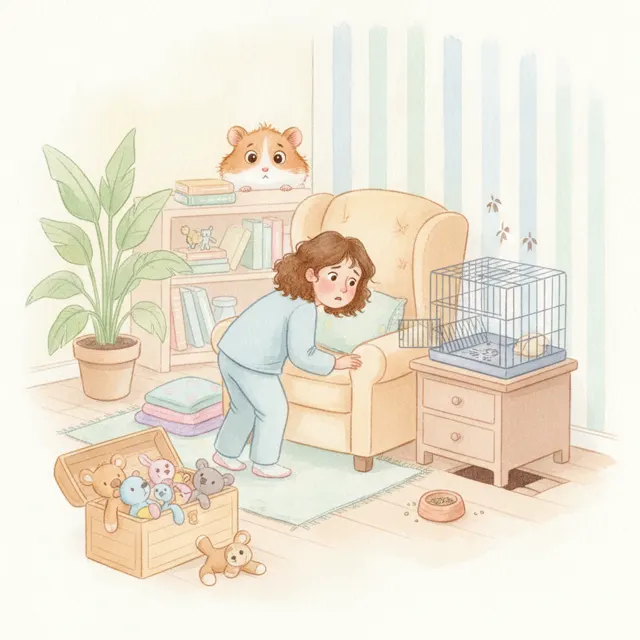
Lila and the Lost Hamster

Ages 3-84 minresponsibility
Lila and the Lost Hamster story for kids illustration

Lila promises to watch her friend's hamster while she is away, but she forgets to close the cage door. When Nibbles escapes, Lila must search everywhere and learn that a promise is a big deal.

Moral: A promise is a big deal, and keeping it, even when it is hard, is what matters.

Lila's best friend Priya was going away for the weekend, and she asked Lila to take care of her hamster, Nibbles. "I promise I'll take good care of him," Lila said. The first day, Lila filled Nibbles' food bowl and gave him fresh water. The second day, she opened the cage to pet him and forgot to close the little door all the way. That night, Nibbles slipped out and went exploring. In the morning Lila's heart nearly stopped. The cage door hung open, and Nibbles was gone. She looked under the couch, behind the bookshelf, inside the shoe box. No Nibbles. "Mom!" she cried, near tears. "I lost Priya's hamster. I promised I'd take care of him, and I didn't." "Then let's keep that promise," Mom said. "Let's think like a hamster. Where would he hide?" They searched together. They found Nibbles at last behind the washing machine, nestled in a pile of warm towels, fast asleep. Lila carried him back to his cage and closed the door until it clicked. Then she sat beside the cage and talked to Nibbles the rest of the weekend, because she was not taking her eyes off him again. When Priya came home, Lila told her the truth. "I'm sorry," she said. "I almost broke my promise." "You found him and told me the truth," Priya said. "That's taking care of him too." And Lila felt a little better, and a lot more careful. And she promised herself that next time, she would double check every little door.

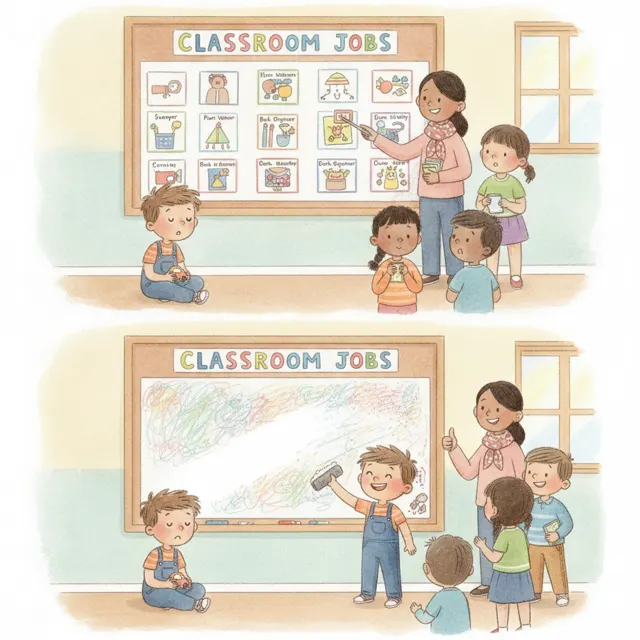
The Classroom Jobs Chart

Ages 3-83 minresponsibility
The Classroom Jobs Chart story for kids illustration

Ms. Patel's class makes a jobs chart, and everyone picks a chore. Benny the eraser monitor forgets his job until the board is a mess. When he finally does it, he feels how good contributing feels.

Moral: Doing your small part is how a whole classroom works, and it feels good to help.

On Monday, Ms. Patel hung up a big jobs chart with pictures of every job the class needed. There was line leader, plant waterer, paper passer, and eraser monitor. "Everyone picks one job and does it all week," she said. "A classroom works when everyone does their part." Benny picked eraser monitor, because he liked the idea of clapping the erasers together outside. But when it came time to actually do it, Benny forgot. Day after day the board got chalkier and chalkier, until the numbers looked like they were wearing gray sweaters. "Benny," Ms. Patel said on Thursday, "the board really needs its eraser monitor." Benny sighed and shuffled to the front. He clapped the erasers outside until the chalk dust puffed away in little clouds. Then he washed the board with a wet cloth until it was clean and bright. It took longer than he thought, but when he stepped back, the board looked brand new. "Wow," he said quietly. "That actually feels good." The next day Benny did his job without being asked. He even wiped down the chalk tray and lined up the erasers in a neat row. On Friday, Ms. Patel wrote on the clean board: GREAT JOB, CLASS. And Benny smiled, because he knew he had a little piece of that message too. From then on, Benny was the first to do his job every day, because he had learned that a classroom, like a team, only works when everyone shows up and does their part.

The Girl Who Returned the Library Book

Ages 3-83 minresponsibility
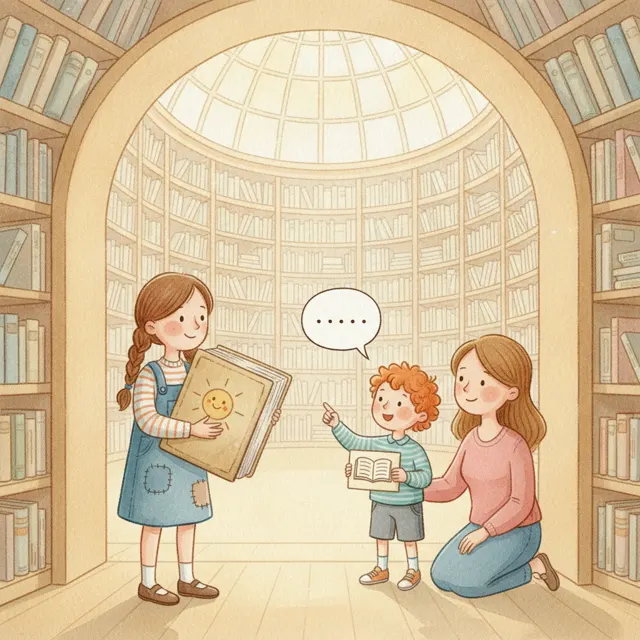
The Girl Who Returned the Library Book story for kids illustration

Ava keeps a library book so long it almost feels like hers. When she finally returns it, she discovers another kid has been waiting for it, and she learns that returning what you borrow is part of sharing.

Moral: Returning what you borrow, and on time, is a way of keeping a promise you share with everyone.

Ava borrowed a book from the school library called The Whale and the Lighthouse, and she loved it so much that she kept it on her nightstand for weeks. She read it every night, traced the pictures with her finger, and even slept with it under her pillow. The due date came and went. Ava knew she should return it, but every time she thought about it, she thought, one more night. One day her teacher announced, "Ava, the library says that book is very overdue. Another student has been asking for it for two weeks." Ava's stomach dropped. She had not thought about the other kids who might be waiting. The book felt like hers, but it was not. It belonged to everyone in the school. That afternoon she carried the book to the library and put it in the return slot. Then she did something brave. She found the librarian and said, "I'm sorry I kept it so long. Someone else wanted to read it." The librarian smiled. "Thank you for returning it, Ava. And guess what? Because you came back, I can show you the newest book by the same author. It just arrived." Ava's eyes went wide. She checked out the new book right away, and this time she wrote the due date on her hand so she would not forget. She learned that a library book is a promise you share with the whole school, and returning it on time is how you keep that promise.

Ben's First Allowance

Ages 3-85 minresponsibility
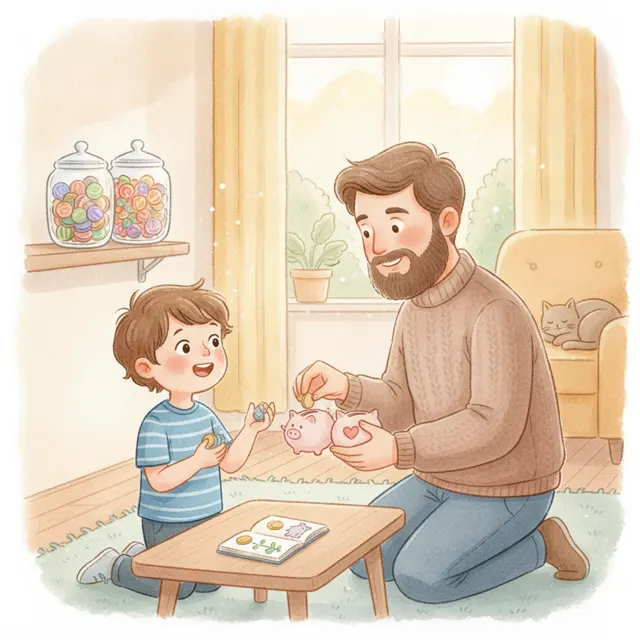
Ben's First Allowance story for kids illustration

Ben gets his first allowance and wants to spend it all on candy. His dad shows him how to save a little and share a little, and Ben learns that handling money is a kind of responsibility too.

Moral: Money is a responsibility too, and planning what to save, spend, and share makes it grow into good things.

On his sixth birthday, Ben's dad sat him down and said, "You're old enough now for an allowance. Every Saturday you'll get five coins, and you get to decide what to do with them." Ben could hardly sleep that night. Five coins! He could buy candy, or a toy car, or three whole packs of stickers. The first Saturday, Ben took his coins straight to the corner store and spent every single one on candy. By Sunday afternoon the candy was gone, and so were his coins. "Where did it all go?" Ben asked, licking sugar off his fingers. "That's the thing about money," Dad said. "It goes fast if you don't plan. Let me show you a trick." Dad brought out three little jars. He wrote SPEND on one, SAVE on one, and SHARE on one. "Every week, put some coins in each jar. The spend jar is for little treats now. The save jar is for something big later. And the share jar is for helping someone else." Ben tried it. Each Saturday he split his coins into the three jars. It was hard at first, but watching the save jar fill up felt like a secret power. After two months, Ben had saved enough for the toy fire truck he had been eyeing, and he used his share jar to buy a sandwich for a man who had none. He had never felt so grown up in his whole life. And he never spent his whole allowance on candy again, because now he had a plan.

The Fish Who Needed Feeding

Ages 3-82 minutesresponsibility
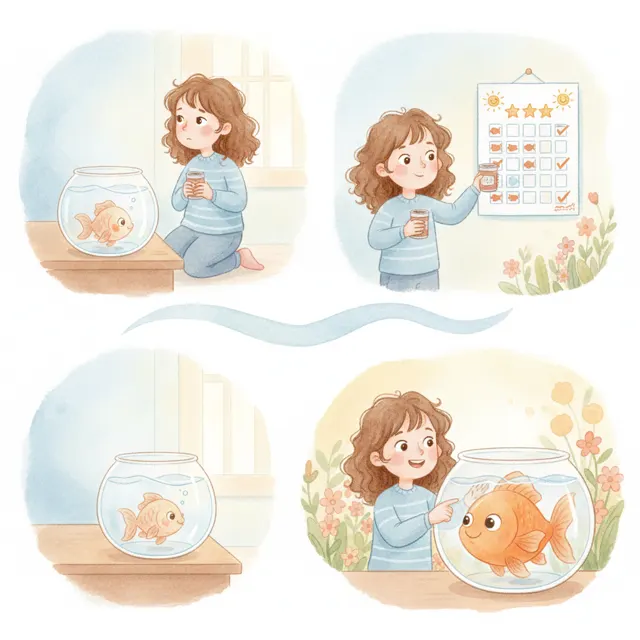
The Fish Who Needed Feeding story for kids illustration

Ana gets a pet fish and promises to feed it. At first she forgets, and the fish looks weak. Ana makes a chart and feeds it every day. The fish grows strong, and Ana learns feeding a pet is a promise.

Moral: Feeding a pet is a promise you keep.

Ana got a pet fish. It was orange and silver. She named it Sunny. "Sunny is your pet now," said Dad. "You must feed him every day. That is your job." "I promise," Ana said. The first week, Ana fed Sunny every morning. Then she got busy. She forgot one day. Then two. Sunny swam slower. He stayed at the bottom of the bowl. "Sunny looks sick," Mom said. "When did you feed him last?" Ana's heart sank. "I forgot," she said. "Two days ago." Ana ran to the fish food. She sprinkled a little in the bowl. Sunny swam up and ate fast. "I am sorry, Sunny," Ana said. "I promised to feed you and I forgot. Feeding you is my job." She made a chart and taped it by the bowl. It had seven boxes, one for each day. Every morning she fed Sunny and colored a box. After a week, all the boxes were full. Sunny swam fast and bright again. "You look strong, Sunny," Ana said. "I will not forget again." Mom smiled. "A pet is a promise. When we feed and care for it, we keep our word." Ana nodded. "Sunny counts on me. I will be there every day." From then on, Ana fed Sunny first thing each morning. She cleaned his bowl each week. Sunny grew big and bright. Ana learned that taking care of a pet means keeping a promise, every single day. Sunny seemed to say thank you with every happy swim. Ana never missed a feeding again.

Mia's Morning Job

Ages 3-82 minutesresponsibility
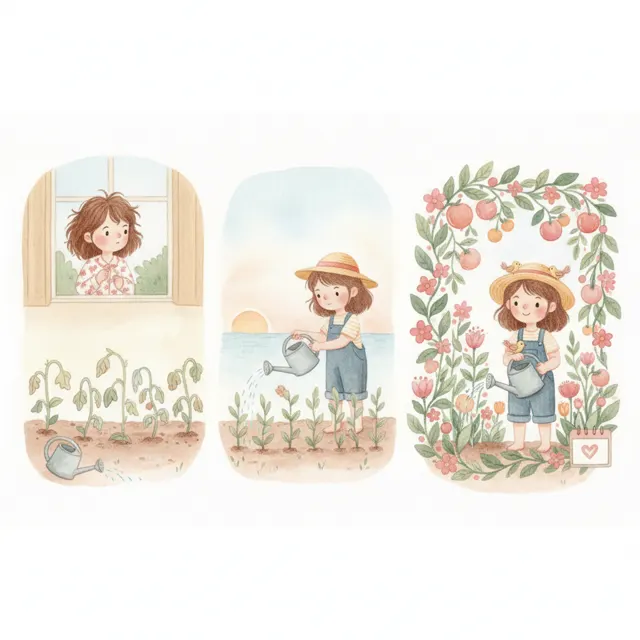
Mia's Morning Job story for kids illustration

Mia's job is to water the garden each morning. At first she forgets and the plants droop. She makes it part of her routine, and the garden grows. She learns small daily jobs become strong habits.

Moral: Small daily jobs build strong habits.

Mia had one job: water the garden every morning. Her mom showed her the watering can and the rows of little plants. "This is your job now," Mom said. "A little water every day." "Okay," Mia said. The first day she watered. The next day she forgot. She was too busy playing. The day after, she forgot again. The little plants began to droop. Their leaves turned soft and sad. Mom saw them. "The garden looks thirsty, Mia. Did you water today?" Mia looked down. "I forgot again," she said. "Let's make it easy," Mom said. "Do it right after breakfast, before play. Make it part of your morning." The next day, Mia ate breakfast and went straight to the garden. She filled the can and watered each plant. It became her habit. After a week, the plants stood tall and green. Little flowers opened. Mia felt proud. "I did that," she said. "Every day, a little water." "A small job done every day becomes a strong habit," Mom said. "You are very responsible now." Mia kept watering. The garden grew bigger. Soon there were tomatoes and bright flowers. "Your garden is the best on the street," a neighbor said. "Thanks," Mia said. "I water it every morning. It is my job." Mia learned that small jobs done every day add up to big, good things. Habits are built one morning at a time. Every bright flower and red tomato in the garden was a little reward for showing up each morning.

The Dog Walker's Rainy Day

Ages 3-82 minutesresponsibility
The Dog Walker's Rainy Day story for kids illustration

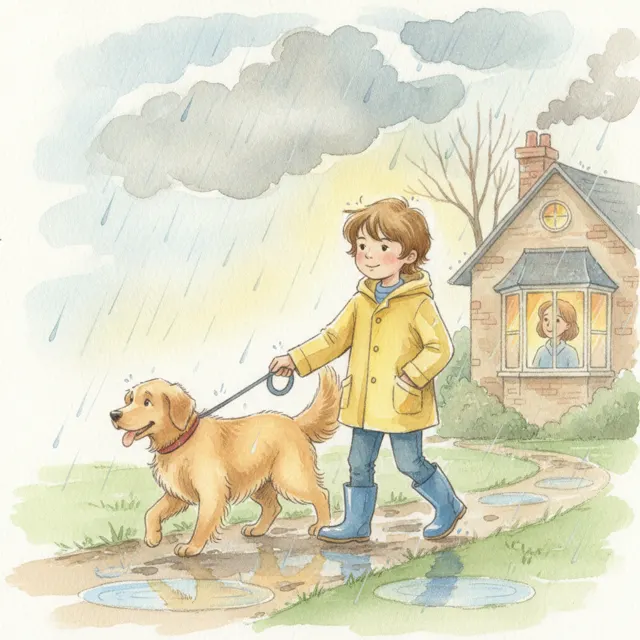
Ben promises to walk his neighbor's dog each afternoon. One rainy day he wants to stay inside. But he remembers his promise, puts on his coat, and walks the dog anyway. He learns keeping your word matters most when it is hard.

Moral: Keep your promises even when it is hard.

Ben had a job. Every afternoon he walked Mrs. Lee's dog, Biscuit. Mrs. Lee was old and could not walk far. Ben promised to help. One day it rained hard. Ben looked out the window. The rain poured down. "I do not want to go out," Ben said. "It is cold and wet." "Biscuit still needs his walk," Mom said. "You made a promise." "But it is raining!" Ben said. "Can't I skip one day?" Mom sat down. "Mrs. Lee counts on you. Biscuit counts on you too. Keeping a promise matters most on the hard days." Ben thought about it. He put on his coat and boots. He grabbed the leash and an umbrella. At Mrs. Lee's door, he knocked. Mrs. Lee opened it. "Ben! In this rain? You still came?" "I promised," Ben said. "Biscuit needs his walk." Biscuit wagged his tail and pulled Ben outside. They walked in the rain. Ben held the umbrella over both of them. Back home, Mrs. Lee gave Ben a warm cookie. "You are a boy who keeps his word," she said. "That is worth more than gold." Ben ate the cookie. He felt warm and proud, even with wet socks. "I almost skipped," he said. "I am glad I did not." "Keeping promises on easy days is simple," Mrs. Lee said. "On hard days, it shows who you are." Ben learned that a promise is a promise, even in the rain. Keeping it is what makes you dependable. And Biscuit licked his hand as if to say thank you.

The Homework That Waited

Ages 3-82 minutesresponsibility
The Homework That Waited story for kids illustration

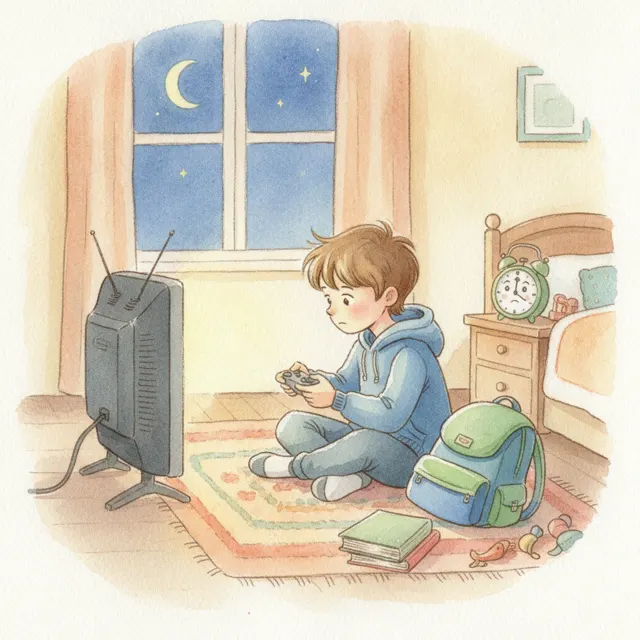
Sam wants to play video games, but he has homework. He plays first and has to rush at bedtime. The next day he does homework first, then plays with no worry. He learns doing the job first feels better.

Moral: Do your job first and play later.

Sam had homework. A whole page of math. But his new game was calling him. "I will play for ten minutes," Sam said. "Then I will do the homework." He played. Ten minutes became thirty. Then an hour. It got dark. "Homework, Sam," Dad said. "It is almost bedtime." Sam rushed. He did his math fast and messy. He made silly mistakes. He felt tired and grumpy. "That was no fun," Sam said. "I worried about the game and rushed my work." The next day Sam tried something new. He came home and did his homework first. He sat at the desk and worked slowly and carefully. When he finished, it was still light out. "Now I can play," Sam said. "And I do not have to rush." He played his game with a happy heart. No homework waiting. No worry in his head. "Which way was better?" Dad asked. "Homework first," Sam said. "I finished it well, and then I played with no worry." "Work before play," Dad said. "It makes the play sweeter." Sam nodded. "When I play first, I worry. When I work first, I am free." From then on, Sam did his work first every day. His math got neater. His game time got happier. Sam learned that doing your job first means you can play with a light heart later. His game was still there when he finished. But now it was a reward, not a hiding spot from work. Sam liked the new way much better.

The Lemonade Stand Debt

Ages 3-82 minutesresponsibility
The Lemonade Stand Debt story for kids illustration

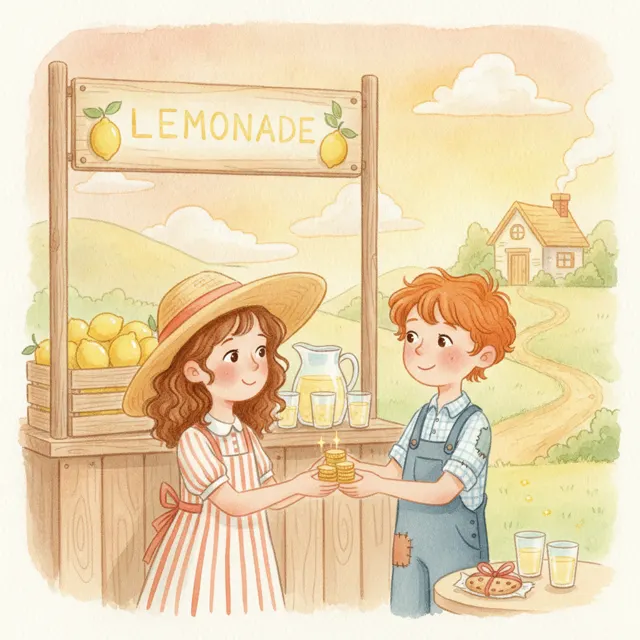
Mina borrows coins from her brother to buy lemons for her lemonade stand, promising to pay him back. The stand does well, and Mina pays him back first before buying herself a treat. She learns to keep her word about money.

Moral: Pay back what you borrow.

Mina wanted to open a lemonade stand. She needed lemons and sugar. But her money jar was empty. Her brother Omar had saved ten coins. "Can I borrow some?" Mina asked. "I will pay you back from my stand money." "Okay," Omar said. "But pay me back, promise?" "I promise," Mina said. Mina bought lemons, sugar, and cups. She made a big jug of lemonade and a sign. The neighbors came. By afternoon, she had sold it all. Her jar was full of coins. "Now I can buy a toy!" Mina thought. Then she remembered her promise. She counted out the coins she owed Omar. "Here is your money back," she said. "Thank you for lending it." Omar smiled. "You kept your word. Now you can spend the rest." Mina looked at what was left. It was less, but it was all hers. She felt good. "I will save a little and spend a little," she said. "But first, I paid my debt." "A person who pays back what they borrow is a person you can trust," Dad said. Mina nodded. "Borrowing is a promise. Paying back keeps a friendship strong." The next week Omar borrowed a book from Mina. "I will return it," he said. And he did. Mina learned that when you borrow, you must pay back. Keeping that promise builds trust with the people you love. Omar counted his coins and smiled. He knew he could always trust his sister. And Mina knew her good name was worth more than any toy.

The Classroom Plant Parent

Ages 3-82 minutesresponsibility
The Classroom Plant Parent story for kids illustration

The class gives each student a small plant to care for at home. Jonah is excited at first, then forgets, and his plant droops while others grow. He starts caring for it again and brings it back to life.

Moral: Care for the things you are given.

The class gave each student a small plant. "Take it home and care for it," the teacher said. "It is your responsibility now." Jonah was excited. He named his plant Greeny and put it by the window. He watered it the first two days. Then he got busy. He forgot to water Greeny. The little plant began to droop. Its leaves turned brown at the edges. At school, other kids' plants were tall and green. Jonah's plant looked small and sad. "What happened to Greeny?" his friend asked. "I forgot to water it," Jonah said, looking down. "I did not take care of what I was given." That night Jonah got to work. He watered Greeny and moved it to the sunny window. He talked to it. "I am sorry, Greeny. I will care for you every day." Day by day, Jonah watered. Slowly, new green leaves grew. Greeny stood tall again. "You brought it back," Mom said. "That took care and time." "Taking care of something is a promise," Jonah said. "I learned that the hard way." At school, Jonah showed his plant. It was green and strong. "I almost let it die," he said. "But I did not give up. I kept my promise." The teacher smiled. "Caring for a plant teaches you to care for people and things. Well done, Jonah." Jonah learned that when you are given something to care for, you must keep caring, every day. Greeny grew tall and bright on the window sill, a little green proof of Jonah's promise.

The Lost Library Card

Ages 3-82 minutesresponsibility
The Lost Library Card story for kids illustration

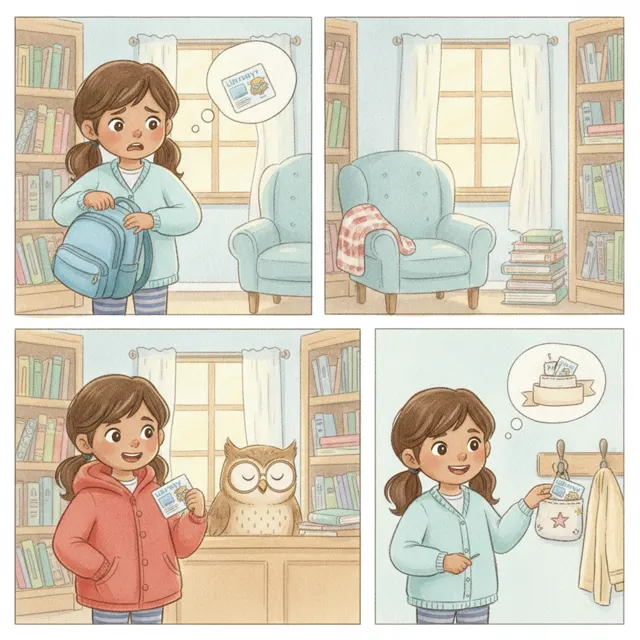
Priya loses her library card and panics. She retraces her steps and finds it in her coat pocket. She learns to put it in the same safe spot every time. Keeping track of your things is a big-kid skill.

Moral: Keeping track of your things is part of growing up.

Priya loved the library. Every week she used her card to check out books. One day she reached for her card. It was gone. Not in her pocket. Not in her bag. Not on her desk. "Oh no!" Priya said. "My library card is lost!" She felt like crying. "I always lose things," she said. "I am so careless." Her mom said, "Let's not panic. Where did you last have it?" Priya thought. "I had it on Monday, after I checked out the book about space. Then I put it... where?" She retraced her steps. She checked the book bag. She checked her coat pockets. She checked under the bed. There, in her blue coat pocket, was the card. It had been there all along. "Found it!" Priya said, holding it up. "It was in my coat the whole time." "You need one safe spot for your card," Mom said. "Always put it in the same place." Priya picked a spot: a small pocket inside her book bag. She put the card there. "This is its home," she said. From then on, every library trip ended the same way. Priya checked out her books and slid the card back into its special pocket. "No more lost cards," she said. "I know exactly where it lives." "Keeping track of your things is part of growing up," Mom said. "You are learning." Priya smiled. "A place for everything, and everything in its place." Priya learned that a safe, regular spot for your things means you never lose them again.

Frequently Asked Questions

Turn Your Child Into the Hero of Their Own Story

Upload their photo and watch as AI creates a beautiful, personalized storybook with illustrations that look just like them. From $5.99/month.

✨ Make Your Child the Hero

Plans from $5.99/month