Stories for 6 Year Olds

Smart, funny stories for kids who are figuring out the world

โœจ Make Your Child the Hero

Six-year-olds are officially in school mode. They're navigating friendships, learning to work in teams, dealing with disagreements, and discovering what they're good at. Stories for this age can afford to be a little more complex, with multiple characters, real problems to solve, and morals that make you think. At CreateStory.ai, we write stories that respect a six-year-old's growing intelligence. These six stories tackle school moments, teamwork challenges, and clever problem-solving with enough humor and heart to hold their attention from the first sentence to the last. Great for independent readers or reading aloud together.

Why do six year olds love short stories so much?

Young children learn fast. Their brains are busy making new links. Reading to them helps a lot. In fact, the share of 3-to-6-year-olds who could name all their letters rose from 21 percent in 1993 to 38 percent in 2012 (American Academy of Pediatrics, 2019).

What makes a good story for a six year old?

A good story for this age is short and clear. The words should be easy to say out loud. Kids like tales about school, friends, and feelings. A happy ending helps too. Short pages keep a young reader going all the way to the end.

Sample Stories

Read these stories, then create a personalized version where your child is the hero

The Science Fair Disaster
Ages 6-74 minschool and quick thinking
The Science Fair Disaster story for kids illustration

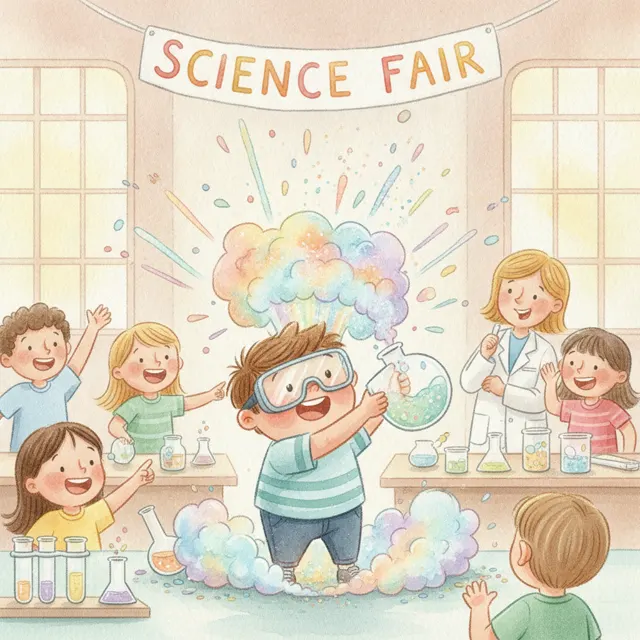
Jake's project explodes at the science fair, but his quick thinking turns the chaos into the best experiment of all.

Moral: Mistakes can turn into opportunities if you keep your cool.

Jake had been working on his volcano for three weeks. Paper mache. Red paint. The baking soda and vinegar hidden in a little bottle inside. On science fair day, he carried it carefully. So carefully. Then Tyler bumped into him. The volcano wobbled. The bottle tipped. And the experiment exploded early, right in the hallway. White foam went everywhere. On Jake. On Tyler. On the principal. Everyone went silent. Jake turned red. He wanted to disappear. But then the principal looked at the foam bubbling on the floor. "What's the chemical reaction here?" she asked. Jake blinked. "Baking soda and vinegar. Acid meets base." "Can you tell us more?" So Jake did. He explained it. He drew it on a whiteboard. He made everyone understand why the foam went everywhere. He won the "Best Explanation" prize. Tyler apologized after. "Sorry about your project." "It's okay," said Jake. "I think it worked better this way."
The Team That Couldn't Agree

Ages 6-74 minteamwork and compromise
The Team That Couldn't Agree story for kids illustration

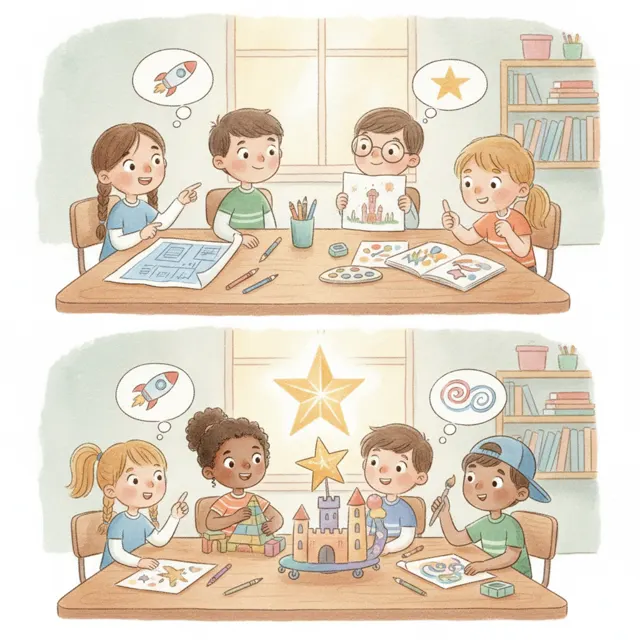
Four kids on a school project all want different things, but learning to compromise gets them a gold star.

Moral: When everyone gives a little, everyone wins a lot.

Miss Rivera gave out a big project. "Work in groups of four," she said. "Make a poster about your favorite animal." Ana wanted penguins. Ben wanted tigers. Sam wanted dolphins. Lily wanted butterflies. They argued for fifteen minutes. No one would budge. Miss Rivera walked over. "How's it going?" "Bad," said all four at once. She smiled. "What do all these animals have in common?" Silence. Then Ben said, "They're all fast in their own way." Sam's eyes lit up. "Dolphins jump!" "Penguins slide really fast!" said Ana. "Butterflies travel thousands of miles!" said Lily. "And tigers sprint at 60 miles per hour!" said Ben. "Speed and journeys," said Lily. "That's our topic!" They stayed in at lunch to work. They made a huge colorful poster. Each kid drew their animal. Ana wrote the title: "Fast and Far." Miss Rivera gave them a gold star. "I like all four animals now," said Sam. "Me too," said everyone else.

Lucy and the Lunch Box Mix-Up

Ages 6-74 minhonesty and kindness
Lucy and the Lunch Box Mix-Up story for kids illustration

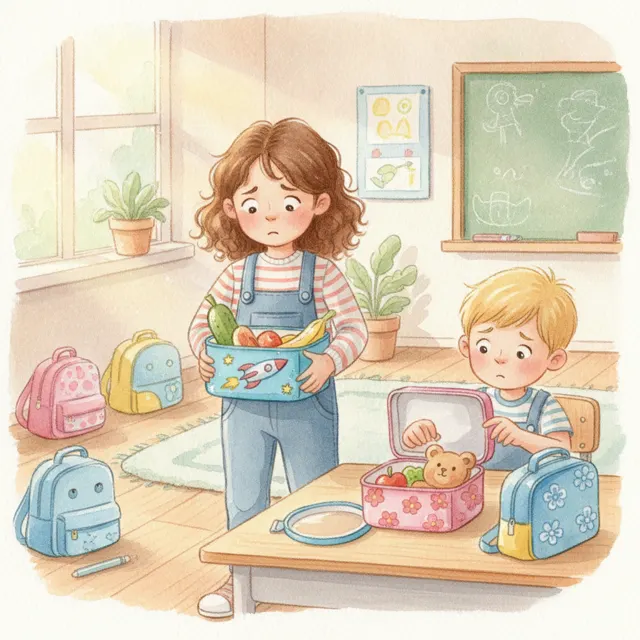
Lucy accidentally takes the wrong lunch box and has to figure out how to make things right.

Moral: Doing the right thing often leads to something better than you expected.

Lucy grabbed her lunch box from the cubby. Blue. Smiley face. Just like hers. But at lunch, she opened it. Ham sandwich. She hated ham. She looked at the tag. It said "Marcus." Oh no. She looked around. Marcus was sitting at the next table, staring at his opened lunch box with a wrinkled nose. He had her avocado wrap. He looked like he'd found a sock inside. Lucy could have said nothing. Just eaten around the ham. But that wouldn't be right. She walked over. "I think I took your lunch box by mistake." Marcus looked up. "And I took yours." They swapped. "Sorry," said Lucy. "Me too," said Marcus. Then Marcus said, "What even is an avocado wrap?" Lucy laughed. "The best thing in the world." "I'll try some if you try some of my cookie." They swapped snacks. Marcus liked the wrap. Lucy liked the cookie. "Maybe we should mix up our lunches every day," said Marcus. Lucy grinned. "Deal."

The Fastest Runner in Class

Ages 6-74 minsportsmanship and kindness
The Fastest Runner in Class story for kids illustration

Dev is the fastest runner in class, but he has to decide if winning matters more than being kind.

Moral: Being a good person matters more than being a winner.

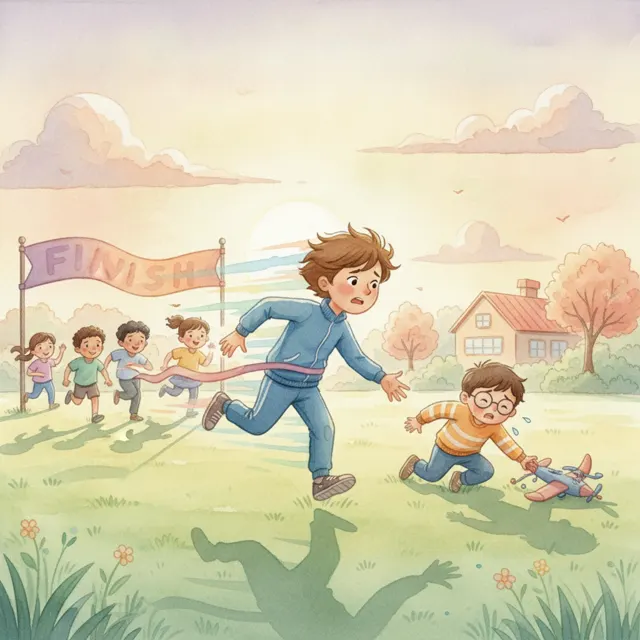
Dev was the fastest runner in Year 1. Everyone knew it. On sports day, he lined up for the 100-meter race. He looked left. He looked right. He was going to win. The whistle blew. Dev shot off. He was ahead. Way ahead. But near the finish line, he glanced back. His friend Noah had tripped. He was sitting on the track, holding his knee. Dev stopped. He jogged back. "You okay?" he asked. Noah nodded. "Just go. You'll still win." "I don't care," said Dev. He helped Noah up. By the time they crossed the finish line together, three other kids had already finished. Dev came fourth. His teacher, Mr. Obasi, came over. "Dev. That was the best thing I saw all day." "But I came fourth." "You helped your friend when you didn't have to. That's what I call a winner." Dev thought about that. He still loved running. But he knew now that winning wasn't the only reason to race.

The Secret Treehouse Club

Ages 6-74 mininclusion and friendship
The Secret Treehouse Club story for kids illustration

Mia's treehouse club has only one rule: no new members. But when a lonely new kid shows up, she reconsiders.

Moral: There's always room for one more kind person.

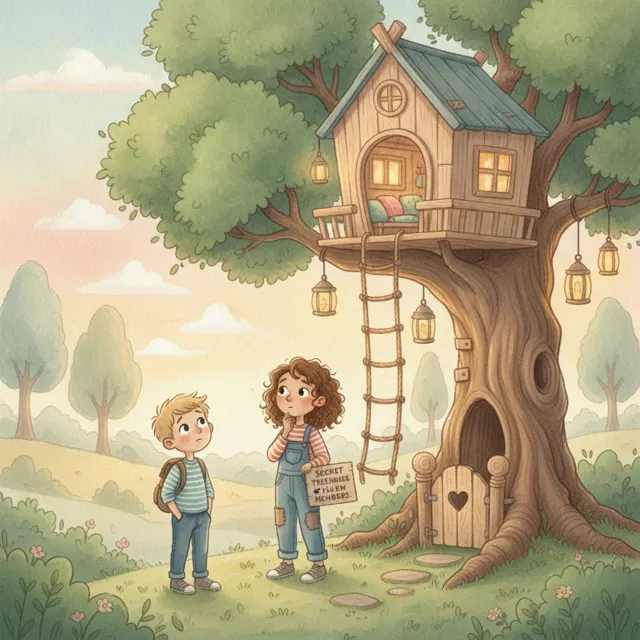
Mia's treehouse had one rule: members only. No new members. Ever. She'd built it with her friends Priya and Joe. Just the three of them. That was enough. Then a new kid moved in next door. His name was Raj. He had a lot of Lego sets and no one to play with. Every day he watched them climb up to the treehouse. Mia pretended not to notice. Rules were rules. But one afternoon it rained. The ladder got slippery. Raj, without being asked, held it steady while they climbed down. "Thanks," said Priya. "No problem," said Raj. Mia looked at him. He hadn't asked to come in. He'd just helped. "Do you want to see the inside?" she asked. Raj's face went bright. "Really?" "Yeah. But only if you share the Lego space sets." Raj laughed. "Deal." The treehouse had four members now. It felt better somehow, fuller, like a club was supposed to feel.

Why Grandpa's Garden is Magic

Ages 6-74 minhard work and patience
Why Grandpa's Garden is Magic story for kids illustration

Kai thinks Grandpa's garden has real magic, but discovers the real secret is hard work and love.

Moral: There's no shortcut for showing up and putting in the work.

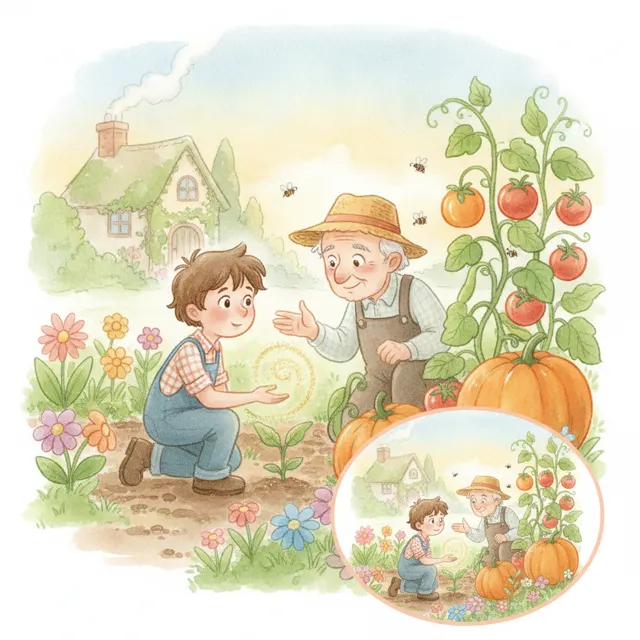
Grandpa's garden grew the biggest tomatoes in the street. His sunflowers were taller than the fence. His roses smelled like something from a dream. "It's magic," Kai told his friends. "My grandpa knows a spell." One Saturday, Kai went to the garden with Grandpa. There was no magic wand. No special words. Grandpa pulled weeds. He turned the soil. He checked the water level. He talked to the plants. "You talk to them?" asked Kai. "Every morning," said Grandpa. "I tell them what kind of day it's going to be." Kai watched. For hours. At the end of the day, his hands were dirty. His back was tired. But the garden looked beautiful. "So the magic is..." Kai started. "Showing up," said Grandpa. "Every day. Whether you feel like it or not." Kai was quiet for a moment. "That's harder than a spell." Grandpa smiled. "Much harder. And much better."

The Spelling Bee Surprise

Ages 3-83 minutesperseverance
The Spelling Bee Surprise story for kids illustration

Maya is nervous about the big spelling bee. She mixes up a word and feels sad. But her teacher shows her that trying hard matters more than a ribbon. Maya learns to be proud of her best.

Moral: Trying your best matters more than winning.

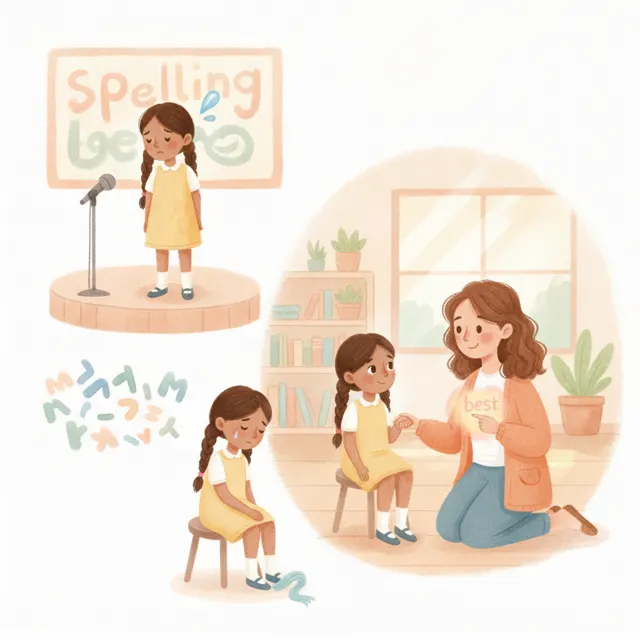
Maya stood at the front of the room. Her hands were cold and wet. The spelling bee was about to start. She looked at the big word list in her head. "First word," said Miss Lee. "Spell the word cat." Maya took a big breath. "C. A. T. Cat," she said. "Correct," said Miss Lee. The class clapped. Maya smiled a little. "Next word," said Miss Lee. "Spell the word happy." Maya felt good. "H. A. P. P. Y. Happy," she said. "Correct," said Miss Lee. Maya's face got warm. She was doing it. She spelled dog, then sun, then ball. Each time she got it right. Soon only two kids were left. Maya and a boy named Sam. "Spell the word friend," said Miss Lee to Sam. Sam spelled it wrong. He sat down and looked at the floor. Now it was Maya's turn. "Spell the word friend," said Miss Lee. Maya thought hard. "F. R. E. N. D. Friend," she said. But she said the letters too fast. She left out the I. The room went quiet. "I am sorry, Maya," said Miss Lee. "That is not right." Maya sat down. Her eyes felt wet. She had come so close. After school, Miss Lee called her over. "You spelled eight words right today," she said. "That is a lot of hard work." Maya looked up. "But I did not win." "You tried your very best," said Miss Lee. "That is what counts." Maya walked home with a small smile. She had not won the ribbon. But she had been brave, and she had done her best.

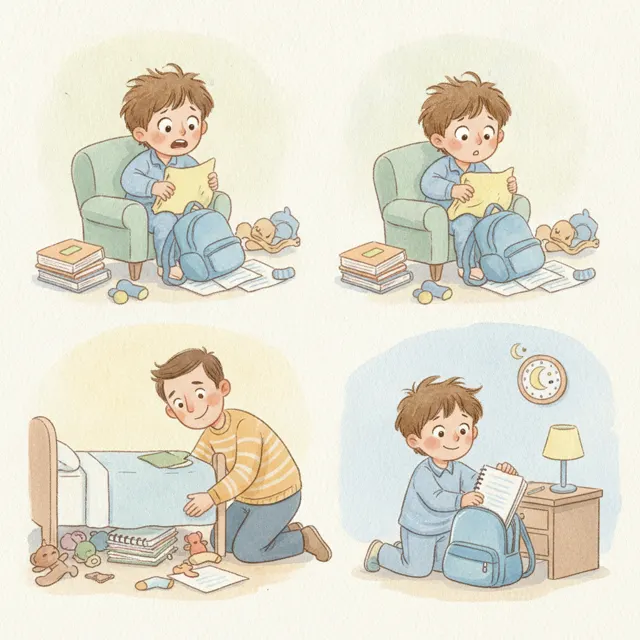
Milo and the Lost Homework

Ages 3-83 minutesresponsibility
Milo and the Lost Homework story for kids illustration

Milo cannot find his homework on Monday morning. He looks everywhere and feels worried. With help from his dad, he finds it under his bed. Milo learns to pack his bag at night.

Moral: Taking care of your things helps you be ready.

Milo was happy on Friday. He drew a big red truck for homework. He put the paper on his desk and ran outside to play. On Monday, Milo opened his bag. The truck was not there. He looked in his bag again. Nothing. "Where is my homework?" Milo said. He looked under his desk. He looked in his coat. He looked in the kitchen. His dad came in. "What are you looking for?" he asked. "My truck picture," said Milo. "I need it for school today." "Let us think," said his dad. "Where did you have it last?" "On my desk," said Milo. "On Friday." They went to Milo's room. The desk was messy. There were toys and crayons and old socks on it. "Let us look together," said his dad. They lifted the toys. They moved the crayons. Under the bed, a white paper stuck out. Milo pulled it. It was his truck picture. "Here it is!" Milo said. He was so glad. At school, he gave the picture to his teacher. She smiled. "What a fine red truck," she said. That night, Milo put his homework in his bag. He put his shoes by the door too. He did not want to lose anything again. "All ready for morning," he said to his dad. "Good job," said his dad. "That is the way to do it." Milo felt proud. His bag was ready, and so was he. From then on, he packed his bag every single night. He never lost his homework again.

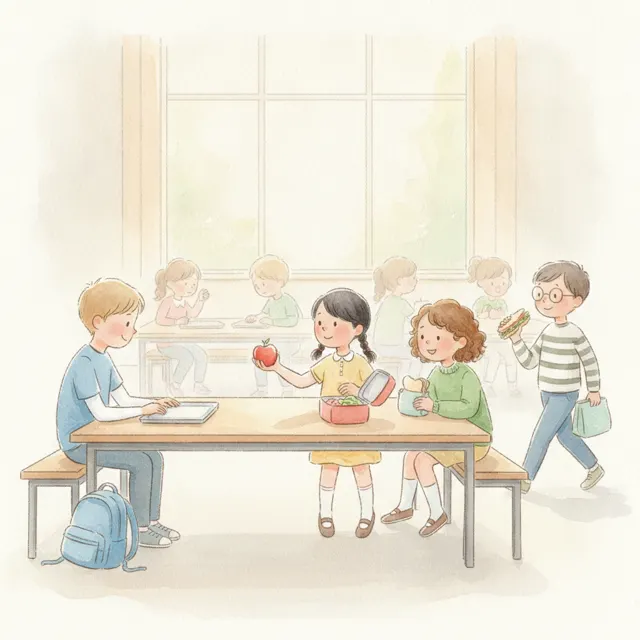
The New Kid's Lunch

Ages 3-83 minuteskindness
The New Kid's Lunch story for kids illustration

A new boy named Leo sits alone at lunch. Mia sees that he has no food and is shy. She shares her apple and sits with him. Soon other kids join them, and Leo feels welcome.

Moral: Being kind to a new friend makes everyone feel good.

At lunch time, the class sat down to eat. A new boy named Leo sat by himself. He held an empty lunch box and looked at his shoes. Mia saw him from across the table. She had a big bag of food. She had a sandwich, an apple, and two cookies. "Why is Leo sitting alone?" Mia asked her friend Ben. "He is new," said Ben. "I think he forgot his lunch." Mia looked at Leo. He seemed shy and a little sad. She picked up her apple and walked over to him. "Hi," she said. "My name is Mia. Do you want to share my apple?" Leo looked up. "Are you sure?" he asked. "Yes," said Mia. "I have a lot. And my mom says sharing is nice." Mia sat down next to Leo. She gave him half of her apple. Then she broke her sandwich and gave him half of that too. "Thank you," said Leo. He smiled for the first time. Ben came over too. "Here, Leo," he said. "You can have one of my cookies." Soon more kids came to the table. They all wanted to say hi to Leo. The table got loud and happy. "See?" said Mia. "You have lots of friends now." Leo laughed. "This is the best lunch ever," he said. At the end of the day, Leo waved to Mia. "See you tomorrow, friend," he said. Mia waved back. She felt warm inside. Being kind had made a whole table of friends. Mia went home and told her mom about Leo. Her mom smiled. "You made his day better," she said. Mia knew it was true.

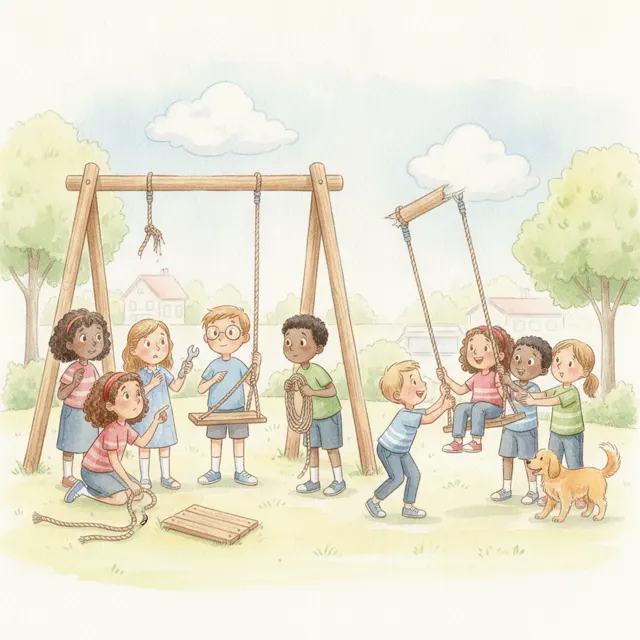
Ada Fixes the Broken Swing

Ages 3-83 minutesproblem solving
Ada Fixes the Broken Swing story for kids illustration

The class swing is broken, and no one can play on it. Ada studies it and finds a loose rope. She asks for help and works with her friends to fix it. The swing is safe again.

Moral: You can fix a problem if you do not give up.

The class went out for recess. Ada ran to the swings. But the red swing was broken. The seat hung low and touched the ground. "Oh no," said Ada. "The swing is broken." A teacher put a sign on it. "No one can use it until it is fixed," she said. The kids were sad. The swing was their favorite. Ada looked at the swing. She did not just look at the seat. She looked at the ropes and the hooks too. "I see it," she said. "One rope is loose. That is why the seat hangs low." "I want to fix it," Ada told her teacher. "Can I try?" "You may try," said the teacher. "But be careful." Ada asked two friends, Kai and Zoe, to help. She showed them the loose rope. "If we pull this rope tight, the seat will lift," she said. Kai held the rope. Zoe held the seat. Ada tied the rope to the hook. She pulled it hard and made a strong knot. "Let it go," said Ada. Kai and Zoe let go. The seat did not fall. It hung straight and high. Ada sat on it slowly. She pushed off the ground. The swing moved back and forth. It worked. "It is fixed!" Ada shouted. The teacher came over and smiled. "Good work, Ada," she said. "You solved the problem." All the kids cheered. Ada and her friends took turns on the swing all recess long. Ada felt proud. She had not given up, and now everyone could play.

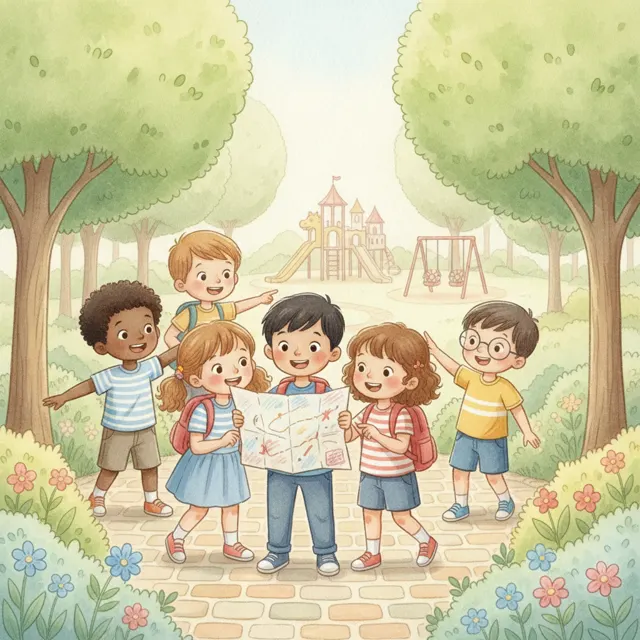
The Map to the Playground

Ages 3-83 minutesteamwork
The Map to the Playground story for kids illustration

The class goes to a new park, but no one knows the way. Ravi draws a map, and his friends help him read it. They follow it together and find the playground.

Moral: Working together makes a hard task easy.

The class went on a trip to a new park. The bus dropped them off by a big gate. "The playground is somewhere in here," said Mr. Cho. "But I do not know the way. Can you help?" The kids looked around. There were paths going left and right. No one knew which way to go. Ravi pulled out a paper and a pencil. "I can draw a map," he said. "But I need to see what is around us." "Good idea," said Mr. Cho. Ravi looked up. He saw a big tree. He drew it. He saw a blue bench. He drew that too. He drew the gate and the two paths. "Now we need to figure out the right path," said Ravi. His friend Ana looked at the map. "There is a sign up there," she said. "What does it say?" Ravi could not read the sign. It was too far. Ana ran ahead and looked. "It says playground," she said, pointing right. Ravi drew an arrow on the map. "This way," he said. The class walked down the path. They passed the blue bench. They passed the big tree. Then they saw a red slide and yellow swings. "We found it!" the kids shouted. Mr. Cho smiled. "You did it together," he said. "Ravi drew the map, and Ana read the way." Ravi and Ana high fived. "A map and a friend," said Ravi. "That is all we needed." The class played until it was time to go. On the way back, Ravi held his map up. It had led them right.

Sami and the Scared Dog

Ages 3-83 minutespatience
Sami and the Scared Dog story for kids illustration

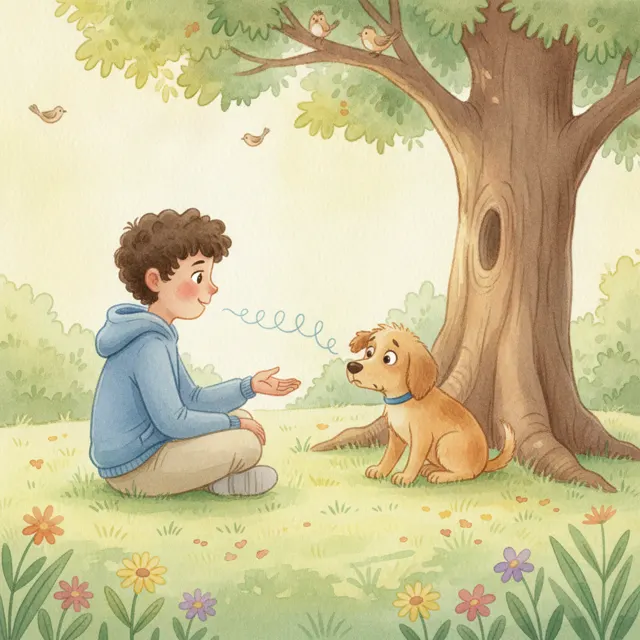
Sami finds a small scared dog in the park. He talks softly and sits very still. Slowly the dog comes close. Sami learns that patience helps a frightened animal feel safe.

Moral: Being calm and slow helps a scared friend trust you.

Sami went to the park with his dad. Near the bushes, he saw a small dog. The dog was shaking. It hid behind a bush and would not come out. "Look, Dad," said Sami. "That dog is scared." "Stay calm," said his dad. "Do not run at it. That will make it more afraid." Sami knelt down on the grass. He stayed very still. He spoke in a soft voice. "Hi there, little dog," he said. "I will not hurt you." The dog peeked out. Its tail was low and its eyes were wide. Sami did not move. He put his hand on the ground, palm up. He waited. The dog took one step out. Then it stopped. "It is okay," Sami said softly. "Take your time." The dog sniffed the air. Then it walked a little closer. Step by step, it came to Sami's hand. It sniffed his fingers. "Good dog," said Sami. He stayed still and let the dog smell him. After a while, the dog sat down next to Sami. It stopped shaking. Sami slowly petted its back. "See, Dad?" said Sami. "It just needed time." Sami's dad smiled. "You were patient," he said. "That is why the dog trusts you now." Sami sat with the dog until the dog wagged its tail. It licked Sami's hand. Sami laughed. He had made a scared dog feel safe, just by being calm and slow. Before they left, the dog followed Sami to the gate. It wagged its tail the whole way. Sami knew he had made a new friend.

The Best Wrong Answer

Ages 3-83 minutescourage
The Best Wrong Answer story for kids illustration

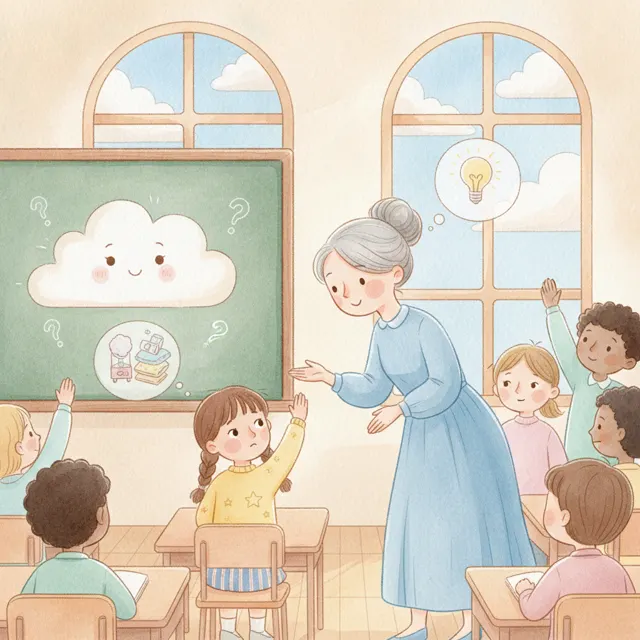
In class, the teacher asks what clouds are made of. Zara is scared to answer. She gives a wrong answer but the teacher is kind. Zara learns that trying and asking questions is good.

Moral: It is brave to say what you think.

Zara sat at the back of the class. She did not like to talk in front of everyone. It made her tummy feel funny. "Who can tell me what clouds are made of?" asked Mr. Dean. Some kids raised their hands fast. Zara kept her hand down. She thought she knew, but she was not sure. What if she was wrong? "Zara," said Mr. Dean. "What do you think?" Zara's face got hot. Everyone looked at her. "I think clouds are made of cotton," she said in a small voice. A few kids giggled. Zara wanted to hide. Mr. Dean smiled. "That is a great guess," he said. "Clouds look soft like cotton, do they not?" Zara nodded slowly. "But clouds are really made of tiny drops of water," said Mr. Dean. "So close. You were thinking like a real scientist." Zara felt a little better. "Really?" she asked. "Yes," said Mr. Dean. "Asking and guessing is how we learn. There are no bad questions." After class, Zara raised her hand more. She asked about rain and snow. Each time, Mr. Dean smiled and answered. That night, Zara told her mom. "I said a wrong answer today," she said. "And what happened?" asked her mom. "Nothing bad," said Zara. "My teacher said it was a good guess." Her mom hugged her. "It is brave to speak up," she said. Zara smiled. The next day, she raised her hand first. It was okay to be wrong. Trying was the brave part.

Priya's Long Wait

Ages 3-83 minutespatience
Priya's Long Wait story for kids illustration

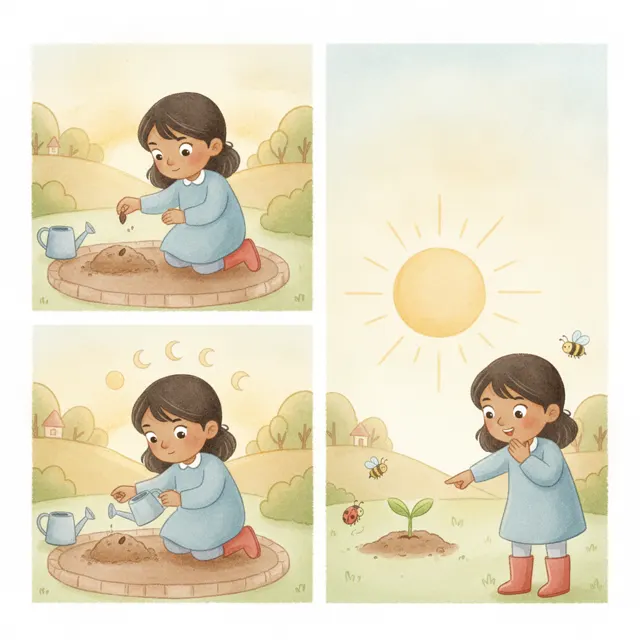
Priya plants a small seed and wants it to grow fast. She waters it and waits day after day. At last a green sprout comes up. Priya learns that growing takes time.

Moral: Good things come to those who wait.

Priya got a small seed in a cup from her teacher. She took it home and put it in a pot of dirt. "Grow, little seed, grow," she said. She gave it water and put it by the window. The next morning, she ran to the pot. There was only dirt. "Why is it not growing?" Priya asked her mom. "Growing takes time," said her mom. "You have to wait and take care of it." Priya did not like waiting. She checked the pot every hour. She gave it more water. Still, nothing came up. "Maybe it is a bad seed," said Priya. Her mom shook her head. "Keep watering it once a day," she said. "And be patient." Priya waited one day. Then two days. Then three. Each day she gave the seed a little water. Each day she looked for a green sprout. On the fifth day, Priya saw something small and green. It was a tiny sprout poking out of the dirt. "It is growing!" Priya shouted. She showed her mom. "See? All that waiting worked." The sprout grew a little more every day. Soon it had two small leaves. Priya talked to it and gave it sun. "You were right, Mom," she said. "Good things take time." Priya kept the plant on her desk. Every day she checked it, and every day it was a little bigger. She was glad she did not give up. Priya smiled at her plant every morning. She was proud of the little green friend she had grown.

The Class Pet's Big Day

Ages 3-83 minutesresponsibility
The Class Pet's Big Day story for kids illustration

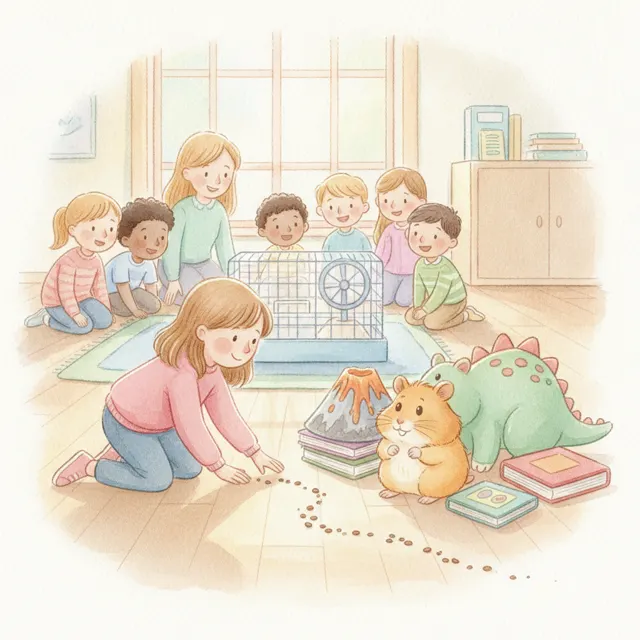
The class hamster, Pip, gets out of its cage on show day. Tessa stays calm and follows a trail of seeds. She finds Pip and brings it back. The class is so happy.

Moral: Taking care of a pet is a big job done with love.

Today was show day. The class would show their hamster, Pip, to the whole school. Tessa was in charge of Pip's cage. "I will open the cage so everyone can see him," said Tessa. But when she opened the little door, Pip ran out. He was fast. He zipped across the floor and under the bookshelf. "Oh no!" the kids shouted. "Pip is gone!" Tessa's heart beat fast. But she told herself to stay calm. "Pip likes seeds," she said. "Let us look for him slowly." She saw a few seeds on the floor. They made a little trail. Pip must have dropped them. "Follow the seeds," said Tessa. The kids walked slowly and quietly. They did not want to scare Pip. The trail led behind the reading corner. Tessa peeked behind a box of books. There was Pip. He was eating a seed and washing his face. "Found you, Pip," Tessa said softly. She sat still and held out a seed. Pip sniffed it and walked into her hand. She held him gently and put him back in his cage. She closed the door tight. The class clapped. "You saved show day!" said her teacher. Tessa smiled. "I just stayed calm and followed the seeds," she said. The show went on. Everyone came to see Pip. Tessa stood by the cage and watched him. She felt proud. Taking care of a pet was a big job, and she had done it well. Pip sat in his cage, safe and sound. Tessa gave him a fresh seed as a treat.

Omar Says Sorry

Ages 3-83 minuteshonesty
Omar Says Sorry story for kids illustration

Omar breaks his friend's toy by accident and hides it. He feels bad all day. At last he tells the truth and says sorry. His friend forgives him, and Omar feels better.

Moral: Saying sorry and telling the truth fixes a mistake.

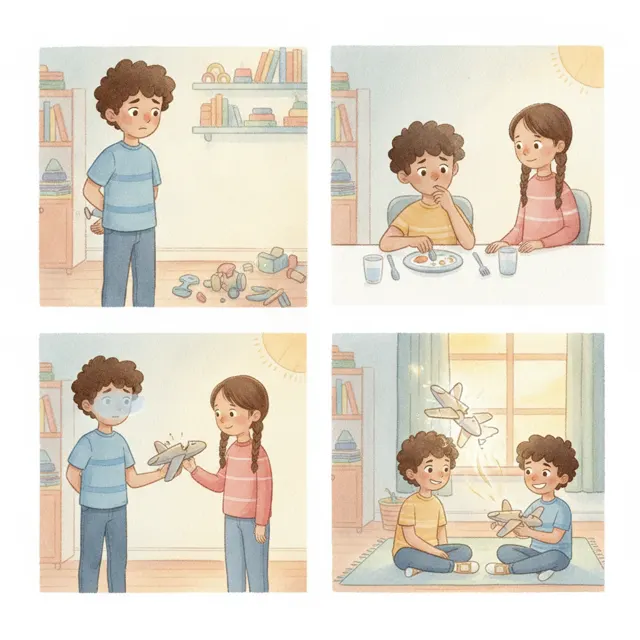
Omar was at his friend Sam's house. They were playing with Sam's toy car. It was Sam's favorite car. It was red and shiny. "Can I see it?" Omar asked. Sam handed it to him. Omar rolled the car on the floor. It went fast. Then it hit the wall. One wheel broke off. Omar's heart sank. "Oh no," he said. Sam was in the kitchen. He did not see it. Omar did not know what to do. He put the broken car under the couch. "Let us play outside," Omar said quickly. They went outside, but Omar felt sick. His tummy hurt. He could not stop thinking about the broken car. "Are you okay?" Sam asked. "I am fine," Omar said. But he was not fine. That night, Omar could not sleep. The secret felt heavy. The next morning, Omar went to Sam's house. "Sam," he said, "I have to tell you something." "What is it?" Sam asked. "I broke your red car," Omar said. "I hid it under the couch. I am very sorry." Sam looked sad for a moment. Then he said, "Thank you for telling me the truth. It was brave." "I will help you fix it," said Omar. "My dad has glue." They found the car under the couch. Omar's dad glued the wheel back on. The car rolled again. "I am sorry I hid it," said Omar. "It is okay," said Sam. "You told the truth. That is what friends do." Omar felt light and happy. Telling the truth had fixed everything.

The Rainy Recess Mystery

Ages 3-83 minutesproblem solving
The Rainy Recess Mystery story for kids illustration

It rains, so the class stays inside. Then Maya's lunch box goes missing. The kids search the room and follow small clues. They find it behind the plant. The mystery is solved, and everyone is glad.

Moral: Looking closely helps you solve a mystery.

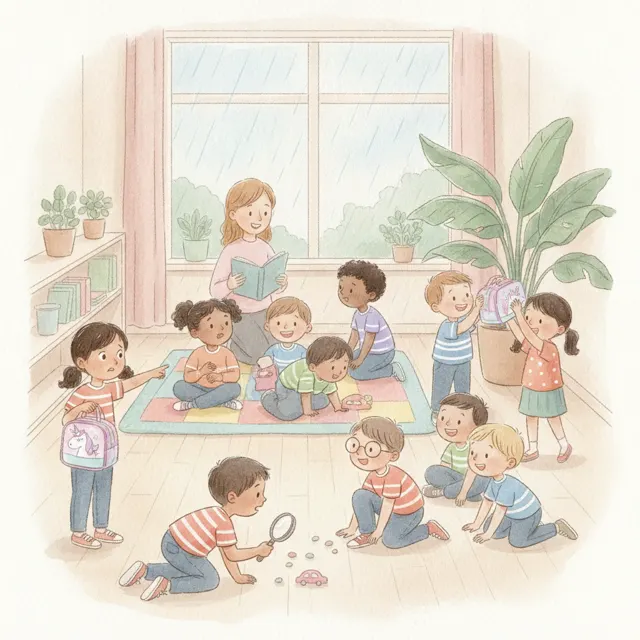
It rained all day, so the class stayed inside for recess. Maya ate her lunch at her desk. She had a purple lunch box with a star on it. After recess, Maya looked for her lunch box. It was gone. "My lunch box is missing!" she said. The kids looked around the room. No one had seen it. "Let us be detectives," said their teacher. "Look for clues." The kids spread out. They looked under desks and behind chairs. "I found a crumb trail," said Ben. He pointed to small crumbs on the floor. "What kind of crumbs?" asked Maya. "Cookie crumbs," said Ben. "From your lunch box, I bet." They followed the crumbs. The trail went past the art table and stopped by the window. There was a big green plant in the corner. Maya looked behind the plant. There was her purple lunch box. It was open, and a little mouse sat next to it. "A mouse!" Maya said. "It took my lunch box!" The class laughed. The mouse had dragged the lunch box to its hiding spot for the cookie inside. The teacher put the mouse in a safe box to let it go outside later. Maya got her lunch box back. "That was a fun mystery," she said. Ben smiled. "We solved it with the crumb trail." Maya cleaned her lunch box. The next day, she closed it tight so no mouse could open it again. Everyone went back to their seats. The rainy day had turned into a fun one after all.

Two Teams One Ball

Ages 3-83 minutesteamwork
Two Teams One Ball story for kids illustration

Two groups of kids fight over one ball at recess. No one gets to play. A girl named Jo suggests they all play one big game. Everyone shares the ball and has fun.

Moral: Sharing is more fun than fighting.

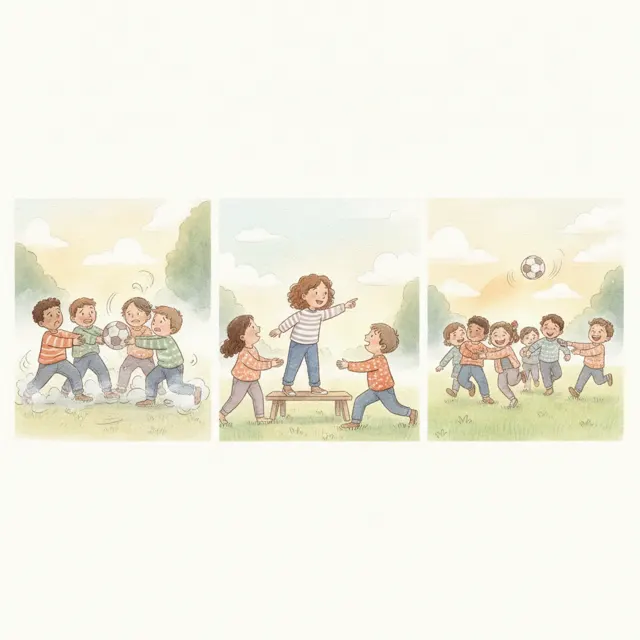
At recess, two groups of kids wanted the same ball. The red team had it first. The blue team said it was their turn. "It is ours!" said a boy from the red team. "No, it is ours!" said a girl from the blue team. They pulled the ball back and forth. No one could play. Everyone was angry. A girl named Jo watched them. She had an idea. "Stop!" Jo said. "Why not play together?" The kids looked at her. "How?" asked the red boy. "We are too many for one small game," said the blue girl. Jo smiled. "Then let us make one big game," she said. "Two teams, one ball, one big field." The kids thought about it. It sounded fair. "Okay," said the red boy. "But we pick teams first." They split into two even teams. Jo explained the rules. Everyone would share the ball. Everyone would get a turn. They started to play. The ball went back and forth. Red scored, then blue scored. Both teams cheered. "This is fun!" shouted the blue girl. "I know," said Jo. "Sharing is more fun than fighting." At the end of recess, the kids were tired and happy. No one had won the fight, but everyone had won the game. The bell rang, and the kids walked back to class together. They were already planning the next game. The next day, both teams met on the field again. This time, they started with one big game right away. Everyone had a turn, and everyone had fun.

Nina's Nervous Note

Ages 3-83 minutescourage
Nina's Nervous Note story for kids illustration

Nina has to sing a note in the school show. She feels very nervous. Her grandma tells her to take a deep breath. Nina sings, and the crowd claps for her.

Moral: It is okay to feel nervous and still be brave.

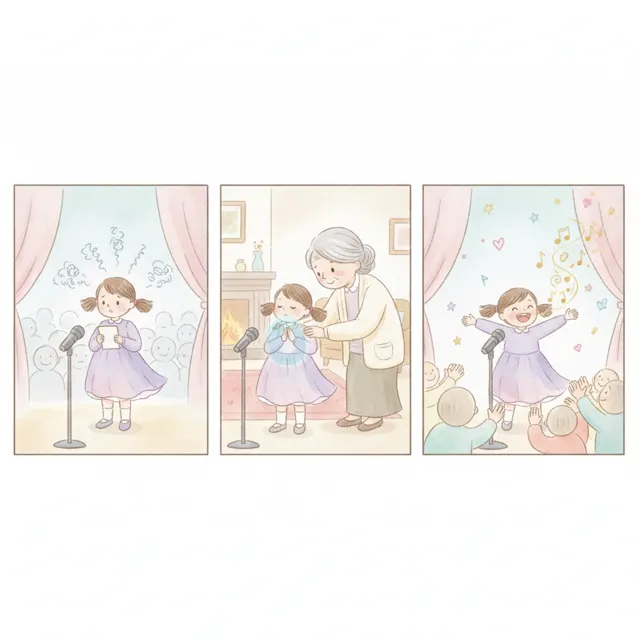
Nina had to sing one note in the school show. It was a small note, but to Nina it felt big. Her hands were sweaty and her heart went fast. "I cannot do it," she told her grandma. "I will forget the words." Her grandma held her hand. "You do not have to be perfect," she said. "Just take a deep breath and sing." "But what if I make a mistake?" Nina asked. "Then you smile and keep going," said her grandma. "Everyone makes mistakes." On show day, Nina stood backstage. The lights were bright. She could hear the crowd. "It is your turn, Nina," said her teacher. Nina walked out. Her legs felt like jelly. She looked at the crowd and froze. She remembered her grandma's words. She took a deep breath. Then she opened her mouth and sang her note. Her voice came out soft at first. Then it grew strong and clear. She sang the whole note without stopping. When she finished, the crowd clapped. Her teacher smiled and gave her a thumbs up. Nina ran off the stage. Her grandma was waiting with open arms. "You did it!" said her grandma. "I was so scared," Nina said. "But I sang anyway." "That is what brave means," said her grandma. Nina smiled. She had been nervous, but she had not let it stop her. That night, she felt proud of her one small note. She could not wait to sing again. Being brave did not mean being calm. It meant doing the thing even when she was scared.

The Homework That Ran Away

Ages 3-83 minutesproblem solving
The Homework That Ran Away story for kids illustration

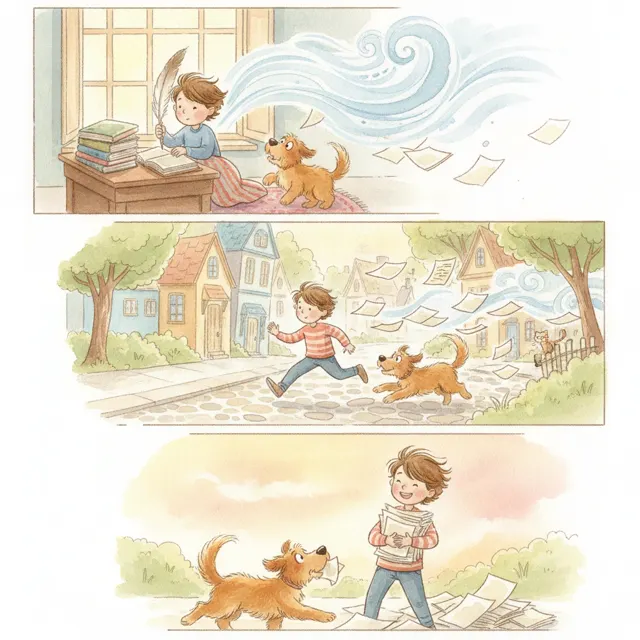
Leo does his homework by an open window. A big gust of wind blows the pages away. He chases them down the street with his dog. Together they get every page back.

Moral: Staying calm helps you catch what runs away.

Leo sat by the open window doing his homework. He wrote his name at the top of the page. Then a big gust of wind blew in. Whoosh! The pages flew off the desk. They danced in the air and sailed out the window. "My homework!" Leo shouted. He ran outside. The pages floated down the street like white birds. One landed on a bush. One landed on a car. One kept flying toward the corner. Leo's dog, Chip, ran after him. Chip barked and chased the flying pages. "Help me, Chip!" Leo said. Chip jumped and caught one page in his mouth. He brought it back to Leo. The page was a little wet, but Leo could still read it. "Good dog," said Leo. Leo ran to the bush and grabbed another page. He chased the last page to the corner. A kind man caught it and held it out. "I think this is yours," the man said. "Yes, thank you!" Leo said. Leo carried the pages back home. He laid them on the table to dry. Some were a little torn and a little dirty, but they were all there. "I will close the window next time," Leo said to Chip. He sat down and finished his homework. Chip lay by his feet. The wind blew outside, but the window was shut tight. "All done," said Leo. He put the pages in his folder. His homework was safe now, and so was he. He read the pages one more time before bed. Every word was there, safe and dry.

Frequently Asked Questions

Turn Your Child Into the Hero of Their Own Story

Upload their photo and watch as AI creates a beautiful, personalized storybook with illustrations that look just like them. From $5.99/month.

โœจ Make Your Child the Hero

Plans from $5.99/month