Stories for 10 Year Olds

Stories for readers on the edge of something bigger

โœจ Make Your Child the Hero

Ten-year-olds are on the edge. They're not little kids anymore, but they're not teenagers yet, and that in-between space is both exciting and strange. Stories for this age need to honor that. They need characters who feel like real people, problems that don't have easy answers, and themes that matter: independence, responsibility, belonging, and figuring out who you actually are when nobody's watching. At CreateStory.ai, we write ten-year-old stories with the respect this age deserves. No talking down. No oversimplified endings. Just honest, warm narratives about kids figuring it out, making mistakes, and growing in ways they didn't expect.

Why do ten year olds stop being read to at home?

As kids grow, many families read aloud less often. Schoolwork and busy schedules get in the way. But ten year olds still love a good story, even if they do not always say so.

The numbers show the drop. Only about 17 percent of kids ages nine to eleven, or one in six, are read aloud to at home five to seven days a week, down from 54 percent for kids under five (Scholastic Kids and Family Reading Report).

What stories keep a ten year old interested and thinking?

Ten year olds like stories with a real problem and a character who has to choose. They are old enough to see both sides of a fight and to wonder what they would do. Honest endings beat easy ones at this age.

Let them read on their own too. A chapter at night or a story over the weekend all counts. Ask what they think about the ending. When kids get to talk about a story, the story stays with them longer.

Sample Stories

Read these stories, then create a personalized version where your child is the hero

The Summer of Almost
Ages 10-115 minidentity and trying new things
The Summer of Almost story for kids illustration

The summer before middle school, Nadia tries a dozen new things and fails at most of them, and discovers why that was the point.

Moral: You don't need to master something to learn from it. Trying is its own kind of success.

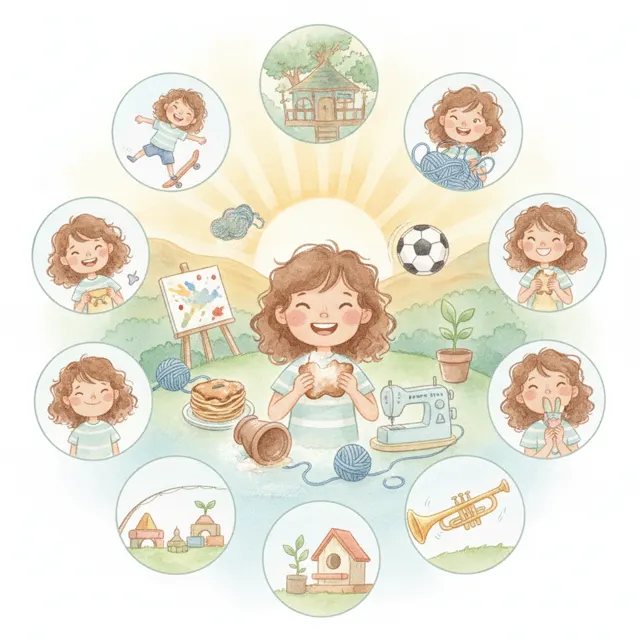
The summer before Year 6, Nadia made a list. Things to try: - Skateboarding - Sourdough bread - Speaking Spanish for a week - Wild swimming - Coding - Guitar She gave herself ten days per thing. She was bad at all of them. She fell off the skateboard six times. The bread came out like a brick. She lasted four days in Spanish before she got frustrated. Wild swimming was freezing. The code crashed everything. The guitar sounded like a cat in distress. On the last day of summer, her dad asked how it went. "Terrible," said Nadia. "I didn't get good at anything." "Did you want to keep any of them?" She thought. "Coding, kind of. And the swimming, if the water was warmer." "So you found two things worth continuing," said Dad. "Out of six tries. That's not failure. That's a really good hit rate." Nadia looked at her list. She crossed out the ones she'd dropped and circled the two. Maybe the point was never to be perfect. Maybe the point was to figure out which things were yours. She signed up for a coding class the following Monday.
The Speech That Almost Wasn't

Ages 10-115 minauthenticity and leadership
The Speech That Almost Wasn't story for kids illustration

Eli is elected class rep but freezes on speech day, and the unexpected thing he says instead changes everything.

Moral: The most powerful thing you can say in front of people is something true.

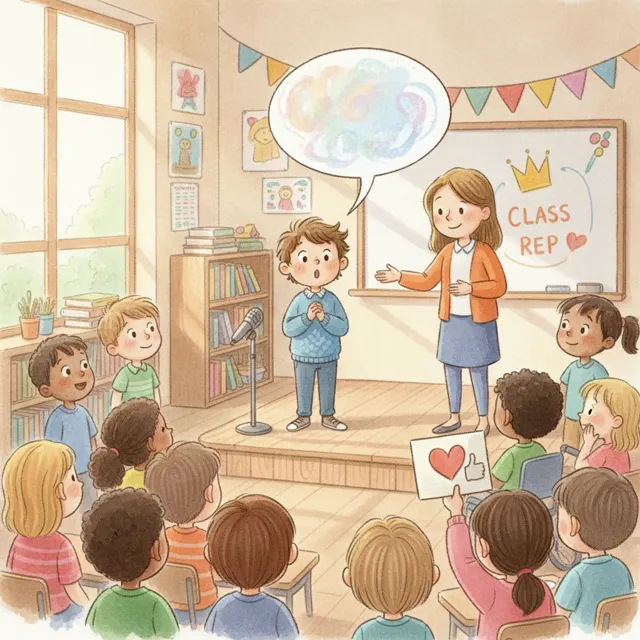
Eli had written a perfect speech. He'd practiced it forty times. He knew every word. He stood at the front of the class. Thirty faces looked at him. His mind went blank. The speech disappeared. He stood in silence for ten seconds. It felt like ten years. Then, because he had nothing else, he said: "I don't actually know if I should be class rep. I'm not the loudest person. I'm not the most confident. But I notice things. I noticed when the Year 4 kids lost their lunch spot and nobody did anything. I noticed that three people in this class never eat lunch with anyone. I noticed our art room has no art from this decade on the walls." He stopped. The room was quiet. "I think a rep should notice things and then do something about them. I'll try to do that." He sat down. He got the most votes of anyone. Aisha told him afterward: "That was better than a real speech." "It wasn't a speech," he said. "It was just true." "Maybe that's why it worked," said Aisha.

Running the Stall

Ages 10-115 minresponsibility and judgment
Running the Stall story for kids illustration

When her parents can't manage the family market stall one Saturday, Maya has to run it alone and faces some unexpected decisions.

Moral: Real responsibility means making decisions you can stand behind, not just following rules.

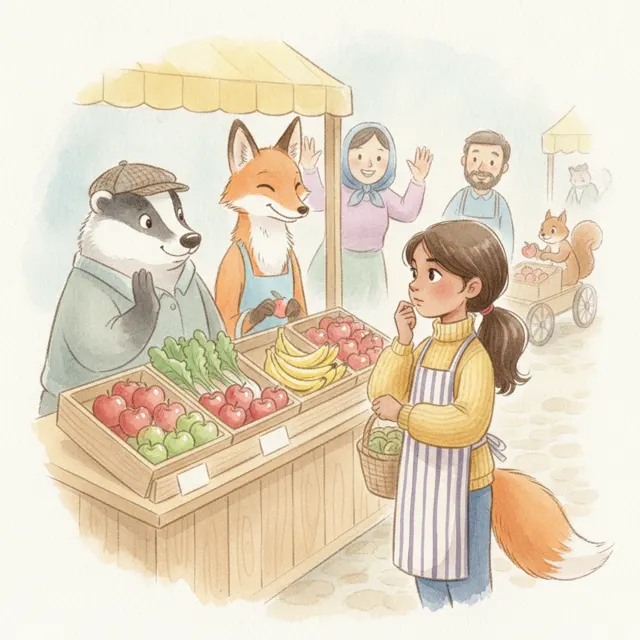
Maya's parents ran a stall at the Saturday market. Handmade candles. Her mom's recipe. Her dad's packaging. The day before, her mom sprained her ankle. Her dad had an emergency call from his own mother. They looked at Maya. She was ten. She shrugged. "I know where everything is." She set up at 7am. She'd helped enough times to know the flow. By 9am she'd sold twelve candles and had a problem: a woman wanted to return one she'd bought last week. It wasn't their policy, but the woman said it hadn't burned right. Maya thought. The candle cost four pounds. Was it worth an argument? "Of course," said Maya, and swapped it. The woman bought three more. At 11, a boy her age tried to pocket a small candle when he thought she wasn't looking. She was looking. "I saw you," she said. "Just put it back." He put it back. He looked mortified. "Do you want to buy it?" she asked. "I don't have money." "Help me carry stock at the end of the day. I'll give you one." He stayed. He helped. She gave him a lavender candle. He said thank you like he meant it. Her parents got home at 4pm. "How much did you make?" Dad asked. Maya handed him the cash box. "Also," she said, "I changed the return policy." Dad looked at Mom. Mom smiled. "Good," she said.

The Other Side of the Argument

Ages 10-115 mincritical thinking and empathy
The Other Side of the Argument story for kids illustration

When Sam debates against his best friend in class, he wins but realizes something important got lost in the process.

Moral: The best way to understand an argument is to try to make it.

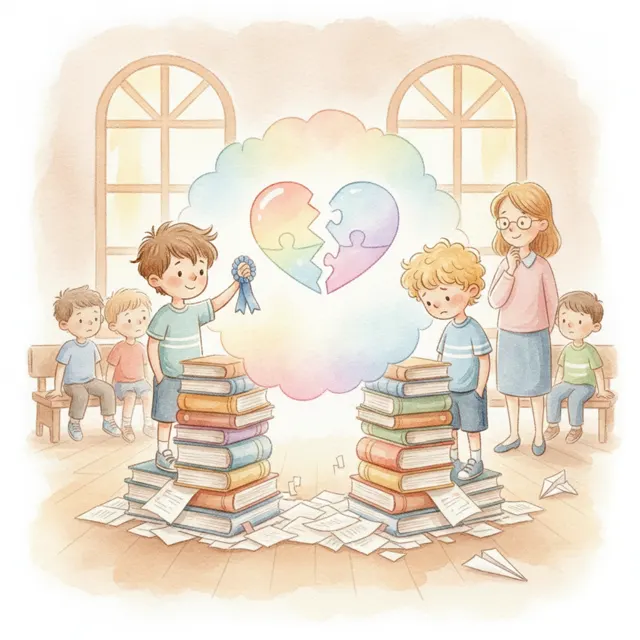
The debate topic was: "Should school uniforms be compulsory?" Sam was assigned: yes. His best friend, Priya, was assigned: no. They'd always agreed on everything. School uniforms were dumb. They both thought so. Sam didn't want to argue the other side. But he had to, so he researched it properly. By debate day, he'd found things he hadn't expected. Uniforms reduced bullying over clothes. They helped kids from poorer families not stand out. Some studies suggested they improved focus. He argued his case. Well. Better than he expected. Priya countered. Also well. The class voted. Sam's side won by two votes. At lunch, Priya was quiet. "You okay?" asked Sam. "I just didn't expect you to actually believe it," said Priya. "I don't, totally," said Sam. "But some of the arguments were real. I looked." Priya was quiet again. Then: "I didn't look as hard." "You still argued better than me." She smiled a little. "Did you actually change your mind?" Sam thought. "About some things. Yeah." He handed her half his sandwich. "The best debates probably aren't about winning." "Tell that to the two people who voted wrong," said Priya. They both laughed.

Twelve Hours Alone

Ages 10-115 minidentity and independence
Twelve Hours Alone story for kids illustration

For the first time ever, Zara spends a full Saturday home alone and discovers what she's actually like without anyone watching.

Moral: Who you are when no one is watching is who you actually are.

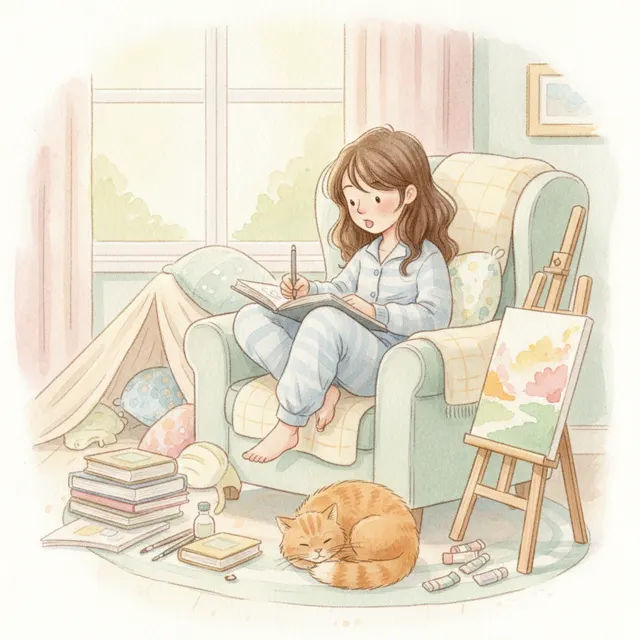
It was the first time Zara had been home alone for a full day. Parents at a wedding. Older brother at football. Back by 7pm. She'd been excited. Now it was 9am and she was just... sitting. She made breakfast. Too many eggs, but she ate them all anyway. She read for two hours. Real reading, not assigned reading. She finished a whole novel. She reorganized her bookshelf by color, then changed her mind and did it by the year she'd read them. She danced in the kitchen for twenty minutes. Nobody saw. She made tea. She burned the toast. She ate it anyway. At 3pm she felt a strange feeling. Not lonely. More like... herself. Like she'd found a version of Zara that only came out when there was no audience. This Zara liked silence. Liked doing things slowly. Liked burning toast and not caring. When her family came home, she didn't mention any of it. But she thought about it for a long time afterward. There's a version of you that exists only when nobody's watching. Getting to know her is one of the most important things you can do.

The Last Year of Being Young

Ages 10-115 mintransition and growth
The Last Year of Being Young story for kids illustration

On the last day of primary school, Theo reflects on everything he didn't know at the start, and everything he still doesn't know.

Moral: Not knowing what comes next isn't a problem. It's the beginning.

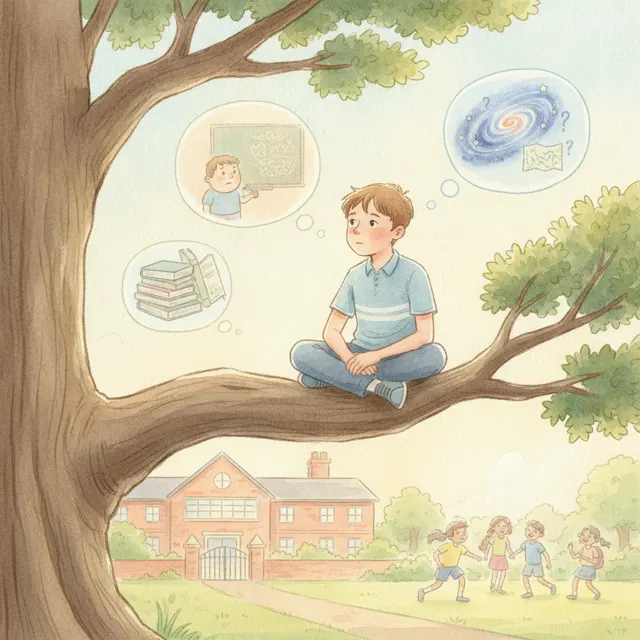
Theo had been at the same school for seven years. On the last day, everyone was crying, signing shirts, taking photos. Theo wasn't crying. He didn't know what he was feeling. He walked through the school slowly. The library where he'd found his first real book. The playground where he'd fallen off the climbing frame at six. The art room where he'd made something he was actually proud of at nine. He sat in the empty classroom at lunch. Just him. He thought about seven-year-old Theo, who thought Year 7 was impossibly grown up. And now here he was. He didn't feel grown up. He just felt like himself, a slightly bigger version. Miss Carter found him there. "You alright?" she asked. "I don't know what comes next," he said. "Nobody does," she said. "That's not a problem. That's the whole point." "What if I'm not ready?" "Then you'll get ready while you're there. That's how it works." Theo nodded slowly. He thought about what he knew now that he hadn't known at the start. A lot. And he thought about what he still didn't know. Even more. "That's okay," he said. Mostly to himself. He got up and went to sign someone's shirt.

The Rumor I Didn't Start

Ages 3-84 minutesintegrity
The Rumor I Didn't Start story for kids illustration

A false rumor spreads about Leo cheating on a test. Mia refuses to pass it on, even when it feels easier to go along. When the truth comes out, Mia learns a rumor stopped is a quiet kind of courage.

Moral: Refusing to pass on a rumor is a quiet kind of courage.

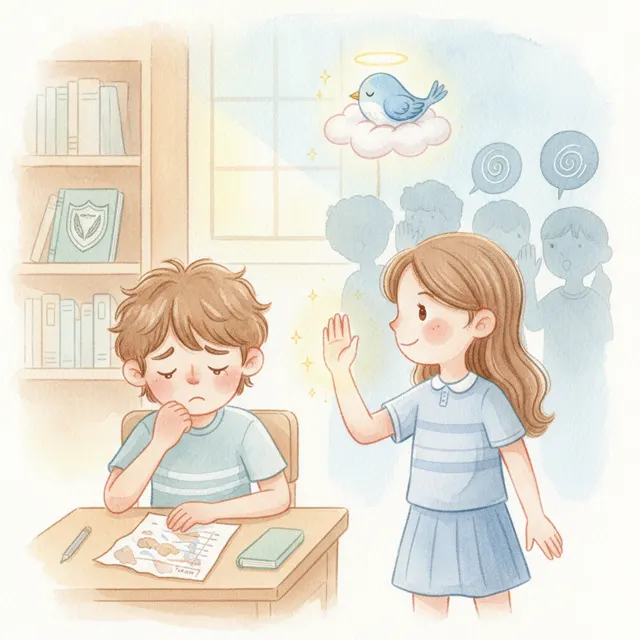
At school, a rumor started about Leo. People said Leo had cheated on the science test. Mia heard it at lunch, whispered from one friend to another. "Do you think it is true?" her friend Jay asked. Mia did not know. She had sat next to Leo during the test. She had not seen him cheat. But everyone was talking about it, and it felt easy to go along. Then someone asked Mia to pass the rumor to a new table. "Tell them what Leo did," a boy said. Mia opened her mouth. Then she closed it. She remembered how it felt when people talked about her last year, and it was not even true. "I do not know that it is true," Mia said. "I am not going to pass it on." The boy shrugged and walked away. Mia felt her heart beat fast. Saying no had not been easy. For the rest of the day, she felt a little out of step with everyone. The next morning, the teacher, Ms. Bell, stood up. "I want to clear something up," she said. "Leo did not cheat. I watched the whole test. Someone started a false rumor, and it has been very hard on Leo." The room went quiet. Mia looked at Leo. His head was down. She walked over to his desk after class. "I am sorry people said that about you," she said. "I did not pass it on." Leo looked up, surprised. "You did not? Thank you, Mia. That means a lot." Mia learned something that day. It takes no courage to repeat a rumor. It takes real courage to let one stop with you. And that is the kind of courage Mia chose to have.

Speaking Up on the Bus

Ages 3-84 minutescourage
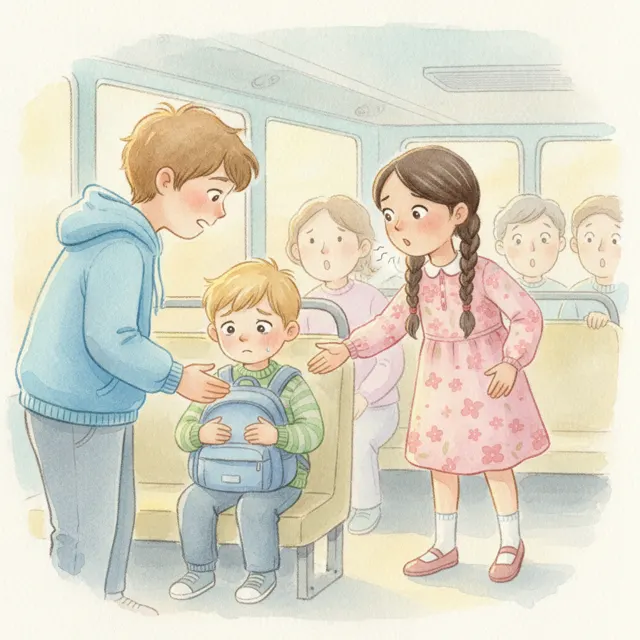
Speaking Up on the Bus story for kids illustration

A bigger kid picks on quiet Tom every day, and Nina stays silent out of fear. One day she stands up for Tom even though her voice shakes. Her brave act changes everything for both of them.

Moral: Standing up for someone else is brave, even when your voice shakes.

Every day on the bus, a bigger kid named Drew picked on a quiet boy named Tom. He called Tom names and flicked his backpack. The other kids looked away. Nina sat a few rows back. Every day she watched and said nothing. It made her stomach hurt, but she was scared. What if Drew turned on her? One afternoon, Drew grabbed Tom's hat and threw it to the back of the bus. Tom's face went red. He looked like he might cry. Nina's heart pounded. She told herself to stay quiet. But her legs stood up on their own. She walked down the aisle and picked up Tom's hat. She handed it back to him. "Leave him alone, Drew," she said. Her voice shook, but the words came out. Drew laughed. "What are you going to do about it?" Nina took a deep breath. "I am going to tell the driver if you do not stop. And I am not scared of you." The bus went quiet. Drew looked around. He saw the other kids watching. He saw the driver look in the mirror. He shrugged and turned away. "Whatever," he mumbled. Nina sat down next to Tom. "Are you okay?" she asked. "Yeah," Tom said quietly. "Thank you. No one has ever stood up for me before." The next day, two more kids sat with Tom. Drew did not bother him again. Nina's hands were still a little shaky, but she felt taller than she ever had. Standing up for someone else is scary. But a brave voice, even a shaking one, can change everything.

The Tryout List

Ages 3-84 minutesresilience
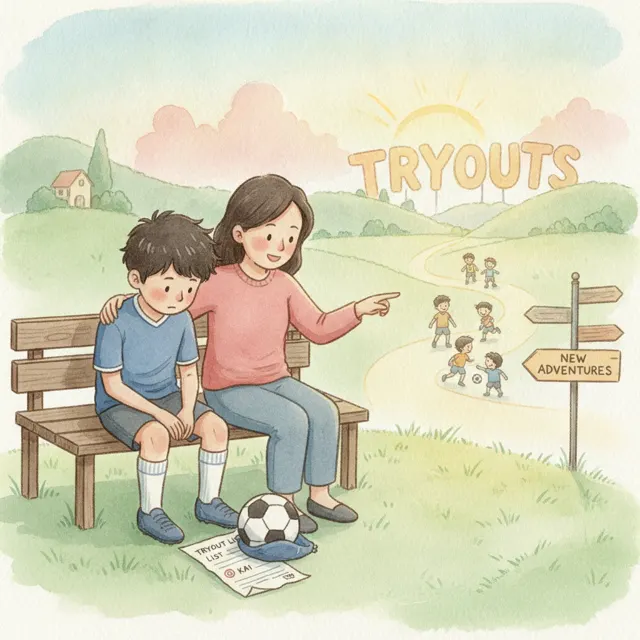
The Tryout List story for kids illustration

Kai practices soccer all summer but does not make the school team. His mom helps him see that one list does not define him. He keeps playing and learns a no is just a turn in the road.

Moral: Not making the list does not mean you are not good enough.

Kai practiced for the soccer team all summer. He ran, he kicked, he did drills in the yard until dark. On tryout day, he played his heart out. A week later, the coach posted the list outside the gym. Kai ran to look. He read the names once, then twice. His name was not there. Kai walked home slowly. He sat on the porch steps and stared at his shoes. "I worked so hard," he said to his mom. "I guess I am just not good enough." His mom sat down next to him. "Kai, one list does not tell you who you are. It only tells you one coach's choice on one day. It does not take away all the running and kicking you did. That hard work is still in your legs." Kai wiped his eyes. "So what do I do now?" "You keep playing," she said. "There is a team at the community center. Try out there. And if you still want the school team, try again next year. Hard work is never wasted." Kai thought about that. He had become faster and stronger all summer. That was real, even if the list said no. He tried out for the community team the next week. He made it. He scored two goals in his first game. At the end of the season, Kai kept the tryout list in his drawer, folded up. He did not need it. He had learned something better than a spot on a list. He had learned that one no is not the end. It is just a turn in the road.

Maya's Own Choice

Ages 3-84 minutespeer pressure
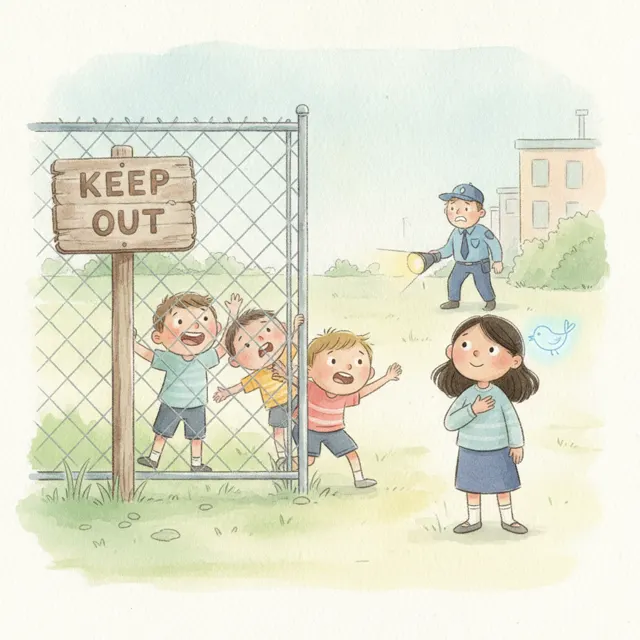
Maya's Own Choice story for kids illustration

Maya's friends sneak into a fenced lot that says keep out. Maya wants to fit in but listens to her own voice and stays behind. When a guard shows up, she is glad she chose what was right.

Moral: Doing what you believe is right matters more than fitting in.

Maya's friends wanted to sneak into the old lot after school. There was a hole in the fence, and the sign said no trespassing. But the lot was big and empty, and everyone said it would be fun. "Come on, Maya," said Jo. "Everyone is going. Are you scared?" Maya looked at the sign. She looked at the hole in the fence. Her friends were already ducking through. Her heart said no, but she wanted to fit in so badly. "The sign says keep out," Maya said. "It is not safe." "It is fine," Jo said. "No one ever checks. Are you with us or not?" Maya stood still. She thought about what her dad always said. "You do not have to follow the crowd to be part of it." She took a small step back. "I am not going," she said. "I will meet you at the corner later." Her friends laughed a little and went through the hole. Maya walked to the corner and sat on the bench, feeling alone. She felt silly. Maybe she was being scared for nothing. Twenty minutes later, a security car pulled up to the lot. The driver got out and blew a whistle. Her friends scrambled back through the hole, out of breath, faces red. "You were right, Maya," Jo said, panting. "That was a bad idea. We almost got caught." Maya smiled a little. She did not say "I told you so." She just walked home with them. That night, Maya looked in the mirror. She was glad she had listened to her own voice. Fitting in was nice, but doing what she believed was right felt even better. It felt like being herself.

The Test I Took Alone

Ages 3-83 minuteshonesty
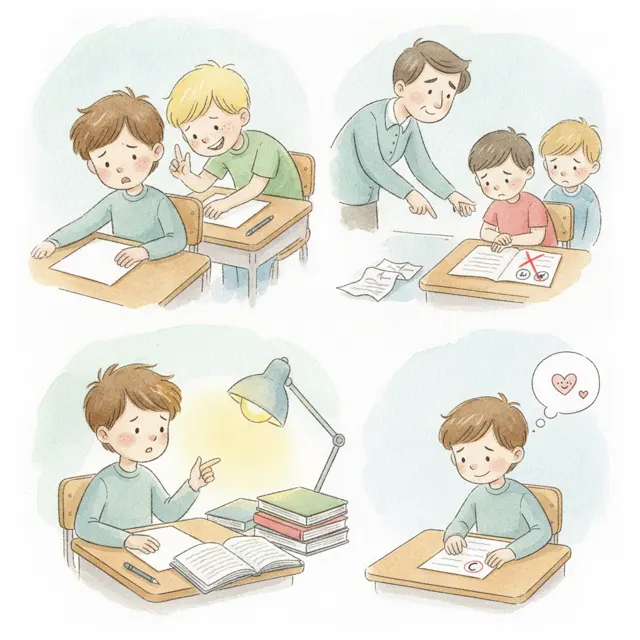
The Test I Took Alone story for kids illustration

Danny's friend offers to tap test answers on his chair. Danny is tempted but says no and studies instead. When two cheaters get caught, Danny learns an honest C beats a stolen A.

Moral: Doing your own work, even when it is hard, is the honest path.

Danny had a big math test coming. Math was hard for him. His friend Rob was great at math and sat right behind him. The night before the test, Rob texted Danny. "I sit behind you tomorrow. I can tap the answers on your chair. One tap for A, two for B. Easy." Danny stared at the phone. It would be so easy. He could get a good grade without studying. He wanted to say yes. Then he thought about it. He would not really be getting a good grade. He would be getting Rob's grade. And if they got caught, both of them would be in big trouble. "No thanks," Danny typed back. "I will study tonight instead." Danny studied until his eyes were tired. The next day, he took the test on his own. Some problems he knew. Some he guessed. When the test ended, he felt tired but honest. A few days later, the tests came back. Danny got a C. It was not a great grade. But it was his. Then the teacher made an announcement. "Two students cheated on this test, and they have both received a zero. I will not name them, but I want the rest of you to know how proud I am that you did your own work." Danny looked at his C. It was not a high grade, but it was real. He had earned every point. And that felt better than any stolen A ever could.

The Trophy We Shared

Ages 3-84 minutesteamwork
The Trophy We Shared story for kids illustration

A science team wins first place but argues over who should hold the trophy. Emma reminds them they won together. They put all three names on the tag and learn shared credit feels best.

Moral: Sharing credit feels better than grabbing it alone.

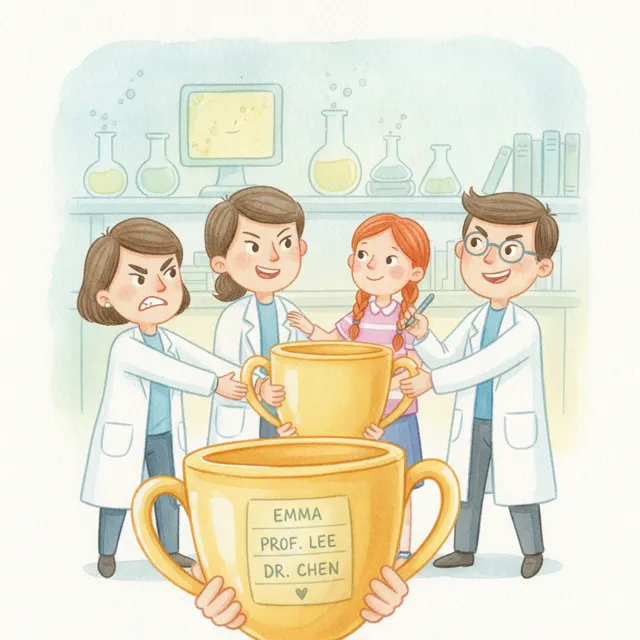
The science fair team was small. It was just Priya, Owen, and Emma. They built a model volcano that really erupted. It took weeks of work after school. On fair day, the judges walked around with clipboards. When they stopped at the volcano, Priya talked about the baking soda. Owen showed the wiring for the light. Emma explained the paint job. They all did their part. At the end, the team won first place. A big golden trophy came with it. The judges asked who would hold it. "I should hold it," Owen said. "I did the hardest part." "I did the most work," Priya said. "I should take it home first." They started to argue. The trophy sat on the table between them while they pointed fingers. "Wait," Emma said. "We did not win alone. We won together. All three of us worked on this. So all three of us should share it." Owen and Priya went quiet. Emma was right. The volcano had three names on it, not one. "Okay," Owen said. "We can take turns. Priya takes it home first, then me, then Emma." Priya nodded. "That is fair. And we should put all three names on the winner tag, not just one." They walked up to accept the trophy together. All three hands held it up while the crowd clapped. It felt better shared than it ever would have felt alone. Back in the classroom, the trophy went on the shelf with all three names on the tag. A win is best when everyone who earned it gets to share it.

Frequently Asked Questions

Turn Your Child Into the Hero of Their Own Story

Upload their photo and watch as AI creates a beautiful, personalized storybook with illustrations that look just like them. From $5.99/month.

โœจ Make Your Child the Hero

Plans from $5.99/month