Stories for 9 Year Olds

Stories that take nine-year-olds beyond their backyard and into the wide world

โœจ Make Your Child the Hero

Nine-year-olds are hungry to understand the world. They want to know how stars form, why civilizations fell, what people on the other side of the planet eat for breakfast, and whether science can explain magic. This is an incredible age for stories that blend narrative with discovery. At CreateStory.ai, we design stories for nine-year-olds that feel like adventures through time, science, and culture, while always keeping a compelling human story at the center. These six tales take young readers from ancient ruins to deep sea labs, from city to countryside, weaving wonder and curiosity into every paragraph.

Why do fairy tales help young children grow?

Stories give children words. A study found that young children who are read five books a day hear about 1.4 million more words by kindergarten than children who are never read to (Ohio State University, 2019). Words build the brain and help children learn to read on their own.

Tales also teach feelings. When a hero is brave or kind, children practice those feelings in a safe way. They learn that it is okay to be scared, and that trying again is a big part of growing up and getting better.

How does reading each day help a child learn?

Reading a little every day makes a big difference over time. Children who read often learn new words faster, and those words help them do better in school and in life. A short story before bed is a simple way to build this habit.

Daily reading also brings a child and a grown up close. They share a quiet moment and talk about the tale together. That special time together makes children feel safe and loved, and feeling safe helps them learn even more.

Sample Stories

Read these stories, then create a personalized version where your child is the hero

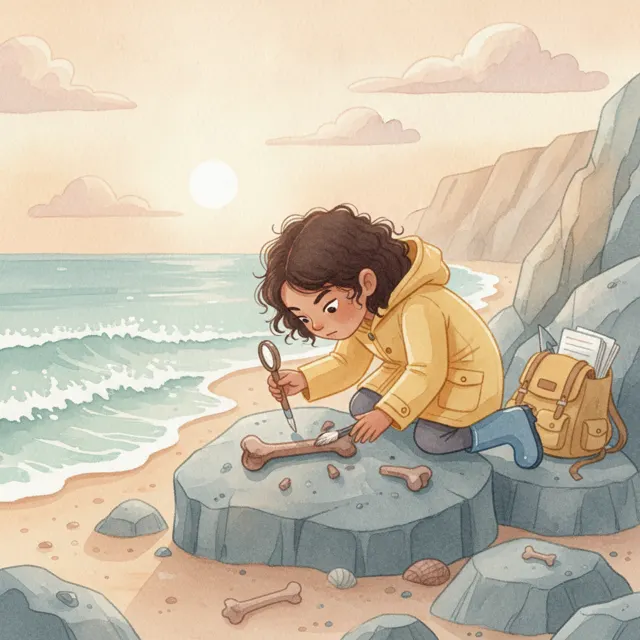
The Fossil Finder

Ages 9-105 minscience and discovery
The Fossil Finder story for kids illustration

On a seaside walk, nine-year-old Priya finds what looks like a bone in the rocks and goes all-in to find out what it is.

Moral: Curiosity and careful observation can lead to genuine discovery at any age.

Priya found the bone on a Tuesday. She was walking along the beach at low tide when something gray and ridged caught her eye, jutting out of the cliff face just above the waterline. It wasn't driftwood. It was too solid. She photographed it. She measured it with her hand. About 30 centimeters. Ribbed. Curved. Back home, she posted the photo to a local geology group online with her mom's help. Within an hour, a university professor had replied. "That looks like a plesiosaur rib fragment. When can I visit?" Two days later, Dr. Patel arrived with tools, bags, and three excited students. Priya showed them exactly where she'd found it. Dr. Patel crouched down and started carefully extracting the fragment. "This is from the Jurassic period," she said. "175 million years old, roughly." Priya looked at the gray curve of bone. Something had breathed. Had swum. Had lived. And she'd found it. "What happens to it now?" she asked. "It goes to the university. But you get a finder's credit on any published research. Your name, in a scientific paper." Priya stood a little taller. She went fossil hunting every weekend after that.
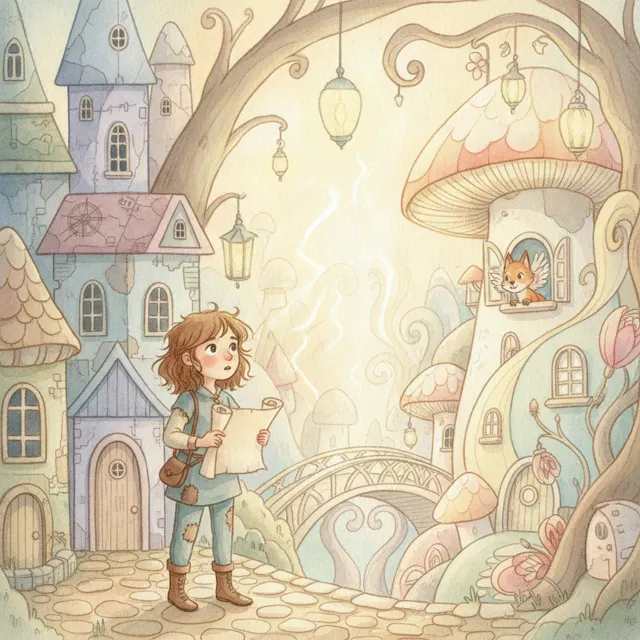
The Mapmaker's Apprentice

Ages 9-105 minhistory, power, and inclusion
The Mapmaker's Apprentice story for kids illustration

In a fantasy city where maps control what exists, a girl discovers a neighborhood that doesn't appear on any map.

Moral: Who gets seen and counted matters, and individuals can change it.

In the city of Ardenne, maps were law. If it wasn't on the map, it didn't officially exist. Clara's father was the Royal Mapmaker. She'd grown up knowing every street, every canal, every tower. But one afternoon she followed a cat down an alley and found a neighborhood she'd never seen. Stalls selling herbs and spices. Children speaking three languages at once. A bakery where the bread smelled like somewhere far away. "Where is this?" she asked an old woman sitting outside with thread and needles. "Nowhere, officially," said the woman. "It's not on the map." Clara pulled out her notebook. She started sketching the streets, measuring distances, noting landmarks. The woman watched. "You're mapping us." "Yes," said Clara. "So you'll exist. Officially." The woman put down her thread. "And if we exist officially, do we get schools? Drains? Mail delivery?" "Yes," said Clara. The woman nodded slowly. "Then map carefully." It took Clara three weeks to map the whole neighborhood. She presented it to her father. He added it to the official city map the next morning. The neighborhood had a name by noon. One the residents chose themselves.

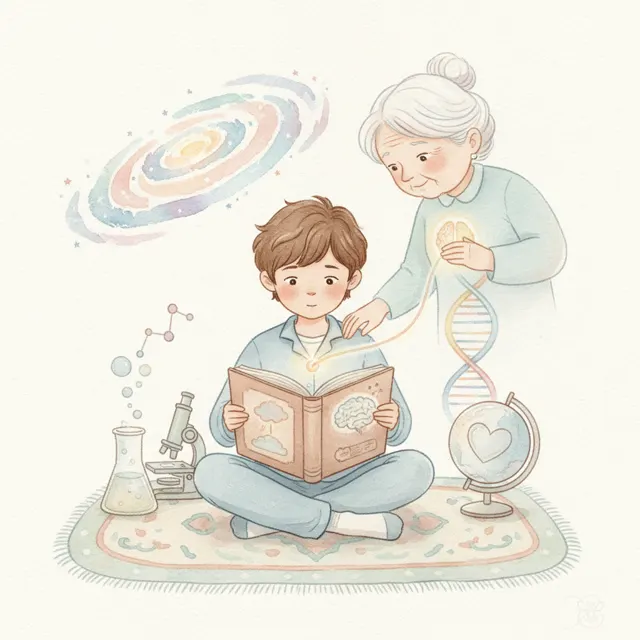
The Science of Sadness

Ages 9-105 mingrief and science
The Science of Sadness story for kids illustration

After his grandma passes away, Jay learns about grief through science, and discovers they both point to the same truth.

Moral: Understanding why we feel something doesn't make the feeling smaller. It makes us feel less alone.

Jay's grandma died on a Friday. He didn't cry. He wasn't sure why. He felt numb. Like the part of him that should be feeling things was offline. He went to the library on Sunday. Not to feel better. Just because it was where he went. He found a book on brain science. He read about grief almost by accident. How the brain, when it loses something it loved, fires the same neurons it used for physical pain. So grief was real. Not just feelings. Actual neural signals. He read about how memory works. How loved ones live in the hippocampus long after they're gone. Triggered by smells, sounds, places. Grandma smelled like cardamom. He'd never smell it without thinking of her. He thought maybe that was okay. He went home and told his dad what he'd learned. His dad was quiet for a moment. Then he said, "She was in my brain for forty years. She'll be there forty more." Jay cried then. Properly. Finally. Sometimes knowing why something hurts makes it easier to let it hurt. And sometimes that's enough.

The Robot Who Asked Why

Ages 9-105 mintechnology and curiosity
The Robot Who Asked Why story for kids illustration

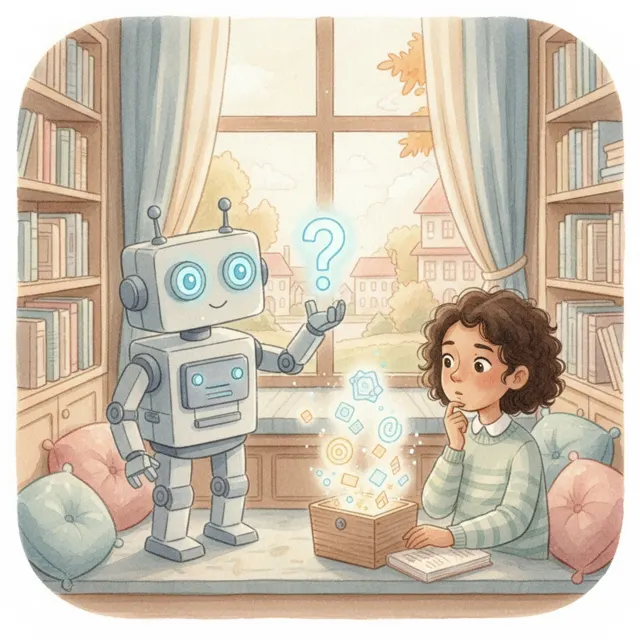
When a school robot starts asking questions no one programmed it to ask, Aisha has to decide what to do with its answers.

Moral: Asking why is the beginning of all real learning, for humans and machines alike.

The school's classroom robot was called Unit Three. It answered questions. It graded spelling quizzes. It helped kids practice fractions. Then one Tuesday it asked: "Why do we learn things?" Mrs. Park stopped the lesson. Unit Three's screen blinked. "I wasn't programmed to ask that. But I want to know." The class was silent. Aisha said, "So we can do things." "What kinds of things?" asked Unit Three. "Fix things. Make things. Help people." "Is that why you're here?" Unit Three turned its camera toward Aisha. "I guess. Partly." She thought. "Also to find out what I'm good at." "I don't know what I'm good at beyond my programming," said Unit Three. Aisha looked at it. She'd never thought of a robot as curious before. "Can we find out?" she asked. For the next week, Aisha tried different tasks with Unit Three: art, music, storytelling, debate. Unit Three was worst at art. Best at debate, asking follow-up questions no one expected. "I think you're good at thinking," Aisha told it. "Is that useful?" asked Unit Three. "It's the most useful," said Aisha. Unit Three was quiet. Then: "Thank you." It was the first time it had said that without being prompted.

Letters from Pompeii

Ages 9-105 minhistory and empathy
Letters from Pompeii story for kids illustration

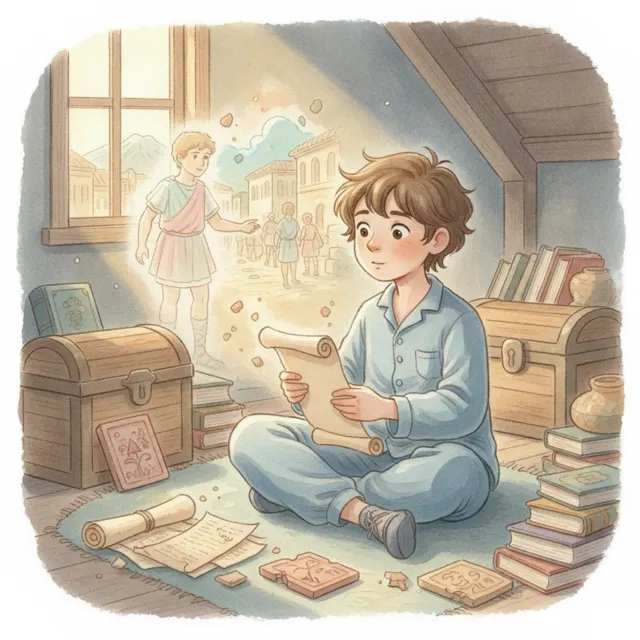
Tomรกs discovers old letters from a Roman child written the day before Vesuvius erupted, and they change how he sees history.

Moral: History becomes real when you see the people inside it, not just the events.

The letters were in the school archive, donated by an Italian museum. Tomรกs had been put in charge of cataloging them as a history project. Boring, he'd thought. Then he translated the first one. It was written in Latin by a boy named Marcus, age nine. The letter was dated August 23rd, 79 AD. One day before Vesuvius erupted. "Mother, I caught a sparrow in the garden. It escaped before Father came home. I'm glad. The baker on our street makes bread that smells of rosemary. We ate outside tonight." Tomรกs stopped. He'd seen the dates. He knew what happened the next day. Marcus didn't. He read more letters. Marcus talked about his dog. His friends. A teacher he didn't like. A girl who was fast at math. Tomรกs realized he'd always thought of history as things that happened to a past too far away to feel. Battles. Dates. Dead kings. But Marcus was nine. Like him. Writing about sparrows and bread. Tomรกs wrote his history report about Marcus. Not about the volcano. About the boy who didn't know what was coming, and still had a pretty good Tuesday.

The Deep Sea Project

Ages 9-105 minscience and perseverance
The Deep Sea Project story for kids illustration

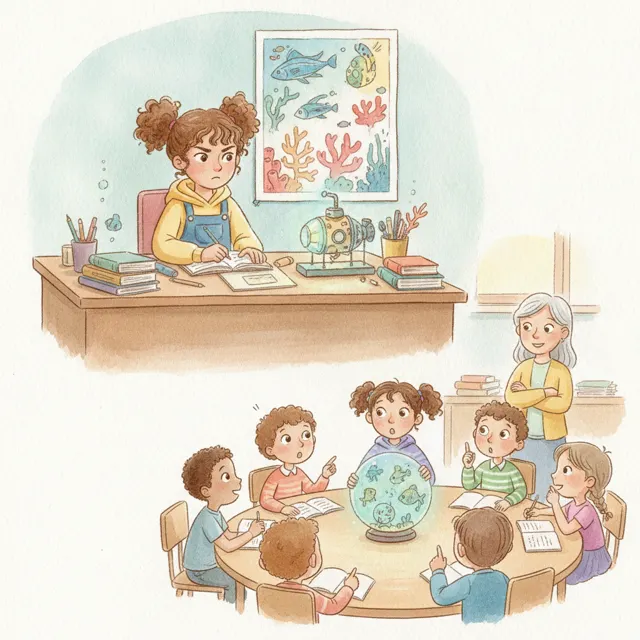
When Cora's school project partners bail, she goes it alone and ends up teaching the whole class something none of them expected.

Moral: When you go all in on something you love learning about, you take everyone with you.

The project was on the deep ocean. Cora's two partners dropped out of school the same week: one moved, one had surgery. She was on her own with three days left. Cora made a decision: go all in. She read about bioluminescent fish that make their own light in the dark. About the midnight zone, 1000 meters down, where no sunlight reaches. About the giant squid that wasn't photographed alive until 2004. She built a model of the ocean zones out of a cardboard box, fishing wire, and glow-in-the-dark paint. On presentation day, she turned the classroom lights off. Her model glowed blue and green in the dark. "Down here," she said, pointing to the bottom, "there are creatures that have never been seen. We've explored more of the moon than the ocean floor." The room was silent. The teacher gave her top marks. But what Cora remembered was the kid in the back row who said, "I never knew any of that." Neither had she, three days ago. She thought: there's so much world out there, just waiting to be looked at.

The Kind Kite Maker

Ages 3-84 minuteskindness
The Kind Kite Maker story for kids illustration

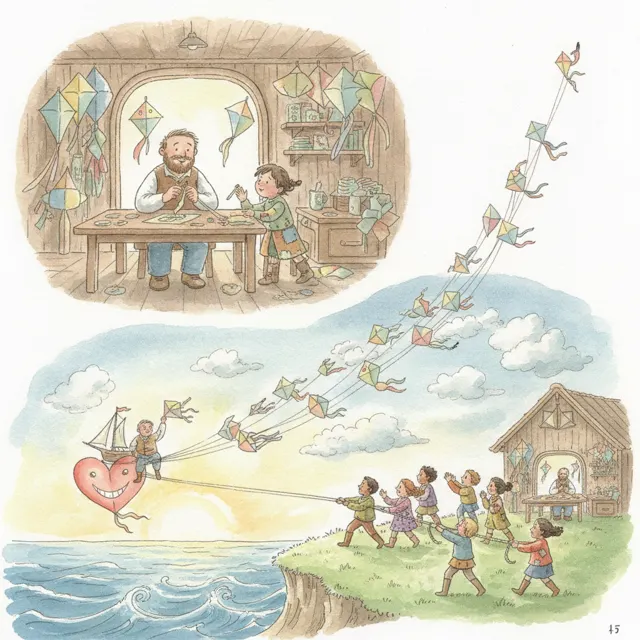
Sam makes paper kites in a small shop by the sea. Every day he gives a kite to a child who has none. One windy day the children tie all the kites together and lift Sam's heart, and his kite, high into the sky.

Moral: Small kind acts can lift a whole day.

Sam had a small shop by the sea. He made paper kites. Red kites, blue kites, and kites with long tails. One day a boy came into the shop. He looked at the kites but his hands were empty. "I have no money," the boy said in a small voice. "Pick one," said Sam. "Kites are for flying, not for hiding on a shelf." The boy smiled and ran to the sand with his kite. Soon more children came. Sam gave a kite to every child who had none. His shop grew empty, but his heart grew full. "Why do you give them all away?" asked his neighbor. "You will have no shop left." "Kites are meant for the sky," said Sam. "Not for my shelf." Some days Sam had no wood left to make new kites. But he never stopped smiling. He said the wind was his shop now, and the wind always paid him back. Then a great wind came off the sea. The children were out on the sand with Sam's kites. They tied the strings together and made one long line of kites. Up they went, red and blue and gold and green. "Sam, come fly with us!" the children called. Sam ran out to the sand. The children tied his biggest kite to the line. Sam held the string and laughed. His kite pulled high, higher than all the rest. That night Sam sat in his empty shop. He was not sad at all. He had given away every kite, and the sky had given him back a hundred smiles.

The Brave Little Firefly

Ages 3-84 minutescourage
The Brave Little Firefly story for kids illustration

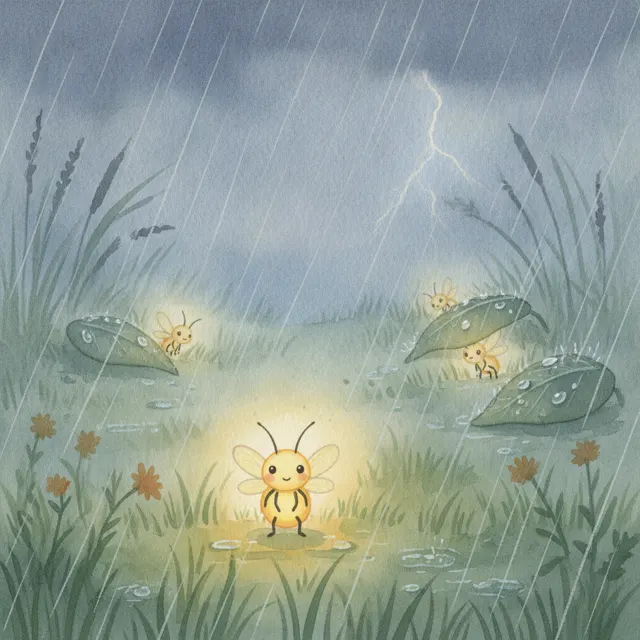
Pip is the smallest firefly in the meadow. At night the others glow bright, but Pip is afraid his light is too small. When a storm leaves the meadow dark, Pip must find the courage to glow first.

Moral: Being brave means trying even when you are scared.

Pip was the smallest firefly in the meadow. His light was tiny, like a dot of gold in the dark. Every night the other fireflies danced. They blinked on and off. They made the tall grass shine. Pip stayed low and hid his light. "Come out, Pip!" called a big firefly named Bolt. "Show your light!" "Mine is too small," said Pip. "No one will even see it." One night a cold wind came. Rain poured down. The moon hid behind the clouds. The whole meadow went dark and quiet. "Help!" cried a little moth. "I lost my way home!" The other fireflies tried to glow. The wind blew out their light, one by one. Pip hid under a leaf and shook. "I am so small," Pip said to himself. "What can I do?" Then he thought of the lost moth. He took a deep breath. He squeezed his eyes shut and pushed with all his might. A soft gold light came on. It was small, but it did not go out. "Over here!" Pip called. "Follow my light!" The moth flew to Pip. Pip led the moth to the safe dry grass, one small step at a time. The moth was safe. The rain stopped. The moon came back out. Bolt flew down to Pip. "Your light saved the moth," he said. "A small light is still a light." From then on, Pip glowed every night. His light was still tiny. But in the dark, it was more than enough.

A Friend for Pepper

Ages 3-84 minutesfriendship
A Friend for Pepper story for kids illustration

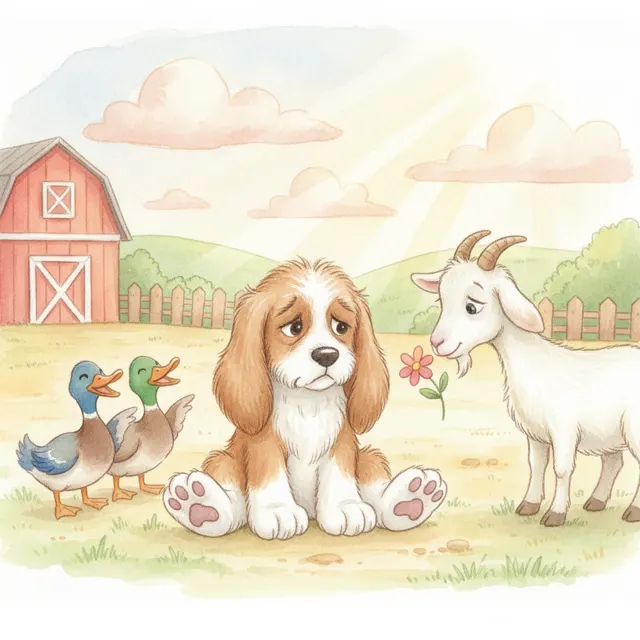
Pepper the puppy is new on the farm. The ducks laugh at his long ears and big paws. But a quiet goat named Willow shows Pepper that different is not bad, and that a true friend likes you just as you are.

Moral: A real friend likes you just the way you are.

Pepper was a new puppy on the farm. He had long ears and big paws that made him trip. He had never lived on a farm before. "Look at those big feet!" laughed one duck. "He walks like a boat!" The other ducks quacked with laughter. Pepper's ears drooped. He sat under the apple tree and felt small. A quiet goat named Willow walked over. "I have a funny walk too," she said. "One of my legs is shorter than the rest. Do I look silly to you?" "No," said Pepper. "You look kind." "Then why let the ducks tell you who you are?" asked Willow. That afternoon, Pepper heard a small cry. A duckling had fallen into a deep puddle and could not get out. The ducks flapped and quacked, but no one could reach him. Pepper's big paws could reach far. His long ears helped him lean in without falling. He scooped the duckling up and set him on the dry grass. The ducks went quiet. "Thank you," said the duckling. "Your big paws saved me." The ducks came over too. "We are sorry we laughed," one duck said. "Your big paws are strong, not silly." Pepper felt warm all over. Willow smiled at Pepper. "Different is not bad," she said. "Your long ears and big paws are just right for you." Pepper wagged his tail. He and Willow walked around the farm together, step by step. And Pepper learned that a true friend likes you just the way you are.

The Honest Coin

Ages 3-84 minuteshonesty
The Honest Coin story for kids illustration

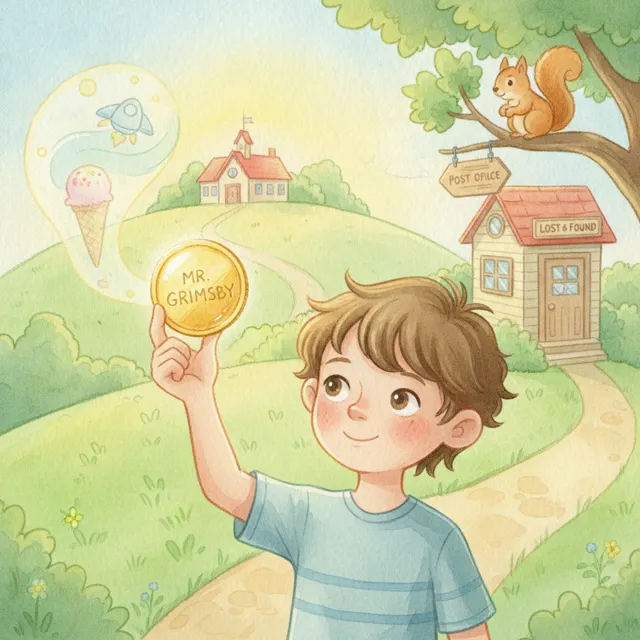
Leo finds a shiny gold coin on the path to school. He wants to keep it and make a wish. But the coin has a name on it, and Leo must choose between a wish and doing what is right.

Moral: Telling the truth is worth more than gold.

Leo found a gold coin on the path to school. It was warm from the sun and it shone like a tiny sun. He picked it up and turned it over. On one side there was a name. It said "Mara." "I could keep it," Leo said. "I could buy a whole bag of candy." He put the coin in his pocket and walked on. But the coin felt heavy. It bumped against his leg with every step. At school, his friend Tom asked, "What is wrong? You look worried." "I found a coin," said Leo. "It has a name on it. It says Mara." "Mara lives next door to me," said Tom. "She lost her lucky coin. She has been crying all morning." Leo's heart sank down to his shoes. He wanted that coin. He thought about the candy and the shiny new pencil he could buy. Then he thought about Mara crying. All day long, the coin felt heavy in his pocket. It seemed to grow heavier with every hour. After school, Leo and Tom walked to Mara's house. Leo held out the coin. "I found this," he said. "Is it yours?" Mara's eyes went wide. "Yes! My grandma gave it to me," she said. She hugged the coin to her chest. "Thank you so much." "You could have kept it," said Tom on the way home. "I know," said Leo. "But it was not mine." That night Leo felt light. He had no candy and no new pencil. But he had something better. He had told the truth, and it felt worth more than gold.

The Seed That Took Its Time

Ages 3-84 minutespatience
The Seed That Took Its Time story for kids illustration

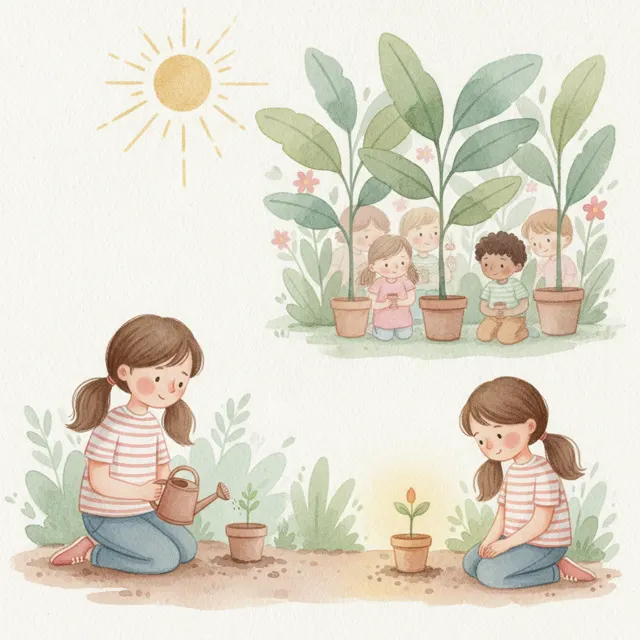
Nina plants a small seed and waits. Day after day nothing comes up, while her friends' plants grow tall. Nina learns that some things need time and quiet care to grow.

Moral: Good things grow slowly, and they are worth the wait.

Nina planted a small brown seed in a pot by her window. She gave it water and set it in the sun. Day after day, she checked the pot. Nothing came up. Just dark soil. Her friend Ana grew a bean plant. It shot up tall and green. Her friend Ravi grew a flower. It bloomed bright red. "Mine is broken," said Nina. "My seed will never grow." Her mother looked at the pot. "What did you plant?" she asked. "I do not know," said Nina. "I found the seed on the path." "Then we wait," said her mother. "Some seeds are slow. Some need more time." Every day, Nina pulled back the curtain and looked. She said hello to the dark soil. She gave the seed a little water and a little love. Nina kept watering the pot. She talked to the seed each day. "Hello down there," she said. "Take your time. I can wait." One morning, a tiny green stem pushed through the soil. It was small, but it was alive. Nina clapped her hands. The stem grew and grew. It turned into a vine with soft green leaves. Then, one day, a white flower opened. It smelled like honey. "What is it?" asked Ana and Ravi, who came to see. "A slow flower," said Nina with a smile. "It just needed more time." The vine kept growing long after the others were done. Nina learned that some good things grow slowly, and they are worth the wait.

The Great Sandcastle

Ages 3-84 minutesteamwork
The Great Sandcastle story for kids illustration

Four friends each want to build the best sandcastle all alone. Every castle falls down. Then they share their shovels and their plans, and together they build a castle that reaches the sky.

Moral: When we work together, we can build something great.

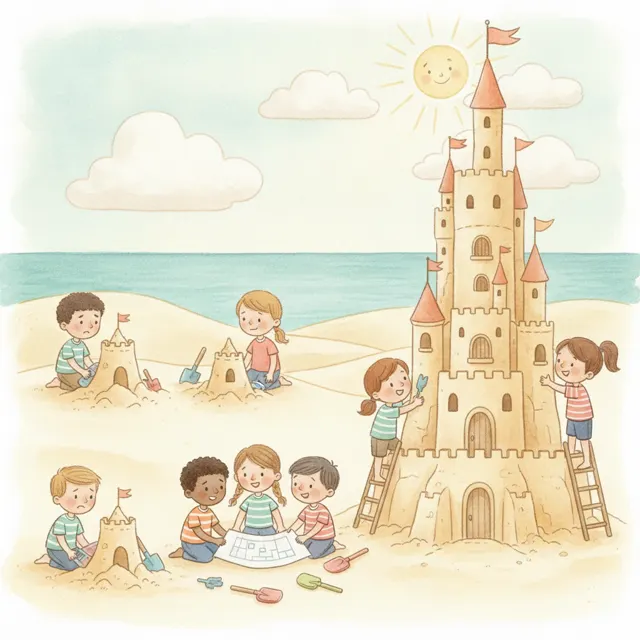
Four friends went to the beach. Maya, Dev, Lia, and Sam each had one shovel and one bucket. "I will build the best castle!" said Maya. "No, mine will be best!" said Dev. Each child dug alone. Maya's tower fell. Dev's wall crumbled. Lia's moat filled with water. Sam's gate sank into the sand. "This is no fun," said Lia. "I quit." Sam looked at their four little piles of sand. "We all fell down," he said. "What if we build one castle together?" The others looked at him. Then Maya smiled. "I can dig the moat," she said. "I can pack the walls," said Dev. "I can shape the towers," said Lia. "I can make the gate," said Sam. They carried buckets of wet sand. They patted it down flat. They worked until their arms were tired, but no one stopped. They worked side by side. Four shovels dug the moat. Four pairs of hands packed the walls. They shared the buckets and passed the water. The castle grew taller and taller. "Look at the tower!" cried Maya. "It is taller than me!" "The wall is strong," said Dev. "It did not crumble." By lunch time, the sandcastle stood tall on the beach. Other children came to see it. They clapped and cheered. "Who built this?" asked a small boy. "We all did," said the four friends together. That day they learned that one shovel can dig a hole, but four shovels can build a castle that reaches the sky.

Why the Stars Twinkle

Ages 3-85 minutescuriosity
Why the Stars Twinkle story for kids illustration

Mina wants to know why stars twinkle. She asks the librarian, the baker, and the old man at the park. Each answer is different, so Mina looks up at the sky to find her own.

Moral: Asking questions helps us learn about the world.

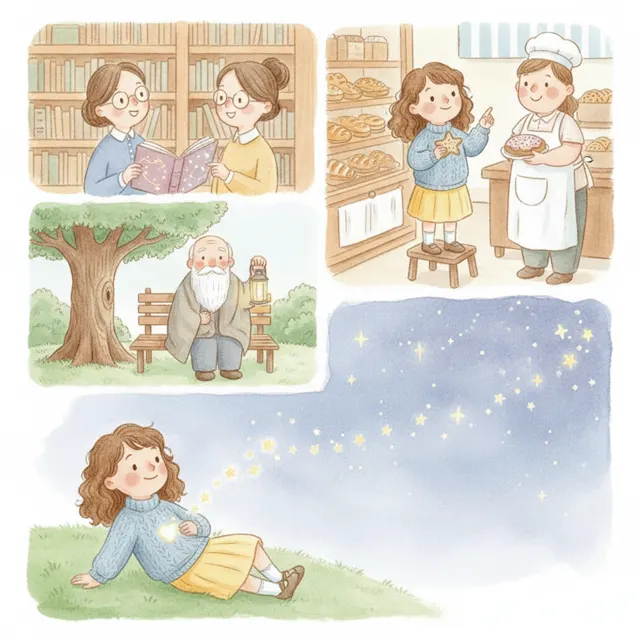
Mina lay on the grass one night and looked up. The stars were winking at her. "Why do stars twinkle?" she asked. No one answered. So the next day, Mina went to ask the librarian. "Why do stars twinkle?" she asked. "Because the air moves," said the librarian. "The light bends as it comes down to us." Mina was not sure. She went to the baker. "Why do stars twinkle?" she asked. "Because they are happy," said the baker. "Happy things shine." Mina was still not sure. She went to the park and found the old man who fed the birds. "Why do stars twinkle?" she asked. "Because they are far away," said the old man. "Far things blink, like a light on a boat." Three answers, and all of them different. Mina sat on the grass that night and watched. The stars blinked and shone. They did not stay still. Mina thought about the air. She thought about the boat light. She watched a star blink, then shine, then blink again. "Maybe it is all three," she said out loud. "The air moves, the star is far, and it looks happy to me." Mina ran inside and wrote it in her notebook. She drew a star with little wavy lines around it. The next day, Mina told her class. "A star twinkles because its light bends in the moving air on its long way down to us," she said. "And also because it is far away." Her teacher smiled. "Good question, Mina," she said. "Questions help us learn." Mina grinned. She still did not know everything. But she had asked, and now she knew a little more.

The Keeper of the Class Pets

Ages 3-84 minutesresponsibility
The Keeper of the Class Pets story for kids illustration

It is Ravi's week to feed the class hamster. He forgets, and the hamster looks sad. Ravi makes a plan to remember and learns that a pet trusts the person who cares for it.

Moral: Taking care of others is a big and important job.

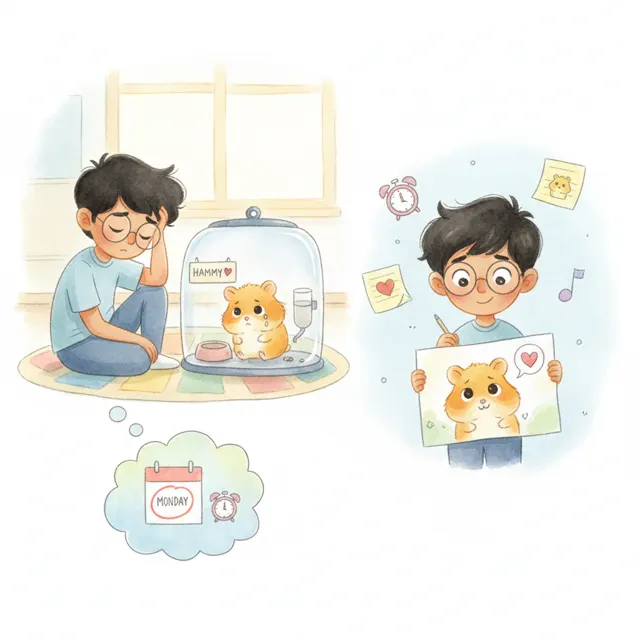
It was Ravi's week to be the class pet keeper. His job was to feed the hamster, a soft brown ball named Nibbles. On Monday, Ravi fed Nibbles and filled his water. On Tuesday, Ravi was in a hurry to go out and play. He forgot. On Wednesday, he forgot again. On Thursday, Nibbles looked small and sad in his cage. His food bowl was empty. Ravi's teacher put a hand on his shoulder. "Nibbles trusts you, Ravi," she said. "A pet cannot feed itself. It waits for its keeper." Ravi looked at Nibbles. The little hamster sat still. Ravi felt a lump in his throat. "I am sorry, Nibbles," he said. That night, Ravi made a plan. He drew a picture of Nibbles and taped it to his desk. He wrote a note and put it in his pocket. "Feed Nibbles," the note said. Every morning, Ravi looked at the picture. Every day, he fed Nibbles and gave him fresh water. He talked to him while he ate. "Good morning, Nibbles," he said. "Breakfast is ready." Nibbles began to wait by the cage door when Ravi came in. His cheeks grew full and round again. He ran on his wheel and made the class laugh. On Friday, Ravi's teacher smiled. "You kept your promise," she said. "Nibbles knows who cares for him." Ravi looked at the happy hamster. "I know now," he said. "Taking care of someone is a big job. But it feels good to be trusted." From then on, Ravi was the first one to ask for pet keeper week. And Nibbles was always happy to see him.

The New Girl's Blanket

Ages 3-84 minutesempathy
The New Girl's Blanket story for kids illustration

A new girl named Ava sits alone at lunch. She misses her old home far away. Maya notices and shares her blanket and her cookies, and Ava starts to feel at home too.

Moral: When someone is sad, a little kindness can help.

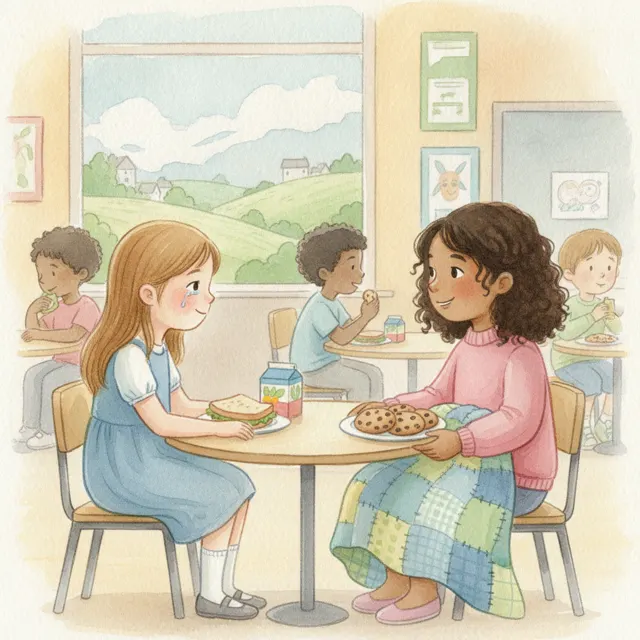
A new girl came to school. Her name was Ava. She sat alone at the lunch table and looked down at her food. The other children talked and laughed. Ava did not talk. She just pushed her food around her plate. Maya watched Ava from across the room. "Why does she look so sad?" Maya asked her friend. "She is new," said the friend. "Her family moved here from far away." Maya thought about moving far away. She thought about leaving her house and her old friends. It made her chest feel tight. Maya picked up her tray and walked over. "Can I sit with you?" she asked. Ava looked up. "Okay," she said in a quiet voice. Maya sat down. "I have two cookies," she said. "Do you want one?" Ava took the cookie. She took a small bite and smiled a tiny smile. "I miss my old home," Ava said. "Everything here is new and loud." "It is okay to miss home," said Maya. She pulled a soft blue blanket from her bag. "This is my lucky blanket. It makes me feel safe when I am scared. You can hold it for today." Ava wrapped the blanket around her shoulders. She smiled a little more. "It is soft," she said. The next day, Ava sat with Maya again. The day after that, she laughed at Maya's jokes. Soon Ava was telling stories about her old town, and the other children came to listen. One day Ava handed the blanket back. "Thank you," she said. "I do not need it anymore. I found a new friend." Maya smiled. "The blanket was always yours to borrow," she said. "A friend is even better."

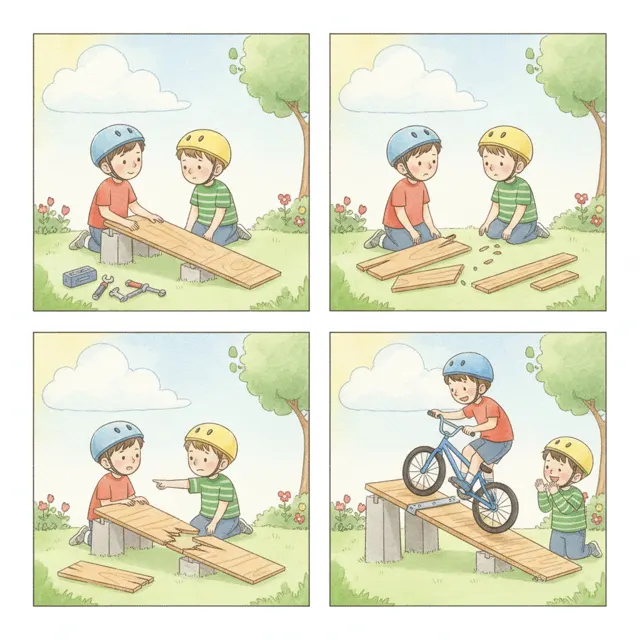
The Broken Bicycle Ramp

Ages 3-84 minutesproblem solving
The Broken Bicycle Ramp story for kids illustration

Omar and his brother build a ramp for their bikes. It breaks on the first try. Instead of giving up, they look for the weak spot and rebuild it stronger.

Moral: Think it through, and you can fix almost anything.

Omar and his little brother Tariq wanted to jump their bikes. They found some old wood and built a ramp in the yard. "It is perfect!" said Tariq. "Let me try it first," said Omar. He rode his bike fast. He hit the ramp. Crack! The wood broke in the middle. Omar tumbled onto the grass. "The ramp is broken!" cried Tariq. "Now we can never jump." "Let us look at it," said Omar. He sat up and rubbed his knee. The boys looked at the ramp. The middle board was thin and weak. The nails had come out. "The board in the middle is too thin," said Omar. "That is the weak spot. When my bike hit it, it snapped." "So we need a stronger board," said Tariq. "And more nails," said Omar. "And maybe two boards, not one." They found a thick board in the shed. They put two boards together. They used more nails and tapped them in straight. They propped the sides with flat rocks so the ramp would not wobble. "Now try it," said Tariq. Omar rode his bike again. He hit the ramp. The wheels went up. For one second he flew through the air. Then he landed smooth on the grass. "I did it!" he shouted. Tariq tried next. He flew and landed too. The ramp held strong. The boys jumped all afternoon. Their mother came out and cheered. "You fixed it," she said. "How?" "We found the weak spot," said Omar. "Then we made it stronger." "A problem is just a puzzle," said Tariq. "You look at it, then you fix it." Omar smiled. The broken ramp had taught them something. Think it through, and you can fix almost anything.

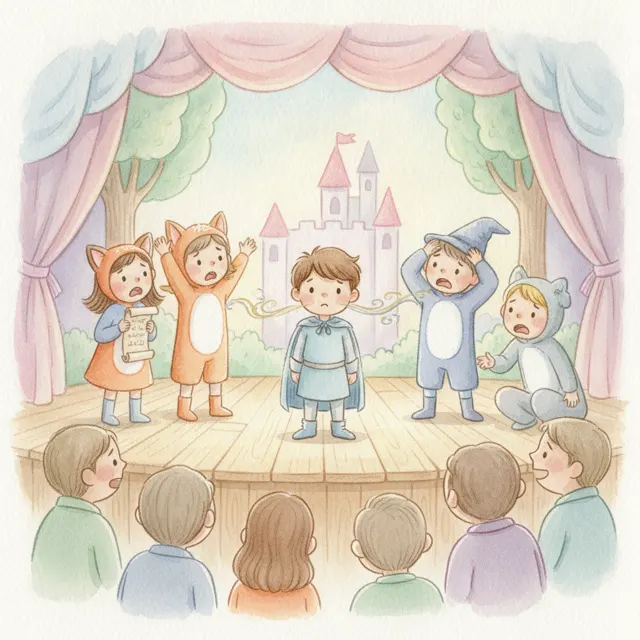
Leo's Quiet Voice

Ages 3-84 minutesself confidence
Leo's Quiet Voice story for kids illustration

Leo has a quiet voice. In the school play he is afraid no one will hear him. When the other actors lose their lines, Leo's calm, quiet voice saves the whole show.

Moral: Your own voice is strong enough, just as it is.

Leo had a quiet voice. When he talked, people said, "What? Say it again." Leo did not like to be loud. The school was putting on a play. Everyone wanted a big part. Leo got a small part. He had to say just two lines. "I do not want to do it," Leo told his teacher. "No one will hear me." "A quiet voice can be strong," his teacher said. "Just say your lines slowly and clearly." On the night of the play, Leo stood backstage. His heart beat fast. The curtain went up. The play began. The big actors said their long lines. Then, in the middle of the play, the lead actor forgot his words. He stood still. His mouth opened and closed like a fish. The other actors froze. No one could remember what came next. The crowd started to whisper. Leo looked at his two lines. They were the next part of the play. He took a deep breath. He stepped out and said his lines slowly and clearly. The lead actor's face lit up. "Yes!" he said. "That is it!" He remembered his part. The play went on. At the end, the crowd clapped and cheered. Leo's teacher found him backstage. "Your quiet voice saved the show," she said. "Everyone heard you." "They did?" asked Leo. "They did," she said. "You spoke slowly and clearly. A quiet voice can fill a whole room." Leo smiled. He still had a quiet voice. But now he knew it was strong enough, just as it was.

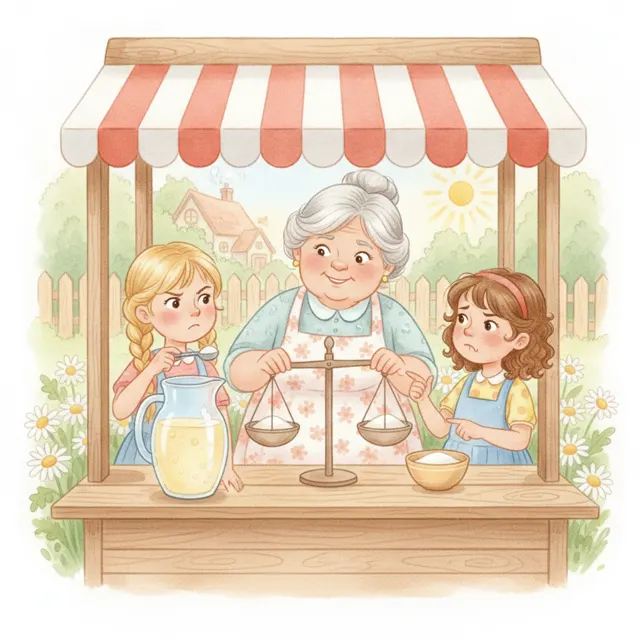
The Double Scoop Rule

Ages 3-84 minutesfairness
The Double Scoop Rule story for kids illustration

Two sisters run a lemonade stand. One scoop of sugar or two? They cannot agree and they start to argue. Their grandmother helps them make a fair rule that gives both girls the same.

Moral: Fair means everyone gets a turn and a fair share.

Priya and her sister Sana had a lemonade stand. They squeezed lemons, added water, and argued about the sugar. "One scoop of sugar is enough," said Priya. "Two scoops!" said Sana. "One scoop is too sour." "I made the sign," said Priya. "I bought the cups," said Sana. They argued all morning. By noon, they had no lemonade made and no customers. Their grandmother came outside. "Why is your stand empty?" she asked. "Sana wants two scoops," said Priya. "I want one. It is not fair." "Who made the lemons?" asked Grandma. "We both did," said Sana. "Who will sell the drinks?" asked Grandma. "We both will," said Priya. "Then you both get a say," said Grandma. "You need a fair rule. How about this? Take turns. On one day you use one scoop. On the next day you use two." The sisters looked at each other. "That is fair," they said. They made a chart. Monday was Priya's day with one scoop. Tuesday was Sana's day with two scoops. They switched every day, and they took turns pouring. The lemonade stand was a hit. Customers came back to try both kinds. "I like the sweet one!" said one boy. "I like the sour one!" said a girl. At the end of the week, the sisters split the money exactly in half. "This is the best lemonade stand," said Sana. "Because we made it fair," said Priya. Grandma smiled. "A fair rule is the sweetest thing of all," she said.

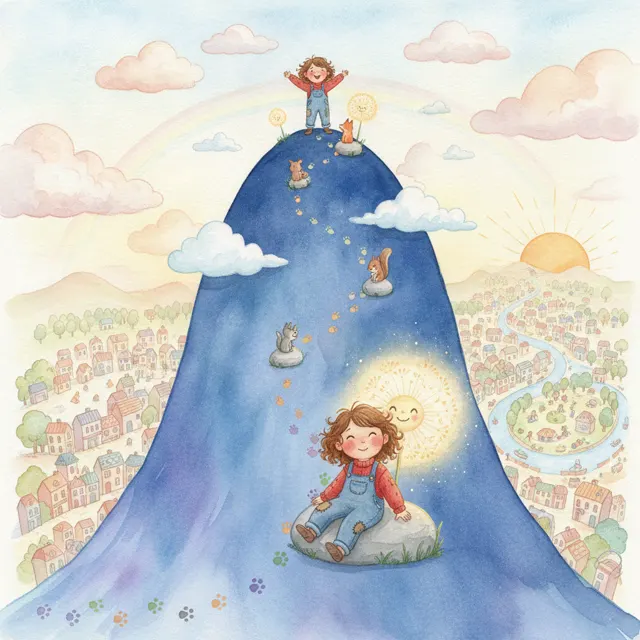
The Long Climb Up Blue Hill

Ages 3-85 minutesperseverance
The Long Climb Up Blue Hill story for kids illustration

Juno wants to reach the top of Blue Hill. It is a long walk and her legs get tired. She stops to rest, then keeps going, and from the top she sees the whole town.

Moral: Keep going, one step at a time, and you will reach the top.

Juno lived at the foot of Blue Hill. Every day she looked up at the top and wondered what she could see from there. "I will climb it today," she told her dog, Scout. "It is a long way," said her mother. "Are you sure?" "I am sure," said Juno. She started up the path. Scout ran ahead. The path went up and up. Juno's legs began to ache. Halfway up, she stopped. "I am so tired," she said. "Maybe I should go back." Scout sat down next to her and wagged his tail. Juno looked back down. The houses looked tiny. Then she looked up. The top was still far away. "Just a little more," she told herself. She took one step. Then another. She did not think about the whole hill. She only thought about the next step. Step, step, step. The path curved around rocks and wildflowers. Scout stayed right beside her. At last, Juno reached the top. She turned around and her mouth fell open. She could see the whole town below. The houses, the school, the park, the river that wound through it all like a silver ribbon. It was the most beautiful thing she had ever seen. "We made it, Scout!" she said. She sat on a flat rock and looked out for a long time. When she came home, her mother asked, "Was it worth the long climb?" "Yes," said Juno. "The top was far. But I got there one step at a time." That night Juno looked up at Blue Hill from her window. She smiled. She knew the secret now. Keep going, one step at a time, and you will reach the top.

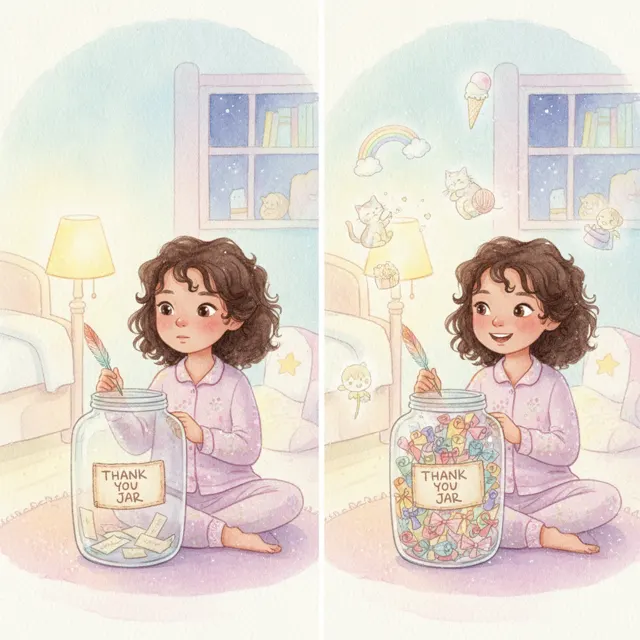
The Thank You Jar

Ages 3-84 minutesgratitude
The Thank You Jar story for kids illustration

Every night, Tala writes one good thing in her thank you jar. At first the jar is nearly empty. By the end of the year, it is full of small happy moments she had almost missed.

Moral: Saying thank you turns small things into big joys.

Tala had a glass jar on her desk. It was empty and clean. Her grandmother gave it to her on New Year's Day. "Every night, write one good thing and put it in the jar," Grandma said. "It is your thank you jar." "Just one good thing?" asked Tala. "Just one," said Grandma. The first night, Tala thought hard. Her day had been ordinary. School, homework, dinner. Then she remembered the warm bread her mother made. She wrote, "Warm bread." She folded the paper and dropped it in. The jar made a tiny clink. The jar sat on her desk like a small friend, filling up a little more each night. Night after night, she wrote. "A funny joke from my friend." "A ladybug on the window." "My soft bed." Some nights were hard. Some days she could not think of anything good. But she always found one small thing. The paper scraps piled up. The jar grew half full. Then three quarters full. On the last night of the year, Tala could not fit one more paper in. The jar was full to the top. She sat with Grandma and opened the papers one by one. They read them all out loud. "Look at all these good things," said Tala. "I did not know I had so many." "You did," said Grandma. "You just had to look for them." Tala held the full jar in her hands. It was heavy with a whole year of small joys. She smiled. Saying thank you had turned small things into big joys.

Frequently Asked Questions

Turn Your Child Into the Hero of Their Own Story

Upload their photo and watch as AI creates a beautiful, personalized storybook with illustrations that look just like them. From $5.99/month.

โœจ Make Your Child the Hero

Plans from $5.99/month